In Carius method, 0.75 g of an organic compound gave 1.2 g of barium sulphate, find percentage of sulphur (molar mass 32text g mol^-1$32\text{ g mol}^{-1}$). Molar mass of barium sulphate is 233text g mol^-1$233\text{ g mol}^{-1}$.
A.4.55\%$4.55\%$
B.10.30\%$10.30\%$
C.21.97\%$21.97\%$
D.16.48\%$16.48\%$
Solution & Explanation
### Related Formula
textPercentage of Sulphur = fractextMass of S text in BaSO_4textMolar mass of BaSO_4 times fractextMass of BaSO_4 text formedtextMass of organic compound times 100$$\text{Percentage of Sulphur} = \frac{\text{Mass of } S \text{ in } BaSO_4}{\text{Molar mass of } BaSO_4} \times \frac{\text{Mass of } BaSO_4 \text{ formed}}{\text{Mass of organic compound}} \times 100$$
### Core Logic
Molar mass of BaSO_4$BaSO_4$ = 233 g/mol.
Mass of Sulfur (S) in 1 mole of BaSO_4$BaSO_4$ = 32 g.
Mass of BaSO_4$BaSO_4$ formed = 1.2 g.
Mass of organic compound = 0.75 g.
\% mathrmS = frac32233 times frac1.20.75 times 100$$\% \mathrm{S} = \frac{32}{233} \times \frac{1.2}{0.75} \times 100$$\% mathrmS = frac32 times 1.2 times 100233 times 0.75 = frac3840174.75 approx 21.97\%$$\% \mathrm{S} = \frac{32 \times 1.2 \times 100}{233 \times 0.75} = \frac{3840}{174.75} \approx 21.97\%$$
### Evaluation Rubric / Model Answer
null
### Chapter Mix
Class 11 Chemistry: Organic Chemistry - Some Basic Principles and Techniques
Keywords:#Carius method#percentage of sulphur#JEE Main 2026 Morning Q58#Organic Chemistry - Some Basic Principles and Techniques JEE Main 2026
More Organic Chemistry - Some Basic Principles and Techniques Previous-Year Questions — Page 15
Q65jee_main_2024_30_jan_morningAromaticity
Which of the following molecule/species is most stable?
A.
B.
C.textOption 3$\text{Option 3}$
D.textOption 4$\text{Option 4}$
Solution
### Core Logic
Stability of cyclic carbocations can be determined using Huckel's rule for aromaticity.
A species is exceptionally stable if it is aromatic. Aromaticity requires the system to be cyclic, planar, fully conjugated, and possess (4n + 2) pi$(4n + 2) \pi$ electrons.
### Step 1: Analyze Option 1
The tropylium cation (Option 1) is a 7-membered ring with 3 double bonds and a positive charge in continuous conjugation.
Aromaticity solution diagram for Q65 - JEE Main 2024 Morning
Number of pi$\pi$ electrons = 6$6$. Since 6$6$ satisfies (4n+2)$(4n+2)$ for n=1$n=1$, it is aromatic and therefore highly stable.
### Pattern Recognition
Tropylium ion (C_7H_7^+$C_7H_7^+$) is a classic example of a stable aromatic carbocation. It frequently appears in stability comparison questions.
### Evaluation Rubric / Model Answer
null
### Chapter Mix
Class 11 Chemistry: Organic Chemistry - Some Basic Principles and Techniques
Q79jee_main_2024_30_jan_morningQualitative Analysis of Organic Compounds
A.textAgCN is soluble in HNO_3$\text{AgCN is soluble in }HNO_3$
B.textSilver halides are soluble in HNO_3$\text{Silver halides are soluble in }HNO_3$
C.Ag_2Stext is soluble in HNO_3$Ag_2S\text{ is soluble in }HNO_3$
D.Na_2Stext and NaCN are decomposed by HNO_3$Na_2S\text{ and NaCN are decomposed by }HNO_3$
Solution
### Core Logic
In Lassaigne's test for halogens, we add AgNO_3$AgNO_3$ to form a precipitate of silver halide (AgX$AgX$).
However, if the organic compound also contains Nitrogen or Sulphur, the Lassaigne's extract will contain NaCN$NaCN$ or Na_2S$Na_2S$.
### Step 1: Reason for adding HNO3
These ions (CN^-$CN^-$ and S^2-$S^{2-}$) would also react with AgNO_3$AgNO_3$ to form precipitates (AgCN$AgCN$ - white, Ag_2S$Ag_2S$ - black), which would interfere with the test for halogens.
Boiling the extract with concentrated/dilute HNO_3$HNO_3$ decomposes the cyanide and sulphide to HCN$HCN$ and H_2S$H_2S$ gases, which escape, thus removing the interference.
NaCN + HNO_3 rightarrow NaNO_3 + HCN uparrow$$NaCN + HNO_3 \rightarrow NaNO_3 + HCN \uparrow$$Na_2S + 2HNO_3 rightarrow 2NaNO_3 + H_2S uparrow$$Na_2S + 2HNO_3 \rightarrow 2NaNO_3 + H_2S \uparrow$$
### Evaluation Rubric / Model Answer
null
### Chapter Mix
Class 11 Chemistry: Organic Chemistry - Some Basic Principles and Techniques
Q86jee_main_2024_30_jan_morningChromatography
On a thin layer chromatographic plate, an organic compound moved by 3.5text cm$3.5\text{ cm}$, while the solvent moved by 5text cm$5\text{ cm}$. The retardation factor of the organic compound is ________ times 10^-1$\times 10^{-1}$
Numerical Answer.Answer: 7 to 7
Solution
### Related Formula
R_f = fractextDistance travelled by compoundtextDistance travelled by solvent$$R_f = \frac{\text{Distance travelled by compound}}{\text{Distance travelled by solvent}}$$
### Step 1: Substitution and calculation
R_f = frac3.55$$R_f = \frac{3.5}{5}$$R_f = 0.7$R_f = 0.7$R_f = 7 times 10^-1$$R_f = 7 \times 10^{-1}$$
### Evaluation Rubric / Model Answer
null
### Chapter Mix
Class 11 Chemistry: Organic Chemistry - Some Basic Principles and Techniques
Q75jee_main_2024_31_jan_eveningPurification of Organic Compounds
The fragrance of flowers is due to the presence of some steam volatile organic compounds called essential oils. These are generally insoluble in water at room temperature but are miscible with water vapour in vapour phase. A suitable method for the extraction of these oils from the flowers is -
### Core Logic
Steam distillation technique is applied to separate substances which are steam volatile and are immiscible with water.
Since the essential oils in flowers are steam volatile and insoluble in water, steam distillation is the perfect technique for their extraction.
### Evaluation Rubric / Model Answer
null
### Chapter Mix
Class 11 Chemistry: Organic Chemistry - Some Basic Principles and Techniques
### Core Logic
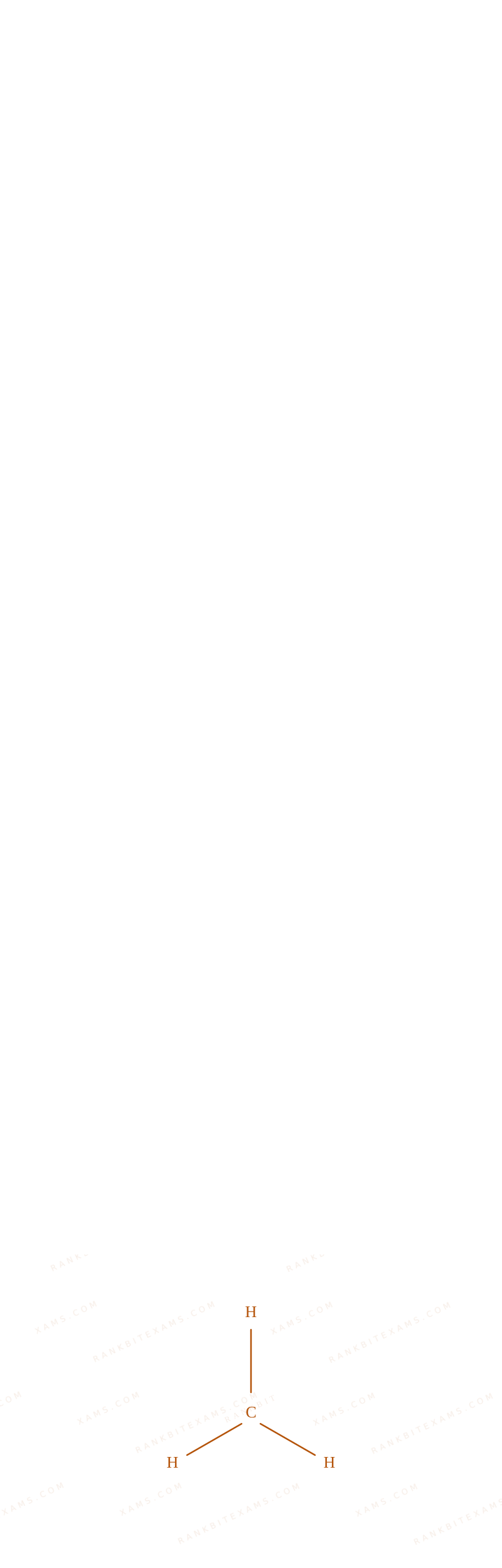
Reaction Intermediates diagram for Q66 - JEE Main 2024 Morning
A carbocation has three bonds and an empty p-orbital, yielding a sextet (6) of electrons in its valence shell. Due to its electron deficiency, it acts as a strong electrophile.
### Evaluation Rubric / Model Answer
null
### Chapter Mix
Class 11 Chemistry: Organic Chemistry - Some Basic Principles and Techniques
More Organic Chemistry - Some Basic Principles and Techniques Questions — jee_main_2026_21_jan_morning
We Map Every Repeating Question in Competitive Exams.
Say goodbye to generic mock test fatigue. RankBit uses smart analysis to group past exam questions into their foundational Repeating Question Types. Find chapter weightage, track repeating questions, and score higher with targeted practice.
Select Your Target Exam
Choose an exam track below to find formulas per chapter and patterns.
Syncing Exam Intelligence
Mapping formulas and patterns across all tracks…
PATH A — FULL LENGTH PRACTICE
Full Mock Test Hub
Simulate real NTA exam conditions with fully tracked mocks. Time yourself against past papers.
Practice past-year questions one chapter at a time. Pick an exam → subject → chapter and get every PYQ for that topic — pulled together from all past papers — with the chapter's key formulas alongside.