Pre-exponential factors of two different reactions of same order are identical. Let activation energy of first reaction exceeds the activation energy of second reaction by 20text kJ mol^-1. If k_1 and k_2 are the rate constants of first and second reaction respectively at 300 K, then ln frack_2k_1 will be ..... (nearest integer) [R=8.3text J K^-1text mol^-1]

Numerical Answer Type:
Enter a numerical value Answer: 8 to 8 +4 marks

Solution & Explanation

### Related Formula ln k = ln A - fracE_aRT ### Core Logic For Reaction 1: ln k_1 = ln A - fracE_1RT For Reaction 2: ln k_2 = ln A - fracE_2RT (Pre-exponential factor A is the same). Subtracting the first from the second: ln k_2 - ln k_1 = -fracE_2RT - left(-fracE_1RTright) ln left(frack_2k_1right) = fracE_1 - E_2RT Given that E_1 exceeds E_2 by 20text kJ mol^-1, E_1 - E_2 = 20000text J mol^-1. T = 300text K, R = 8.3text J K^-1text mol^-1. ln left(frack_2k_1right) = frac200008.3 times 300 = frac2008.3 times 3 = frac20024.9 ln left(frack_2k_1right) = 8.032 Rounding off to nearest integer gives 8. ### Evaluation Rubric / Model Answer null ### Chapter Mix Class 12 Chemistry: Chemical Kinetics
Reference Study Guides

More Chemical Kinetics Previous-Year Questions — Page 6

Q83 jee_main_2024_29_jan_morning Arrhenius Equation and Activation Energy
For a reaction taking place in three steps at same temperature, overall rate constant mathrmK = fracmathrmK_1mathrmK_2mathrmK_3 . If mathrmEa_1 , mathrmEa_2 and mathrmEa_3 are 40, 50 and 60 kJ/mol respectively, the overall Ea is ______ kJ/mol.
Numerical Answer. Answer: 30 to 30

Solution

### Related Formula K = A e^-E_a/RT ### Core Logic Given the relationship between the rate constants: K = fracK_1 cdot K_2K_3 Substituting the Arrhenius equation for each rate constant: A cdot e^-E_a/RT = fracA_1 cdot e^-E_a1/RT cdot A_2 cdot e^-E_a2/RTA_3 cdot e^-E_a3/RT Combining the exponential terms using rules of exponents: A cdot e^-E_a/RT = left(fracA_1 cdot A_2A_3right) cdot e^frac-(E_a1 + E_a2 - E_a3)RT ### Step 1: Equating Activation Energies By comparing the powers of e on both sides, the overall activation energy E_a is related to the individual steps as follows: E_a = E_a1 + E_a2 - E_a3 Substitute the given values (E_a1 = 40, E_a2 = 50, E_a3 = 60 kJ/mol): E_a = 40 + 50 - 60 E_a = 90 - 60 E_a = 30 text kJ/mol ### Pattern Recognition When rate constants are multiplied or divided (K = K_1^a K_2^b / K_3^c), the corresponding overall activation energy follows the linear combination of the exponents: E_a = a E_a1 + b E_a2 - c E_a3. ### Evaluation Rubric / Model Answer null ### Chapter Mix Class 12 Chemistry: Chemical Kinetics
Q82 jee_main_2024_30_january_evening Rate of Chemical Reaction
mathrmNO_2 required for a reaction is produced by decomposition of mathrmN_2mathrmO_5 in mathrmCCl_4 as by equation 2mathrmN_2mathrmO_5(g) rightarrow 4mathrmNO_2(g) + mathrmO_2(g) The initial concentration of mathrmN_2mathrmO_5 is 3 mathrmmol mathrmL^-1 and it is 2.75 mathrmmol mathrmL^-1 after 30 minutes. The rate of formation of mathrmNO_2 is x times 10^-3 mathrmmol mathrmL^-1 mathrmmin^-1, value of x is
Numerical Answer. Answer: 17 to 17

Solution

### Related Formula textRate of Reaction (ROR) = -frac12 fracDelta [mathrmN_2mathrmO_5]Delta t = frac14 fracDelta [mathrmNO_2]Delta t ### Core Logic First, find the rate of disappearance of mathrmN_2mathrmO_5. -fracDelta [mathrmN_2mathrmO_5]Delta t = - frac(2.75 - 3)30 = frac0.2530 mathrmmol \, L^-1 \, min^-1 Now, equate it to the general Rate of Reaction: textROR = -frac12 fracDelta [mathrmN_2mathrmO_5]Delta t = frac12 left(frac0.2530right) = frac0.12530 = frac1240 mathrmmol \, L^-1 \, min^-1 ### Step 1: Calculate the Rate of Formation of mathrmNO_2 Rate of formation of mathrmNO_2 = fracDelta [mathrmNO_2]Delta t = 4 times textROR = 4 times frac1240 = frac160 mathrmmol \, L^-1 \, min^-1 Convert this to scientific notation to find x: frac160 approx 0.01666 = 16.66 times 10^-3 mathrmmol \, L^-1 \, min^-1 Rounding to the nearest integer, we get x = 17. ### Evaluation Rubric / Model Answer null ### Chapter Mix Class 12 Chemistry: Chemical Kinetics
Q81 jee_main_2024_30_jan_morning First Order Reactions
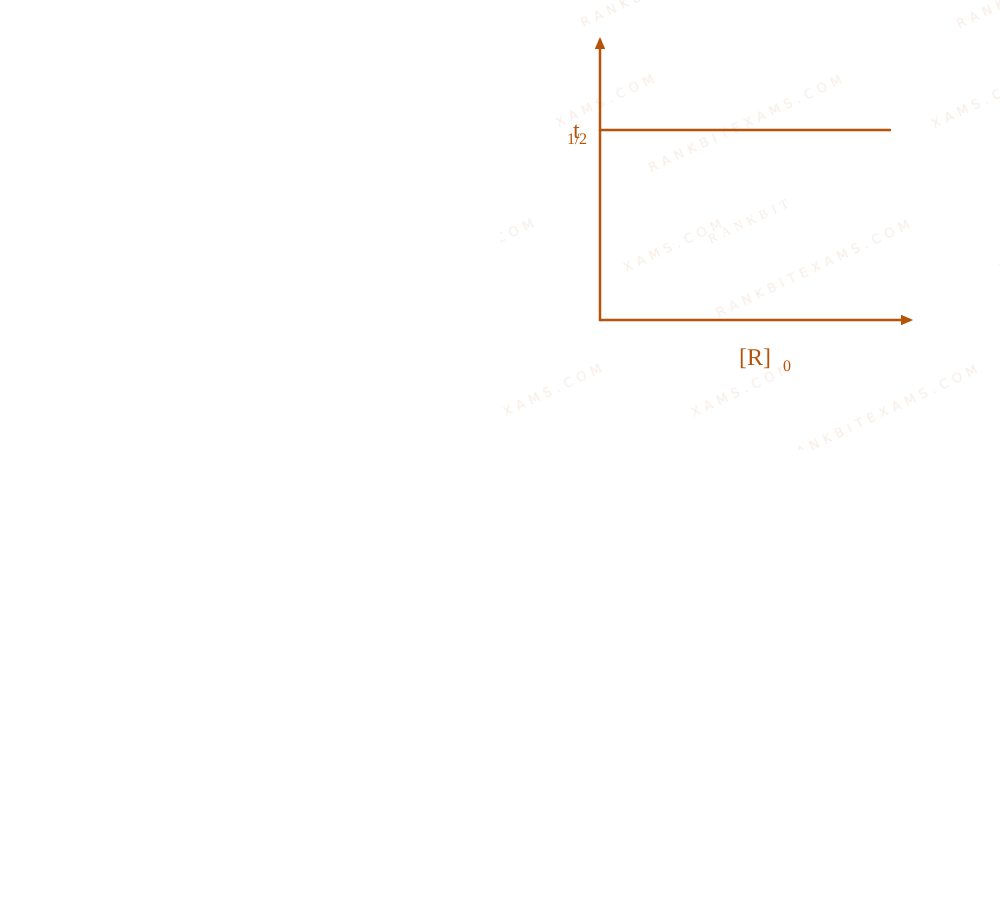
The rate of first order reaction is 0.04text mol L^-1s^-1 at 10 minutes and 0.03text mol L^-1s^-1 at 20 minutes after initiation. Half life of the reaction is ________ minutes. (Given log 2=0.3010, log 3=0.4771)
Numerical Answer. Answer: 24 to 24.1

Solution

### Related Formula Rate = k[A] [A] = [A]_0 e^-kt t_1/2 = fracln 2k ### Core Logic For a first order reaction, rate is directly proportional to concentration. R_1 = k[A]_10 = k[A]_0 e^-k(10 times 60) R_2 = k[A]_20 = k[A]_0 e^-k(20 times 60) ### Step 1: Setting up equations 0.04 = k[A]_0 e^-600k dots (1) 0.03 = k[A]_0 e^-1200k dots (2) ### Step 2: Solving for k Dividing equation (1) by (2): frac0.040.03 = frace^-600ke^-1200k frac43 = e^600k Take natural log on both sides: lnleft(frac43right) = 600k k = fracln(4/3)600 text s^-1 ### Step 3: Calculating half life t_1/2 = fracln 2k = fracln 2fracln(4/3)600 = frac600 ln 2ln 4 - ln 3 text seconds Convert to minutes by dividing by 60: t_1/2 = frac10 ln 2ln 4 - ln 3 text minutes Substitute log values (since ln x = 2.303 log x, the 2.303 cancels out): t_1/2 = 10 times fraclog 2log 4 - log 3 text minutes t_1/2 = 10 times frac0.30102(0.3010) - 0.4771 t_1/2 = 10 times frac0.30100.6020 - 0.4771 = 10 times frac0.30100.1249 t_1/2 = 24.099 approx 24 text minutes ### Evaluation Rubric / Model Answer null ### Chapter Mix Class 12 Chemistry: Chemical Kinetics
Q82 jee_main_2024_31_jan_evening First Order Kinetics
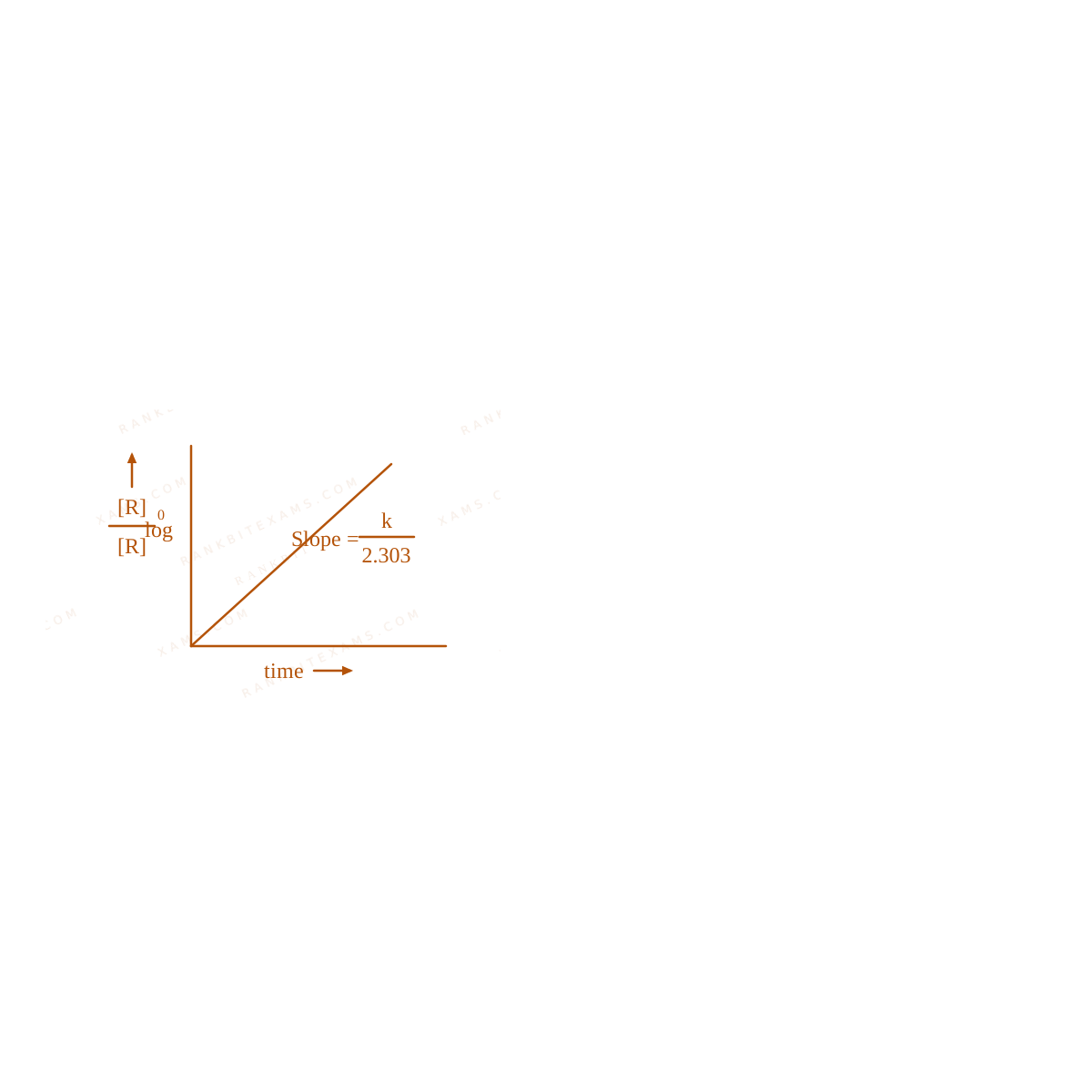
r = k[A] for a reaction, 50\% of A is decomposed in 120text minutes. The time taken for 90\% decomposition of A is ________ minutes.
Numerical Answer. Answer: 398.5 to 399.5

Solution

### Related Formula k = frac0.693t_1/2 t = frac2.303k logleft( fracaa - x right) ### Core Logic Since r = k[A], the reaction follows first-order kinetics. The half-life (50\% decomposition) is t_1/2 = 120text minutes. ### Step 1: Calculating for 90% decomposition For 90\% completion of the reaction, [A]_0 = 100 and [A]_t = 100 - 90 = 10. t = frac2.303k log frac10010 t = frac2.303left( frac0.693t_1/2 right) log (10) t = frac2.303 times 1200.693 times 1 t = 398.78text minutes Rounding off to the nearest integer, we get 399text minutes. ### Pattern Recognition For a first order reaction, t_90\% approx 3.32 times t_50\%. 120 times 3.32 = 398.4, so roughly 399. ### Evaluation Rubric / Model Answer null ### Chapter Mix Class 12 Chemistry: Chemical Kinetics

Q73 jee_main_2024_31_jan_morning First Order Reactions
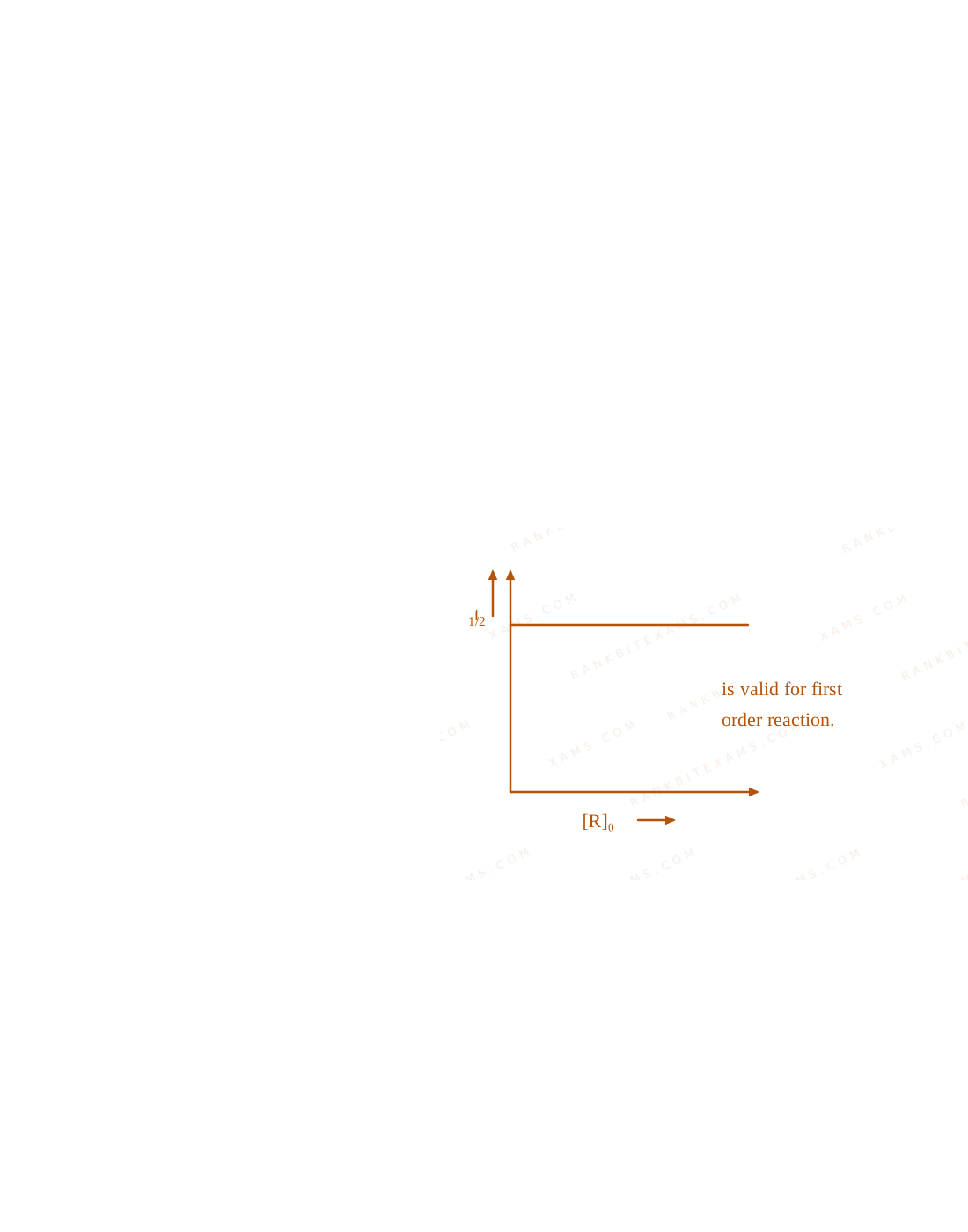
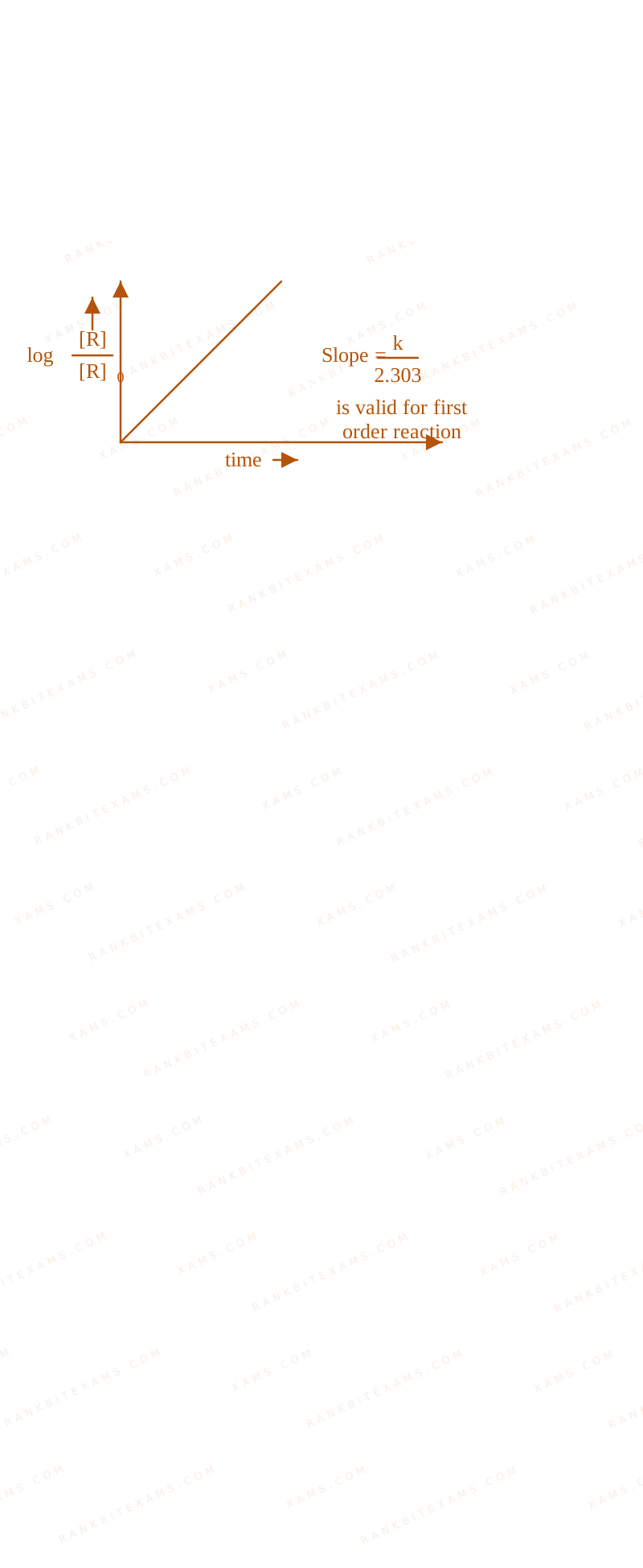
Integrated rate law equation for a first order gas phase reaction is given by (where P_i is initial pressure and P_t is total pressure at time t)
  • A. k = frac2.303t times log fracP_i(2P_i - P_t)
  • B. k = frac2.303t times log frac2P_i(2P_i - P_t)
  • C. k = frac2.303t times log frac(2P_i - P_t)P_i
  • D. k = frac2.303t times fracP_i(2P_i - P_t)

Solution

### Core Logic Consider a general gas phase reaction: A rightarrow B + C Initial (t=0): quad P_i quadquad 0 quadquad 0 At time t: quad P_i - x quadquad x quadquad x Total pressure at time t: P_t = (P_i - x) + x + x = P_i + x x = P_t - P_i Partial pressure of A at time t (P_A): P_A = P_i - x P_A = P_i - (P_t - P_i) = 2P_i - P_t For a first-order reaction: k = frac2.303t log fracP_0P_t Here, P_0 = P_i and the pressure of the reactant at time t is P_A. k = frac2.303t log fracP_i2P_i - P_t ### Evaluation Rubric / Model Answer null ### Chapter Mix Class 12 Chemistry: Chemical Kinetics

More Chemical Kinetics Questions — jee_main_2026_21_jan_morning

Practice all Chemical Kinetics previous-year questions →

Rankbit System
JEE Physics: Waves (+15.5%) | Electrostatics: Concentric Shells (-29.7%) | Modern Physics: Photoelectric Clones (+34.2%) | Mathematics: Definite Integrals (+18.1%) | Chemistry: Coordination Splitting (-11.4%) | JEE Physics: Waves (+15.5%) | Electrostatics: Concentric Shells (-29.7%) | Modern Physics: Photoelectric Clones (+34.2%) | Mathematics: Definite Integrals (+18.1%) | Chemistry: Coordination Splitting (-11.4%)
YOUR FIRST PREP STEP STARTS HERE

We Map Every Repeating Question in Competitive Exams.

Say goodbye to generic mock test fatigue. RankBit uses smart analysis to group past exam questions into their foundational Repeating Question Types. Find chapter weightage, track repeating questions, and score higher with targeted practice.

Select Your Target Exam

Choose an exam track below to find formulas per chapter and patterns.

Syncing Exam Intelligence

Mapping formulas and patterns across all tracks…

PATH A — FULL LENGTH PRACTICE

Full Mock Test Hub

Simulate real NTA exam conditions with fully tracked mocks. Time yourself against past papers.

Now Live Open
PATH B — TARGETED PRACTICE

Topic-wise Practice Hub

Practice past-year questions one chapter at a time. Pick an exam → subject → chapter and get every PYQ for that topic — pulled together from all past papers — with the chapter's key formulas alongside.

Loading Questions... Browse Topics
Latest from the Blog
View all →

Loading articles...