Pre-exponential factors of two different reactions of same order are identical. Let activation energy of first reaction exceeds the activation energy of second reaction by 20text kJ mol^-1. If k_1 and k_2 are the rate constants of first and second reaction respectively at 300 K, then ln frack_2k_1 will be ..... (nearest integer) [R=8.3text J K^-1text mol^-1]

Numerical Answer Type:
Enter a numerical value Answer: 8 to 8 +4 marks

Solution & Explanation

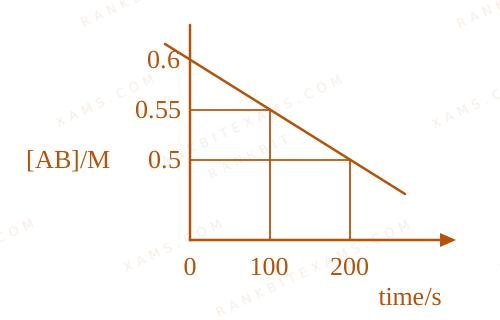
### Related Formula ln k = ln A - fracE_aRT ### Core Logic For Reaction 1: ln k_1 = ln A - fracE_1RT For Reaction 2: ln k_2 = ln A - fracE_2RT (Pre-exponential factor A is the same). Subtracting the first from the second: ln k_2 - ln k_1 = -fracE_2RT - left(-fracE_1RTright) ln left(frack_2k_1right) = fracE_1 - E_2RT Given that E_1 exceeds E_2 by 20text kJ mol^-1, E_1 - E_2 = 20000text J mol^-1. T = 300text K, R = 8.3text J K^-1text mol^-1. ln left(frack_2k_1right) = frac200008.3 times 300 = frac2008.3 times 3 = frac20024.9 ln left(frack_2k_1right) = 8.032 Rounding off to nearest integer gives 8. ### Evaluation Rubric / Model Answer null ### Chapter Mix Class 12 Chemistry: Chemical Kinetics
Reference Study Guides

More Chemical Kinetics Previous-Year Questions — Page 2

Q jee_main_2025_07_april_morning Integrated Rate Equations
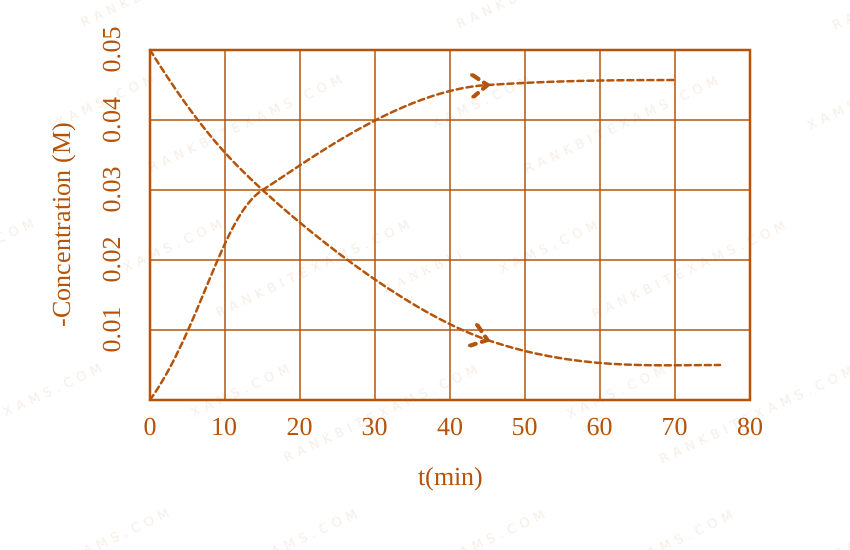
A person's wound was exposed to some bacteria and then bacteria growth started to happen at the same place. The wound was later treated with some antibacterial medicine and the rate of bacterial decay (r) was found to be proportional with the square of the existing number of bacteria at any instance. Which of the following set of graphs correctly represents the 'before' and 'after' situation of the application of the medicine? [Given: mathrmN = textNo. of bacteria, textt = texttime, bacterial growth follows mathrmI^mathrmst order kinetics.]
  • A.
  • B.
  • C.
  • D.

Solution

### Related Formula textBefore: fracdNdt = k_1 N implies N = N_0 e^k_1 t textAfter: -fracdNdt = k_2 N^2 implies frac1N - frac1N_0 = k_2 t ### Core Logic Let's analyze the kinetics for the two stages: 1. **Before applying medicine**: - Bacterial growth follows 1^textst order kinetics: fracdNdt = k_1 N. - Integrating this yields: N(t) = N_0 e^k_1 t. - The graph of fracNN_0 vs t is a rising exponential curve starting from 1 (since at t=0, fracNN_0 = 1). 2. **After applying medicine**: - Reductive rate is proportional to the square of existing bacteria (2^textnd order decay): -fracdNdt = k_2 N^2 implies fracdNN^2 = -k_2 dt - Integrating this yields: -frac1N = -k_2 t + C implies frac1N = k_2 t + frac1N_0 N(t) = fracN_01 + N_0 k_2 t - A plot of N vs t or fracNN_0 vs t for this decay is a hyperbolic curve decreasing gradually. - Option B correctly matches the exponential growth before medicine and the hyperbolic decay after medicine. ### Pattern Recognition First-order growth is an exponential curve (N_0 e^kt), while second-order decay behaves as a rational hyperbolic relationship (1 / (1 + bt)). Option B shows the exact transition from an exponential rise to a hyperbolic decay curve. ### Evaluation Rubric / Model Answer null ### Chapter Mix Class 12 Chemistry: Chemical Kinetics
Q28 jee_main_2025_07_april_morning First Order Reactions
Reaction mathrmA(g) rightarrow 2mathrmB(g) + mathrmC(g) is a first order reaction. It was started with pure A.
t / textminPressure of system at time t / textmm Hg
10160
infty240
Which of the following options is incorrect?
  • A. textInitial pressure of A is 80 mm Hg
  • B. textThe reaction never goes to completion
  • C. textRate constant of the reaction is 1.693 min^-1
  • D. textPartial pressure of A after 10 minute is 40 mm Hg

Solution

### Related Formula k = frac2.303t logleft(fracP_0P_tright) ### Core Logic For the reaction: mathrmA(g) rightarrow 2mathrmB(g) + mathrmC(g) - At t=0, pressure of A = P_0, while B = 0 and C = 0. - At t=infty, A is completely consumed, leaving 2P_0 of B and P_0 of C. P_infty = 3P_0 = 240 text mm Hg implies P_0 = 80 text mm Hg This confirms option (1) is correct. At any time t, pressure of A = P_0 - x, B = 2x, C = x. P_t = P_0 + 2x = 80 + 2x At t=10 text min, P_10 = 160 text mm Hg: 80 + 2x = 160 implies x = 40 text mm Hg Thus, partial pressure of A after 10 text min is: P_A = P_0 - x = 80 - 40 = 40 text mm Hg This confirms option (4) is correct. Now, calculate the rate constant k: k = frac110 lnleft(frac8040 ight) = fracln 210 = 0.0693 text min^-1 Therefore, option (3) which states k = 1.693 text min^-1 is incorrect. ### Pattern Recognition At t=infty, the total pressure is 3 times the initial pressure of A. So, P_0 = P_infty / 3 = 80 text mm Hg. Half-life t_1/2 = 10 text min since P_A drops from 80 to 40 in 10 text min. Thus, k = 0.693 / 10 = 0.0693 text min^-1. ### Evaluation Rubric / Model Answer null ### Chapter Mix Class 12 Chemistry: Chemical Kinetics
Q26 jee_main_2025_08_april_evening First Order Reactions
In a first order decomposition reaction, the time taken for the decomposition of reactant to one fourth and one eighth of its initial concentration are t_1 and t_2 (s), respectively. The ratio t_1 / t_2 will: Choose the correct answer from the options given below:
  • A. frac43
  • B. frac32
  • C. frac34
  • D. frac23

Solution

### Related Formula For a first-order reaction: t = frac2.303k logleft(fracC_0C_tright) Alternatively, using half-life t_50\%: C_t = fracC_02^n where n is the number of half-lives (n = fractt_50\%). ### Core Logic Step 1: Calculate t_1 for decomposition to frac14 of initial concentration: C_t = fracC_04 = fracC_02^2 implies n = 2 t_1 = 2 cdot t_50\% Step 2: Calculate t_2 for decomposition to frac18 of initial concentration: C_t = fracC_08 = fracC_02^3 implies n = 3 t_2 = 3 cdot t_50\% Step 3: Find the ratio fract_1t_2: fract_1t_2 = frac2 cdot t_50\%3 cdot t_50\% = frac23 ### Pattern Recognition For first-order kinetics, every step of concentration halving takes exactly one half-life (t_50\%). textInitial xrightarrowt_50\% frac12 xrightarrowt_50\% frac14 quad text(Total 2 text half-lives) frac14 xrightarrowt_50\% frac18 quad text(Total 3 text half-lives) Therefore, the ratio is simply the ratio of the number of half-lives: 2 : 3. ### Evaluation Rubric / Model Answer null ### Chapter Mix Class 12 Chemistry: Chemical Kinetics

Q42 jee_main_2025_29_jan_evening First Order Reaction Kinetics
Drug X becomes ineffective after 50\% decomposition. The original concentration of drug in a bottle was 16text mg/mL which becomes 4text mg/mL in 12 months. The expiry time of the drug in months is (Assume that the decomposition of the drug follows first order kinetics). (1) 12 (2) 2 (3) 3 (4) 6
  • A. 12
  • B. 2
  • C. 3
  • D. 4

Solution

### Related Formula N_t = N_0 left(frac12 ight)^n ### Core Logic Let's track concentration reductions: 16text mg/mL xrightarrowt_1/2 8text mg/mL xrightarrowt_1/2 4text mg/mL This total progression constitutes exactly 2 half-lives (n = 2). 2 cdot t_1/2 = 12text months implies t_1/2 = 6text months Since the drug becomes ineffective right after 50\% decomposition, its functional expiry limit is exactly 1 half-life period. textExpiry time = t_1/2 = 6text months ### Pattern Recognition For multi-step concentration halving, bypass complex integrated logarithmic rate expressions by directly applying integer half-life steps (16 ightarrow 8 ightarrow 4). ### Evaluation Rubric / Model Answer null ### Chapter Mix Class 12 Chemistry: Chemical Kinetics
Q32 jee_main_2025_28_jan_morning Order of Reaction and Half-life
For a given reaction mathrmRrightarrow mathrmP,mathrmt_1 / 2 is related to [mathrmA]_0 as given in table :
[A]_0 / mathrmmol\,L^-1t_1/2 / mathrmmin
0.100200
0.025100
Given: log 2 = 0.30 Which of the following is true? A. The order of the reaction is frac12 . B. If [mathrmA]_0 is 1mathrmM , then mathrmt_1/2 is 200sqrt10 min C. The order of the reaction changes to 1 if the concentration of reactant changes from 0.100 mathrmM to 0.500 mathrmM . D. t_1 / 2 is 800 mathrm~min for [mathrmA]_0 = 1.6 mathrmM Choose the correct answer from the options given below:
  • A. textA and C only
  • B. textA and B only
  • C. textA, B and D only
  • D. textC and D only

Solution

### Related Formula The dependence of half-life on initial concentration is given by: t_1/2 propto frac1[A]_0^n-1 ### Step 1: Finding the reaction order (n) Using the values provided: frac(t_1/2)_1(t_1/2)_2 = left( frac[A]_0,2[A]_0,1 right)^n-1 frac200100 = left( frac0.0250.100 right)^n-1 Rightarrow 2 = left( frac14 right)^n-1 2 = 2^-2(n-1) Rightarrow 1 = -2n + 2 Rightarrow n = frac12 Hence, statement A is correct. ### Step 2: Checking half-life at other concentrations Since n = frac12, t_1/2 propto sqrt[A]_0. - For [A]_0 = 1\,mathrmM: frac200t_1/2 = sqrtfrac0.11 Rightarrow t_1/2 = 200sqrt10\,mathrmmin Hence, statement B is correct. - For [A]_0 = 1.6\,mathrmM: frac200t_1/2 = sqrtfrac0.11.6 = sqrtfrac116 = frac14 Rightarrow t_1/2 = 800\,mathrmmin Hence, statement D is correct. ### Pattern Recognition Sees: Half-life reducing as initial concentration decreases. Trap: Assuming all reactions are first or zero order without calculations. Shortcut: Reduction of [A]_0 by 4 causes reduction of t_1/2 by 2 rightarrow indicates a square root dependence (t_1/2 propto sqrtA_0), which implies n = 0.5. ### Evaluation Rubric / Model Answer null ### Chapter Mix Class 12 Chemistry: Chemical Kinetics

More Chemical Kinetics Questions — jee_main_2026_21_jan_morning

Practice all Chemical Kinetics previous-year questions →

Rankbit System
JEE Physics: Waves (+15.5%) | Electrostatics: Concentric Shells (-29.7%) | Modern Physics: Photoelectric Clones (+34.2%) | Mathematics: Definite Integrals (+18.1%) | Chemistry: Coordination Splitting (-11.4%) | JEE Physics: Waves (+15.5%) | Electrostatics: Concentric Shells (-29.7%) | Modern Physics: Photoelectric Clones (+34.2%) | Mathematics: Definite Integrals (+18.1%) | Chemistry: Coordination Splitting (-11.4%)
YOUR FIRST PREP STEP STARTS HERE

We Map Every Repeating Question in Competitive Exams.

Say goodbye to generic mock test fatigue. RankBit uses smart analysis to group past exam questions into their foundational Repeating Question Types. Find chapter weightage, track repeating questions, and score higher with targeted practice.

Select Your Target Exam

Choose an exam track below to find formulas per chapter and patterns.

Syncing Exam Intelligence

Mapping formulas and patterns across all tracks…

PATH A — FULL LENGTH PRACTICE

Full Mock Test Hub

Simulate real NTA exam conditions with fully tracked mocks. Time yourself against past papers.

Now Live Open
PATH B — TARGETED PRACTICE

Topic-wise Practice Hub

Practice past-year questions one chapter at a time. Pick an exam → subject → chapter and get every PYQ for that topic — pulled together from all past papers — with the chapter's key formulas alongside.

Loading Questions... Browse Topics
Latest from the Blog
View all →

Loading articles...