JEE Main · Mathematics ↓ Falling

Complex Numbers appeared 41 times across 3 years — 4.7% of Mathematics. This question is from Geometry of Complex Numbers.

Year 2026 2025 2024 Total
Questions 11 16 14 41

Let z be the complex number satisfying |z-5|≤ 3 and having maximum positive principal argument. Then 34|(5z-12)/(5iz+16)|² is equal to:

Solution & Explanation

Related Formula
For maximum argument of z on a circle, the ray from origin is tangent to the circle. If |z-a| ≤ r, maximum argument implies θ = (r)/(|a|) and coordinates are x=a ²θ, y=a θ θ
Core Logic

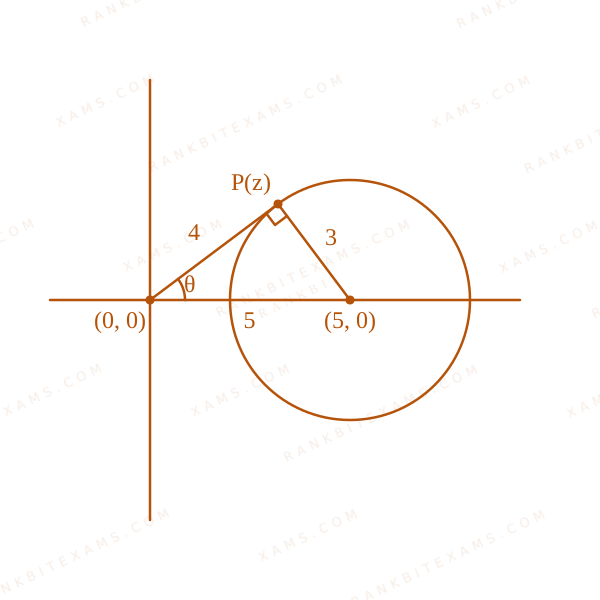
Complex geometry maximum argument diagram for Q19 - JEE Main 2026 Evening
The condition |z-5|≤ 3 represents a disk centered at (5,0) with radius 3. To maximize the principal argument θ, the ray from origin must touch the circle in the first quadrant. The tangent, origin, and center form a right-angled triangle.

Step 1: Locate the Point z

From geometry, hypotenuse c = 5, opposite (radius) r = 3. The adjacent side (length of tangent) is √(5² - 3²) = 4. The angle of tangency θ satisfies θ = (3)/(5) and θ = (4)/(5). The point P(z) lies on the circle and the tangent ray:

z ≡ (4 θ, 4 θ) = (4((4)/(5)), 4((3)/(5))) = ((16)/(5), (12)/(5)) z = (16)/(5) + (12)/(5)i
Step 2: Evaluate the Target Expression

We need 34|(5z - 12)/(5iz + 16)|². Substitute 5z = 16 + 12i: Numerator: 5z - 12 = 16 + 12i - 12 = 4 + 12i Denominator: 5iz + 16 = i(16 + 12i) + 16 = 16i - 12 + 16 = 4 + 16i Expression:

34 |(4 + 12i)/(4 + 16i)|² = 34 (|4 + 12i|²)/(|4 + 16i|²) = 34 (4² + 12²)/(4² + 16²) = 34 ((16 + 144)/(16 + 256)) = 34 ((160)/(272)) = (34 × 160)/(272) = (5440)/(272) = 20
Pattern Recognition

For maximum (z) on |z-c| = r where c is real, z coordinates are given by geometric projection: z = √(c²-r²)( θ + i θ) where θ = r/c.

Chapter Mix

Class 11 Maths: Complex Numbers

Reference Study Guides

More Complex Numbers Previous-Year Questions — Page 8

Q23 jee_main_2024_29_jan_morning Higher Powers of Roots
Let α, β be the roots of the equation x²-x+2=0 with Im(α) gt Im(β). Then α⁶+α⁴+β⁴-5α² is equal to
Numerical Answer. Answer: 13 to 13

Solution

Related Formula

Since α is a root of x² - x + 2 = 0, it must satisfy the equation exactly:

α² - α + 2 = 0 ⇒ α² = α - 2

This is an essential root reduction property allowing polynomials of high degrees to be collapsed linearly.

Core Logic

We need to evaluate the expression E = α⁶ + α⁴ + β⁴ - 5α². Use the substitution α² = α - 2 to iteratively depress the powers of α.

α⁴ = (α²)² = (α - 2)² = α² - 4α + 4

Substitute α² = α - 2 again into the result:

α⁴ = (α - 2) - 4α + 4 = -3α + 2

Now, generate α⁶ using α⁴:

α⁶ = α⁴ · α² = (-3α + 2)(α - 2) = -3α² + 6α + 2α - 4 = -3α² + 8α - 4

Substitute α² = α - 2 into the result again:

α⁶ = -3(α - 2) + 8α - 4 = -3α + 6 + 8α - 4 = 5α + 2
Step 1: Simplify the Full Expression

The symmetry of the roots dictates that β⁴ behaves identically to α⁴. Thus:

β⁴ = -3β + 2

Substitute all depressed linear forms back into E = α⁶ + α⁴ + β⁴ - 5α²:

E = (5α + 2) + (-3α + 2) + (-3β + 2) - 5(α - 2) E = 5α - 3α - 5α - 3β + 2 + 2 + 2 + 10 E = -3α - 3β + 16 E = -3(α + β) + 16
Step 2: Apply Sum of Roots

From the original quadratic equation x² - x + 2 = 0, the sum of roots is:

α + β = -(-1)/(1) = 1

Substitute this back:

E = -3(1) + 16 = 13

(Note: The condition Im(α) gt Im(β) was a distractor since the expression simplified perfectly symmetrically into α + β without needing the individual complex values of the roots).

Pattern Recognition

Never compute De Moivre polar forms for high root powers unless the quadratic has roots like ω or i. Always use the characteristic quadratic relation α² = pα + q to rapidly step down degrees until everything is strictly linear.

Chapter Mix

Class 11 Mathematics: Complex Numbers and Quadratic Equations

Q16 jee_main_2024_30_january_evening Roots of Unity
If z is a complex number, then the number of common roots of the equation z¹⁹⁸⁵ + z¹⁰⁰ + 1 = 0 and z³ + 2z² + 2z + 1 = 0 , is equal to:
  • A. 1
  • B. 2
  • C. 0
  • D. 3

Solution

Related Formula
z³-1 = (z-1)(z²+z+1) Cube roots of unity: 1, ω, ω² ω³ = 1 and 1+ω+ω² = 0
Core Logic

Let's first find the roots of the lower degree polynomial:

z³ + 2z² + 2z + 1 = 0

Group the terms:

(z³ + 1) + 2z(z + 1) = 0 (z + 1)(z² - z + 1) + 2z(z + 1) = 0 (z + 1)(z² - z + 1 + 2z) = 0 (z + 1)(z² + z + 1) = 0

Thus, the roots are z = -1, and the roots of z² + z + 1 = 0 which are z = ω, ω².

Step 1: Check z = -1

Substitute z = -1 into the first equation z¹⁹⁸⁵ + z¹⁰⁰ + 1 = 0:

(-1)¹⁹⁸⁵ + (-1)¹⁰⁰ + 1 = -1 + 1 + 1 = 1 ≠ 0

So, z = -1 is not a common root.

Step 2: Check z = ω and ω²

Substitute z = ω:

ω¹⁹⁸⁵ + ω¹⁰⁰ + 1

Reduce the powers modulo 3 (since ω³ = 1): 1985 = 3 × 661 + 2 ⇒ ω¹⁹⁸⁵ = ω² 100 = 3 × 33 + 1 ⇒ ω¹⁰⁰ = ω¹ = ω So, ω¹⁹⁸⁵ + ω¹⁰⁰ + 1 = ω² + ω + 1 = 0. z = ω is a common root.

Substitute z = ω²:

(ω²)¹⁹⁸⁵ + (ω²)¹⁰⁰ + 1 = ω³⁹⁷⁰ + ω²⁰⁰ + 1

3970 = 3 × 1323 + 1 ⇒ ω³⁹⁷⁰ = ω 200 = 3 × 66 + 2 ⇒ ω²⁰⁰ = ω² So, ω³⁹⁷⁰ + ω²⁰⁰ + 1 = ω + ω² + 1 = 0. z = ω² is also a common root.

Step 3: Conclusion

There are exactly 2 common roots: ω and ω².

Pattern Recognition

Whenever z²+z+1 emerges as a factor, its roots ω and ω² can be directly tested in massive degree polynomials using exponent reduction modulo 3.

Chapter Mix

Class 11 Maths: Complex Numbers

Q3 jee_main_2024_30_jan_morning Modulus and Conjugate of a Complex Number
If z = x + iy, xy ≠ 0, satisfies the equation z² + i z = 0, then |z²| is equal to:
  • A. 9
  • B. 1
  • C. 4
  • D. (1)/(4)

Solution

Related Formula

|zⁿ| = |z|ⁿ | z| = |z|

Core Logic

Given the equation: z² = -i z Taking the modulus on both sides:

|z²| = |-i z|

Using properties of modulus:

|z|² = |-i| · | z|

Since |-i| = 1 and | z| = |z|: |z|² = |z| |z|² - |z| = 0

|z|(|z| - 1) = 0
Step 1: Applying the non-zero condition

This gives two possibilities: |z| = 0 or |z| = 1. Since z = x + iy and xy ≠ 0, neither x nor y is zero, which implies |z| ≠ 0. Therefore, |z| = 1. We are asked for |z²|:

|z²| = |z|² = 1² = 1
Pattern Recognition

When dealing with equations involving z and z, applying modulus to both sides rapidly simplifies the problem, turning complex equations into simple real algebraic equations in |z|.

Chapter Mix

Class 11 Maths: Complex Numbers and Quadratic Equations

Q28 jee_main_2024_30_jan_morning Quadratic Equations
Let α, β in N be roots of equation x² - 70x + λ = 0 where (λ)/(2), (λ)/(3) N. If λ assumes the minimum possible value, then (√(α - 1) + √(β - 1))(λ + 35)|α - β| is equal to:
Numerical Answer. Answer: 60 to 60

Solution

Related Formula
Sum of roots (α + β) = -(b)/(a) Product of roots (α β) = (c)/(a)
Core Logic

For the equation x² - 70x + λ = 0: α + β = 70 α β = λ Since α, β in N, their sum is 70. This gives α(70 - α) = λ. We are given λ / 2 N and λ / 3 N. This means λ is not divisible by 2 or 3. So λ must be an odd number and not a multiple of 3. Thus, neither α nor β can be a multiple of 2 or 3.

Step 1: Finding minimum lambda

We need to find the minimum value of λ. λ = α(70 - α). This parabola opens downwards, so the minimum product occurs when the integers α and β are as far apart as possible. Let's test small values for α: If α = 1, β = 69 ⇒ λ = 69, but 69 = 3 × 23, which is divisible by 3. Rejected. If α = 2, divisible by 2. Rejected. If α = 3, divisible by 3. Rejected. If α = 4, divisible by 2. Rejected. If α = 5, β = 65 ⇒ λ = 325. Check divisibility: 325 is odd (not div by 2). 3+2+5 = 10 (not div by 3). So minimum λ = 325 with roots α = 5, β = 65.

Step 2: Evaluating the target expression

We need to compute:

E = (√(α - 1) + √(β - 1))(λ + 35)|α - β|

Substitute the values α = 5, β = 65, λ = 325:

|α - β| = |5 - 65| = 60 √(α - 1) = √(4) = 2 √(β - 1) = √(64) = 8 E = ((2 + 8)(325 + 35))/(60) = ((10)(360))/(60) = 10 × 6 = 60

The result is exactly 60.

Pattern Recognition

Minimizing the product of two numbers with a fixed sum requires them to be as far apart as possible. Divisibility constraints are quickly verified using prime modulus filters (%2 ≠ 0, %3 ≠ 0).

Chapter Mix

Class 11 Maths: Complex Numbers and Quadratic Equations

Q3 jee_main_2024_31_jan_evening Algebra of Complex Numbers
Let z₁ and z₂ be two complex numbers such that z₁ + z₂ = 5 and z₁³ + z₂³ = 20 + 15i. Then |z₁⁴ + z₂⁴| equals-
  • A. 30√(3)
  • B. 75
  • C. 15√(15)
  • D. 25√(3)

Solution

Related Formula
a³+b³ = (a+b)³ - 3ab(a+b) a²+b² = (a+b)² - 2ab a⁴+b⁴ = (a²+b²)² - 2a²b²
Core Logic

Given z₁+z₂=5 and z₁³+z₂³=20+15i.

z₁³+z₂³ = (z₁+z₂)³ - 3z₁z₂(z₁+z₂) 20+15i = 125 - 15z₁z₂ 15z₁z₂ = 105 - 15i z₁z₂ = 7-i

Now, compute z₁²+z₂²:

z₁²+z₂² = (z₁+z₂)² - 2z₁z₂ = 25 - 2(7-i) = 11+2i

Now, compute z₁⁴+z₂⁴:

z₁⁴+z₂⁴ = (z₁²+z₂²)² - 2(z₁z₂)² = (11+2i)² - 2(7-i)² = (121 - 4 + 44i) - 2(49 - 1 - 14i) = 117 + 44i - 2(48 - 14i) = 117 + 44i - 96 + 28i = 21 + 72i

Finally, find magnitude:

|z₁⁴+z₂⁴| = |21+72i| = √(21² + 72²) = √(441 + 5184) = √(5625) = 75
Pattern Recognition

Standard algebraic identities recursively applied. Extract sum and product, then ladder up to higher powers.

Chapter Mix

Class 11 Maths: Complex Numbers and Quadratic Equations

More Complex Numbers Questions — jee_main_2026_21_jan_evening

Practice all Complex Numbers previous-year questions →

Rankbit System
JEE Physics: Waves (+15.5%) | Electrostatics: Concentric Shells (-29.7%) | Modern Physics: Photoelectric Clones (+34.2%) | Mathematics: Definite Integrals (+18.1%) | Chemistry: Coordination Splitting (-11.4%) | JEE Physics: Waves (+15.5%) | Electrostatics: Concentric Shells (-29.7%) | Modern Physics: Photoelectric Clones (+34.2%) | Mathematics: Definite Integrals (+18.1%) | Chemistry: Coordination Splitting (-11.4%)