Let alpha = frac-1 + mathrmisqrt32 and beta = frac-1 - mathrmisqrt32,mathrmi = sqrt-1. If (7 - 7alpha +9beta)^20 + (9 + 7alpha -7beta)^20 + (-7 + 9alpha +7beta)^20 + (14 + 7alpha +7beta)^20 = mathrmm^10, then m is ____.

Numerical Answer Type:
Enter a numerical value Answer: 49 to 49 +4 marks

Solution & Explanation

### Related Formula alpha = omega, quad beta = omega^2 1 + omega + omega^2 = 0 implies omega^3 = 1 ### Core Logic Substitute omega and omega^2 into the terms: Let T_1 = 7 - 7omega + 9omega^2 Let T_2 = 9 + 7omega - 7omega^2 Let T_3 = -7 + 9omega + 7omega^2 Let T_4 = 14 + 7omega + 7omega^2 ### Step 1: Simplify Each Term Using Properties of Omega Notice relationships between the terms by factoring powers of omega: T_1 = omega cdot omega^2(7 - 7omega + 9omega^2) text wait, an easier path is factoring Observe that: omega cdot T_2 = omega(9 + 7omega - 7omega^2) = 9omega + 7omega^2 - 7 = T_3 omega^2 cdot T_2 = omega^2(9 + 7omega - 7omega^2) = 9omega^2 + 7 - 7omega = T_1 So, T_1^20 + T_2^20 + T_3^20 = (omega^2 T_2)^20 + T_2^20 + (omega T_2)^20 = omega^40 T_2^20 + T_2^20 + omega^20 T_2^20 = T_2^20 (1 + omega^40 + omega^20) Since omega^3 = 1, we have omega^40 = omega and omega^20 = omega^2. Thus, T_2^20 (1 + omega + omega^2) = T_2^20 (0) = 0. ### Step 2: Evaluating the Non-Zero Term The only remaining term is T_4^20: T_4 = 14 + 7(omega + omega^2) Since omega + omega^2 = -1, T_4 = 14 + 7(-1) = 14 - 7 = 7 So the entire expression sum is 0 + 7^20 = 7^20. ### Step 3: Finding m Given that the sum equals m^10: m^10 = 7^20 = (7^2)^10 = 49^10 Hence, m = 49.
Cube Roots of Unity diagram for Q21 - JEE Main 2026 Morning
### Pattern Recognition Complex expressions with omega raised to large powers almost always exploit rotational symmetry. If coefficients are permuted circularly (A, B, C) to (C, A, B) to (B, C, A), multiplying by omega maps them to one another, meaning their sum of 3n or symmetric powers identically nullifies. ### Evaluation Rubric / Model Answer null ### Chapter Mix Class 11 Maths: Complex Numbers

Reference Study Guides

More Complex Numbers Previous-Year Questions

Q17 jee_main_2026_21_jan_morning Cube Roots of Unity
If x^2 + x + 1 = 0 , then the value of left(mathrmx+frac1mathrmxright)^4+left(mathrmx^2+frac1mathrmx^2right)^4+left(mathrmx^3+frac1mathrmx^3right)^4+ldots+left(mathrmx^25+frac1mathrmx^25right)^4 is :
  • A. 128
  • B. 162
  • C. 175
  • D. 145

Solution

### Related Formula x^2 + x + 1 = 0 Rightarrow x = omega, omega^2 Properties of cube roots of unity: omega^3 = 1 and 1 + omega + omega^2 = 0. ### Core Logic Let alpha = omega. Then frac1x = frac1omega = omega^2. The series is sum_k=1^25 (omega^k + omega^2k)^4. Evaluate the term T_k = (omega^k + omega^2k)^4 based on the modulo of k with 3. ### Step 1: Cyclic Evaluation Case 1: k = 3m (multiples of 3) T_3m = (omega^3m + omega^6m)^4 = (1 + 1)^4 = 2^4 = 16 There are 8 such multiples up to 25 (3, 6, 9, dots, 24). Case 2: k neq 3m (non-multiples of 3) For k = 1, 2, 4, 5, dots omega^k + omega^2k will always be omega + omega^2 or omega^2 + omega. Since 1 + omega + omega^2 = 0, we have omega + omega^2 = -1. T_k neq 3m = (-1)^4 = 1 There are 25 - 8 = 17 such non-multiples up to 25. ### Step 2: Total Sum textSum = 17 times 1 + 8 times 16 = 17 + 128 = 145 ### Pattern Recognition Powers of x+1/x when x solves x^2 pm x + 1 = 0 perfectly orbit around periods of 3 or 6. Isolate the 3m resonant beats (which hit pure scalars like 1+1=2) versus the out-of-phase beats (which collapse to -1 or 1 via basic omega identities). ### Evaluation Rubric / Model Answer null ### Chapter Mix Class 11 Maths: Complex Numbers and Quadratic Equations
Q19 jee_main_2026_21_jan_evening Geometry of Complex Numbers
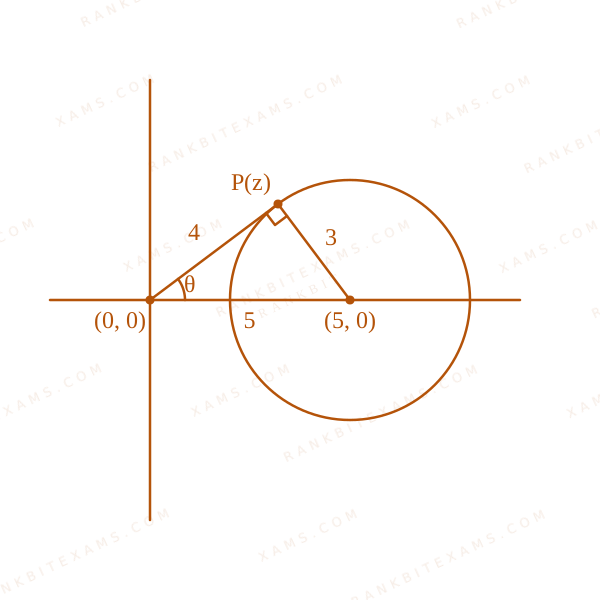
Let z be the complex number satisfying |z-5|leq 3 and having maximum positive principal argument. Then 34left|frac5z-125iz+16right|^2 is equal to:
  • A. 16
  • B. 12
  • C. 26
  • D. 20

Solution

### Related Formula textFor maximum argument of z text on a circle, the ray from origin is tangent to the circle. textIf |z-a| leq r, text maximum argument implies sintheta = fracr|a| text and coordinates are x=acos^2theta, y=asinthetacostheta ### Core Logic
Complex geometry maximum argument diagram for Q19 - JEE Main 2026 Evening
The condition |z-5|leq 3 represents a disk centered at (5,0) with radius 3. To maximize the principal argument theta, the ray from origin must touch the circle in the first quadrant. The tangent, origin, and center form a right-angled triangle. ### Step 1: Locate the Point z From geometry, hypotenuse c = 5, opposite (radius) r = 3. The adjacent side (length of tangent) is sqrt5^2 - 3^2 = 4. The angle of tangency theta satisfies sintheta = frac35 and costheta = frac45. The point P(z) lies on the circle and the tangent ray: z equiv (4costheta, 4sintheta) = left(4left(frac45right), 4left(frac35right)right) = left(frac165, frac125right) z = frac165 + frac125i ### Step 2: Evaluate the Target Expression We need 34left|frac5z - 125iz + 16right|^2. Substitute 5z = 16 + 12i: Numerator: 5z - 12 = 16 + 12i - 12 = 4 + 12i Denominator: 5iz + 16 = i(16 + 12i) + 16 = 16i - 12 + 16 = 4 + 16i Expression: 34 left|frac4 + 12i4 + 16iright|^2 = 34 frac|4 + 12i|^2|4 + 16i|^2 = 34 frac4^2 + 12^24^2 + 16^2 = 34 left(frac16 + 14416 + 256right) = 34 left(frac160272right) = frac34 times 160272 = frac5440272 = 20 ### Pattern Recognition For maximum arg(z) on |z-c| = r where c is real, z coordinates are given by geometric projection: z = sqrtc^2-r^2(costheta + isintheta) where sintheta = r/c. ### Evaluation Rubric / Model Answer null ### Chapter Mix Class 11 Maths: Complex Numbers
Q4 jee_main_2026_22_january_evening Complex Equations and Modulus
Let S = \z in mathbbC : 4z^2 + overlinez = 0\. Then sum_z in S |z|^2 is equal to:
  • A. frac316
  • B. frac764
  • C. frac116
  • D. frac564

Solution

### Related Formula For z = x + iy, overlinez = x - iy and |z|^2 = x^2 + y^2. ### Core Logic Substitute z = x + iy into 4z^2 + overlinez = 0: 4(x^2 - y^2 + 2ixy) + x - iy = 0 Separating real and imaginary parts: 4x^2 - 4y^2 + x = 0 quad textand quad y(8x - 1) = 0 Case 1: y = 0 implies 4x^2 + x = 0 implies x = 0 or x = -1/4. Solutions: z_1 = 0 implies |z_1|^2 = 0, z_2 = -1/4 implies |z_2|^2 = 1/16. Case 2: x = 1/8 implies 4(1/64) - 4y^2 + 1/8 = 0 implies 4y^2 = 3/16 implies y = pm fracsqrt38. Solutions: z_3, z_4 = frac18 pm i fracsqrt38 implies |z_3|^2 = |z_4|^2 = frac164 + frac364 = frac116. ### Step 1: Sum of Modulus Squared sum_z in S |z|^2 = 0 + frac116 + frac116 + frac116 = frac316 ### Pattern Recognition Separate complex equation into real and imaginary components to systematically find all roots. ### Evaluation Rubric / Model Answer null ### Chapter Mix Class 11 Maths: Complex Numbers
Q75 jee_main_2025_02_april_evening Quadratic Equations
If the set of all a in mathbbR - \1\, for which the roots of the equation (1 - a)x^2 + 2(a - 3)x + 9 = 0 are positive is (-infty, -alpha] cup [beta, gamma), then 2alpha + beta + gamma is equal to ____________.
Numerical Answer. Answer: 7 to 7

Solution

### Related Formula textFor a quadratic equation A x^2 + B x + C = 0 text to have two positive real roots: text1. Real roots: D = B^2 - 4AC ge 0 text2. Sum of roots: -fracBA > 0 text3. Product of roots: fracCA > 0 ### Core Logic We write down three systems of inequalities based on real and positive root conditions, find their intersection, and map the boundaries to solve for the parameters. ### Step 1: Apply the discriminant condition (Real roots) For real roots, the discriminant D ge 0: D = left[ 2(a - 3) right]^2 - 4(1 - a)(9) ge 0 4(a^2 - 6a + 9) - 36(1 - a) ge 0 (a^2 - 6a + 9) - 9(1 - a) ge 0 a^2 - 6a + 9 - 9 + 9 a ge 0 a^2 + 3a ge 0 implies a(a + 3) ge 0 Thus, the interval is: a in (-infty, -3] cup [0, infty) quad text--- (1) ### Step 2: Apply the sum of roots condition (Positive sum) For positive roots, the sum of roots must be positive: -fracBA = frac-2(a - 3)1 - a = frac2(a - 3)a - 1 > 0 Using the wavy curve method for fraca-3a-1 > 0: a in (-infty, 1) cup (3, infty) quad text--- (2) ### Step 3: Apply the product of roots condition (Positive product) For positive roots, the product of roots must be positive: fracCA = frac91 - a > 0 implies 1 - a > 0 implies a < 1 Thus, the interval is: a in (-infty, 1) quad text--- (3) ### Step 4: Find the intersection of all conditions Intersecting equations (1), (2), and (3): - First, intersect (2) and (3): ( (-infty, 1) cup (3, infty) ) cap (-infty, 1) = (-infty, 1) - Next, intersect with (1): ( (-infty, -3] cup [0, infty) ) cap (-infty, 1) = (-infty, -3] cup [0, 1) Comparing this with (-infty, -alpha] cup [beta, gamma): - alpha = 3 - beta = 0 - gamma = 1 Now calculate the target sum: 2alpha + beta + gamma = 2(3) + 0 + 1 = 7 ### Pattern Recognition Location of roots: When both roots are positive, checking sum and product signs along with D ge 0 is the standard and fastest set of inequalities, avoiding complex vertex projections. ### Evaluation Rubric / Model Answer null ### Chapter Mix Class 11 Chemistry: Practical Chemistry

More Complex Numbers Questions — jee_main_2026_22_january_morning

Practice all Complex Numbers previous-year questions →

Rankbit System
JEE Physics: Waves (+15.5%) | Electrostatics: Concentric Shells (-29.7%) | Modern Physics: Photoelectric Clones (+34.2%) | Mathematics: Definite Integrals (+18.1%) | Chemistry: Coordination Splitting (-11.4%) | JEE Physics: Waves (+15.5%) | Electrostatics: Concentric Shells (-29.7%) | Modern Physics: Photoelectric Clones (+34.2%) | Mathematics: Definite Integrals (+18.1%) | Chemistry: Coordination Splitting (-11.4%)
