Let z$z$ be the complex number satisfying |z-5|≤ 3$|z-5|\leq 3$ and having maximum positive principal argument. Then 34|(5z-12)/(5iz+16)|²$34\left|\frac{5z-12}{5iz+16}\right|^{2}$ is equal to:
A.16$16$
B.12$12$
C.26$26$
D.20$20$
Solution & Explanation
Related Formula
For maximum argument of z on a circle, the ray from origin is tangent to the circle.$$\text{For maximum argument of } z \text{ on a circle, the ray from origin is tangent to the circle.}$$If |z-a| ≤ r, maximum argument implies θ = (r)/(|a|) and coordinates are x=a ²θ, y=a θ θ$$\text{If } |z-a| \leq r, \text{ maximum argument implies } \sin\theta = \frac{r}{|a|} \text{ and coordinates are } x=a\cos^2\theta, y=a\sin\theta\cos\theta$$
Core Logic
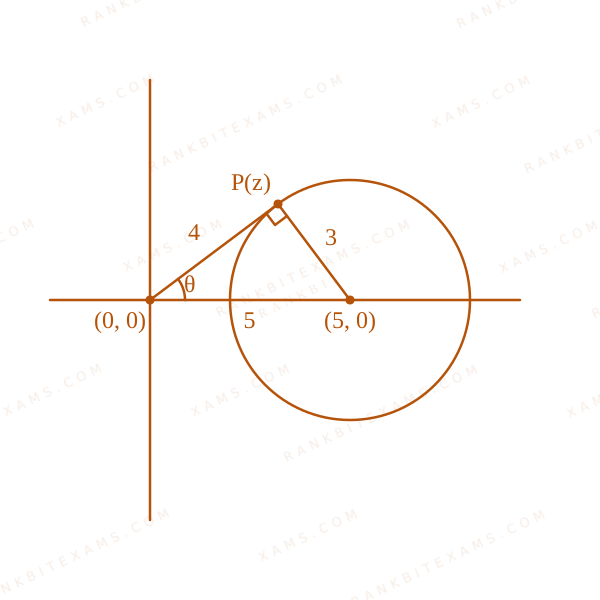
Complex geometry maximum argument diagram for Q19 - JEE Main 2026 Evening
The condition |z-5|≤ 3$|z-5|\leq 3$ represents a disk centered at (5,0)$(5,0)$ with radius 3$3$.
To maximize the principal argument θ$\theta$, the ray from origin must touch the circle in the first quadrant.
The tangent, origin, and center form a right-angled triangle.
Step 1: Locate the Point z
From geometry, hypotenuse c = 5$c = 5$, opposite (radius) r = 3$r = 3$.
The adjacent side (length of tangent) is √(5² - 3²) = 4$\sqrt{5^2 - 3^2} = 4$.
The angle of tangency θ$\theta$ satisfies θ = (3)/(5)$\sin\theta = \frac{3}{5}$ and θ = (4)/(5)$\cos\theta = \frac{4}{5}$.
The point P(z)$P(z)$ lies on the circle and the tangent ray:
For maximum (z)$\arg(z)$ on |z-c| = r$|z-c| = r$ where c$c$ is real, z$z$ coordinates are given by geometric projection: z = √(c²-r²)( θ + i θ)$z = \sqrt{c^2-r^2}(\cos\theta + i\sin\theta)$ where θ = r/c$\sin\theta = r/c$.
Keywords:#satisfying |z-5|<=3#JEE Main 2026 Evening Q19#Complex Numbers JEE Main 2026#Geometry of Complex Numbers JEE Main 2026
More Complex Numbers Previous-Year Questions — Page 9
Q26jee_main_2024_31_jan_morningProperties of Modulus and Argument
If α$\alpha$ denotes the number of solutions of |1 - i|^x = 2^x$|1 - i|^x = 2^x$ and β = ((|z|)/( (z)))$\beta = \left(\frac{|z|}{\arg(z)}\right)$, where z = (π)/(4) (1 + i)⁴ ( 1 - √(π) i√(π) + i + √(π) - i1 + √(π) i), i = √(-1)$z = \frac{\pi}{4} (1 + i)^4 \left(\frac{1 - \sqrt{\pi} i}{\sqrt{\pi} + i} + \frac{\sqrt{\pi} - i}{1 + \sqrt{\pi} i}\right), i = \sqrt{-1}$, then the distance of the point (α, β)$(\alpha, \beta)$ from the line 4x - 3y = 7$4x - 3y = 7$ is
Practice past-year questions one chapter at a time. Pick an exam → subject → chapter and get every PYQ for that topic — pulled together from all past papers — with the chapter's key formulas alongside.