JEE Main · Mathematics ↓ Falling

Complex Numbers appeared 41 times across 3 years — 4.7% of Mathematics. This question is from Geometry of Complex Numbers.

Year 2026 2025 2024 Total
Questions 11 16 14 41

Let z be the complex number satisfying |z-5|≤ 3 and having maximum positive principal argument. Then 34|(5z-12)/(5iz+16)|² is equal to:

Solution & Explanation

Related Formula
For maximum argument of z on a circle, the ray from origin is tangent to the circle. If |z-a| ≤ r, maximum argument implies θ = (r)/(|a|) and coordinates are x=a ²θ, y=a θ θ
Core Logic

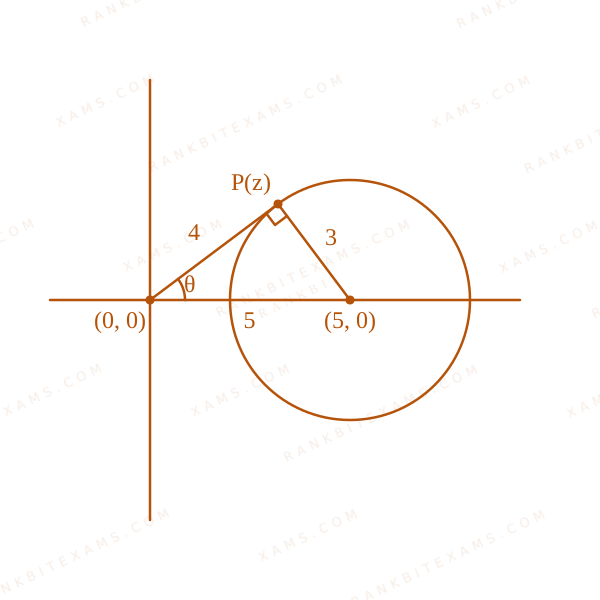
Complex geometry maximum argument diagram for Q19 - JEE Main 2026 Evening
The condition |z-5|≤ 3 represents a disk centered at (5,0) with radius 3. To maximize the principal argument θ, the ray from origin must touch the circle in the first quadrant. The tangent, origin, and center form a right-angled triangle.

Step 1: Locate the Point z

From geometry, hypotenuse c = 5, opposite (radius) r = 3. The adjacent side (length of tangent) is √(5² - 3²) = 4. The angle of tangency θ satisfies θ = (3)/(5) and θ = (4)/(5). The point P(z) lies on the circle and the tangent ray:

z ≡ (4 θ, 4 θ) = (4((4)/(5)), 4((3)/(5))) = ((16)/(5), (12)/(5)) z = (16)/(5) + (12)/(5)i
Step 2: Evaluate the Target Expression

We need 34|(5z - 12)/(5iz + 16)|². Substitute 5z = 16 + 12i: Numerator: 5z - 12 = 16 + 12i - 12 = 4 + 12i Denominator: 5iz + 16 = i(16 + 12i) + 16 = 16i - 12 + 16 = 4 + 16i Expression:

34 |(4 + 12i)/(4 + 16i)|² = 34 (|4 + 12i|²)/(|4 + 16i|²) = 34 (4² + 12²)/(4² + 16²) = 34 ((16 + 144)/(16 + 256)) = 34 ((160)/(272)) = (34 × 160)/(272) = (5440)/(272) = 20
Pattern Recognition

For maximum (z) on |z-c| = r where c is real, z coordinates are given by geometric projection: z = √(c²-r²)( θ + i θ) where θ = r/c.

Chapter Mix

Class 11 Maths: Complex Numbers

Reference Study Guides

More Complex Numbers Previous-Year Questions — Page 7

Q21 jee_main_2024_29_january_evening Roots of Quadratic Equations
Let α, β be the roots of the equation x² - √(6) x + 3 = 0 such that Im(α) > Im(β). Let a, b be integers not divisible by 3 and n be a natural number such that α⁹⁹β + α⁹⁸ = 3ⁿ (a + ib), i = √(-1). Then n + a + b is equal to
Numerical Answer. Answer: 49 to 49

Solution

Related Formula

Using Euler's formula:

eiθ = θ + i θ
Core Logic

Solving the quadratic root configurations for x² - √(6)x + 3 = 0:

x = √(6) ± √(6 - 12)2 = √(6) ± i√(6)2 = √(6)2(1 ± i)

Given Im(α) > Im(β), we set:

α = √(3) ( 1+i√(2)) = √(3) eiπ/4 β = √(3) ( 1-i√(2)) = √(3) e-iπ/4
Step 1: Simplify Target Expression

Let us factor out common variables:

α⁹⁹β + α⁹⁸ = α⁹⁸ ( (α)/(β) + 1 ) = α⁹⁸(α + β)β

Since α + β = √(6):

Value = (√(3)eiπ/4)⁹⁸ · √(6)√(3)e-iπ/4 = 3⁴⁹ ei 98π/4 · √(2) eiπ/4 = 3⁴⁹ · √(2) ei 99π/4

Evaluate ei 99π/4:

99(π)/(4) = 24π + (3π)/(4) ei 99π/4 = ei 3π/4 = -1+i√(2)

Substituting this back:

Value = 3⁴⁹ · √(2) ( -1+i√(2) ) = 3⁴⁹(-1 + i)
Step 2: Resolving Constants

Comparing with the given expression 3ⁿ(a + ib):

n = 49, a = -1, b = 1

Therefore:

n + a + b = 49 - 1 + 1 = 49
Pattern Recognition

Convert complex expressions into polar form r eiθ early. Power scaling like α⁹⁸ becomes simple multiplication under Euler structures.

Chapter Mix

Class 11 Mathematics: Complex Numbers and Quadratic Equations

Q29 jee_main_2024_29_january_evening Integral Solutions
Let the set C = (x,y) x² -2y = 2023, x,yin N. Then Σ(x,y)in C(x + y) is equal to
Numerical Answer. Answer: 46 to 46

Solution

Related Formula

Analyze structural equations through modular constraints (e.g., modulo 3 or 4) to limit potential bounds.

Core Logic

Given the equation: x² - 2^y = 2023. Let us inspect the numbers modulo 8:

2023 ≡ 7 8

A perfect square x² can only be congruent to 0, 1, 4 8.

  • If y ≥ 3, then 2^y ≡ 0 8 x² ≡ 7 8, which is impossible.
  • Therefore, y must be less than 3. Since y in N, the only choices are y = 1 or y = 2.

Step 1: Testing Small Exponent Valuations
  • Case 1: y = 1
x² - 2¹ = 2023 x² = 2025 x = 45 (since 45² = 2025)

This gives a valid natural solution pair: (45, 1).

  • Case 2: y = 2
x² - 2² = 2023 x² = 2027

Since 2027 is not a perfect square, this yields no natural solutions.

Thus, the only valid point element inside set C is (45, 1).

Step 2: Sum Evaluation

Evaluating the required target accumulation:

Σ (x + y) = 45 + 1 = 46
Pattern Recognition

Exponential Diophantine equations (equations with variables in exponents) are best analyzed using modular arithmetic constraints to quickly find small finite upper bounds.

Chapter Mix

Class 11 Mathematics: Principle of Mathematical Induction / Number Theory

Q jee_main_2024_27_jan_morning Modulus and Conjugate
If S=zin C:|z-i|=|z+i|=|z-1|, then n(S) is:
  • A. 1
  • B. 0
  • C. 3
  • D. 2

Solution

Related Formula
|z - z₁| = |z - z₂|

This represents the perpendicular bisector of the line segment joining the points z₁ and z₂ in the complex plane.

Core Logic

The given set defines a complex number z that is equidistant from three fixed points: A ≡ (0, 1) corresponding to i B ≡ (0, -1) corresponding to -i C ≡ (1, 0) corresponding to 1

The condition |z-i|=|z+i|=|z-1| implies that z is the point of intersection of the perpendicular bisectors of the sides of the triangle formed by A, B, and C.

Step 1: Finding the Circumcenter

The point of intersection of the perpendicular bisectors of a triangle is its circumcenter. Since A(0,1), B(0,-1), and C(1,0) form a unique, non-degenerate triangle, they have exactly one unique circumcenter.

Step 2: Final Conclusion

Therefore, there is only one such complex number z that satisfies the condition. n(S) = 1

Pattern Recognition

Recognize that |z - z₁| = |z - z₂| = |z - z₃| is geometrically identical to finding the circumcenter of a triangle with vertices at z₁, z₂, and z₃. A non-collinear set of three points always yields exactly 1 circumcenter.

Chapter Mix

Class 11 Maths: Complex Numbers Class 11 Maths: Straight Lines

Q30 jee_main_2024_27_jan_morning Cube Roots of Unity
If α satisfies the equation x²+x+1=0 and (1+α)⁷=A+Bα+Cα², A, B, C≥ 0, then 5(3A-2B-C) is equal to:
Numerical Answer. Answer: 5 to 5

Solution

Related Formula
1 + ω + ω² = 0

ω³ = 1

Core Logic

The equation x² + x + 1 = 0 is the standard identity whose roots are the non-real cube roots of unity, ω and ω². Let us assign α = ω. We are given the expression (1+α)⁷. Substituting the root: (1+ω)⁷.

Step 1: Simplify using Unity Properties

From the identity 1 + ω + ω² = 0, we extract:

1 + ω = -ω²

Substitute this into the expression:

(1+ω)⁷ = (-ω²)⁷ = -ω¹⁴
Step 2: Cyclical Reduction

Using ω³ = 1, reduce the exponent 14 modulo 3:

14 = 3(4) + 2 ⇒ ω¹⁴ = (ω³)⁴ · ω² = 1 · ω² = ω²

Thus, the expression reduces to -ω². Rewrite this back to its linear form using 1 + ω + ω² = 0:

-ω² = 1 + ω = 1 + α
Step 3: Finding Co-efficients

We compare 1 + α with A + Bα + Cα². Notice that 1 + α can be directly represented without any α² term (and we must keep A, B, C ≥ 0). So, A = 1, B = 1, C = 0.

Step 4: Final Output Evaluation

Substitute these constants into the required equation 5(3A - 2B - C):

5(3(1) - 2(1) - 0) 5(3 - 2) = 5(1) = 5
Pattern Recognition

The roots of x²+x+1=0 are always ω, ω². Expressions of the form (1+ω)^k rapidly collapse down to single variables via the 1+ω+ω²=0 rule, making multi-variable polynomial equations instantly trivial.

Chapter Mix

Class 11 Maths: Complex Numbers

Q5 jee_main_2024_29_jan_morning Modulus and Equality of Complex Numbers
If z=(1)/(2)-2i, is such that |z+1|=α z+β(1+i), i=√(-1) and α,βin R, then α+β is equal to
  • A. -4
  • B. 3
  • C. 2
  • D. -1

Solution

Related Formula
|x + iy| = √(x² + y²)

Two complex numbers are equal if and only if their real and imaginary parts are respectively equal.

Core Logic

Given z = (1)/(2) - 2i. Calculate |z + 1|:

|z + 1| = | ((1)/(2) - 2i) + 1 | = | (3)/(2) - 2i | = √(((3)/(2))² + (-2)²) = √((9)/(4) + 4) = √((25)/(4)) = (5)/(2)

Now substitute z and |z + 1| into the original equation:

(5)/(2) = α((1)/(2) - 2i) + β(1 + i)

Expand and group real and imaginary components on the RHS:

(5)/(2) = ((α)/(2) - 2α i) + (β + β i) (5)/(2) = ((α)/(2) + β) + i(β - 2α)
Step 1: Equate Parts

By equating the real and imaginary parts from both sides, we get a system of linear equations:

Imaginary part:

0 = β - 2α ⇒ β = 2α

Real part:

(5)/(2) = (α)/(2) + β

Substitute β = 2α into the real part equation:

(5)/(2) = (α)/(2) + 2α (5)/(2) = (5α)/(2)

α = 1

Using α = 1, find β:

β = 2(1) = 2
Step 2: Final Calculation

Calculate the final requested value:

α + β = 1 + 2 = 3
Pattern Recognition

Equating complex parts reduces single complex equations into two simultaneous linear equations. Treat |z+1| strictly as a scalar magnitude and parse directly into algebraic components.

Chapter Mix

Class 11 Mathematics: Complex Numbers and Quadratic Equations

More Complex Numbers Questions — jee_main_2026_21_jan_evening

Practice all Complex Numbers previous-year questions →

Rankbit System
JEE Physics: Waves (+15.5%) | Electrostatics: Concentric Shells (-29.7%) | Modern Physics: Photoelectric Clones (+34.2%) | Mathematics: Definite Integrals (+18.1%) | Chemistry: Coordination Splitting (-11.4%) | JEE Physics: Waves (+15.5%) | Electrostatics: Concentric Shells (-29.7%) | Modern Physics: Photoelectric Clones (+34.2%) | Mathematics: Definite Integrals (+18.1%) | Chemistry: Coordination Splitting (-11.4%)