Let circle C$C$ be the image of x² + y² - 2x + 4y - 4 = 0$x^{2} + y^{2} - 2x + 4y - 4 = 0$ in the line 2x - 3y + 5 = 0$2x - 3y + 5 = 0$ and A$A$ be the point on C$C$ such that OA$OA$ is \parallel to the x-axis and A$A$ lies on the \right hand side of the centre O$O$ of C$C$. If B(α,β)$B(\alpha,\beta)$, with β < 4$\beta < 4$, lies on C$C$ such that the length of the arc AB$AB$ is (1/6)th$(1/6)^{\text{th}}$ of the perimeter of C$C$, then β - √(3)α$\beta - \sqrt{3}\alpha$ is equal to :
A.3$3$
B.3 + √(3)$3 + \sqrt{3}$
C.4 - √(3)$4 - \sqrt{3}$
D.4$4$
Solution & Explanation
Related Formula
The coordinates for the reflection image of a point (x₁, y₁)$(x_1, y_1)$ across a standard line ax + by + c = 0$ax + by + c = 0$ are determined using:
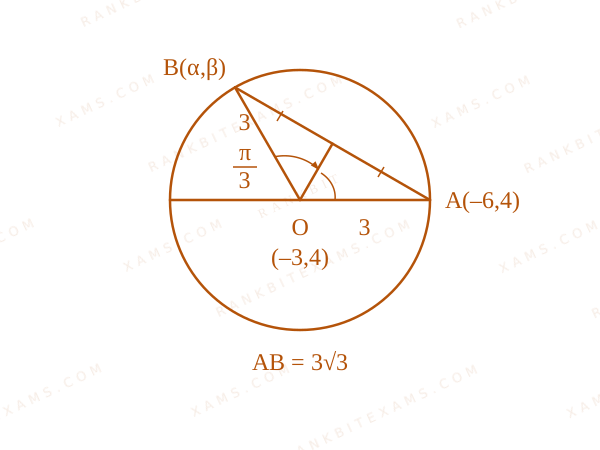
Thus, the center O$O$ of the reflected circle C$C$ is (-3, 4)$(-3, 4)$, and its radius is preserved at r = 3$r = 3$.
Step 1: Locate Point A
We are given that OA$OA$ is ∥$\parallel$ to the x-axis, meaning its y-coordinate matches the center. Since A$A$ lies to the right of the center O(-3, 4)$O(-3, 4)$:
Since β < 4$\beta < 4$, the angle θ$\theta$ must point downwards into the negative quadrant relative to A$A$, meaning θ = -60^° = -(π)/(3)$\theta = -60^\circ = -\frac{\pi}{3}$:
Whenever parametric configurations on a circle involve radical coordinate multipliers like β - √(3)α$\beta - \sqrt{3}\alpha$, using angular vectors centered at the origin of the circle avoids setting up and solving long distance equations.
Chapter Mix
Class 11 Mathematics: Circles
More Circles Previous-Year Questions
Q11jee_main_2026_21_jan_morningCoinciding Foci of Ellipse and Hyperbola
Let the foci of hyperbola coincide with the foci of the ellipse (x²)/(36) +(y²)/(16) = 1$\frac{x^2}{36} +\frac{y^2}{16} = 1$ . If the eccentricity of the hyperbola is 5, then the length of its latus rectum is:
A. 12
B. 16
C.96√(5)$\frac{96}{\sqrt{5}}$
D.24√(5)$24\sqrt{5}$
Solution
Related Formula
Eccentricity of ellipse e₁ = √(1 - (b²)/(a²))$$\text{Eccentricity of ellipse } e_1 = \sqrt{1 - \frac{b^2}{a^2}}$$Foci = (± ae₁, 0)$$\text{Foci} = (\pm ae_1, 0)$$Length of Latus Rectum of hyperbola = 2bhyp²ahyp$$\text{Length of Latus Rectum of hyperbola} = \frac{2b_{hyp}^2}{a_{hyp}}$$
Core Logic
For the given ellipse (x²)/(36) + (y²)/(16) = 1$\frac{x^2}{36} + \frac{y^2}{16} = 1$:
a² = 36 ⇒ a = 6$a^2 = 36 \Rightarrow a = 6$b² = 16$b^2 = 16$
Foci of the ellipse are at (± ae₁, 0) = (± 6 · √(5)3, 0) = (± 2√(5), 0)$(\pm ae_1, 0) = \left(\pm 6 \cdot \frac{\sqrt{5}}{3}, 0\right) = (\pm 2\sqrt{5}, 0)$.
Step 1: Establish Hyperbola Parameters
Let the hyperbola be (x²)/(p²) - (y²)/(q²) = 1$\frac{x^2}{p^2} - \frac{y^2}{q^2} = 1$.
Its foci coincide with the ellipse, so the foci of hyperbola are also (± 2√(5), 0)$(\pm 2\sqrt{5}, 0)$.
Let e$e$ be the eccentricity of the hyperbola. We are given e = 5$e = 5$.
Focus of hyperbola is pe = 2√(5)$pe = 2\sqrt{5}$.
p(5) = 2√(5) ⇒ p = 2√(5)5 = 2√(5)$$p(5) = 2\sqrt{5} \Rightarrow p = \frac{2\sqrt{5}}{5} = \frac{2}{\sqrt{5}}$$
Co-focal conics share the exact mathematical value of their focal length ae$ae$ (or pe$pe$). Instantly extract c = ae$c = ae$ from the first shape and map it directly to c = pe$c = pe$ for the second.
Chapter Mix
Class 11 Maths: Conic Sections
Q15jee_main_2026_21_jan_morningLocus of Intersection of Tangents
Let PQ and MN be two straight lines touching the circle x² + y² - 4x - 6y - 3 = 0$x^{2} + y^{2} - 4x - 6y - 3 = 0$ at the points A and B respectively. Let O be the centre of the circle and ∠ AOB = π/3$\angle AOB = \pi/3$ . Then the locus of the point of intersection of the lines PQ and MN is:
For external tangents from point R$R$ forming angle 2θ$2\theta$ at the center, the distance d$d$ from center to intersection point obeys θ = (r)/(d)$\cos \theta = \frac{r}{d}$.
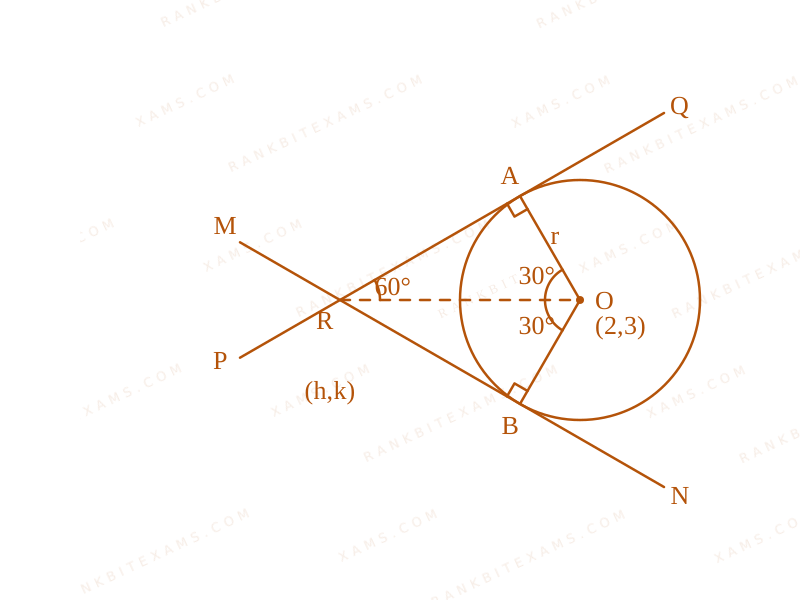
The tangents PQ and MN intersect at some point R(h, k)$R(h, k)$.
The radius vectors OA$OA$ and OB$OB$ subtend angle ∠ AOB = (π)/(3) = 60°$\angle AOB = \frac{\pi}{3} = 60^{\circ}$ at the center.
The line joining O$O$ and R$R$ bisects the angle ∠ AOB$\angle AOB$.
Thus, ∠ AOR = 30°$\angle AOR = 30^{\circ}$.
Step 1: Apply Trigonometric Relations
Circle tangents intersection locus diagram for Q15 - JEE Main 2026 Morning
In the right-angled triangle Δ AOR$\Delta AOR$, OA$OA$ is the radius (r = 4$r = 4$) and OR$OR$ is the hypotenuse.
The locus of the intersection of tangents enclosing a constant angle is simply a concentric circle. Its radius expands by 1/ (α/2)$1/\sin(\alpha/2)$ or 1/ (θ)$1/\cos(\theta)$ depending on whether the angle is measured at intersection or center.
Chapter Mix
Class 11 Maths: Conic Sections
Class 11 Maths: Straight Lines
Q20jee_main_2026_21_jan_morningLocus of Internal Section Point
Let O be the vertex of the parabola x²=4y$x^{2}=4y$ and Q be any point on it. Let the locus of the point P, which divides the line segment OQ internally in the ratio 2: 3 be the conic C. Then the equation of the chord of C, which is bisected at the point (1, 2), is:
A. 5x-y-3=0
B. 4x-5y+6=0
C. x-2y + 3 = 0
D. 5x-4y+3=0
Solution
Related Formula
Section Formula: P = (m · Q + n · O)/(m + n)$$\text{Section Formula:} \quad P = \frac{m \cdot Q + n \cdot O}{m + n}$$Chord bisected at (x₁, y₁) : T = S₁$$\text{Chord bisected at } (x_1, y_1) : \quad T = S_1$$
Core Logic
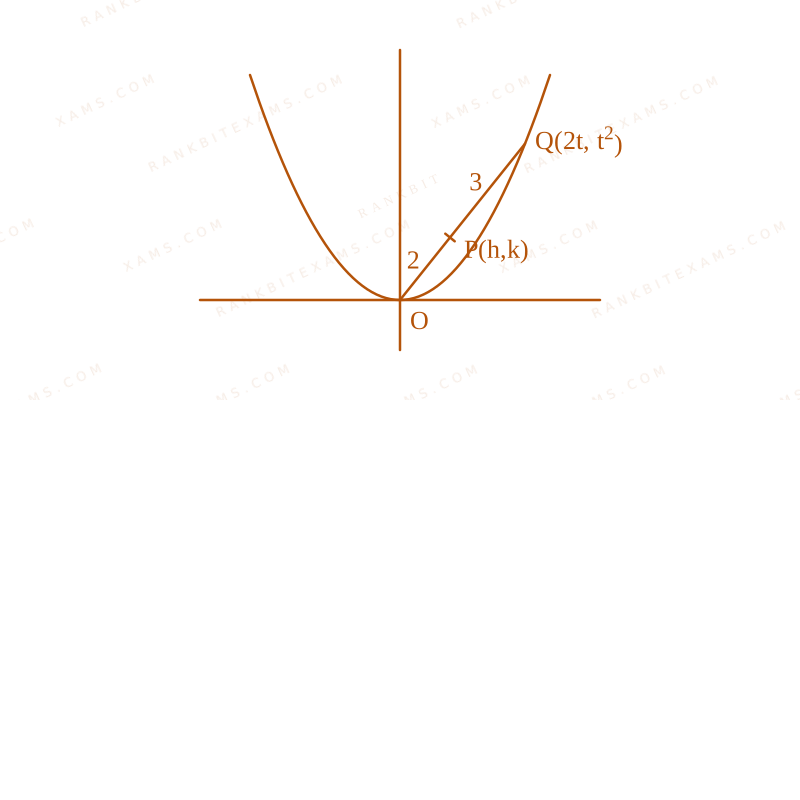
Given parabola x² = 4y$x^2 = 4y$, its vertex O = (0, 0)$O = (0, 0)$.
A general point Q$Q$ on x² = 4y$x^2 = 4y$ is (2t, t²)$(2t, t^2)$.
Let P(h, k)$P(h, k)$ divide OQ$OQ$ in ratio 2:3$2:3$.
By section formula:
So the conic C is the parabola 5x² = 8y$5x^2 = 8y$.
Step 2: Chord bisected at a point
We need the equation of the chord of C: 5x² - 8y = 0$C: 5x^2 - 8y = 0$ bisected at (x₁, y₁) = (1, 2)$(x_1, y_1) = (1, 2)$.
Use T = S₁$T = S_1$.
T = 5xx₁ - 4(y + y₁) = 5x(1) - 4(y + 2) = 5x - 4y - 8$T = 5xx_1 - 4(y + y_1) = 5x(1) - 4(y + 2) = 5x - 4y - 8$S₁ = 5(1)² - 8(2) = 5 - 16 = -11$S_1 = 5(1)^2 - 8(2) = 5 - 16 = -11$
Equating T$T$ and S₁$S_1$:
5x - 4y - 8 = -11$$5x - 4y - 8 = -11$$
5x - 4y + 3 = 0$5x - 4y + 3 = 0$
Pattern Recognition
Internal division locus of a vertex chord on standard conic identically scales the conic. Once the child-conic is found, standard mid-point chord protocol (T=S₁$T=S_1$) strictly applies algebraically.
Chapter Mix
Class 11 Maths: Parabola
Class 11 Maths: Straight Lines
Q4jee_main_2026_21_jan_eveningEllipse
In the line α x + 4y = √(7)$\alpha x + 4y = \sqrt{7}$, where α in R$\alpha \in R$, touches the ellipse3x² + 4y² = 1$3x^{2} + 4y^{2} = 1$ at the point P$P$ in the first quadrant, then one of the focal distances of P$P$ is:
Condition of tangency for ellipse (x²)/(a²) + (y²)/(b²) = 1 is c² = a²m² + b²$$\text{Condition of tangency for ellipse } \frac{x^2}{a^2} + \frac{y^2}{b^2} = 1 \text{ is } c^2 = a^2m^2 + b^2$$Focal distance SP = a ± ex$$\text{Focal distance } SP = a \pm ex$$Eccentricity e = √(1 - (b²)/(a²))$$\text{Eccentricity } e = \sqrt{1 - \frac{b^2}{a^2}}$$
Core Logic
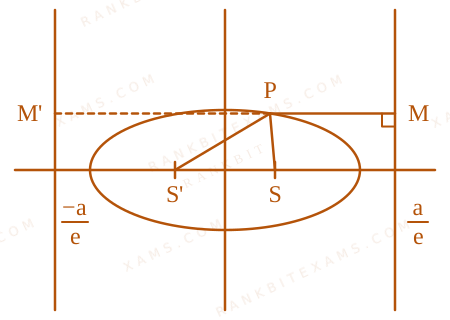
Ellipse diagram for Q4 - JEE Main 2026 Evening
Identify the slope and intercepts of the line to find α$\alpha$. Use the point of contact formula to locate P(x₁, y₁)$P(x_1, y_1)$ and apply focal distance definitions.
Step 1: Determine alpha
Rewrite the ellipse: (x²)/(1/3) + (y²)/(1/4) = 1 a² = (1)/(3), b² = (1)/(4)$\frac{x^2}{1/3} + \frac{y^2}{1/4} = 1 \implies a^2 = \frac{1}{3}, b^2 = \frac{1}{4}$.
The line is y = -(α)/(4)x + √(7)4$y = -\frac{\alpha}{4}x + \frac{\sqrt{7}}{4}$.
Using c² = a²m² + b²$c^2 = a^2m^2 + b^2$:
Matching with the options, the focal distance is 1√(3) + 12√(7)$\frac{1}{\sqrt{3}} + \frac{1}{2\sqrt{7}}$.
Pattern Recognition
For tangency lx+my+n=0$lx+my+n=0$ to x²/a² + y²/b² = 1$x^2/a^2 + y^2/b^2 = 1$, use a² l² + b² m² = n²$a^2 l^2 + b^2 m^2 = n^2$. Points of contact can be quickly evaluated by comparing T=0$T=0$ to the normalized tangent equation.
Chapter Mix
Class 11 Maths: Conic Sections
Q5jee_main_2026_21_jan_eveningParabola
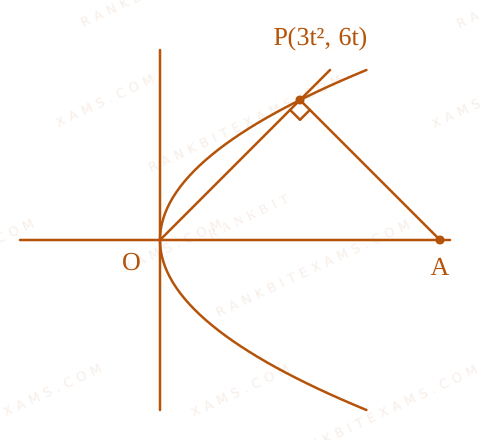
Let y² = 12x$y^{2} = 12x$ be the parabola with its vertex at O. Let P be a point on the parabola and A be a point on the x-axis such that ∠ OPA = 90°$\angle OPA = 90^{\circ}$. Then the locus of the centroid of such triangles OPA is:
Parabola geometry diagram for Q5 - JEE Main 2026 Evening
Define coordinates: O(0,0)$O(0,0)$, P(3t², 6t)$P(3t^2, 6t)$ (since y² = 12x 4a = 12 a=3$y^2 = 12x \implies 4a = 12 \implies a=3$).
Determine the slope of OP$OP$ and use perpendicularity to find the equation of PA$PA$ and locate point A$A$ on the x-axis.
Step 1: Locate A via Perpendicularity
Slope of OP$OP$ is mOP = (6t - 0)/(3t² - 0) = (2)/(t)$m_{OP} = \frac{6t - 0}{3t^2 - 0} = \frac{2}{t}$.
Since ∠ OPA = 90^°$\angle OPA = 90^\circ$, slope of AP$AP$ is mAP = -(t)/(2)$m_{AP} = -\frac{t}{2}$.
Equation of AP$AP$:
Replacing (h, k)$(h, k)$ with (x, y)$(x, y)$, the locus is y² = 2x - 8 y² - 2x + 8 = 0$y^2 = 2x - 8 \implies y^2 - 2x + 8 = 0$.
Pattern Recognition
For any right-angled configuration involving the origin and axis on a parabola, parametric geometry simplifies equations significantly. Find coordinates O, P, A$O, P, A$, set up the centroid algebraic relations, and eliminate parameter t$t$.
Chapter Mix
Class 11 Maths: Conic Sections
Class 11 Maths: Straight Lines
Practice past-year questions one chapter at a time. Pick an exam → subject → chapter and get every PYQ for that topic — pulled together from all past papers — with the chapter's key formulas alongside.