JEE Main · Mathematics → Steady

Circles appeared 17 times across 3 years — 2% of Mathematics. This question is from Circles Touching Axes and Intercepts.

Year 2026 2025 2024 Total
Questions 6 6 5 17

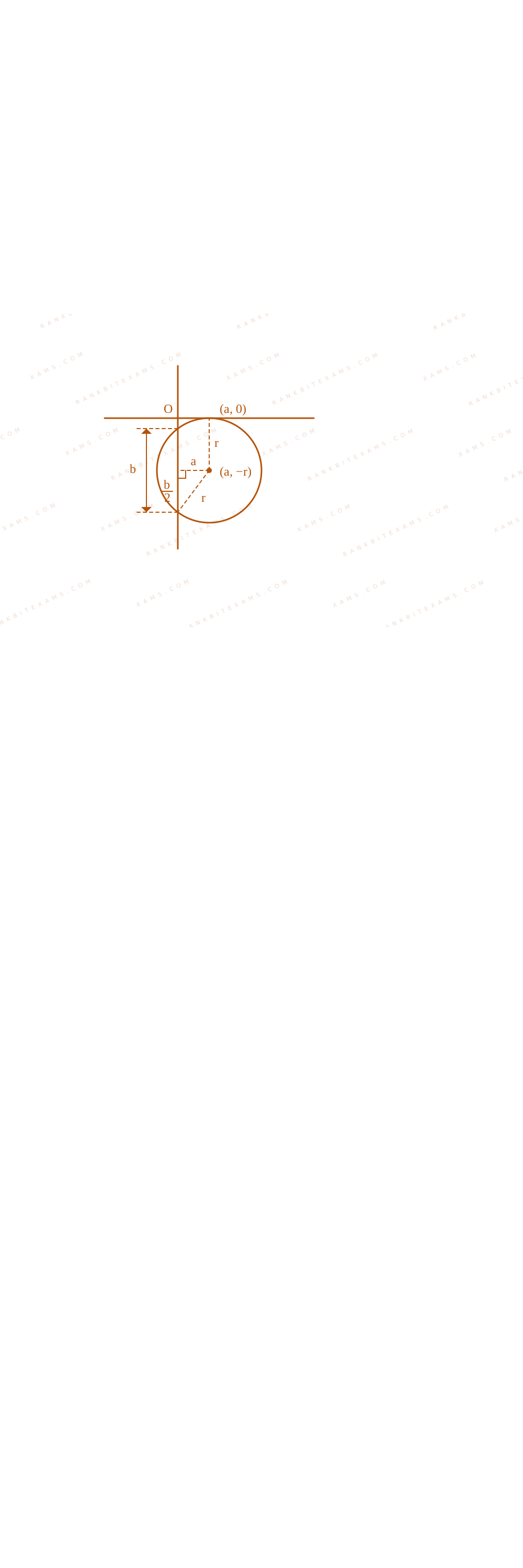
Let the equation of the circle, which touches x-axis at the point (a, 0), a > 0 and cuts off an intercept of length b on y-axis be x² + y² - α x + β y + γ = 0. If the circle lies below x-axis, then the ordered pair (2a, b²) is equal to:

Solution & Explanation

Related Formula

Circle intercepts standard form templates:

y-intercept = 2√(f² - c)
Core Logic

Since the circle touches the x-axis at (a,0) and lies entirely below it, its center is located at (a, -p) where p matches its radius r.

By Pythagoras' theorem:

Circles Touching Axes and Intercepts diagram for Q58 - JEE Main 2025 Morning

r² = a² + (b²)/(4) = p²
Step 1: Translating to General Equation Form

The explicit standard equation is (x-a)² + (y+p)² = r². Expanding it out:

x² + y² - 2ax + 2py + a² = 0

Comparing this directly to x² + y² - α x + β y + γ = 0 yields: α = 2a, β = 2p, and γ = a².

Step 2: Evaluating the Target Mapped Ordered Pair

Isolating b² using the parametric radius dimensions:

b² = 4p² - 4a² = (2p)² - 4(a²) = β² - 4γ

Thus, the mapped ordered pair (2a, b²) evaluates directly to (α, β² - 4γ).

Pattern Recognition

Tangency conditions fix center parameters to match radius scale sizes instantly, reducing variable overhead in coordinate transformations.

Chapter Mix

Class 11 Maths: Circles

More Circles Previous-Year Questions

Q15 jee_main_2026_21_jan_morning Locus of Intersection of Tangents
Let PQ and MN be two straight lines touching the circle x² + y² - 4x - 6y - 3 = 0 at the points A and B respectively. Let O be the centre of the circle and ∠ AOB = π/3 . Then the locus of the point of intersection of the lines PQ and MN is:
  • A. 3(x² + y²) - 18x - 12y + 25 = 0
  • B. x² + y² - 12x - 18y - 25 = 0
  • C. x² + y² - 18x - 12y - 25 = 0
  • D. 3(x² + y²) - 12x - 18y - 25 = 0

Solution

Related Formula

For external tangents from point R forming angle 2θ at the center, the distance d from center to intersection point obeys θ = (r)/(d).

Core Logic

Given circle: x² + y² - 4x - 6y - 3 = 0 Center O = (2, 3) Radius r = √((-2)² + (-3)² - (-3)) = √(4 + 9 + 3) = √(16) = 4.

The tangents PQ and MN intersect at some point R(h, k). The radius vectors OA and OB subtend angle ∠ AOB = (π)/(3) = 60° at the center. The line joining O and R bisects the angle ∠ AOB. Thus, ∠ AOR = 30°.

Step 1: Apply Trigonometric Relations
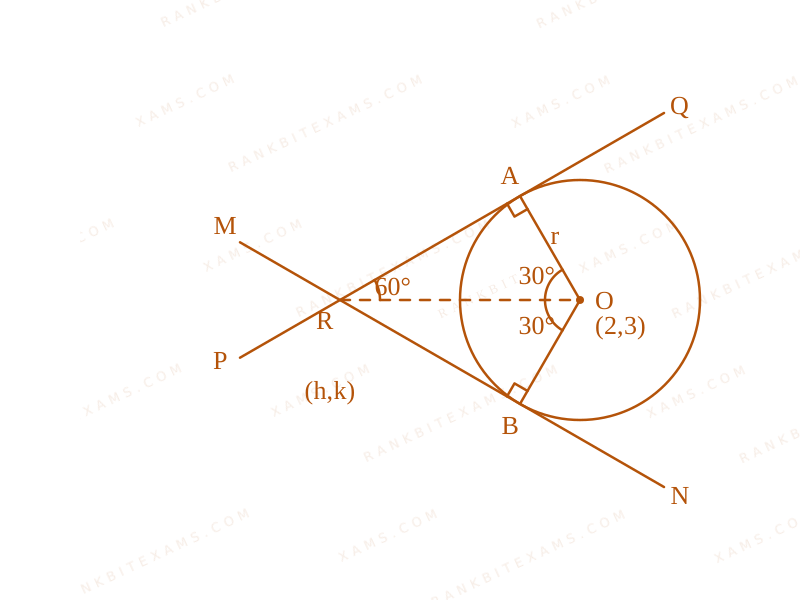
Circle tangents intersection locus diagram for Q15 - JEE Main 2026 Morning

In the right-angled triangle Δ AOR, OA is the radius (r = 4) and OR is the hypotenuse.

(30°) = (OA)/(OR) = (r)/(OR) √(3)2 = (4)/(OR) ⇒ OR = 8√(3)
Step 2: Construct the Locus Equation

The distance squared between O(2,3) and R(h,k) is OR²:

OR² = (h - 2)² + (k - 3)² = ( 8√(3))² (h - 2)² + (k - 3)² = (64)/(3) h² - 4h + 4 + k² - 6k + 9 = (64)/(3) 3(h² + k² - 4h - 6k + 13) = 64 3h² + 3k² - 12h - 18k + 39 - 64 = 0 3(h² + k²) - 12h - 18k - 25 = 0
Step 3: Generalize the Equation

Replace (h, k) with (x, y) for the general locus:

3(x² + y²) - 12x - 18y - 25 = 0
Pattern Recognition

The locus of the intersection of tangents enclosing a constant angle is simply a concentric circle. Its radius expands by 1/ (α/2) or 1/ (θ) depending on whether the angle is measured at intersection or center.

Chapter Mix

Class 11 Maths: Conic Sections Class 11 Maths: Straight Lines
Q25 jee_main_2026_21_jan_evening Locus
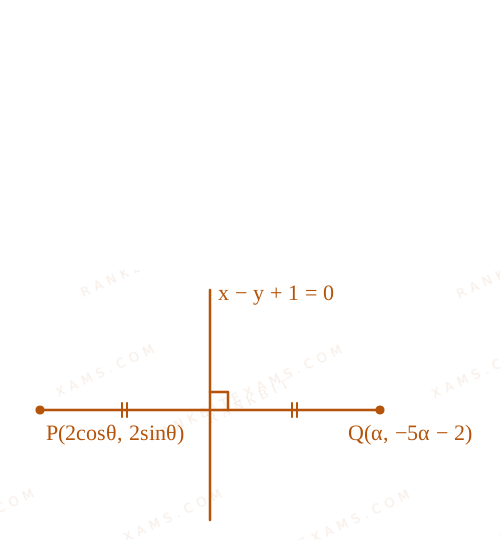
If P is a point on the circle x² + y² = 4, Q is a point on the straight line 5x + y + 2 = 0 and x - y + 1 = 0 is the perpendicular bisector of PQ, then 13 times the sum of abscissa of all such point P is ____.
Numerical Answer. Answer: 2 to 2

Solution

Related Formula
Perpendicular bisector properties: m₁m₂ = -1 and mid-point lies on the line. Parametric point on circle x²+y²=r² is (r θ, r θ)
Core Logic

Circle locus perpendicular bisector diagram for Q25 - JEE Main 2026 Evening
Let P = (2 θ, 2 θ). Let Q on the line 5x + y + 2 = 0 be Q(α, -5α-2). The line x - y + 1 = 0 is the perpendicular bisector of PQ. This gives two conditions: slope of PQ is -1, and mid-point of PQ satisfies the bisector equation.

Step 1: Apply Slope Condition

Slope of bisector is 1, so slope of PQ must be -1.

(2 θ - (-5α - 2))/(2 θ - α) = -1 2 θ + 5α + 2 = -2 θ + α θ + θ + 2α + 1 = 0 (1)
Step 2: Apply Midpoint Condition

Midpoint of PQ is ( (2 θ + α)/(2), (2 θ - 5α - 2)/(2) ). Substitute into x - y + 1 = 0:

(2 θ + α)/(2) - (2 θ - 5α - 2)/(2) + 1 = 0 2 θ + α - 2 θ + 5α + 2 + 2 = 0 θ - θ + 3α + 2 = 0 (2)
Step 3: Eliminate alpha and Solve

From (1), 2α = - θ - θ - 1 α = (- θ - θ - 1)/(2). Substitute α into (2):

θ - θ + 3( (- θ - θ - 1)/(2) ) + 2 = 0 2 θ - 2 θ - 3 θ - 3 θ - 3 + 4 = 0 - θ - 5 θ + 1 = 0 θ + 5 θ = 1

Let's express in half angles:

1 - 2 ²(θ)/(2) + 10 (θ)/(2) (θ)/(2) = 1 2 (θ)/(2) ( 5 (θ)/(2) - (θ)/(2) ) = 0

So, (θ)/(2) = 0 θ = 1 or (θ)/(2) = 5 θ = (1 - ²(θ/2))/(1 + ²(θ/2)) = (1 - 25)/(1 + 25) = -(24)/(26) = -(12)/(13).

Step 4: Final Calculation

The abscissa of P is 2 θ. Values of abscissa are 2(1) = 2 and 2(-(12)/(13)) = -(24)/(13). Sum of abscissa values = 2 - (24)/(13) = (26 - 24)/(13) = (2)/(13). We need 13 × (Sum) = 13 × (2)/(13) = 2.

Pattern Recognition

Instead of finding the image of a generic circle point in a line, construct the reflection point Q parameter, use slope logic (m₁m₂=-1) and midpoint logic simultaneously to create a trigonometric linear equation.

Chapter Mix

Class 11 Maths: Circles Class 11 Maths: Straight Lines

Q12 jee_main_2026_22_january_morning Intersection of Two Circles
Let the set of all values of r, for which the circles (x + 1)² + (y + 4)² = r² and x² + y² - 4x - 2y - 4 = 0 intersect at two distinct points be the interval (α, β). Then αβ is equal to
  • A. 25
  • B. 20
  • C. 21
  • D. 24

Solution

Related Formula
Two circles intersect at distinct points if |r₁ - r₂| < d < r₁ + r₂

where d is the distance between their centers.

Core Logic

Circle 1: (x + 1)² + (y + 4)² = r² Center C₁ = (-1, -4) and Radius r₁ = r.

Circle 2: x² + y² - 4x - 2y - 4 = 0 (x - 2)² + (y - 1)² = 3² Center C₂ = (2, 1) and Radius r₂ = 3.

Step 1: Distance Between Centers

Distance d between C₁ and C₂:

d = √((2 - (-1))² + (1 - (-4))²) d = √(3² + 5²) = √(9 + 25) = √(34)
Step 2: Applying the Intersection Condition

For two distinct intersection points:

|r - 3| < √(34) < r + 3

Breaking this down into two inequalities:

  • |r - 3| < √(34) -√(34) < r - 3 < √(34) 3 - √(34) < r < 3 + √(34)
  • r + 3 > √(34) r > √(34) - 3
  • Since radius r > 0, taking the intersection of the conditions:

r in (√(34) - 3, √(34) + 3)

Thus, α = √(34) - 3 and β = √(34) + 3.

Step 3: Calculating Final Product
αβ = (√(34) - 3)(√(34) + 3) = 34 - 9 = 25
Pattern Recognition

Intersection of two circles boils down to the fundamental triangle inequality relating the radii to the center distance: |r₁ - r₂| < d < r₁ + r₂. Solving this naturally yields an interval (α, β) formatted as a difference of squares upon multiplication.

Chapter Mix

Class 11 Maths: Circles

Q8 jee_main_2026_23_january_evening Family of Curves
If the points of intersection of the ellipses x² + 2y² - 6x - 12y + 23 = 0 and 4x² + 2y² - 20x - 12y + 35 = 0 lie on a circle of radius r and centre (a, b), then the value of ab + 18r² is
  • A. 53
  • B. 51
  • C. 52
  • D. 55

Solution

Related Formula

The equation of a family of curves passing through the intersection of two conics S₁ = 0 and S₂ = 0 is S₁ + λ S₂ = 0. For this resulting curve to be a circle, the coefficient of x² must equal the coefficient of y², and the coefficient of the xy term must be zero.

Core Logic

Let the two ellipses be: S₁ ≡ x² + 2y² - 6x - 12y + 23 = 0 S₂ ≡ 4x² + 2y² - 20x - 12y + 35 = 0

Equation of the curve passing through their intersection is S₁ + λ S₂ = 0:

(1 + 4λ)x² + (2 + 2λ)y² - (6 + 20λ)x - (12 + 12λ)y + (23 + 35λ) = 0

For this to represent a circle, coefficient of x² = coefficient of y²:

1 + 4λ = 2 + 2λ 2λ = 1 λ = (1)/(2)
Step 1: Finding Circle Parameters

Substitute λ = 1/2 back into the family equation:

(1 + 2)x² + (2 + 1)y² - (6 + 10)x - (12 + 6)y + (23 + (35)/(2)) = 0 3x² + 3y² - 16x - 18y + (81)/(2) = 0

Dividing by 3 to write in standard form:

x² + y² - (16)/(3)x - 6y + (27)/(2) = 0

The centre (a, b) is given by (-g, -f):

a = (8)/(3), b = 3

The radius r is given by r² = g² + f² - c:

r² = ((-8)/(3))² + (-3)² - (27)/(2) = (64)/(9) + 9 - (27)/(2) = (128 + 162 - 243)/(18) = (47)/(18)
Step 2: Final Calculation

We need to find ab + 18r²:

ab = ((8)/(3))(3) = 8 18r² = 18((47)/(18)) = 47 ab + 18r² = 8 + 47 = 55
Pattern Recognition

When intersection points of two 2nd degree curves form a circle, apply S₁ + λ S₂ = 0 immediately, forcing the necessary symmetric coefficients to extract λ.

Chapter Mix

Class 11 Maths: Conic Sections Class 11 Maths: Circles

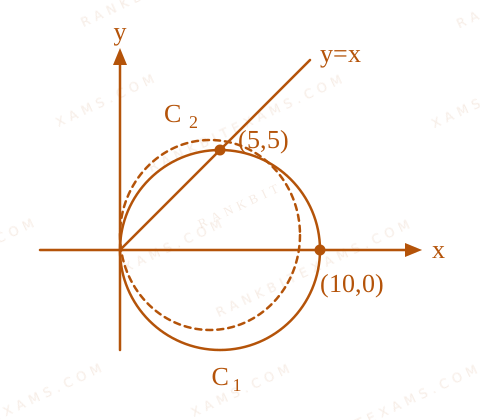
Q3 jee_main_2026_28_january_morning Chord of a Circle
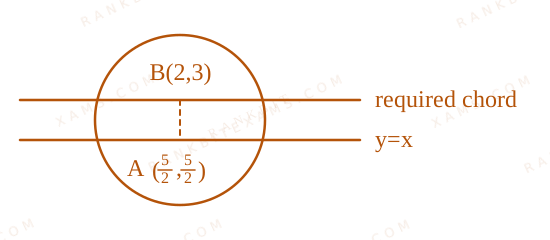
Let y = x be the equation of a chord of the circle C₁ (in the closed half-plane x ≥ 0) of diameter 10 passing through the origin. Let C₂ be another circle described on the given chord as its diameter. If the equation of the chord of the circle C₂, which passes through the point (2, 3) and is farthest from the center of C₂, is x + ay + b = 0, then a - b is equal to:
  • A. 10
  • B. -6
  • C. -2
  • D. 6

Solution

Core Logic

Chord of a Circle
Chord of a Circle
Chord of a Circle
Chord of a Circle
Equation of circle C₂ with diameter along y=x passing through origin and having length 10. Wait, C₁ has diameter 10. The chord y=x passes through (0,0). For the chord to be a diameter of C₂, the points of intersection with C₁ must form the diameter. The center of C₂ is the midpoint of the chord. Let the ends of the chord be (0,0) and (5,5) (since length is √(50)? Wait, the problem implies the chord of C₁ is y=x. If C₁ is a circle in x ≥ 0 of diameter 10 through origin. Center of C₂ lies on the chord y=x. The equation of circle C₂ is:

x² + y² - 5x - 5y = 0

Its center is N((5)/(2), (5)/(2)).

Step 1: Find Farthest Chord

We need the chord of C₂ passing through B(2, 3) which is farthest from the center N((5)/(2), (5)/(2)). The farthest chord passing through a given point is always perpendicular to the line joining the center to that point. Slope of line NB:

mNB = (3 - (5)/(2))/(2 - (5)/(2)) = ((1)/(2))/(-(1)/(2)) = -1
Step 2: Chord Equation

The slope of the required chord is perpendicular to mNB:

Slope of required chord = 1

Equation of the required chord passing through (2,3):

y - 3 = 1(x - 2)

x - y + 1 = 0 Comparing this with x + ay + b = 0, we get:

a = -1, b = 1
Step 3: Final Calculation
a - b = -1 - 1 = -2
Pattern Recognition

The chord of a circle passing through a given internal point that is FARTHEST from the center is exactly the chord that is PERPENDICULAR to the radius (or line segment) connecting the center to that internal point.

Chapter Mix

Class 11 Mathematics: Circles Class 11 Mathematics: Straight Lines

Rankbit System
JEE Physics: Waves (+15.5%) | Electrostatics: Concentric Shells (-29.7%) | Modern Physics: Photoelectric Clones (+34.2%) | Mathematics: Definite Integrals (+18.1%) | Chemistry: Coordination Splitting (-11.4%) | JEE Physics: Waves (+15.5%) | Electrostatics: Concentric Shells (-29.7%) | Modern Physics: Photoelectric Clones (+34.2%) | Mathematics: Definite Integrals (+18.1%) | Chemistry: Coordination Splitting (-11.4%)