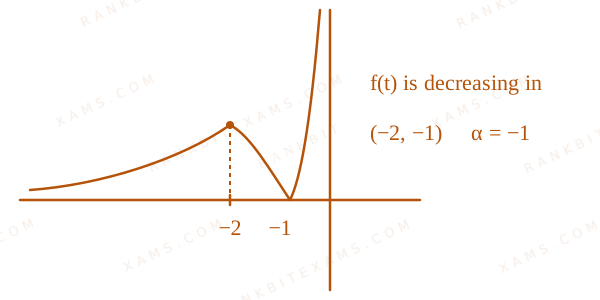
Let f : R rightarrow R be a twice differentiable function such that f''(x) > 0 for all x in R and f'(a-1) = 0, where a is a real number. Let g(x) = f(tan^2 x - 2tan x + a), 0 < x < fracpi2. Consider the following two statements: (I) g is increasing in left(0, fracpi4right) (II) g is decreasing in left(fracpi4, fracpi2right) Then,

Solution & Explanation

### Related Formula g'(x) = f'(h(x)) cdot h'(x) For monotonicity, g'(x) > 0 implies increasing, and g'(x) < 0 implies decreasing. ### Core Logic Given g(x) = f((tan x - 1)^2 + a - 1). Differentiating w.r.t. x: g'(x) = f'((tan x - 1)^2 + a - 1) cdot 2(tan x - 1)sec^2 x ### Step 1: Analyze the Sign of the Derivative We know f''(x) > 0 implies f'(x) is strictly increasing. Since f'(a-1) = 0, for any input X > a-1, f'(X) > 0. Here, the input to f' is (tan x - 1)^2 + a - 1. Since (tan x - 1)^2 geq 0, it is strictly positive for x neq fracpi4 in the given interval. Thus, (tan x - 1)^2 + a - 1 geq a - 1 implies f'((tan x - 1)^2 + a - 1) > 0 for all valid x. ### Step 2: Determine Intervals of Monotonicity Now, the sign of g'(x) depends solely on the term (tan x - 1) because 2sec^2 x > 0. Case 1: x in left(0, fracpi4right) Here tan x < 1 implies tan x - 1 < 0. So, g'(x) < 0 implies g(x) is decreasing. Case 2: x in left(fracpi4, fracpi2right) Here tan x > 1 implies tan x - 1 > 0. So, g'(x) > 0 implies g(x) is increasing. Therefore, neither statement (I) nor (II) is true. ### Pattern Recognition When a function wraps a quadratic, f((u-k)^2 + c), the critical points match the inner function's extrema. Evaluate the sign directly from the inner derivative u' and (u-k). ### Evaluation Rubric / Model Answer null ### Chapter Mix Class 12 Maths: Application of Derivatives

Reference Study Guides

More Application of Derivatives Questions — jee_main_2026_21_jan_evening

Practice all Application of Derivatives previous-year questions →

Rankbit System
JEE Physics: Waves (+15.5%) | Electrostatics: Concentric Shells (-29.7%) | Modern Physics: Photoelectric Clones (+34.2%) | Mathematics: Definite Integrals (+18.1%) | Chemistry: Coordination Splitting (-11.4%) | JEE Physics: Waves (+15.5%) | Electrostatics: Concentric Shells (-29.7%) | Modern Physics: Photoelectric Clones (+34.2%) | Mathematics: Definite Integrals (+18.1%) | Chemistry: Coordination Splitting (-11.4%)