Rankbit System
JEE Physics: Waves (+15.5%) | Electrostatics: Concentric Shells (-29.7%) | Modern Physics: Photoelectric Clones (+34.2%) | Mathematics: Definite Integrals (+18.1%) | Chemistry: Coordination Splitting (-11.4%) | JEE Physics: Waves (+15.5%) | Electrostatics: Concentric Shells (-29.7%) | Modern Physics: Photoelectric Clones (+34.2%) | Mathematics: Definite Integrals (+18.1%) | Chemistry: Coordination Splitting (-11.4%)

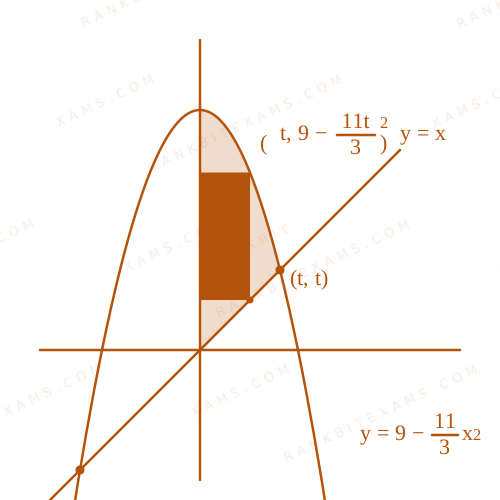
Consider the region R = left\(x,y)colon x leq y leq 9 - frac113x^2, \, x geq 0right\. The area of the largest rectangle with sides parallel to the coordinate axes inscribed in R is :

Solution & Explanation

### Related Formula The area of a rectangle bounded between an upper function curve y_2(x) and lower function curve y_1(x) spanning width x = t is formulated as: A(t) = t cdot [y_2(t) - y_1(t)] ### Core Logic The region is bounded below by the line y = x and above by the downward opening parabola y = 9 - frac113x^2 in the first quadrant:
Maxima and Minima
Maxima and Minima
Let a vertex of the rectangle lie on the upper parabolic boundary at x = t. The corresponding height span of the rectangle is bounded by the line y = t at the base:
Maxima and Minima
Maxima and Minima
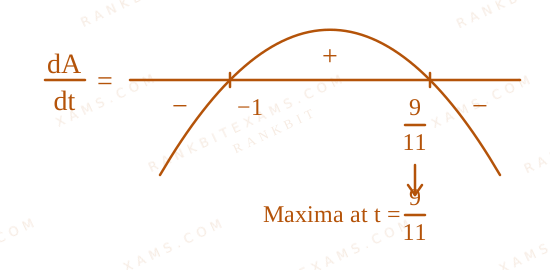
Thus, the area equation as a function of variable parameter t is: A(t) = t cdot left( 9 - frac113t^2 - t right) = 9t - t^2 - frac113t^3 ### Step 1: Differentiate to Identify Critical Values Differentiate the area function with respect to t and equate to zero: fracdAdt = 9 - 2t - 11t^2 = 0 11t^2 + 2t - 9 = 0 11t^2 + 11t - 9t - 9 = 0 +(11t - 9)(t + 1) = 0 Since x \geq 0, we reject the negative root t = -1. This isolates the physical critical point at: t = frac911 ### Step 2: Evaluate Maximum Inscribed Area Substitute t = \frac{9}{11} back into the factored area equation formulation: A_textmax = frac911 cdot left( 9 - frac911 - frac113left(frac911right)^2 right) A_textmax = frac911 cdot left( 9 - frac911 - frac2711 right) A_textmax = frac911 cdot left( 9 - frac3611 right) = frac911 cdot frac6311 = frac567121$ ### Pattern Recognition For optimized area allocation inside custom functional borders, setting the optimization parameter strictly to the horizontal coordinates simplifies high-degree polynomials down to standard derivative templates. ### Evaluation Rubric / Model Answer null ### Chapter Mix Class 12 Mathematics: Application of Derivatives

Reference Study Guides

More Application of Derivatives Previous-Year Questions

Q 2025 Maxima and Minima
If the function f(x) = 2x^3 - 9ax^2 + 12a^2x + 1, where a > 0, attains its local maximum and local minimum values at p and q, respectively, such that p^2 = q, then f(3) is equal to:
  • A. 55
  • B. 10
  • C. 23
  • D. 37

Solution

### Related Formula For local extrema of a differentiable function, set the first derivative to zero: f'(x) = 0 ### Core Logic Differentiate f(x) to obtain its critical points p and q in terms of a, use the constraint p^2 = q to fix a, and evaluate f(3). ### Step 1: Differentiate and Find Critical Points f'(x) = 6x^2 - 18ax + 12a^2 Set f'(x) = 0: 6(x^2 - 3ax + 2a^2) = 0 implies 6(x-a)(x-2a) = 0 The critical points are x = a and x = 2a. Since a > 0, checking the sign change of f'(x) shows that the local maximum occurs at the smaller root (p = a) and the local minimum at the larger root (q = 2a). ### Step 2: Apply Root Constraint Given p^2 = q: a^2 = 2a implies a(a-2) = 0 Since a > 0, we get a = 2. ### Step 3: Evaluate function at x = 3 Substitute a = 2 back into the definition of f(x): f(x) = 2x^3 - 18x^2 + 48x + 1 Now compute f(3): f(3) = 2(3)^3 - 18(3)^2 + 48(3) + 1 = 54 - 162 + 144 + 1 = 37 ### Pattern Recognition For cubic equations with two distinct real critical roots, the smaller root is always the local maximum if the leading coefficient is positive (2 > 0). This ensures p=a and q=2a$ immediately without relying on secondary derivative checks. ### Evaluation Rubric / Model Answer null ### Chapter Mix Class 12 Mathematics: Application of Derivatives
Q53 2025 Maxima and Minima
Let x = -1 and x = 2 be the critical points of the function f(x) = x^3 + ax^2 + b log_e |x| + 1, x neq 0 . Let m and M respectively be the absolute minimum and the absolute maximum values of f in the interval left[-2, -frac12right] . Then |M + m| is equal to (Take log_e 2 = 0.7 ):
  • A. 21.1
  • B. 19.8
  • C. 22.1
  • D. 20.9

Solution

### Related Formula Critical points occur where f'(x) = 0. For absolute maximum and minimum on an interval [c, d], evaluate function values at the boundaries and at any local critical points falling inside the domain. ### Core Logic Given f(x) = x^3 + ax^2 + bln|x| + 1 Differentiating with respect to x: f'(x) = 3x^2 + 2ax + fracbx Since x = -1 and x = 2 are critical points: f'(-1) = 3(-1)^2 + 2a(-1) + fracb-1 = 3 - 2a - b = 0 implies 2a + b = 3 f'(2) = 3(2)^2 + 2a(2) + fracb2 = 12 + 4a + fracb2 = 0 implies 8a + b = -24 ### Step 1: Solve for Coefficients Subtracting the first simplified derivative equation from the second: (8a + b) - (2a + b) = -24 - 3 6a = -27 implies a = -frac92 Substituting a back to get b: 2left(-frac92right) + b = 3 implies -9 + b = 3 implies b = 12 Thus, the function is: f(x) = x^3 - frac92x^2 + 12ln|x| + 1 ### Step 2: Check Critical Points in Target Interval The given interval is [-2, -1/2]. Inside this interval, the relevant critical point is x = -1 (since x = 2 lies outside). Evaluate the function values at x = -2, -1, -1/2: 1. At x = -1: f(-1) = (-1)^3 - frac92(-1)^2 + 12ln|-1| + 1 = -1 - 4.5 + 0 + 1 = -4.5 2. At x = -2: f(-2) = (-2)^3 - frac92(-2)^2 + 12ln|-2| + 1 = -8 - 18 + 12(0.7) + 1 = -25 + 8.4 = -16.6 3. At x = -1/2: f(-1/2) = left(-frac12right)^3 - frac92left(-frac12right)^2 + 12lnleft|-frac12right| + 1 = -0.125 - 1.125 - 12(0.7) + 1 = -1.25 - 8.4 + 1 = -8.65 ### Step 3: Calculate Absolute Sum Comparing the calculated values: M = textAbsolute Maximum = -4.5 quad (textat x = -1) m = textAbsolute Minimum = -16.6 quad (textat x = -2) Therefore: |M + m| = |-4.5 + (-16.6)| = |-21.1| = 21.1 ### Pattern Recognition Always verify whether the critical points lie inside the requested boundary interval before blindly testing all values. Here, x=2 was an irrelevant trap for the interval valuation phase. ### Evaluation Rubric / Model Answer null ### Chapter Mix Class 12 Mathematics: Application of Derivatives
Q53 2025 Monotonicity
Let the function f(x) = fracx3 + frac3x + 3, x neq 0 be strictly increasing in (-infty, alpha_1) cup (alpha_2, infty) and strictly decreasing in (alpha_3, alpha_4) cup (alpha_4, alpha_5). Then sum_i=1^5 alpha_i^2 is equal to:
  • A. 48
  • B. 28
  • C. 40
  • D. 36

Solution

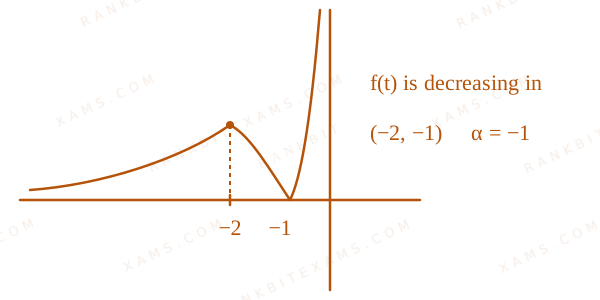
### Related Formula f'(x) > 0 implies textIncreasing f'(x) < 0 implies textDecreasing ### Core Logic Differentiate the rational function and determine the critical intervals by assessing where the derivative flips signs around critical points and domain boundaries. ### Step 1: Derivative Assessment Given f(x) = fracx3 + frac3x + 3 f'(x) = frac13 - frac3x^2 = fracx^2 - 93x^2 Critical points occur at x = pm 3, and a domain discontinuity sits at x = 0. ### Step 2: Sign Scheme Mapping Analyzing interval signs: * Strictly Increasing (f'(x) > 0): x in (-infty, -3) cup (3, infty) * Strictly Decreasing (f'(x) < 0): x in (-3, 0) cup (0, 3) ### Step 3: Interval Summation Comparing bounds with assigned symbols: alpha_1 = -3, quad alpha_2 = 3, quad alpha_3 = -3, quad alpha_4 = 0, quad alpha_5 = 3 sum_i=1^5 alpha_i^2 = (-3)^2 + (3)^2 + (-3)^2 + (0)^2 + (3)^2 = 9 + 9 + 9 + 0 + 9 = 36 ### Pattern Recognition Functions of the form x + frackx always present localized extrema turning symmetric zones at pmsqrtk. Always include the asymptotes (x=0) when stating precise disjoint decreasing intervals. ### Evaluation Rubric / Model Answer null ### Chapter Mix Class 12 Mathematics: Application of Derivatives
Q68 2025 Maxi-Mini of Functions
Let f(x) = int_0^x t(t^2 - 9t + 20) \, mathrmdt, 1 leq x leq 5. If the range of f is [alpha, beta], then 4(alpha + beta) equals:
  • A. 157
  • B. 253
  • C. 125
  • D. 154

Solution

### Related Formula Leibniz Rule for differentiation under integral sign: fracddx left( int_0^x g(t) \, dt right) = g(x) ### Core Logic Find critical points inside the interval by finding f'(x) = 0: f'(x) = x(x^2 - 9x + 20) = x(x - 4)(x - 5) = 0
Maxi-Mini of Functions diagram for Q68 - JEE Main 2025 Evening
Critical points inside the interval [1, 5] are x = 4 and x = 5. ### Step 1: Perform Integration Integrate the function to evaluate boundary metrics: f(x) = int_0^x (t^3 - 9t^2 + 20t) \, dt = left[ fract^44 - 3t^3 + 10t^2 right]_0^x f(x) = fracx^44 - 3x^3 + 10x^2 ### Step 2: Evaluate Points and Sum up Range Boundaries Evaluate at endpoints and critical points: f(1) = frac14 - 3 + 10 = frac294 = 7.25 f(4) = frac2564 - 3(64) + 10(16) = 64 - 192 + 160 = 32 f(5) = frac6254 - 3(125) + 10(25) = 156.25 - 375 + 250 = 31.25 Thus, the global minimum is alpha = f(1) = frac294, and the global maximum is \beta = f(4) = 32. 4(alpha + beta) = 4 left( frac294 + 32 right) = 29 + 128 = 157 ### Pattern Recognition Always check boundary points along with interior critical values when finding the absolute range on a closed interval. ### Evaluation Rubric / Model Answer null ### Chapter Mix Class 12 Mathematics: Application of Derivatives Class 12 Mathematics: Integral Calculus
Q64 2025 Local Maxima and Minima
The sum of all local minimum values of the function f(x) = begincases 1 - 2x, & x < -1 \\ frac13(7 + 2|x|), & -1 le x le 2 \\ frac1118(x - 4)(x - 5), & x > 2 endcases is: (1) frac17172 (2) frac13172 (3) frac15772 (4) frac16772
  • A. frac17172
  • B. frac13172
  • C. frac15772
  • D. frac16772

Solution

### Related Formula Local minima occur at points where the derivative changes sign from negative to positive, or at sharp corners where the function reaches a local low point. ### Core Logic Analyze the piecewise sections across all transition domains:
Local Maxima and Minima diagram for Q64 - JEE Main 2025 Morning
For x in [-1, 2], f(x) = frac13(7 + 2|x|). This curve has a sharp structural minimum at x = 0 since |x| decreases then increases. Value at x = 0 implies f(0) = frac73. ### Step 1: Analyzing the Quadratic Domain Boundaries For x > 2, f(x) = frac1118(x^2 - 9x + 20). Finding the vertex point by setting the derivative to zero: f^prime(x) = frac1118(2x - 9) = 0 implies x = frac92 = 4.5 Since 4.5 > 2, this vertex is within the valid domain and represents a local minimum. Value at x = 4.5 implies fleft(frac92right) = frac1118left(frac12right)left(-frac12right) = -frac1172. ### Step 2: Calculating Final Combined Summation Summing both local minima: textTotal Minima Sum = frac73 + left(-frac1172right) = frac168 - 1172 = frac15772 ### Pattern Recognition For piecewise function systems, always verify if the quadratic vertices fall inside their restricted intervals before adding them to your solution path. ### Evaluation Rubric / Model Answer null ### Chapter Mix Class 12 Maths: Application of Derivatives
More Application of Derivatives Questions — jee_main_2025_24_jan_morning

Practice all Application of Derivatives previous-year questions →

YOUR FIRST PREP STEP STARTS HERE

We Map Every Repeating Question in Competitive Exams.

Say goodbye to generic mock test fatigue. RankBit uses smart analysis to group past exam questions into their foundational Repeating Question Types. Find chapter weightage, track repeating questions, and score higher with targeted practice.

Select Your Target Exam

Choose an exam track below to find formulas per chapter and patterns.

Syncing Exam Intelligence

Mapping formulas and patterns across all tracks…

PATH A — FULL LENGTH PRACTICE

Full Mock Test Hub

Simulate real NTA exam conditions with fully tracked mocks. Time yourself against past papers.

Under Development
PATH B — TARGETED PRACTICE

Topic-wise Practice Hub

Practice past-year questions one chapter at a time. Pick an exam → subject → chapter and get every PYQ for that topic — pulled together from all past papers — with the chapter's key formulas alongside.

Loading Questions... Browse Topics
Latest from the Blog
View all →

Loading articles...
