
JEE Main · Mathematics ↓ Falling

Application of Derivatives appeared 25 times across 3 years — 2.9% of Mathematics. This question is from Local Maxima and Minima.

Year 2026 2025 2024 Total
Questions 5 8 12 25

The sum of all local minimum values of the function f(x) = cases 1 - 2x, & x < -1 (1)/(3)(7 + 2|x|), & -1 ≤ x ≤ 2 (11)/(18)(x - 4)(x - 5), & x > 2 cases is:

Solution & Explanation

Related Formula

Local minima occur at points where the derivative changes sign from negative to positive, or at sharp corners where the function reaches a local low point.

Core Logic

Analyze the piecewise sections across all transition domains:

Local Maxima and Minima diagram for Q64 - JEE Main 2025 Morning
For x in [-1, 2], f(x) = (1)/(3)(7 + 2|x|). This curve has a sharp structural minimum at x = 0 since |x| decreases then increases. Value at x = 0 f(0) = (7)/(3).

Step 1: Analyzing the Quadratic Domain Boundaries

For x > 2, f(x) = (11)/(18)(x² - 9x + 20). Finding the vertex point by setting the derivative to zero:

f^ (x) = (11)/(18)(2x - 9) = 0 x = (9)/(2) = 4.5

Since 4.5 > 2, this vertex is within the valid domain and represents a local minimum. Value at x = 4.5 f((9)/(2)) = (11)/(18)((1)/(2))(-(1)/(2)) = -(11)/(72).

Step 2: Calculating Final Combined Summation

Summing both local minima:

Total Minima Sum = (7)/(3) + (-(11)/(72)) = (168 - 11)/(72) = (157)/(72)
Pattern Recognition

For piecewise function systems, always verify if the quadratic vertices fall inside their restricted intervals before adding them to your solution path.

Chapter Mix

Class 12 Maths: Application of Derivatives

More Application of Derivatives Previous-Year Questions

Q2 jee_main_2026_21_jan_evening Monotonicity
Let f : R arrow R be a twice differentiable function such that f''(x) > 0 for all x in R and f'(a-1) = 0, where a is a real number. Let g(x) = f( ² x - 2 x + a), 0 < x < (π)/(2). Consider the following two statements: (I) g is increasing in (0, (π)/(4)) (II) g is decreasing in ((π)/(4), (π)/(2)) Then,
  • A. Neither (I) nor (II) is True
  • B. Only (II) is True
  • C. Only (I) is True
  • D. Both (I) and (II) are True

Solution

Related Formula
g'(x) = f'(h(x)) · h'(x)

For monotonicity, g'(x) > 0 increasing, and g'(x) < 0 decreasing.

Core Logic

Given g(x) = f(( x - 1)² + a - 1). Differentiating w.r.t. x:

g'(x) = f'(( x - 1)² + a - 1) · 2( x - 1) ² x
Step 1: Analyze the Sign of the Derivative

We know f''(x) > 0 f'(x) is strictly increasing. Since f'(a-1) = 0, for any input X > a-1, f'(X) > 0. Here, the input to f' is ( x - 1)² + a - 1. Since ( x - 1)² ≥ 0, it is strictly positive for x ≠ (π)/(4) in the given interval. Thus, ( x - 1)² + a - 1 ≥ a - 1 f'(( x - 1)² + a - 1) > 0 for all valid x.

Step 2: Determine Intervals of Monotonicity

Now, the sign of g'(x) depends solely on the term ( x - 1) because 2 ² x > 0. Case 1: x in (0, (π)/(4)) Here x < 1 x - 1 < 0. So, g'(x) < 0 g(x) is decreasing.

Case 2: x in ((π)/(4), (π)/(2)) Here x > 1 x - 1 > 0. So, g'(x) > 0 g(x) is increasing.

Therefore, neither statement (I) nor (II) is true.

Pattern Recognition

When a function wraps a quadratic, f((u-k)² + c), the critical points match the inner function's extrema. Evaluate the sign directly from the inner derivative u' and (u-k).

Chapter Mix

Class 12 Maths: Application of Derivatives
Q5 jee_main_2026_22_january_morning Maxima and Minima
Let f(x) = x²⁰²⁵ - x²⁰⁰⁰, x in [0,1] and the minimum value of the function f(x) in the interval [0,1] be (80)⁸⁰(n)⁻⁸¹. Then n is equal to
  • A. -81
  • B. -40
  • C. -41
  • D. -80

Solution

Related Formula
f'(x) = 0 gives the critical points for extreme values.
Core Logic

Given f(x) = x²⁰²⁵ - x²⁰⁰⁰ on x in [0,1].

Differentiate to find critical points:

f'(x) = 2025 x²⁰²⁴ - 2000 x¹⁹⁹⁹ = 0 x¹⁹⁹⁹(2025x²⁵ - 2000) = 0
Step 1: Identifying the Minima

The critical points are x = 0 and x = ((2000)/(2025))(1)/(25) = ((80)/(81))(1)/(25). Let this root be α.

Evaluating the function at endpoints and the critical point:

  • f(0) = 0
  • f(1) = 1 - 1 = 0
  • f(α) = α²⁰²⁵ - α²⁰⁰⁰ = α²⁰⁰⁰(α²⁵ - 1)
  • Substitute α²⁵ = (80)/(81):

f(α) = (((80)/(81))(1)/(25))²⁰⁰⁰ · ((80)/(81) - 1) f(α) = ((80)/(81))⁸⁰ · (-(1)/(81))
Step 2: Structuring into the Given Format
f(α) = 80⁸⁰81⁸⁰ · (-81)⁻¹ = 80⁸⁰ · (-81)⁻⁸¹

Comparing this with (80)⁸⁰(n)⁻⁸¹, we immediately get n = -81.

Pattern Recognition

When evaluating exponents in the form x^A - x^B, the stationary point occurs at x = (B/A)1/(A-B). Plugging this back into the original function seamlessly factors out (B/A)^B · (B/A - 1).

Chapter Mix

Class 12 Maths: Applications of Derivatives

Q24 jee_main_2026_24_january_morning Maxima and Minima
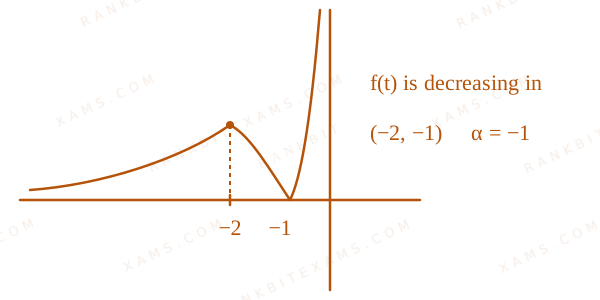
Let (2α, α) be the largest interval in which the function f(t) = (|t + 1|)/(t²), t < 0, is strictly decreasing. Then the local maximum value of the function g(x) = 2 ₑ(x - 2) + α x² + 4x - α, x > 2, is
Numerical Answer. Answer: 4 to 4

Solution

Related Formula
f'(x) < 0 for strictly decreasing function g'(x) = 0 to find critical points for extrema
Core Logic

For f(t) = (|t + 1|)/(t²), graph evaluation reveals decreasing behavior.

Decreasing function curve tracking
For t in (-2, -1), the function is decreasing. Thus, the interval is (-2, -1). Given the interval is (2α, α), this implies 2α = -2 ⇒ α = -1.

Step 1: Finding function g(x)
g(x) = 2 ₑ(x - 2) - x² + 4x + 1 (x > 2) g'(x) = (2)/(x - 2) - 2x + 4 g'(x) = (2 - 2x(x - 2) + 4(x - 2))/(x - 2) g'(x) = (2 - 2x² + 4x + 4x - 8)/(x - 2) = (-2x² + 8x - 6)/(x - 2) g'(x) = (-2(x² - 4x + 3))/(x - 2) = (-2(x - 3)(x - 1))/(x - 2)
Step 2: Determining Maxima

For x > 2, critical point is x = 3. Testing signs around x = 3: For 2 < x < 3, g'(x) > 0 (Increasing) For x > 3, g'(x) < 0 (Decreasing) Maxima occurs at x = 3.

Step 3: Calculating Local Maximum Value
g(3) = 2 ₑ(3 - 2) - (3)² + 4(3) + 1 g(3) = 2 ₑ(1) - 9 + 12 + 1 g(3) = 0 + 4 = 4
Pattern Recognition

Connecting nested parameter values (α) between independent functions ( f(t) and g(x)) demands extreme care on interval boundaries. Derivative sign analysis effortlessly identifies maximums on restricted domains.

Chapter Mix

Class 12 Maths: Application of Derivatives

Q15 jee_main_2026_24_january_evening Monotonicity and Differentiability
Consider the following three statements for the function f: (0, ∞) → R defined by f(x) = | ₑ x| - |x - 1|: (I) f is differentiable at all x > 0. (II) f is increasing in (0, 1). (III) f is decreasing in (1, ∞). Then.
  • A. All (I), (II) and (III) are TRUE.
  • B. Only (I) is TRUE.
  • C. Only (II) and (III) are TRUE.
  • D. Only (I) and (III) are TRUE.

Solution

Related Formula
For x ≥ 1, ln x ≥ 0 and x-1 ≥ 0 For 0 < x < 1, ln x < 0 and x-1 < 0
Core Logic

Break the function into piecewise intervals based on the critical point x=1.

f(x) = cases ln x - (x - 1) & x ≥ 1 -ln x - (-(x - 1)) & 0 < x < 1 cases f(x) = cases ln x - x + 1 & x ≥ 1 -ln x + x - 1 & 0 < x < 1 cases
Step 1: Checking Differentiability (Statement I)

Find the derivative f'(x):

f'(x) = cases (1)/(x) - 1 & x > 1 -(1)/(x) + 1 & 0 < x < 1 cases

Check left-hand derivative (LHD) and right-hand derivative (RHD) at x = 1:

RHD = f'(1^+) = (1)/(1) - 1 = 0 LHD = f'(1^-) = -(1)/(1) + 1 = 0

Since LHD = RHD, f(x) is differentiable at x=1 (and clearly everywhere else in its domain). Thus, Statement (I) is TRUE.

Step 2: Checking Monotonicity (Statements II and III)

Check for x > 1: f'(x) = (1)/(x) - 1 < 0 for all x > 1. Therefore, f is decreasing in (1, ∞). Statement (III) is TRUE.

Check for 0 < x < 1: f'(x) = 1 - (1)/(x) = (x-1)/(x) < 0 for all 0 < x < 1. Therefore, f is also decreasing in (0, 1). Statement (II) is FALSE.

Since f is decreasing in both intervals, it is monotonically decreasing across (0, ∞).

Step 3: Final Conclusion

Only Statement (I) and Statement (III) are true.

Pattern Recognition

Adding or subtracting two modulus functions that change sign at the exact same critical point often smooths out the sharp corner, leading to a perfectly differentiable curve at that node. Always compute LHD and RHD to confirm.

Chapter Mix

Class 12 Maths: Application of Derivatives Class 12 Maths: Limits, Continuity and Differentiability

Q23 jee_main_2026_28_january_evening Maxima and Minima with Integration
Let f be a differentiable function satisfying f(x) = 1 - 2x + ∫₀x e(x-t) f(t) dt, x in R and let g(x) = ∫₀x (f(t) + 2)¹⁵ (t - 4)⁶ (t + 12)¹⁷ dt, x in R. If p and q are respectively the points of local minima and local maxima of g, then the value of |p + q| is equal to
Numerical Answer. Answer: 9 to 9

Solution

Related Formula
Leibniz Rule: (d)/(dx)(∫a(x)b(x) h(x, t) dt) = ∫a(x)b(x) (∂ h)/(∂ x) dt + h(x, b(x))b'(x) - h(x, a(x))a'(x)
Core Logic

First, extract f(x) from the integral equation: f(x) = 1 - 2x + e^x ∫₀x e-t f(t) dt Divide by e^x: e-x f(x) = e-x(1 - 2x) + ∫₀x e-t f(t) dt Differentiate with respect to x using Leibniz rule: e-xf'(x) - e-xf(x) = e-x(-2) - e-x(1-2x) + e-xf(x) Cancel e-x: f'(x) - f(x) = -2 - 1 + 2x + f(x) f'(x) - 2f(x) = 2x - 3

Execution

Solve the linear differential equation (dy)/(dx) - 2y = 2x - 3: Integrating factor IF = e∫ -2 dx = e-2x. Solution: y · e-2x = ∫ e-2x(2x - 3) dx. Using integration by parts, it resolves to y = 1 - x. So f(x) = 1 - x.

Now, analyze g'(x): g(x) = ∫₀x ((1 - t) + 2)¹⁵ (t - 4)⁶ (t + 12)¹⁷ dt g'(x) = (3 - x)¹⁵ (x - 4)⁶ (x + 12)¹⁷ = -(x - 3)¹⁵ (x - 4)⁶ (x + 12)¹⁷.

Find critical points where g'(x) = 0: x = 3, 4, -12. Analyze sign changes of g'(x) around critical points using the wavy curve method. The leading coefficient is negative. For x = -12 (odd power 17), g'(x) changes from negative to positive ⇒ Local Minima (p = -12). For x = 3 (odd power 15), g'(x) changes from positive to negative ⇒ Local Maxima (q = 3). For x = 4 (even power 6), sign does not change.

Calculate |p + q|: |p + q| = |-12 + 3| = |-9| = 9.

Pattern Recognition

Differentiating an integral equation involving ex-t always immediately yields a first-order linear differential equation. Once f(x) is found, Newton-Leibniz on g(x) converts it to a standard Wavy-Curve extrema problem.

Chapter Mix

Class 12 Maths: Application of Derivatives Class 12 Maths: Differential Equations

Rankbit System
JEE Physics: Waves (+15.5%) | Electrostatics: Concentric Shells (-29.7%) | Modern Physics: Photoelectric Clones (+34.2%) | Mathematics: Definite Integrals (+18.1%) | Chemistry: Coordination Splitting (-11.4%) | JEE Physics: Waves (+15.5%) | Electrostatics: Concentric Shells (-29.7%) | Modern Physics: Photoelectric Clones (+34.2%) | Mathematics: Definite Integrals (+18.1%) | Chemistry: Coordination Splitting (-11.4%)