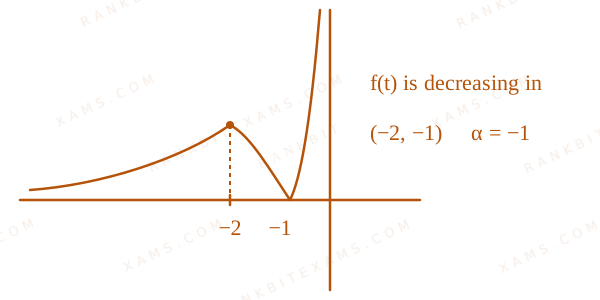
Let x = -1 and x = 2 be the critical points of the function f(x) = x^3 + ax^2 + b log_e |x| + 1, x neq 0 . Let m and M respectively be the absolute minimum and the absolute maximum values of f in the interval left[-2, -frac12right] . Then |M + m| is equal to (Take log_e 2 = 0.7 ):

Solution & Explanation

### Related Formula Critical points occur where f'(x) = 0. For absolute maximum and minimum on an interval [c, d], evaluate function values at the boundaries and at any local critical points falling inside the domain. ### Core Logic Given f(x) = x^3 + ax^2 + bln|x| + 1 Differentiating with respect to x: f'(x) = 3x^2 + 2ax + fracbx Since x = -1 and x = 2 are critical points: f'(-1) = 3(-1)^2 + 2a(-1) + fracb-1 = 3 - 2a - b = 0 implies 2a + b = 3 f'(2) = 3(2)^2 + 2a(2) + fracb2 = 12 + 4a + fracb2 = 0 implies 8a + b = -24 ### Step 1: Solve for Coefficients Subtracting the first simplified derivative equation from the second: (8a + b) - (2a + b) = -24 - 3 6a = -27 implies a = -frac92 Substituting a back to get b: 2left(-frac92right) + b = 3 implies -9 + b = 3 implies b = 12 Thus, the function is: f(x) = x^3 - frac92x^2 + 12ln|x| + 1 ### Step 2: Check Critical Points in Target Interval The given interval is [-2, -1/2]. Inside this interval, the relevant critical point is x = -1 (since x = 2 lies outside). Evaluate the function values at x = -2, -1, -1/2: 1. At x = -1: f(-1) = (-1)^3 - frac92(-1)^2 + 12ln|-1| + 1 = -1 - 4.5 + 0 + 1 = -4.5 2. At x = -2: f(-2) = (-2)^3 - frac92(-2)^2 + 12ln|-2| + 1 = -8 - 18 + 12(0.7) + 1 = -25 + 8.4 = -16.6 3. At x = -1/2: f(-1/2) = left(-frac12right)^3 - frac92left(-frac12right)^2 + 12lnleft|-frac12right| + 1 = -0.125 - 1.125 - 12(0.7) + 1 = -1.25 - 8.4 + 1 = -8.65 ### Step 3: Calculate Absolute Sum Comparing the calculated values: M = textAbsolute Maximum = -4.5 quad (textat x = -1) m = textAbsolute Minimum = -16.6 quad (textat x = -2) Therefore: |M + m| = |-4.5 + (-16.6)| = |-21.1| = 21.1 ### Pattern Recognition Always verify whether the critical points lie inside the requested boundary interval before blindly testing all values. Here, x=2 was an irrelevant trap for the interval valuation phase. ### Evaluation Rubric / Model Answer null ### Chapter Mix Class 12 Mathematics: Application of Derivatives

Reference Study Guides

More Application of Derivatives Previous-Year Questions

Q jee_main_2025_02_april_morning Maxima and Minima
If the function f(x) = 2x^3 - 9ax^2 + 12a^2x + 1, where a > 0, attains its local maximum and local minimum values at p and q, respectively, such that p^2 = q, then f(3) is equal to:
  • A. 55
  • B. 10
  • C. 23
  • D. 37

Solution

### Related Formula For local extrema of a differentiable function, set the first derivative to zero: f'(x) = 0 ### Core Logic Differentiate f(x) to obtain its critical points p and q in terms of a, use the constraint p^2 = q to fix a, and evaluate f(3). ### Step 1: Differentiate and Find Critical Points f'(x) = 6x^2 - 18ax + 12a^2 Set f'(x) = 0: 6(x^2 - 3ax + 2a^2) = 0 implies 6(x-a)(x-2a) = 0 The critical points are x = a and x = 2a. Since a > 0, checking the sign change of f'(x) shows that the local maximum occurs at the smaller root (p = a) and the local minimum at the larger root (q = 2a). ### Step 2: Apply Root Constraint Given p^2 = q: a^2 = 2a implies a(a-2) = 0 Since a > 0, we get a = 2. ### Step 3: Evaluate function at x = 3 Substitute a = 2 back into the definition of f(x): f(x) = 2x^3 - 18x^2 + 48x + 1 Now compute f(3): f(3) = 2(3)^3 - 18(3)^2 + 48(3) + 1 = 54 - 162 + 144 + 1 = 37 ### Pattern Recognition For cubic equations with two distinct real critical roots, the smaller root is always the local maximum if the leading coefficient is positive (2 > 0). This ensures p=a and q=2a$ immediately without relying on secondary derivative checks. ### Evaluation Rubric / Model Answer null ### Chapter Mix Class 12 Mathematics: Application of Derivatives
Q53 jee_main_2025_08_april_evening Monotonicity
Let the function f(x) = fracx3 + frac3x + 3, x neq 0 be strictly increasing in (-infty, alpha_1) cup (alpha_2, infty) and strictly decreasing in (alpha_3, alpha_4) cup (alpha_4, alpha_5). Then sum_i=1^5 alpha_i^2 is equal to:
  • A. 48
  • B. 28
  • C. 40
  • D. 36

Solution

### Related Formula f'(x) > 0 implies textIncreasing f'(x) < 0 implies textDecreasing ### Core Logic Differentiate the rational function and determine the critical intervals by assessing where the derivative flips signs around critical points and domain boundaries. ### Step 1: Derivative Assessment Given f(x) = fracx3 + frac3x + 3 f'(x) = frac13 - frac3x^2 = fracx^2 - 93x^2 Critical points occur at x = pm 3, and a domain discontinuity sits at x = 0. ### Step 2: Sign Scheme Mapping Analyzing interval signs: * Strictly Increasing (f'(x) > 0): x in (-infty, -3) cup (3, infty) * Strictly Decreasing (f'(x) < 0): x in (-3, 0) cup (0, 3) ### Step 3: Interval Summation Comparing bounds with assigned symbols: alpha_1 = -3, quad alpha_2 = 3, quad alpha_3 = -3, quad alpha_4 = 0, quad alpha_5 = 3 sum_i=1^5 alpha_i^2 = (-3)^2 + (3)^2 + (-3)^2 + (0)^2 + (3)^2 = 9 + 9 + 9 + 0 + 9 = 36 ### Pattern Recognition Functions of the form x + frackx always present localized extrema turning symmetric zones at pmsqrtk. Always include the asymptotes (x=0) when stating precise disjoint decreasing intervals. ### Evaluation Rubric / Model Answer null ### Chapter Mix Class 12 Mathematics: Application of Derivatives
Q68 jee_main_2025_29_jan_evening Maxi-Mini of Functions
Let f(x) = int_0^x t(t^2 - 9t + 20) \, mathrmdt, 1 leq x leq 5. If the range of f is [alpha, beta], then 4(alpha + beta) equals:
  • A. 157
  • B. 253
  • C. 125
  • D. 154

Solution

### Related Formula Leibniz Rule for differentiation under integral sign: fracddx left( int_0^x g(t) \, dt right) = g(x) ### Core Logic Find critical points inside the interval by finding f'(x) = 0: f'(x) = x(x^2 - 9x + 20) = x(x - 4)(x - 5) = 0
Maxi-Mini of Functions diagram for Q68 - JEE Main 2025 Evening
Critical points inside the interval [1, 5] are x = 4 and x = 5. ### Step 1: Perform Integration Integrate the function to evaluate boundary metrics: f(x) = int_0^x (t^3 - 9t^2 + 20t) \, dt = left[ fract^44 - 3t^3 + 10t^2 right]_0^x f(x) = fracx^44 - 3x^3 + 10x^2 ### Step 2: Evaluate Points and Sum up Range Boundaries Evaluate at endpoints and critical points: f(1) = frac14 - 3 + 10 = frac294 = 7.25 f(4) = frac2564 - 3(64) + 10(16) = 64 - 192 + 160 = 32 f(5) = frac6254 - 3(125) + 10(25) = 156.25 - 375 + 250 = 31.25 Thus, the global minimum is alpha = f(1) = frac294, and the global maximum is \beta = f(4) = 32. 4(alpha + beta) = 4 left( frac294 + 32 right) = 29 + 128 = 157 ### Pattern Recognition Always check boundary points along with interior critical values when finding the absolute range on a closed interval. ### Evaluation Rubric / Model Answer null ### Chapter Mix Class 12 Mathematics: Application of Derivatives Class 12 Mathematics: Integral Calculus
Q64 jee_main_2025_28_jan_morning Local Maxima and Minima
The sum of all local minimum values of the function f(x) = begincases 1 - 2x, & x < -1 \\ frac13(7 + 2|x|), & -1 le x le 2 \\ frac1118(x - 4)(x - 5), & x > 2 endcases is: (1) frac17172 (2) frac13172 (3) frac15772 (4) frac16772
  • A. frac17172
  • B. frac13172
  • C. frac15772
  • D. frac16772

Solution

### Related Formula Local minima occur at points where the derivative changes sign from negative to positive, or at sharp corners where the function reaches a local low point. ### Core Logic Analyze the piecewise sections across all transition domains:
Local Maxima and Minima diagram for Q64 - JEE Main 2025 Morning
For x in [-1, 2], f(x) = frac13(7 + 2|x|). This curve has a sharp structural minimum at x = 0 since |x| decreases then increases. Value at x = 0 implies f(0) = frac73. ### Step 1: Analyzing the Quadratic Domain Boundaries For x > 2, f(x) = frac1118(x^2 - 9x + 20). Finding the vertex point by setting the derivative to zero: f^prime(x) = frac1118(2x - 9) = 0 implies x = frac92 = 4.5 Since 4.5 > 2, this vertex is within the valid domain and represents a local minimum. Value at x = 4.5 implies fleft(frac92right) = frac1118left(frac12right)left(-frac12right) = -frac1172. ### Step 2: Calculating Final Combined Summation Summing both local minima: textTotal Minima Sum = frac73 + left(-frac1172right) = frac168 - 1172 = frac15772 ### Pattern Recognition For piecewise function systems, always verify if the quadratic vertices fall inside their restricted intervals before adding them to your solution path. ### Evaluation Rubric / Model Answer null ### Chapter Mix Class 12 Maths: Application of Derivatives
More Application of Derivatives Questions — jee_main_2025_07_april_morning

Practice all Application of Derivatives previous-year questions →

Rankbit System
JEE Physics: Waves (+15.5%) | Electrostatics: Concentric Shells (-29.7%) | Modern Physics: Photoelectric Clones (+34.2%) | Mathematics: Definite Integrals (+18.1%) | Chemistry: Coordination Splitting (-11.4%) | JEE Physics: Waves (+15.5%) | Electrostatics: Concentric Shells (-29.7%) | Modern Physics: Photoelectric Clones (+34.2%) | Mathematics: Definite Integrals (+18.1%) | Chemistry: Coordination Splitting (-11.4%)
