System of Particles and Rotational Motion appeared 58 times across 3 years — 6.7% of Physics.
This question is from Angular Momentum of a System of Particles.
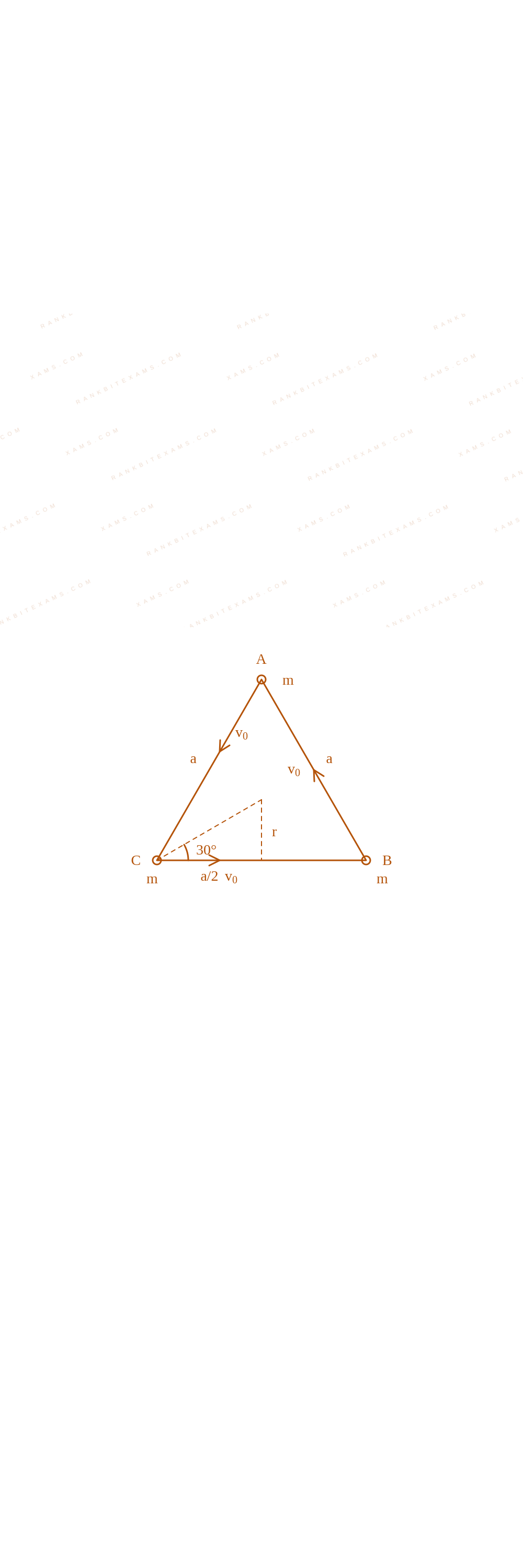
Three equal masses m$m$ are kept at vertices (A, B, C) of an equilateral triangle of side a$a$ in free space. At t = 0$t = 0$ , they are given an initial velocity VA = V₀ AC$\vec{V}_{\mathrm{A}} = V_{0}\overrightarrow{\mathrm{AC}}$ , VB = V₀ BA$\vec{V}_{\mathrm{B}} = V_{0}\overrightarrow{\mathrm{BA}}$ and VC = V₀ CB$\vec{V}_{\mathrm{C}} = V_{0}\overrightarrow{\mathrm{CB}}$ . Here, AC, CB$\overrightarrow{\mathrm{AC}}, \overrightarrow{\mathrm{CB}}$ and BA$\overrightarrow{\mathrm{BA}}$ are unit vectors along the edges of the triangle. If the three masses interact gravitationally, then the magnitude of the net angular momentum of the system at the point of collision is:
The graphic exhibits three mass particles at the vertices of an equilateral triangle with velocity vectors pointed along the cyclic boundary directions.
L = Σ ( rᵢ × m vᵢ)$$\vec{L} = \sum \left(\vec{r}_i \times m \vec{v}_i\right)$$τₑₓₜ = d Ldt$$\vec{\tau}_{\text{ext}} = \frac{d\vec{L}}{dt}$$
Core Logic
Since the three masses interact purely through mutual internal gravitational forces, the net external torque acting on the system about any central reference point is zero:
Let us compute the total angular momentum about the centroid of the equilateral triangle:
The graphic exhibits three mass particles at the vertices of an equilateral triangle with velocity vectors pointed along the cyclic boundary directions.
From trigonometry, the perpendicular distance from the centroid to the velocity vector along any edge is:
r⊥ = a2√(3)$$r_{\perp} = \frac{a}{2\sqrt{3}}$$
The initial angular momentum for one mass about the centroid is L₁ = m V₀ r⊥$L_1 = m V_0 r_{\perp}$. Since all three particles move cyclically in the same direction, their angular momenta reinforce cleanly:
Lₙₑₜ = 3 · (m V₀ a2√(3)) = 32√(3) m V₀ a = √(3)2 a m V₀$$L_{\text{net}} = 3 \cdot \left(m V_0 \frac{a}{2\sqrt{3}}\right) = \frac{3}{2\sqrt{3}} m V_0 a = \frac{\sqrt{3}}{2} a m V_0$$
By conservation of angular momentum, this configuration value remains unchanged up to the point of collision.
Pattern Recognition
Mutual internal central forces can never alter the angular momentum of a system. Hence, the solution completely reduces to measuring the static configuration values at t=0$t=0$ about the center of mass symmetry.
Chapter Mix
Class 11 Physics: System of Particles and Rotational Motion
Class 11 Physics: Gravitation
Keywords:#equal masses m are kept at vertices#JEE Main 2025 Evening Q15#Rotational Motion JEE Main 2025#Angular Momentum of a System of Particles#equilateral triangle#mass particles#gravitational interaction#angular momentum
More System of Particles and Rotational Motion Previous-Year Questions — Page 5
Qjee_main_2025_02_april_eveningTorque and Moment of Inertia
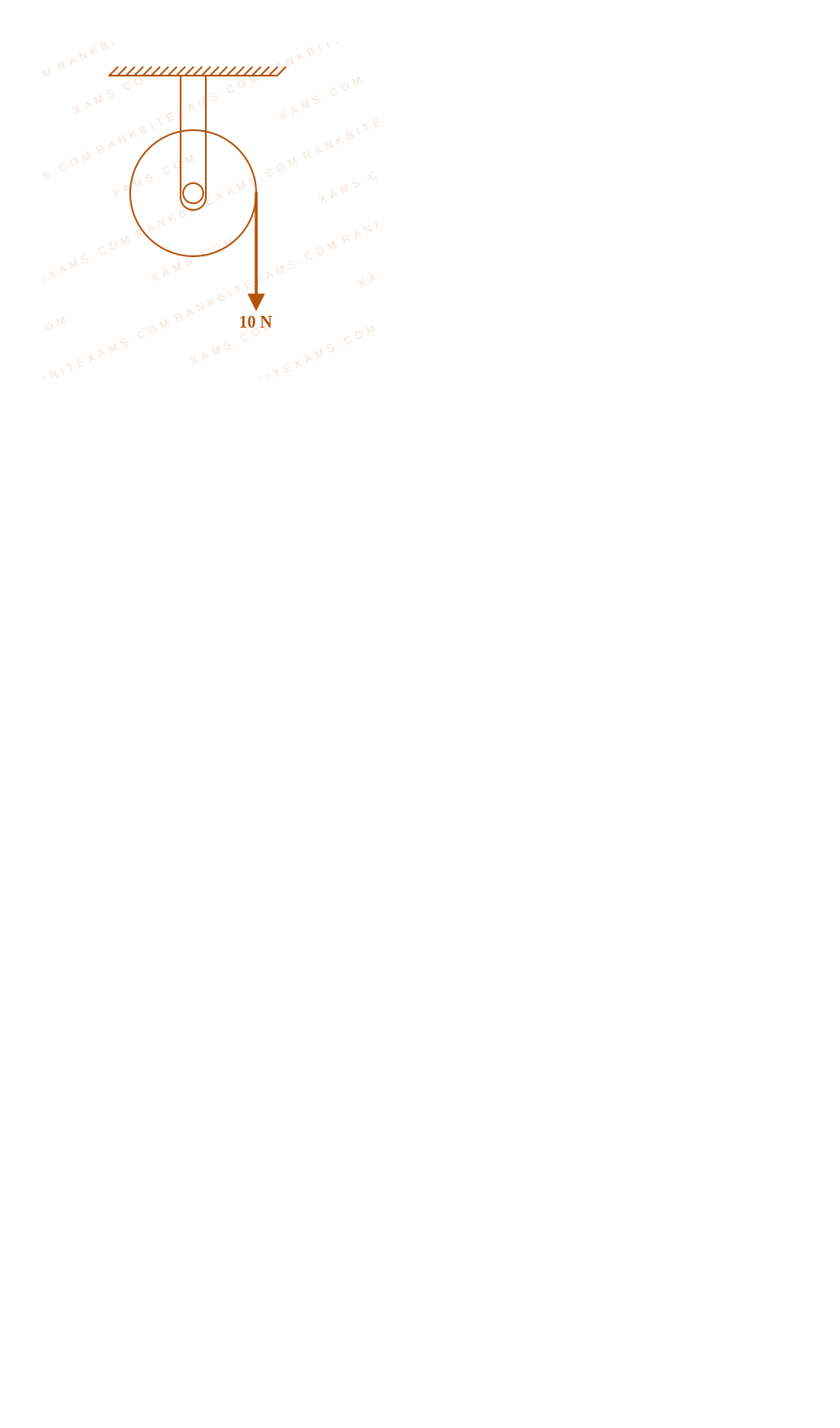
A wheel of radius 0.2 ~m$0.2 \mathrm{~m}$ rotates freely about its center when a string that is wrapped over its rim is pulled by force of 10 ~N$10 \mathrm{~N}$ as shown in figure. The established torque produces an angular acceleration of 2 rad / s²$2 \mathrm{rad} / \mathrm{s}^{2}$ . Moment of inertia of the wheel is ________ kg m²$m^2$ .
(Acceleration due to gravity = 10m / s²$= 10\mathrm{m} / \mathrm{s}^2$)
The diagram displays a circular wheel rotating about its center under a tangential pulling force of 10 N.
Numerical Answer.Answer: 1 to 1
Solution
Related Formula
Torque (τ$\tau$) produced by a tangential pulling force:
τ = F · R$$\tau = F \cdot R$$
Newton's second law for rotation:
τ = I · α$$\tau = I \cdot \alpha$$
Core Logic
We are given:
Radius of the wheel R = 0.2 m$R = 0.2 \ \mathrm{m}$
τ = F · R = 10 N × 0.2 m = 2 N · m$$\tau = F \cdot R = 10 \ \mathrm{N} \times 0.2 \ \mathrm{m} = 2 \ \mathrm{N \cdot m}$$
Next, calculate the moment of inertia I$I$ using τ = Iα$\tau = I\alpha$:
I = (τ)/(α) = 2 N · m2 rad/s² = 1 kg · m²$$I = \frac{\tau}{\alpha} = \frac{2 \ \mathrm{N \cdot m}}{2 \ \mathrm{rad/s^2}} = 1 \ \mathrm{kg \cdot m^2}$$
Thus, the moment of inertia is 1 ~kg· m²$1 \mathrm{~kg\cdot m^2}$.
Pattern Recognition
Sees: Pulley/wheel torque with basic rotational dynamics.
Trap: Attempting to integrate gravity (g = 10 m/s²$g = 10\text{ m/s}^2$) into mass equations. Gravity is a redundant distractor here because the pulling tension force is explicitly defined!
Shortcut: Directly compute torque as τ = F R$\tau = F R$ and divide by the angular acceleration α$\alpha$.
Chapter Mix
Class 11 Physics: System of Particles and Rotational Motion
Q3jee_main_2025_02_april_eveningMoment of Inertia of Ring
The moment of inertia of a circular ring of mass M$M$ and diameter r$r$ about a tangential axis lying in the plane of the ring is:
A.(1)/(2) M r²$\frac{1}{2} M r^2$
B.(3)/(8) M r²$\frac{3}{8} M r^2$
C.(3)/(2) M r²$\frac{3}{2} M r^2$
D.2 M r²$2 M r^2$
Solution
Related Formula
Moment of inertia of a circular ring of mass M$M$ and radius R$R$ about a diametrical axis in its plane:
Idia = (1)/(2) M R²$$I_{\text{dia}} = \frac{1}{2} M R^2$$
Parallel Axis Theorem:
I = Icm + M d²$$I = I_{\text{cm}} + M d^2$$
where d$d$ is the perpendicular distance between the center of mass axis and the parallel axis.
Core Logic
The axis of rotation is tangential and lies in the plane of the ring. Thus, the distance from the center of mass axis (which is also diametrical and in-plane) is equal to the radius R$R$.
Using the parallel axis theorem:
Itangent = Idia + M R² = (1)/(2) M R² + M R² = (3)/(2) M R²$$I_{\text{tangent}} = I_{\text{dia}} + M R^2 = \frac{1}{2} M R^2 + M R^2 = \frac{3}{2} M R^2$$
Step 1: Express in terms of diameter r$r$
The question specifies the diameter of the ring is r$r$.
Therefore, the radius R$R$ is:
R = (r)/(2)$$R = \frac{r}{2}$$
Substitute R = (r)/(2)$R = \frac{r}{2}$ into the moment of inertia formula:
Itangent = (3)/(2) M ((r)/(2))² = (3)/(8) M r²$$I_{\text{tangent}} = \frac{3}{2} M \left(\frac{r}{2}\right)^2 = \frac{3}{8} M r^2$$
Thus, the moment of inertia is (3)/(8) M r²$\frac{3}{8} M r^2$.
Pattern Recognition
Sees: Circular ring tangential axis in-plane.
Trap: Directly using radius r$r$ instead of diameter r$r$. Read variables carefully: often r$r$ is radius, but here it is explicitly given as diameter!
Shortcut: Standard in-plane tangent is (3)/(2)MR²$\frac{3}{2}MR^2$. Substitute R = (r)/(2)$R = \frac{r}{2}$ to get (3)/(8)Mr²$\frac{3}{8}Mr^2$.
Chapter Mix
Class 11 Physics: System of Particles and Rotational Motion
Qjee_main_2025_02_april_morningMoment of Inertia and Torque
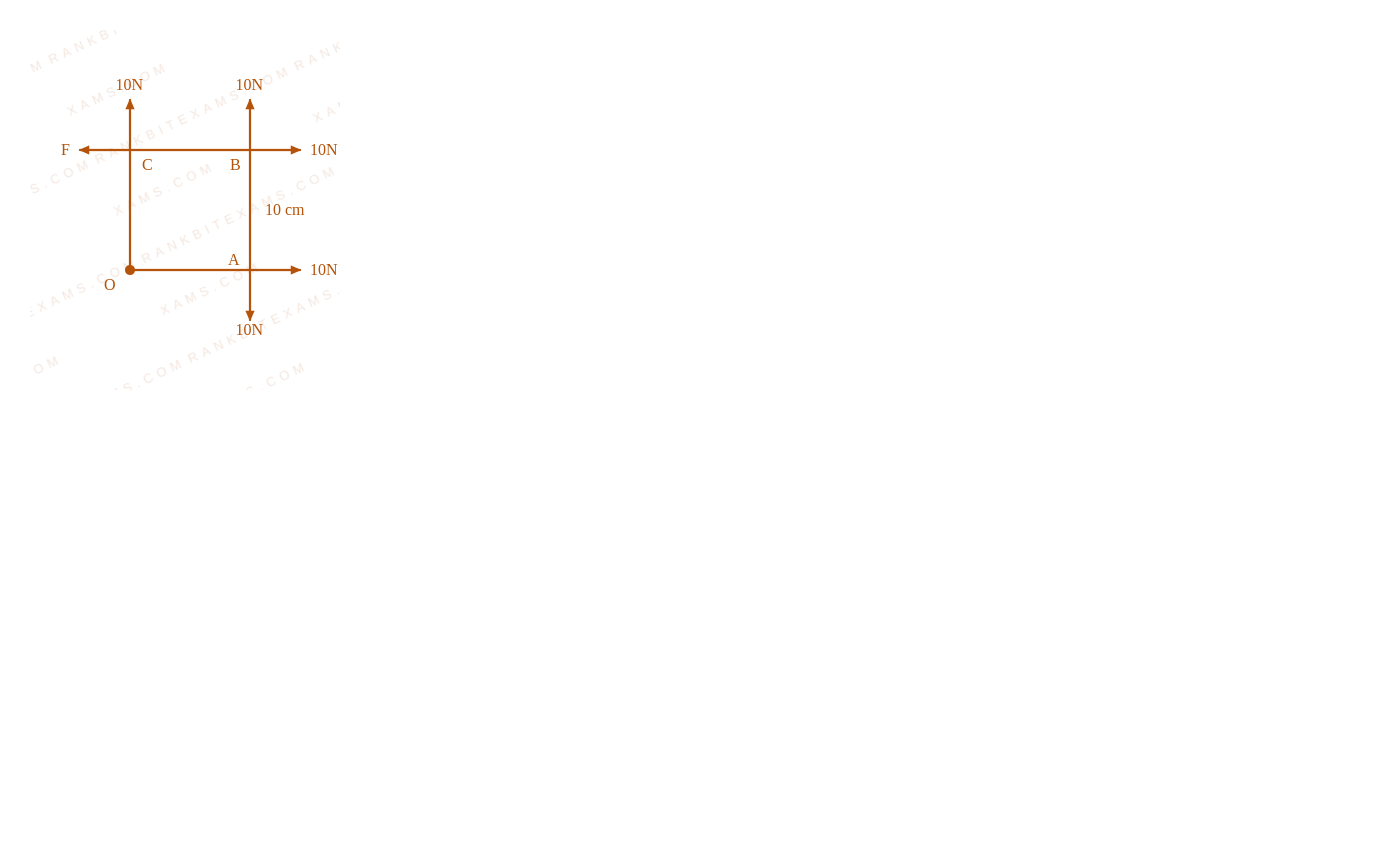
A square Lamina OABC of length 10~cm$10\mathrm{~cm}$ is pivoted at 'O'. Forces act on the Lamina as shown in the figure. If the Lamina remains stationary, then the magnitude of F$F$ is:
A square lamina OABC with multiple force vectors acting on its vertices, pivoted at O.
Let the side length of the square lamina be l = 10~cm$l = 10\mathrm{~cm}$.
The lamina is pivoted at point O(0,0)$O(0,0)$ and remains stationary under rotational equilibrium. Therefore, the net torque about O$O$ must be zero.
Evaluating torque contributions about point O$O$:
Forces acting directly at pivot O$O$ produce zero torque.
Forces whose lines of action pass through O$O$ produce zero torque.
The 10~N$10\mathrm{~N}$ force perpendicular to side OA$OA$ produces torque:
τ₁ = 10 × l (Counter-Clockwise)$$\tau_1 = 10 \times l \quad \text{(Counter-Clockwise)}$$
The unknown force F$F$ acting perpendicular to side OC$OC$ produces torque:
τ₂ = F × l (Clockwise)$$\tau_2 = F \times l \quad \text{(Clockwise)}$$
Setting Σ τO = 0$\sum \tau_O = 0$:
10 · l - F · l = 0 F = 10~N$$10 \cdot l - F \cdot l = 0 \implies F = 10\mathrm{~N}$$
Step 1: Final Conclusion
The magnitude of the force F$F$ is 10~N$10\mathrm{~N}$.
Pattern Recognition
In pivoted laminas, focus on the pivot and disregard any force vector whose line of action passes through the pivot. For symmetric placements, equate Clockwise torque = Counter-Clockwise torque directly.
Chapter Mix
Class 11 Physics: Rotational Motion
Q3jee_main_2025_02_april_morningMoment of Inertia and Torque
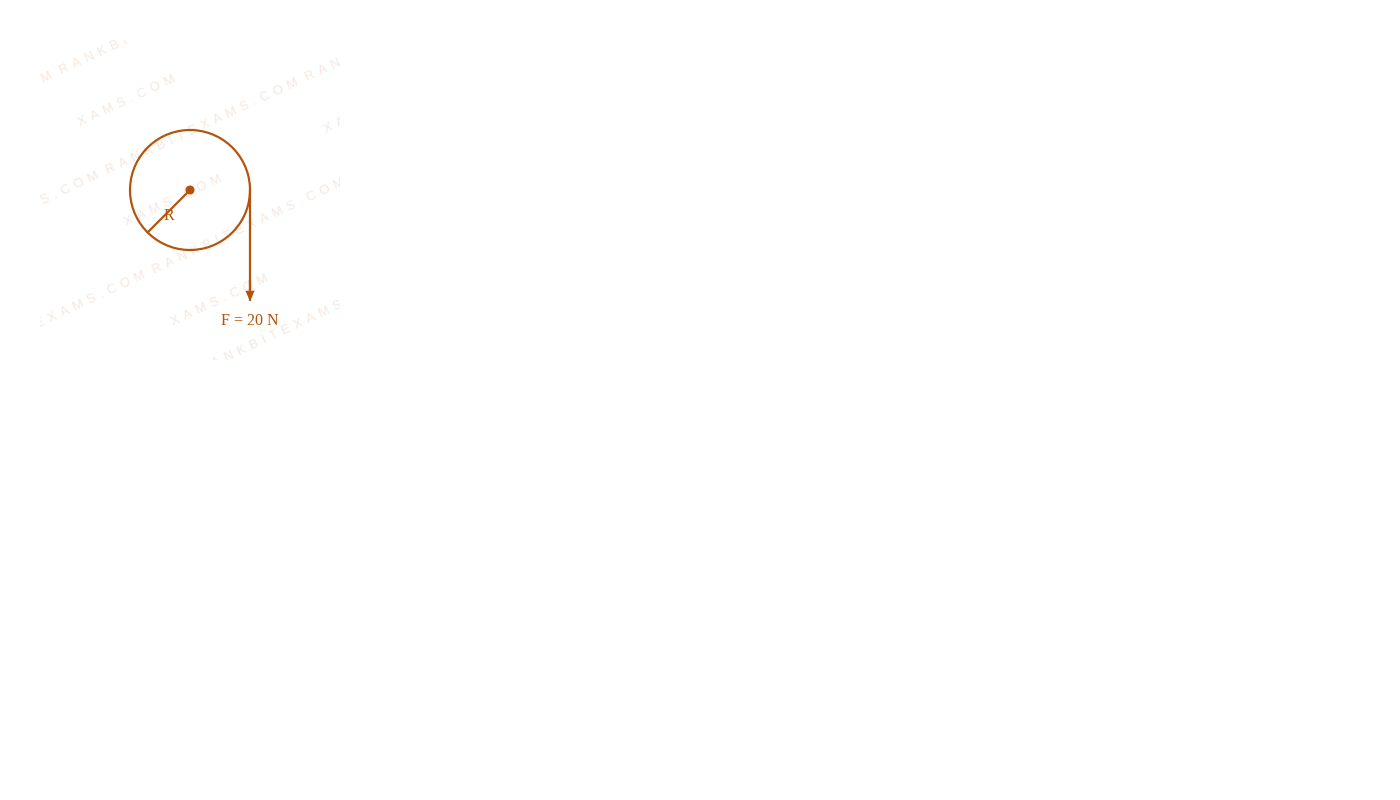
A cord of negligible mass is wound around the rim of a wheel supported by spokes with negligible mass. The mass of wheel is 10~kg$10\mathrm{~kg}$ and radius is 10~cm$10\mathrm{~cm}$ and it can freely rotate without any friction. Initially the wheel is at rest. If a steady pull of 20~N$20\mathrm{~N}$ is applied on the cord, the angular velocity of the wheel, after the cord is unwound by 1~m$1\mathrm{~m}$, would be:
A wheel rotating with a pull force of 20 N acting on the cord.
A.20~rad/s$20\mathrm{~rad/s}$
B.30~rad/s$30\mathrm{~rad/s}$
C.10~rad/s$10\mathrm{~rad/s}$
D.0~rad/s$0\mathrm{~rad/s}$
Solution
Related Formula
WF = F · s$W_F = F \cdot s$
KR = (1)/(2) I ω²$$K_R = \frac{1}{2} I \omega^2$$I = M R² (Moment of inertia of a ring/rim)$$I = M R^2 \quad \text{(Moment of inertia of a ring/rim)}$$
Core Logic
The work done by the constant pulling force F = 20~N$F = 20\mathrm{~N}$ through distance s = 1~m$s = 1\mathrm{~m}$ is completely converted into the rotational kinetic energy of the wheel.
Work done by force:
WF = F · s = 20 × 1 = 20~J$$W_F = F \cdot s = 20 \times 1 = 20\mathrm{~J}$$
Since the spokes are of negligible mass, all mass M = 10~kg$M = 10\mathrm{~kg}$ is distributed on the outer rim of radius R = 10~cm = 0.1~m$R = 10\mathrm{~cm} = 0.1\mathrm{~m}$. The wheel acts as a thin ring:
I = M R² = 10 × (0.1)² = 0.1~kg· m²$$I = M R^2 = 10 \times (0.1)^2 = 0.1\mathrm{~kg\cdot m^2}$$
Work done in unwinding a string is F · s$F \cdot s$. Under pure rotation with zero friction, this is exactly (1)/(2) I ω²$\frac{1}{2} I \omega^2$. Always identify the mass distribution (here, rim with massless spokes acts as a thin cylinder/ring I = MR²$I = MR^2$).
Chapter Mix
Class 11 Physics: Rotational Motion
Class 11 Physics: Work, Energy and Power
Q16jee_main_2025_02_april_morningMoment of Inertia and Torque
Moment of inertia of a rod of mass 'M' and length 'L' about an axis passing through its center and normal to its length is 'α'. Now the rod is cut into two equal parts and these parts are joined symmetrically to form a cross shape. Moment of inertia of cross about an axis passing through its center and normal to plane containing cross is:
A.α$\alpha$
B.α / 4$\alpha / 4$
C.α / 8$\alpha / 8$
D.α / 2$\alpha / 2$
Solution
Related Formula
I = (1)/(12) M L²$$I = \frac{1}{12} M L^2$$
Core Logic
Initially, the moment of inertia is:
α = (M L²)/(12)$$\alpha = \frac{M L^2}{12}$$
When cut into two equal parts, each smaller rod has:
Mass, m = (M)/(2)$m = \frac{M}{2}$
Length, l = (L)/(2)$l = \frac{L}{2}$
When joined symmetrically as a cross, the target axis passes through their joint intersection perpendicular to their plane.
For each rod, this axis passes through its individual center of mass and is perpendicular to its length.
Thus, the total moment of inertia of the cross is the sum of the moments of inertia of the two rods:
Icross = I₁ + I₂ = 2 × ((1)/(12) m l²) = (1)/(6) m l²$$I_{\text{cross}} = I_1 + I_2 = 2 \times \left(\frac{1}{12} m l^2\right) = \frac{1}{6} m l^2$$
Substituting m = (M)/(2)$m = \frac{M}{2}$ and l = (L)/(2)$l = \frac{L}{2}$:
M \propto L), cutting a rod into$), cutting a rod into $nequal segments scales the length by$ equal segments scales the length by $1/nand mass by$ and mass by $1/n. The moment of inertia of each segment scales as$. The moment of inertia of each segment scales as $1/n^3. Reassembling$. Reassembling $nsegments linearly sums their contributions, so the final moment of inertia scales as$ segments linearly sums their contributions, so the final moment of inertia scales as $n \times \frac{1}{n^3} = \frac{1}{n^2}$.
Chapter Mix
Class 11 Physics: Rotational Motion
More System of Particles and Rotational Motion Questions — jee_main_2025_29_jan_evening
Practice past-year questions one chapter at a time. Pick an exam → subject → chapter and get every PYQ for that topic — pulled together from all past papers — with the chapter's key formulas alongside.