System of Particles and Rotational Motion appeared 58 times across 3 years — 6.7% of Physics.
This question is from Angular Momentum of a System of Particles.
Three equal masses m$m$ are kept at vertices (A, B, C) of an equilateral triangle of side a$a$ in free space. At t = 0$t = 0$ , they are given an initial velocity VA = V₀ AC$\vec{V}_{\mathrm{A}} = V_{0}\overrightarrow{\mathrm{AC}}$ , VB = V₀ BA$\vec{V}_{\mathrm{B}} = V_{0}\overrightarrow{\mathrm{BA}}$ and VC = V₀ CB$\vec{V}_{\mathrm{C}} = V_{0}\overrightarrow{\mathrm{CB}}$ . Here, AC, CB$\overrightarrow{\mathrm{AC}}, \overrightarrow{\mathrm{CB}}$ and BA$\overrightarrow{\mathrm{BA}}$ are unit vectors along the edges of the triangle. If the three masses interact gravitationally, then the magnitude of the net angular momentum of the system at the point of collision is:
The graphic exhibits three mass particles at the vertices of an equilateral triangle with velocity vectors pointed along the cyclic boundary directions.
L = Σ ( rᵢ × m vᵢ)$$\vec{L} = \sum \left(\vec{r}_i \times m \vec{v}_i\right)$$τₑₓₜ = d Ldt$$\vec{\tau}_{\text{ext}} = \frac{d\vec{L}}{dt}$$
Core Logic
Since the three masses interact purely through mutual internal gravitational forces, the net external torque acting on the system about any central reference point is zero:
Let us compute the total angular momentum about the centroid of the equilateral triangle:
The graphic exhibits three mass particles at the vertices of an equilateral triangle with velocity vectors pointed along the cyclic boundary directions.
From trigonometry, the perpendicular distance from the centroid to the velocity vector along any edge is:
r⊥ = a2√(3)$$r_{\perp} = \frac{a}{2\sqrt{3}}$$
The initial angular momentum for one mass about the centroid is L₁ = m V₀ r⊥$L_1 = m V_0 r_{\perp}$. Since all three particles move cyclically in the same direction, their angular momenta reinforce cleanly:
Lₙₑₜ = 3 · (m V₀ a2√(3)) = 32√(3) m V₀ a = √(3)2 a m V₀$$L_{\text{net}} = 3 \cdot \left(m V_0 \frac{a}{2\sqrt{3}}\right) = \frac{3}{2\sqrt{3}} m V_0 a = \frac{\sqrt{3}}{2} a m V_0$$
By conservation of angular momentum, this configuration value remains unchanged up to the point of collision.
Pattern Recognition
Mutual internal central forces can never alter the angular momentum of a system. Hence, the solution completely reduces to measuring the static configuration values at t=0$t=0$ about the center of mass symmetry.
Chapter Mix
Class 11 Physics: System of Particles and Rotational Motion
Class 11 Physics: Gravitation
Keywords:#equal masses m are kept at vertices#JEE Main 2025 Evening Q15#Rotational Motion JEE Main 2025#Angular Momentum of a System of Particles#equilateral triangle#mass particles#gravitational interaction#angular momentum
More System of Particles and Rotational Motion Previous-Year Questions — Page 4
Q49jee_main_2026_24_january_eveningMoment of Inertia of Continuous Bodies
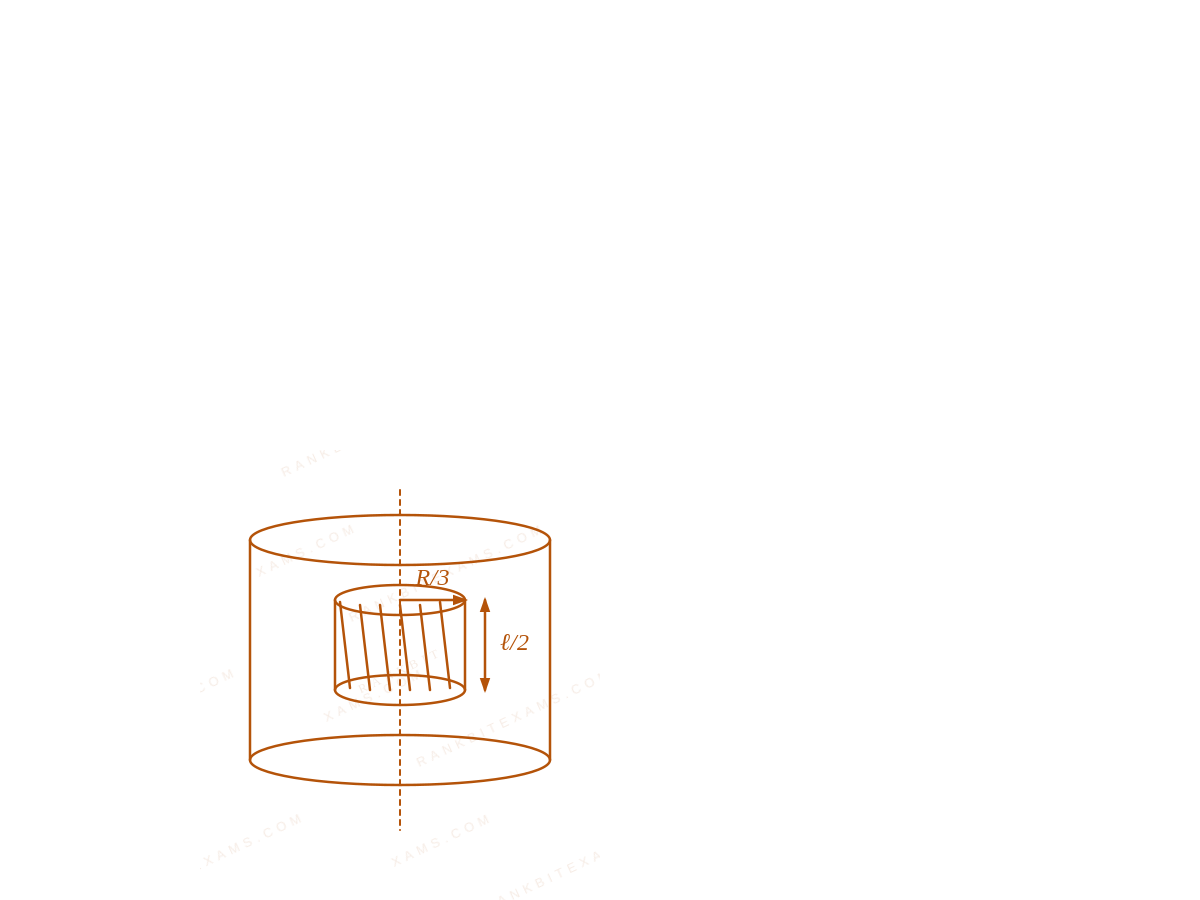
A uniform solid cylinder of length L and radius R has moment of inertia about its axis equal to I₁$I_{1}$ . A small co-centric cylinder of length L/2 and radius R/3 carved from this cylinder has moment of inertia about its axis equals to I₂$I_{2}$ . The ratio I₁/I₂$I_{1}/I_{2}$ is
Numerical Answer.Answer: 162 to 162
Solution
Related Formula
I = (1)/(2) M R²$$I = \frac{1}{2} M R^2$$M = ρ · V = ρ · π R² L$$M = \rho \cdot V = \rho \cdot \pi R^2 L$$
Core Logic
Moment of Inertia of Continuous Bodies diagram for Q49 - JEE Main 2026 Evening
I₂ = (1)/(2) m ((R)/(3))²$$I_2 = \frac{1}{2} m \left(\frac{R}{3}\right)^2$$I₂ = (1)/(2) ( (M)/(18) ) ( (R²)/(9) )$$I_2 = \frac{1}{2} \left( \frac{M}{18} \right) \left( \frac{R^2}{9} \right)$$I₂ = (1)/(324) M R²$$I_2 = \frac{1}{324} M R^2$$
Step 3: Finding the Ratio
(I₁)/(I₂) = ((1)/(2) M R²)/((1)/(324) M R²) = (324)/(2) = 162$$\frac{I_1}{I_2} = \frac{\frac{1}{2} M R^2}{\frac{1}{324} M R^2} = \frac{324}{2} = 162$$
Pattern Recognition
For similar geometries, mass scales as R² L$R^2 L$. Inertia scales as M R²$M R^2$ which ultimately means I ∝ R⁴ L$I \propto R^4 L$. Here R arrow R/3$R \rightarrow R/3$ (factor of 1/81$1/81$) and L arrow L/2$L \rightarrow L/2$ (factor of 1/2$1/2$), so I₂$I_2$ is 1/162$1/162$ of I₁$I_1$.
Chapter Mix
Class 11 Physics: System of Particles and Rotational Motion
Q29jee_main_2026_28_january_morningMoment of Inertia and Torque
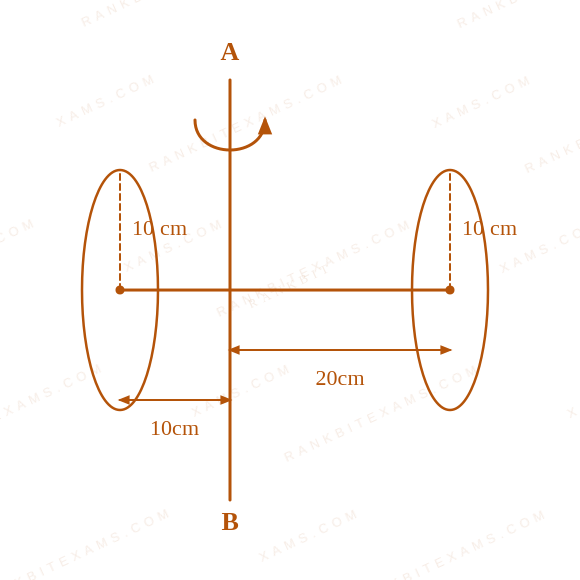
Two circular discs of radius each 10 cm are joined at their centres by a rod of length 30 cm and mass 600 gm as shown in figure.
Illustration showing two discs connected by a rod rotating about axis AB.
If the mass of each disc is 600 gm and applied torque between two discs is 43 × 10⁵ ~dyne· cm$43 \times 10^{5} \mathrm{~dyne\cdot cm}$, the angular acceleration of the discs about the given axis AB is ____ rad/s²$\mathrm{rad/s}^{2}$ .
A.22$22$
B.11$11$
C.100$100$
D.27$27$
Solution
Related Formula
τ = I α$\tau = I \alpha$
where τ$\tau$ is the torque, I$I$ is the moment of inertia about the axis of rotation, and α$\alpha$ is the angular acceleration.
Core Logic
First, calculate the total moment of inertia of the system (two discs + one rod) about axis AB using the parallel axis theorem. Let m = 600 ~gm$m = 600 \mathrm{~gm}$ and R = 10 ~cm$R = 10 \mathrm{~cm}$.
In compound systems, decompose into basic shapes (rod, disc). Determine the parallel distance to the required axis for each center of mass. Keep everything in CGS units since torque is given in dyne-cm.
Chapter Mix
Class 11 Physics: System of Particles and Rotational Motion
Q48jee_main_2026_28_january_morningRadius of Gyration
A solid sphere of radius 10 cm is rotating about an axis which is at a distance 15 cm from its centre. The radius of gyration about this axis is √(n)$\sqrt{n}$ cm. The value of n is ____
We are given k = √(n) ⇒ k² = n$k = \sqrt{n} \Rightarrow k^2 = n$.
n = 265$n = 265$
Pattern Recognition
Whenever radius of gyration is asked, divide out the mass immediately. k² = Icm-factor R² + d²$k^2 = I_{\text{cm-factor}} R^2 + d^2$.
Chapter Mix
Class 11 Physics: System of Particles and Rotational Motion
Q37jee_main_2026_28_january_eveningCross Product and Vector Reversal
When the position vector r=x i+y j+z k$\vec{r}=x\hat{i}+y\hat{j}+z\hat{k}$ changes sign as - r$-\vec{r}$ , which one of the following vector will not flip under sign change?
A.Linear momentum$\text{Linear momentum}$
B.Velocity$\text{Velocity}$
C.Acceleration$\text{Acceleration}$
D.Angular momentum$\text{Angular momentum}$
Solution
Related Formula
v = d rdt$$\vec{v} = \frac{d\vec{r}}{dt}$$p = m v$$\vec{p} = m\vec{v}$$a = d vdt$$\vec{a} = \frac{d\vec{v}}{dt}$$L = r × p$$\vec{L} = \vec{r} \times \vec{p}$$
Core Logic
Under a sign change of coordinates (parity transformation or spatial inversion) r arrow - r$\vec{r} \rightarrow -\vec{r}$.
Then, velocity v = d rdt arrow - v$\vec{v} = \frac{d\vec{r}}{dt} \rightarrow -\vec{v}$.
Linear momentum p = m v arrow - p$\vec{p} = m\vec{v} \rightarrow -\vec{p}$.
Acceleration a = d vdt arrow - a$\vec{a} = \frac{d\vec{v}}{dt} \rightarrow -\vec{a}$.
Angular momentum L = r × p$\vec{L} = \vec{r} \times \vec{p}$.
Under the transformation: L' = (- r) × (- p) = r × p = L$\vec{L}' = (-\vec{r}) \times (-\vec{p}) = \vec{r} \times \vec{p} = \vec{L}$.
Step 1: Final Conclusion
Since both position and momentum vectors change sign, their cross product (angular momentum) retains its original sign. It does not flip.
Pattern Recognition
Angular momentum is a pseudovector (or axial vector). True vectors (polar vectors) flip signs under spatial inversion, but pseudovectors (which are cross products of two polar vectors) do not.
Chapter Mix
Class 11 Physics: Systems of Particles and Rotational Motion
Q50jee_main_2026_28_january_eveningRotation about Fixed Axis
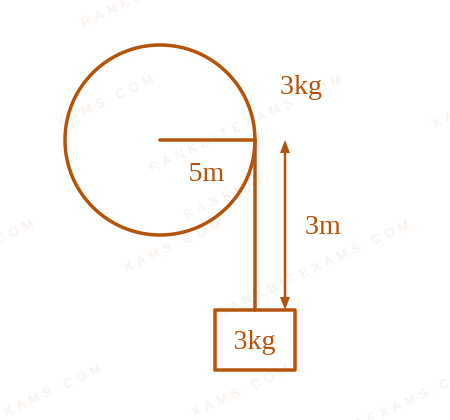
A fly wheel having mass 3 kg$3 \text{ kg}$ and radius 5 m$5 \text{ m}$ is free to rotate about a horizontal axis. A string having negligible mass is wound around the wheel and the loose end of the string is connected to a 3 kg$3 \text{ kg}$ mass. The mass is kept at rest initially and released. Kinetic energy of the wheel when the mass descends by 3 m$3 \text{ m}$ is ____ J. (g = 10 m/s²$g = 10 \text{ m/s}^{2}$ )
Solution for Rotation about Fixed Axis
By conservation of mechanical energy, the loss in gravitational potential energy of the descending mass equals the gain in kinetic energy of the block and the rotational kinetic energy of the flywheel.
mg h = (1)/(2) I ω² + (1)/(2) m v²$$mg h = \frac{1}{2} I \omega^2 + \frac{1}{2} m v^2$$
Step 1: Relate Velocity and Angular Velocity
Since the string does not slip, the linear velocity v$v$ of the mass is related to the angular velocity ω$\omega$ of the wheel by:
v = ω R ⇒ ω = (v)/(R)$$v = \omega R \Rightarrow \omega = \frac{v}{R}$$
Step 2: Energy Conservation
The flywheel is treated as a solid disc/cylinder (from the I = mR²/2$I = mR^2/2$ usage in the solution):
mg h = (1)/(2) ((M R²)/(2)) ω² + (1)/(2) m v²$$mg h = \frac{1}{2} \left(\frac{M R^2}{2}\right) \omega^2 + \frac{1}{2} m v^2$$
Given M = 3 kg$M = 3 \text{ kg}$ (wheel), m = 3 kg$m = 3 \text{ kg}$ (block), h = 3 m$h = 3 \text{ m}$.
Notice that the solution text specifies the flywheel mass as m$m$ and block mass also as m$m$, both being 3 kg$3\text{ kg}$. Let's follow the PDF exactly:
mg × 3 = (1)/(4) m v² + (1)/(2) m v²$$mg \times 3 = \frac{1}{4} m v^2 + \frac{1}{2} m v^2$$3mg = (3)/(4) m v²$$3mg = \frac{3}{4} m v^2$$v² = 4g = 4 × 10 = 40 (m/s)²$$v^2 = 4g = 4 \times 10 = 40 \text{ (m/s)}^2$$
Step 4: Calculate Kinetic Energy of Flywheel
K.E.wheel = (1)/(2) I ω² = (1)/(4) m v²$$K.E._{\text{wheel}} = \frac{1}{2} I \omega^2 = \frac{1}{4} m v^2$$K.E.wheel = (1)/(4) × 3 × 40 = 30 J$$K.E._{\text{wheel}} = \frac{1}{4} \times 3 \times 40 = 30 \text{ J}$$
Pattern Recognition
For a mass pulling a wheel of identical mass (disc), the total K.E.$K.E.$ is split between translational (1/2 mv²$1/2 mv^2$) and rotational (1/4 mv²$1/4 mv^2$). Rotational gets exactly 1/3$1/3$ of the total potential energy lost, 30 J$30\text{ J}$ out of 90 J$90\text{ J}$ total.
Chapter Mix
Class 11 Physics: Systems of Particles and Rotational Motion
Class 11 Physics: Work, Energy and Power
More System of Particles and Rotational Motion Questions — jee_main_2025_29_jan_evening
Practice past-year questions one chapter at a time. Pick an exam → subject → chapter and get every PYQ for that topic — pulled together from all past papers — with the chapter's key formulas alongside.