JEE Main · Physics ↓ Falling

Gravitation appeared 22 times across 3 years — 2.5% of Physics. This question is from Kepler's Laws and Planetary Motion.

Year 2026 2025 2024 Total
Questions 5 9 8 22

Two planets, A and B are orbiting a common star in circular orbits of radii RA and RB , respectively, with RB = 2RA . The planet B is 4√(2) times more massive than planet A. The ratio ( LBLA) of angular momentum (LB) of planet B to that of planet A(LA) is closest to integer ______.

Numerical Answer Type:
Enter a numerical value Answer: 8 to 8 +4 marks

Solution & Explanation

Related Formula
v₀ = GMₛₜₐᵣR L = m v₀ R = m G Mₛₜₐᵣ R
Core Logic

The orbital angular momentum scales as L ∝ m √(R), where m is the mass of the orbiting planet and R is its orbital radius.

Setting up the ratio for planet B to planet A:

(LB)/(LA) = ((mB)/(mA)) · √((RB)/(RA))

Substitute the relative constraints provided by the text:

  • mB = 4√(2) mA
  • RB = 2 RA
(LB)/(LA) = (4√(2)) × √(2) = 4 × 2 = 8
Pattern Recognition

Orbital velocity goes down as 1/√(R), but angular momentum features an explicit distance product multiplier (m v R), shifting the baseline radius factor to a clean numerator scaling profile: √(R).

Chapter Mix

Class 11 Physics: Gravitation

Reference Study Guides

More Gravitation Previous-Year Questions — Page 5

Q46 jee_main_2024_31_jan_evening Escape Velocity
The mass of the moon is 1/144 times the mass of a planet and its diameter 1/16 times the diameter of a planet. If the escape velocity on the planet is v, the escape velocity on the moon will be:
  • A. (v)/(3)
  • B. (v)/(4)
  • C. (v)/(12)
  • D. (v)/(6)

Solution

Related Formula
vescape = √((2GM)/(R))
Core Logic

For the planet: v = √((2GMₚ)/(Rₚ)) For the moon: Mm = (Mₚ)/(144) and Rm = (Rₚ)/(16).

Step 1: Setup the Ratio
vm = √((2G Mm)/(Rm)) vm = √((2G ((Mₚ)/(144)))/(((Rₚ)/(16)))) vm = √((2G Mₚ)/(Rₚ) × (16)/(144))
Step 2: Simplification
vm = √((2G Mₚ)/(Rₚ)) × √((1)/(9)) vm = v × (1)/(3) = (v)/(3)
Pattern Recognition

Escape velocity scales as √(M/R). If M scales by x and R scales by y, velocity scales by √(x/y). Here, √((1/144)/(1/16)) = √(16/144) = √(1/9) = 1/3.

Chapter Mix

Class 11 Physics: Gravitation
Q jee_main_2024_31_jan_morning Superposition Principle
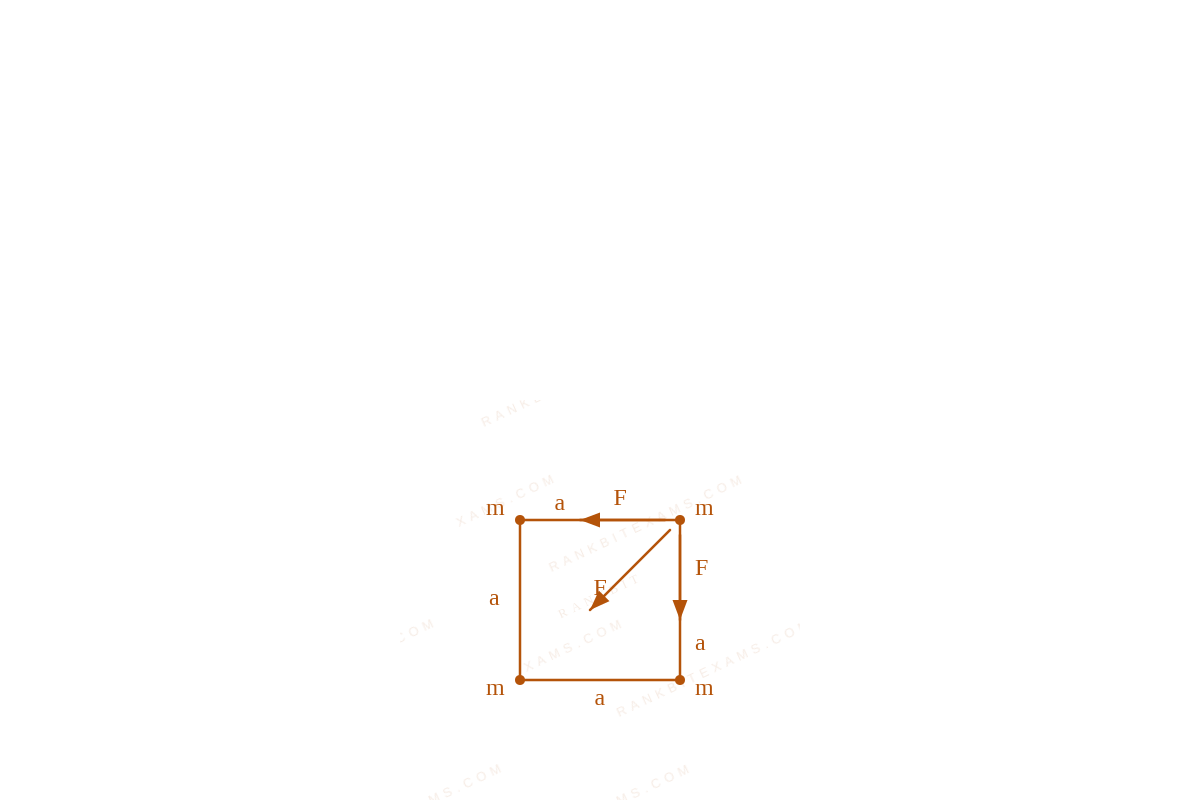
Four identical particles of mass m are kept at the four corners of a square. If the gravitational force exerted on one of the masses by the other masses is ( 2√(2) + 132) Gm²L², the length of the sides of the square is
  • A. L2
  • B. 4 L
  • C. 3L
  • D. 2 L

Solution

Related Formula
F = (G m₁ m₂)/(r²)
Core Logic

Superposition Principle diagram for Q37 - JEE Main 2024 Morning

Let the side length of the square be a. Considering one corner mass, it experiences forces from the adjacent two masses (distance a) and the diagonally opposite mass (distance √(2)a).

The forces from the two adjacent masses are at 90^° to each other:

F = (Gm²)/(a²)

The resultant of these two is √(2)F = √(2) (Gm²)/(a²), directed along the diagonal.

Step 2: Total Force Equation

The force from the diagonal mass is:

F' = Gm²(√(2)a)² = (Gm²)/(2a²)

Total resultant force Fₙₑₜ = √(2)F + F':

Fₙₑₜ = √(2) (Gm²)/(a²) + (Gm²)/(2a²) = (Gm²)/(a²) ( √(2) + (1)/(2) ) Fₙₑₜ = (Gm²)/(a²) ( 2√(2) + 12 )

Equating this to the given force value:

( 2√(2) + 132)(Gm²)/(L²) = (Gm²)/(a²) ( 2√(2) + 12 ) (1)/(32 L²) = (1)/(2 a²)

a² = 16 L² a = 4L

Chapter Mix

Class 11 Physics: Gravitation

More Gravitation Questions — jee_main_2025_29_jan_evening

Practice all Gravitation previous-year questions →

Rankbit System
JEE Physics: Waves (+15.5%) | Electrostatics: Concentric Shells (-29.7%) | Modern Physics: Photoelectric Clones (+34.2%) | Mathematics: Definite Integrals (+18.1%) | Chemistry: Coordination Splitting (-11.4%) | JEE Physics: Waves (+15.5%) | Electrostatics: Concentric Shells (-29.7%) | Modern Physics: Photoelectric Clones (+34.2%) | Mathematics: Definite Integrals (+18.1%) | Chemistry: Coordination Splitting (-11.4%)