A satellite of mass 1000mathrmkg is launched to revolve around the earth in an orbit at a height of 270mathrmkm from the earth's surface. Kinetic energy of the satellite in this orbit is \_ \times 10^{10}\mathrm{J} . (Mass of earth = 6\times 10^{24}\mathrm{kg}, Radius of earth = 6.4 \times 10^{6} \mathrm{~m} , Gravitational constant = 6.67 \times 10^{-11} \mathrm{Nm}^2 \mathrm{kg}^{-2}$)

Numerical Answer Type:
Enter a numerical value Answer: 3 to 3 +4 marks

Solution & Explanation

### Related Formula 1. Orbital speed (v_0) of a satellite at distance r from earth's center: v_0 = sqrtfracG M_er 2. Orbital Radius: r = R_e + h 3. Kinetic Energy of the orbiting satellite: mathrmKE = frac12 m v_0^2 = fracG M_e m2(R_e + h) ### Core Logic Given parameters: - Mass of satellite m = 1000 \ mathrmkg = 10^3 \ mathrmkg - Orbit altitude h = 270 \ mathrmkm = 0.27 times 10^6 \ mathrmm - Earth Radius R_e = 6.4 times 10^6 \ mathrmm - Earth Mass M_e = 6 times 10^24 \ mathrmkg - Gravitational constant G = 6.67 times 10^-11 \ mathrmN cdot m^2 / kg^2 ### Step 1: Calculate kinetic energy First, compute the orbital radius r: r = R_e + h = 6.4 times 10^6 \ mathrmm + 0.27 times 10^6 \ mathrmm = 6.67 times 10^6 \ mathrmm Substitute r = 6.67 times 10^6 \ mathrmm into the kinetic energy equation: mathrmKE = fracG M_e m2 r mathrmKE = frac6.67 times 10^-11 times 6 times 10^24 times 10^32 times 6.67 times 10^6 Notice that the value 6.67 cancels out directly: mathrmKE = frac6 times 10^162 times 10^6 = 3 times 10^10 \ mathrmJ Thus, the kinetic energy coefficient is 3. ### Pattern Recognition Sees: Kinetic energy of a satellite orbiting at an altitude above earth's surface. Trap: Doing long division calculation for 6.67/2. Check for clean cancellations in formulas first! Shortcut: Notice that R_e + h = 6.4 times 10^6 + 0.27 times 10^6 = 6.67 times 10^6, which matches the value of the Gravitational constant G = 6.67 times 10^-11 perfectly. This clean cancellation leaves behind simple integer math to give 3 times 10^10 mathrm~J immediately. ### Evaluation Rubric / Model Answer null ### Chapter Mix Class 11 Physics: Gravitation

Reference Study Guides

More Gravitation Previous-Year Questions

Q44 jee_main_2026_21_jan_morning Satellite Energy
Initially a satellite of 100 kg is in a circular orbit of radius 1.5R_E. This satellite can be moved to a circular orbit of radius 3R_E by supplying alpha times 10^6J of energy. The value of alpha is ____. (Take Radius of Earth R_E = 6 times 10^6text m and g = 10text m/s^2)
  • A. 150
  • B. 500
  • C. 100
  • D. 1000

Solution

### Related Formula E = frac-GM_E m2r Delta E = E_f - E_i g = fracGM_ER_E^2 implies GM_E = g R_E^2 ### Core Logic Energy of a satellite in a circular orbit is given as E = frac-GM_E m2r where r is the radius of the circular orbit. Required energy to be supplied Delta E = E_f - E_i: Delta E = left( frac-GM_E m2(3R_E) right) - left( frac-GM_E m2(1.5R_E) right) Delta E = frac-GM_E m6R_E + fracGM_E m3R_E = fracGM_E m6R_E ### Step 1: Evaluate Delta E Substitute GM_E = g R_E^2 into the expression: Delta E = frac(g R_E^2) m6R_E = frac16 m g R_E = frac16 times 100 times 10 times (6 times 10^6) = 1000 times 10^6text J Comparing with alpha times 10^6text J, we get alpha = 1000. ### Pattern Recognition Orbital transition energy is always Delta E = fracGMm2 (frac1r_i - frac1r_f). Never forget the factor of 2 in the denominator (which accounts for kinetic energy contribution in orbit). ### Evaluation Rubric / Model Answer null ### Chapter Mix Class 11 Physics: Gravitation
Q30 jee_main_2026_22_january_morning Escape Velocity
The escape velocity from a spherical planet A is 10 km/s. The escape velocity from another planet B whose density and radius are 10% of those of planet A, is \_\_\_\_ m/s.
  • A. 1000
  • B. 200sqrt5
  • C. 100sqrt10
  • D. 1000sqrt2

Solution

### Related Formula V_e = sqrtfrac2GMR = sqrtfrac2G rho frac4pi R^33R implies V_e propto sqrtrho times R ### Core Logic Given density and radius of B are 10% (0.1) of planet A: frac(V_e)_B(V_e)_A = sqrtfracrho_Brho_A times fracR_BR_A = sqrt0.1 times 0.1 = frac110sqrt10 (V_e)_B = frac10 times 100010sqrt10 = 100sqrt10 text m/sec ### Pattern Recognition Sees: Escape velocity scaling with density and radius. Shortcut: Express escape velocity in terms of density rho and radius R, then take ratios. Check: Matches option (3). ✓ ### Chapter Mix Class 11 Physics: Gravitation
Q35 jee_main_2026_22_january_morning Gravitational Force and Superposition
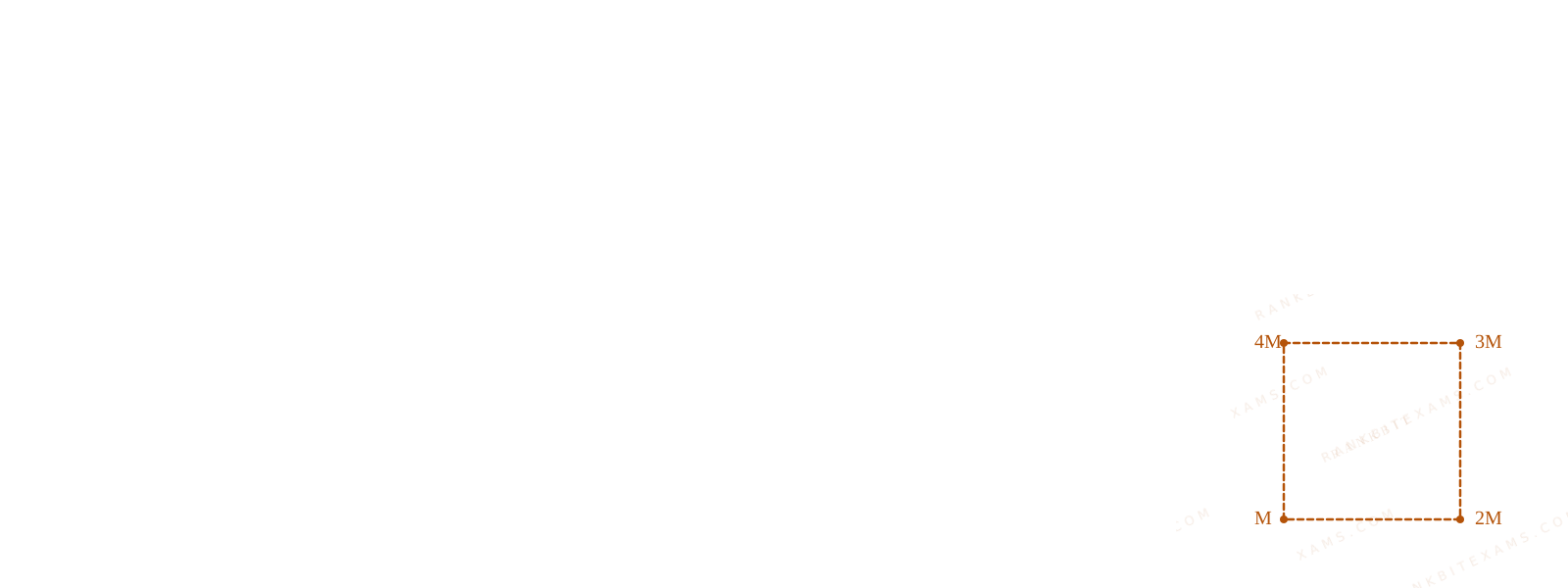
Net gravitational force at the centre of a square is found to be F_1 when four particles having mass M, 2M, 3M and 4M are placed at the four corners of the square as shown in figure and it is F_2 when the positions of 3M and 4M are interchanged. The ratio fracF_1F_2 is fracalphasqrt5. The value of alpha is \_\_\_\_.
Gravitation diagram for Q35 - JEE Main 2026 January Morning
Four point masses placed at the corners of a square.
  • A. 2
  • B. 3
  • C. 1
  • D. 2sqrt5

Solution

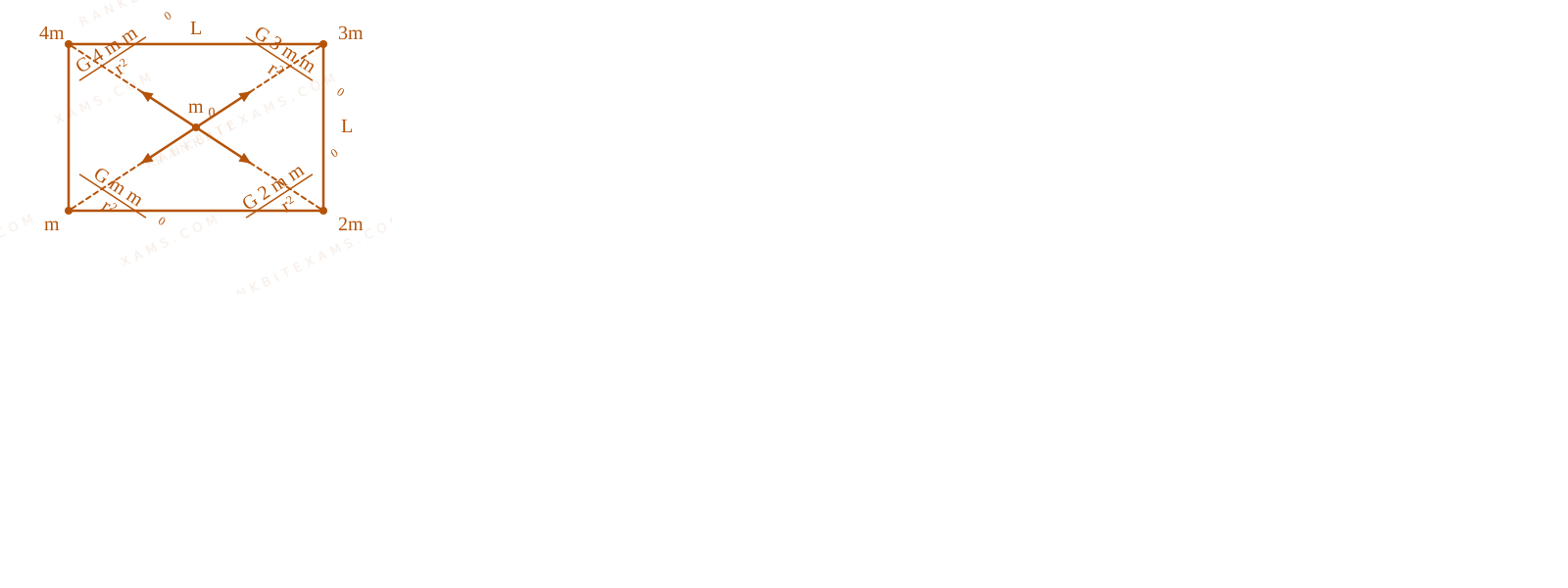
### Related Formula F = fracG m_1 m_2r^2 ### Core Logic
Solution diagram for Q35 - JEE Main 2026 Morning
Four point masses placed at the corners of a square.
Initial configuration: F_1 = 2sqrt2 fracGmm_0r^2$| New configuration (after interchanging 3M and 4M): F_2 = \sqrt{10} \frac{Gmm_0}{r^2}Ratio:\frac{F_1}{F_2} = \frac{2\sqrt{2}}{\sqrt{10}} = \frac{2}{\sqrt{5}} \implies \alpha = 2$$ ### Pattern Recognition Sees: Gravitational force vector sum at center of square. Shortcut: Compute net vector resultants for both mass configurations and take ratio. Check: Matches option (1). ✓ ### Chapter Mix Class 11 Physics: Gravitation
Q39 jee_main_2026_22_january_evening Satellite Motion and Time Period
Given below are two statements : Statement I : A satellite is moving around earth in the orbit very close to the earth surface. The time period of revolution of satellite depends upon the density of earth. Statement II: The time period of revolution of the satellite is T = 2pi sqrtfracR_eg (for satellite very close to the earth surface), where R_e radius of earth and g acceleration due to gravity. In the light of the above statements, choose the correct answer from the options given below :
  • A. Both Statement I and Statement II are false
  • B. Both Statement I and Statement II are true
  • C. Statement I is true but Statement II is false
  • D. Statement I is false but Statement II is true

Solution

### Related Formula T = 2pi sqrtfracR^3GM M = rho cdot frac43pi R^3 g = fracGMR^2 ### Core Logic Evaluating Statement I: Substituting total mass M = rho cdot frac43pi R^3 into time period formula: T = 2pi sqrtfracR^3G left(rho cdot frac43pi R^3right) = sqrtfrac3piG rho Hence, time period depends inversely on the square root of Earth's density rho. Statement I is true. Evaluating Statement II: Substituting g = fracGMR_e^2 into T = 2pi sqrtfracR_e^3GM: T = 2pi sqrtfracR_eg Statement II is also true. ### Step 1: Final Conclusion Both Statement I and Statement II are true. ### Pattern Recognition Near-surface satellite shortcut: T = sqrt3pi / (Grho) approx 84.6 text min. Shows direct dependence on Earth's density rho and formula T = 2pi sqrtR_e / g. ### Evaluation Rubric / Model Answer null ### Chapter Mix Class 11 Physics: Gravitation
Q45 jee_main_2026_24_january_morning Gravitational Potential Energy
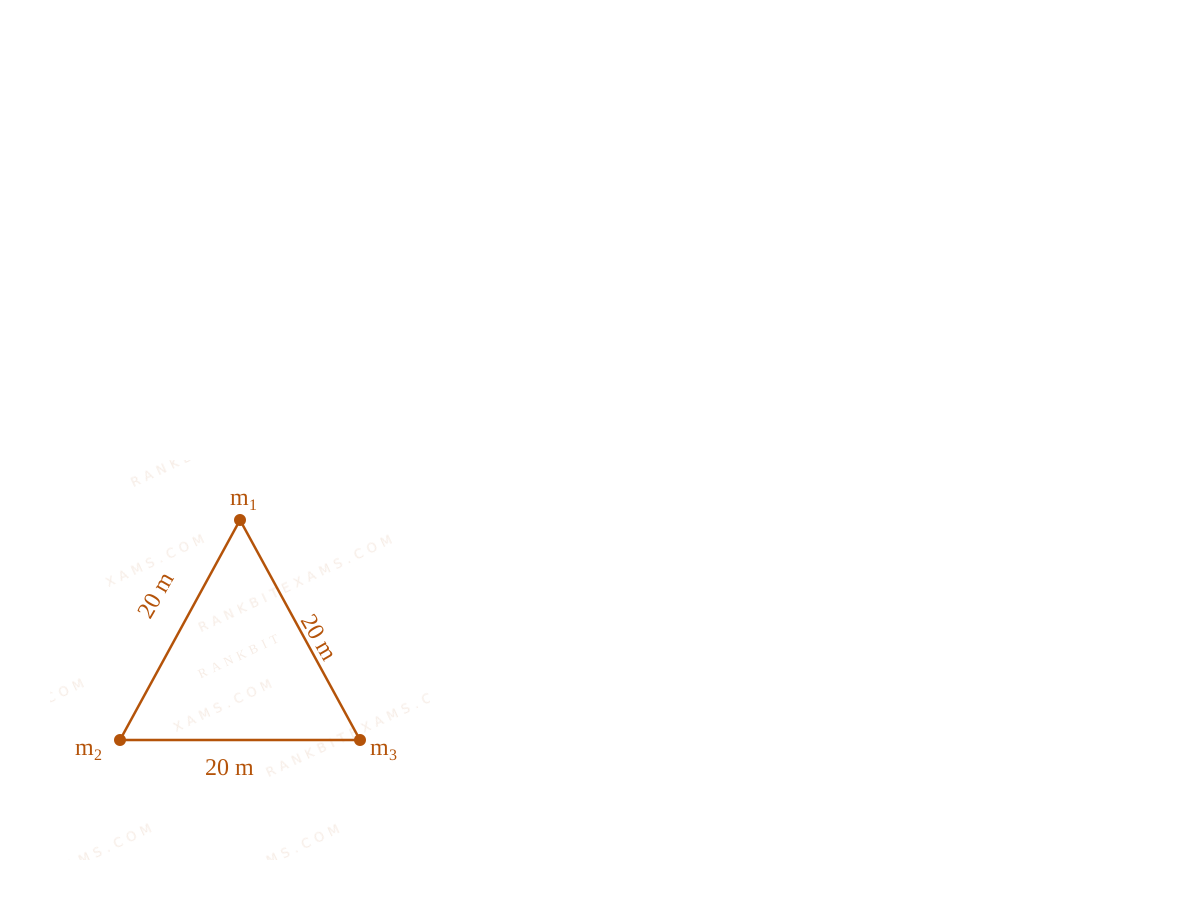
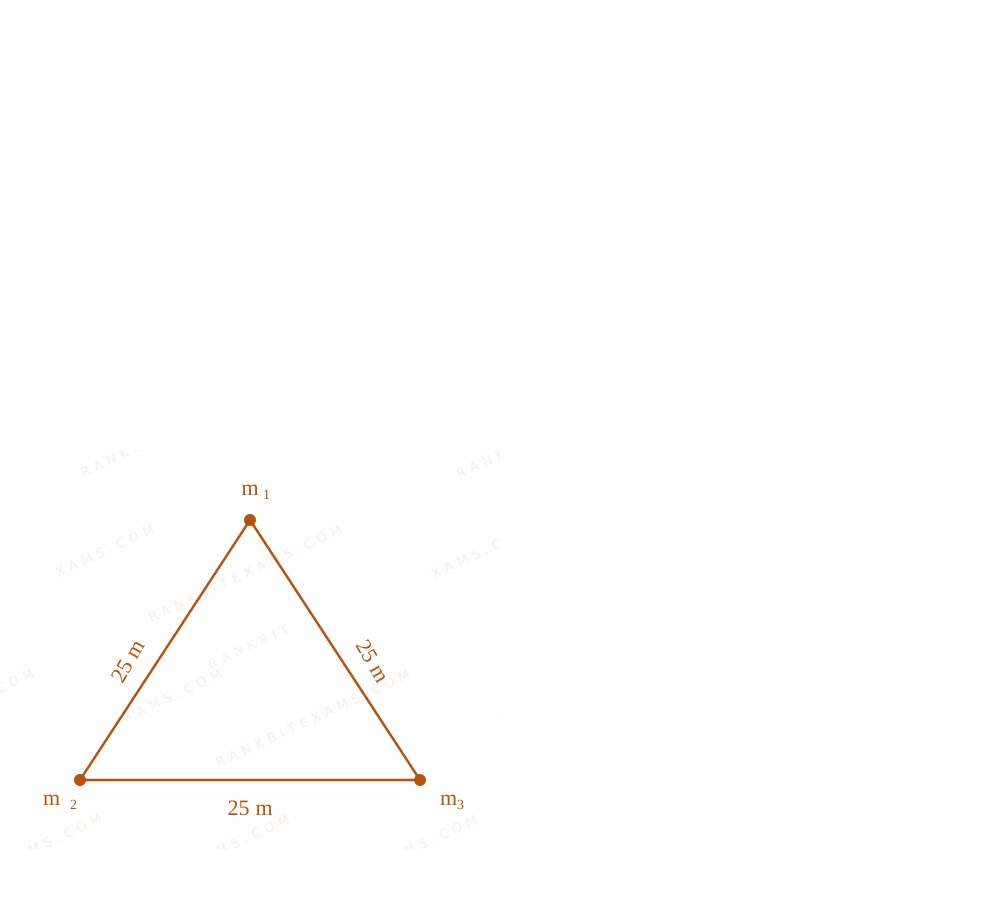
Three masses 200 kg, 300 kg and 400 kg are placed at the vertices of an equilateral triangle with sides 20 m. They are rearranged on the vertices of a bigger triangle of side 25 m and with the same centre. The work done in this process ____ J. (Gravitational constant G = 6.7 times 10^-11 text N m^2 / textkg^2)
  • A. 9.86 times 10^-6
  • B. 2.85 times 10^-7
  • C. 1.74 times 10^-7
  • D. 4.77 times 10^-7

Solution

### Related Formula U = -fracGm_1 m_2r W_textext = Delta U = U_f - U_i ### Core Logic
Equilateral triangle mass configuration scaling
Initial potential energy of the system (r_i = 20 text m): U_i = -fracGr_i (m_1 m_2 + m_2 m_3 + m_1 m_3) U_i = frac-6.67 times 10^-1120 [200 times 300 + 300 times 400 + 200 times 400] U_i = frac-6.67 times 10^-1120 [60000 + 120000 + 80000] U_i = frac-6.67 times 10^-1120 times 260000 = -86.71 times 10^-8 text J
Equilateral triangle mass configuration scaling
Final potential energy of the system (r_f = 25 text m): U_f = -fracGr_f (260000) U_f = frac-6.67 times 10^-1125 times 260000 U_f = -69.36 times 10^-8 text J ### Step 1: Calculate Work Done The work done by an external agent is equal to the change in potential energy: Delta U = U_f - U_i Delta U = (-69.36 times 10^-8) - (-86.71 times 10^-8) Delta U = (86.71 - 69.36) times 10^-8 = 17.35 times 10^-8 text J approx 1.74 times 10^-7 text J ### Pattern Recognition When an entire geometric configuration is isotropically scaled (e.g., side a to b), the total potential energy scales by the ratio of their reciprocals. U_f = U_i (r_i/r_f). ### Evaluation Rubric / Model Answer null ### Chapter Mix Class 11 Physics: Gravitation Class 11 Physics: Work, Energy and Power

More Gravitation Questions — jee_main_2025_02_april_evening

Practice all Gravitation previous-year questions →

Rankbit System
JEE Physics: Waves (+15.5%) | Electrostatics: Concentric Shells (-29.7%) | Modern Physics: Photoelectric Clones (+34.2%) | Mathematics: Definite Integrals (+18.1%) | Chemistry: Coordination Splitting (-11.4%) | JEE Physics: Waves (+15.5%) | Electrostatics: Concentric Shells (-29.7%) | Modern Physics: Photoelectric Clones (+34.2%) | Mathematics: Definite Integrals (+18.1%) | Chemistry: Coordination Splitting (-11.4%)