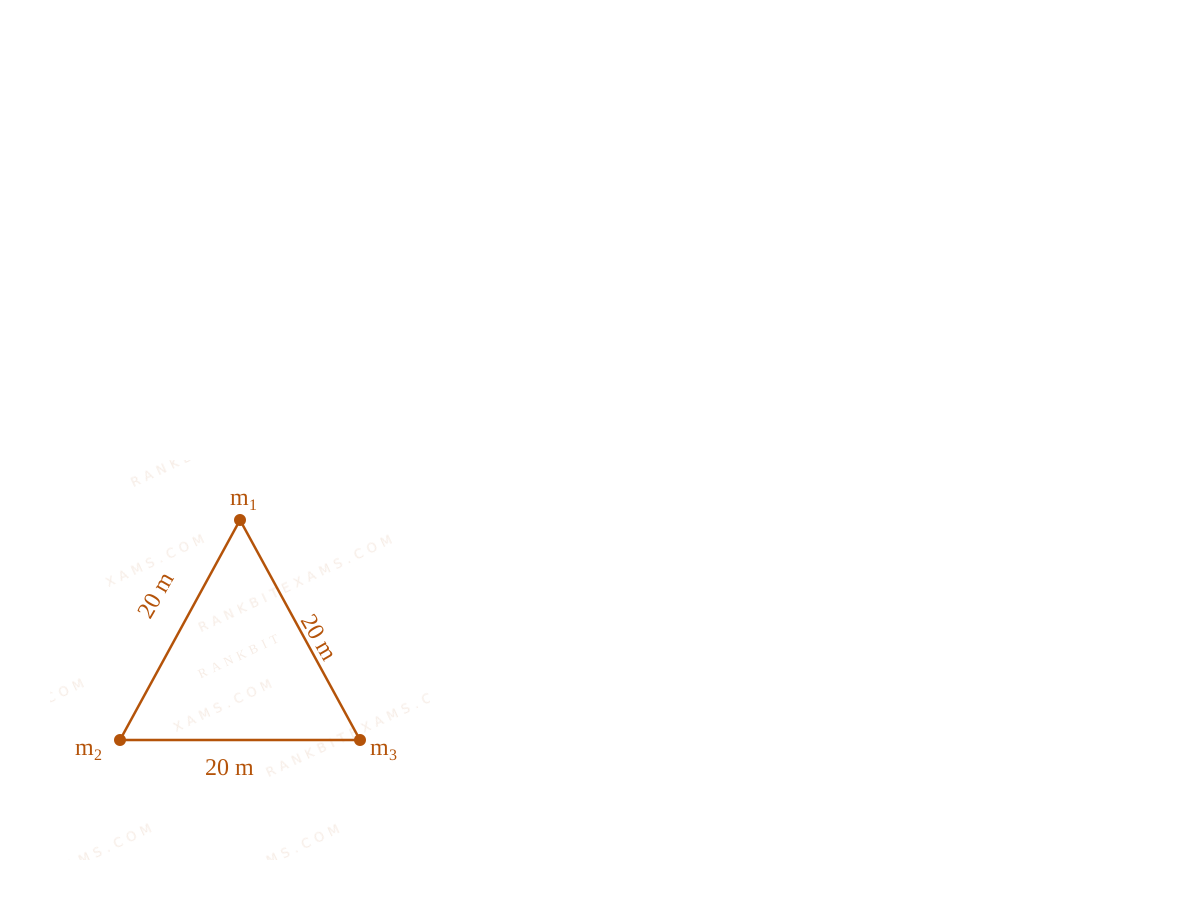
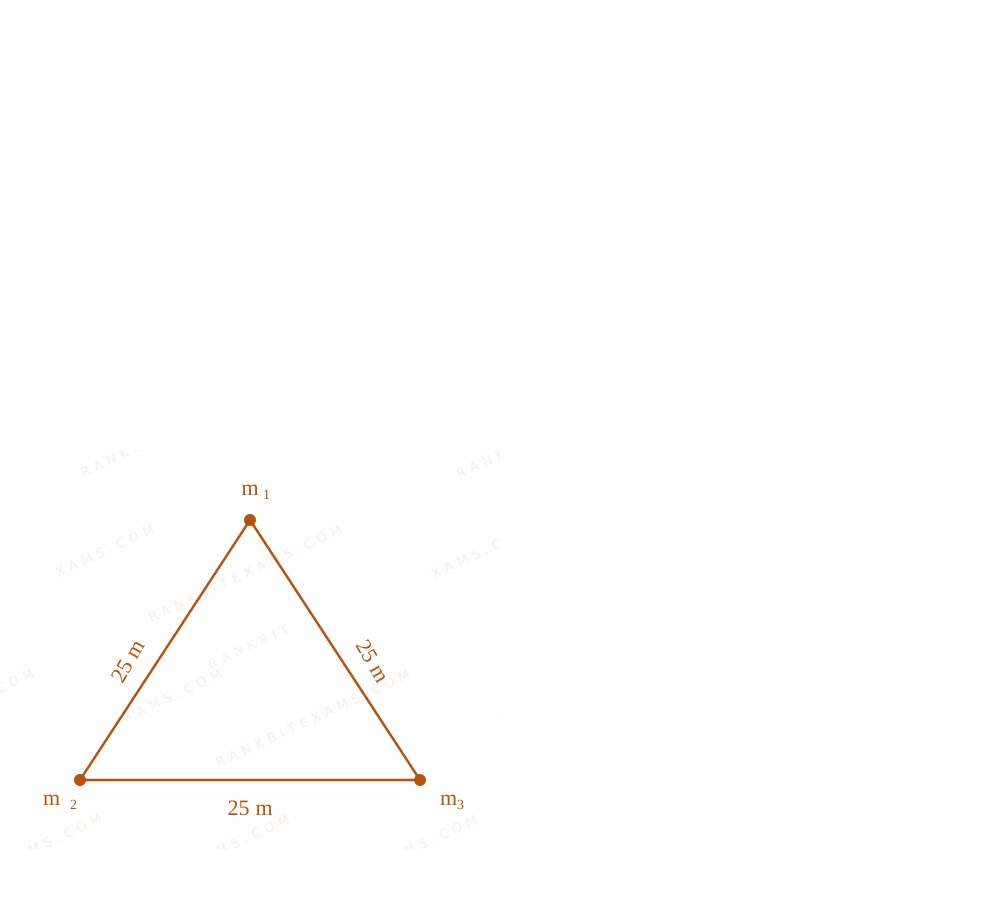
Three masses 200 kg, 300 kg and 400 kg are placed at the vertices of an equilateral triangle with sides 20 m. They are rearranged on the vertices of a bigger triangle of side 25 m and with the same centre. The work done in this process ____ J. (Gravitational constant G = 6.7 times 10^-11 text N m^2 / textkg^2)

Solution & Explanation

### Related Formula U = -fracGm_1 m_2r W_textext = Delta U = U_f - U_i ### Core Logic
Equilateral triangle mass configuration scaling
Initial potential energy of the system (r_i = 20 text m): U_i = -fracGr_i (m_1 m_2 + m_2 m_3 + m_1 m_3) U_i = frac-6.67 times 10^-1120 [200 times 300 + 300 times 400 + 200 times 400] U_i = frac-6.67 times 10^-1120 [60000 + 120000 + 80000] U_i = frac-6.67 times 10^-1120 times 260000 = -86.71 times 10^-8 text J
Equilateral triangle mass configuration scaling
Final potential energy of the system (r_f = 25 text m): U_f = -fracGr_f (260000) U_f = frac-6.67 times 10^-1125 times 260000 U_f = -69.36 times 10^-8 text J ### Step 1: Calculate Work Done The work done by an external agent is equal to the change in potential energy: Delta U = U_f - U_i Delta U = (-69.36 times 10^-8) - (-86.71 times 10^-8) Delta U = (86.71 - 69.36) times 10^-8 = 17.35 times 10^-8 text J approx 1.74 times 10^-7 text J ### Pattern Recognition When an entire geometric configuration is isotropically scaled (e.g., side a to b), the total potential energy scales by the ratio of their reciprocals. U_f = U_i (r_i/r_f). ### Evaluation Rubric / Model Answer null ### Chapter Mix Class 11 Physics: Gravitation Class 11 Physics: Work, Energy and Power

Reference Study Guides

More Gravitation Previous-Year Questions

Q44 jee_main_2026_21_jan_morning Satellite Energy
Initially a satellite of 100 kg is in a circular orbit of radius 1.5R_E. This satellite can be moved to a circular orbit of radius 3R_E by supplying alpha times 10^6J of energy. The value of alpha is ____. (Take Radius of Earth R_E = 6 times 10^6text m and g = 10text m/s^2)
  • A. 150
  • B. 500
  • C. 100
  • D. 1000

Solution

### Related Formula E = frac-GM_E m2r Delta E = E_f - E_i g = fracGM_ER_E^2 implies GM_E = g R_E^2 ### Core Logic Energy of a satellite in a circular orbit is given as E = frac-GM_E m2r where r is the radius of the circular orbit. Required energy to be supplied Delta E = E_f - E_i: Delta E = left( frac-GM_E m2(3R_E) right) - left( frac-GM_E m2(1.5R_E) right) Delta E = frac-GM_E m6R_E + fracGM_E m3R_E = fracGM_E m6R_E ### Step 1: Evaluate Delta E Substitute GM_E = g R_E^2 into the expression: Delta E = frac(g R_E^2) m6R_E = frac16 m g R_E = frac16 times 100 times 10 times (6 times 10^6) = 1000 times 10^6text J Comparing with alpha times 10^6text J, we get alpha = 1000. ### Pattern Recognition Orbital transition energy is always Delta E = fracGMm2 (frac1r_i - frac1r_f). Never forget the factor of 2 in the denominator (which accounts for kinetic energy contribution in orbit). ### Evaluation Rubric / Model Answer null ### Chapter Mix Class 11 Physics: Gravitation
Q30 jee_main_2026_22_january_morning Escape Velocity
The escape velocity from a spherical planet A is 10 km/s. The escape velocity from another planet B whose density and radius are 10% of those of planet A, is \_\_\_\_ m/s.
  • A. 1000
  • B. 200sqrt5
  • C. 100sqrt10
  • D. 1000sqrt2

Solution

### Related Formula V_e = sqrtfrac2GMR = sqrtfrac2G rho frac4pi R^33R implies V_e propto sqrtrho times R ### Core Logic Given density and radius of B are 10% (0.1) of planet A: frac(V_e)_B(V_e)_A = sqrtfracrho_Brho_A times fracR_BR_A = sqrt0.1 times 0.1 = frac110sqrt10 (V_e)_B = frac10 times 100010sqrt10 = 100sqrt10 text m/sec ### Pattern Recognition Sees: Escape velocity scaling with density and radius. Shortcut: Express escape velocity in terms of density rho and radius R, then take ratios. Check: Matches option (3). ✓ ### Chapter Mix Class 11 Physics: Gravitation
Q35 jee_main_2026_22_january_morning Gravitational Force and Superposition
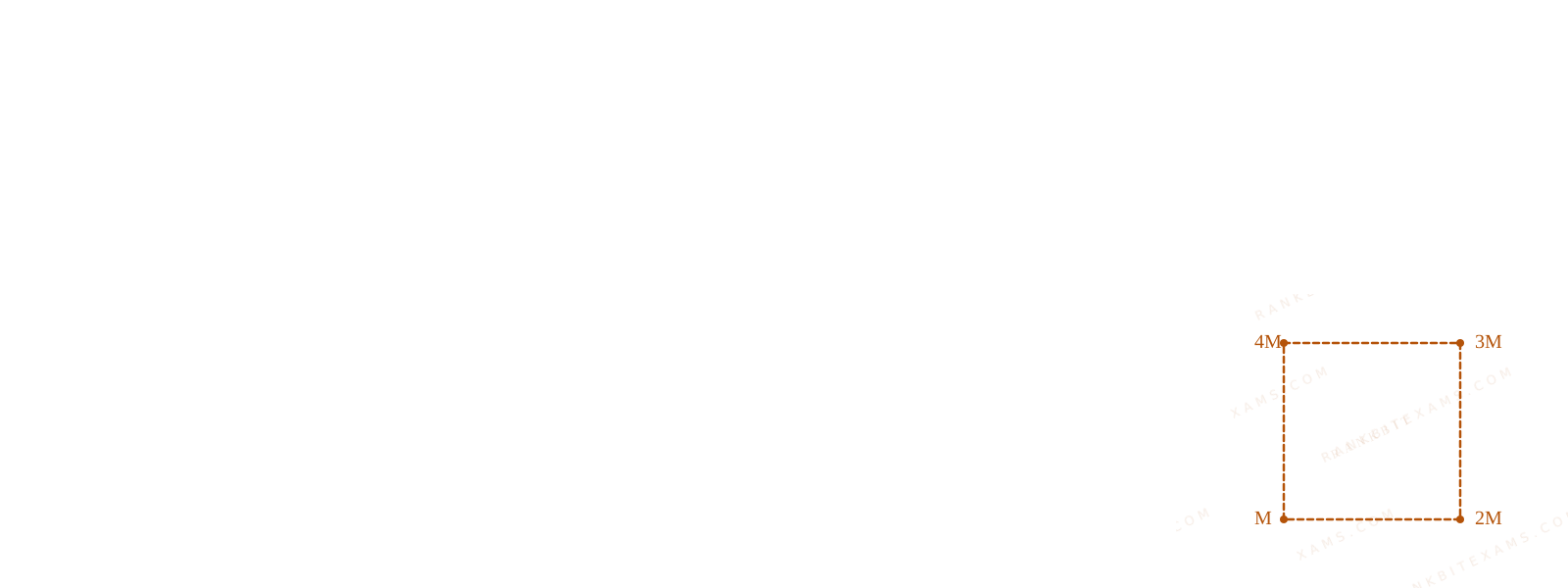
Net gravitational force at the centre of a square is found to be F_1 when four particles having mass M, 2M, 3M and 4M are placed at the four corners of the square as shown in figure and it is F_2 when the positions of 3M and 4M are interchanged. The ratio fracF_1F_2 is fracalphasqrt5. The value of alpha is \_\_\_\_.
Gravitation diagram for Q35 - JEE Main 2026 January Morning
Four point masses placed at the corners of a square.
  • A. 2
  • B. 3
  • C. 1
  • D. 2sqrt5

Solution

### Related Formula F = fracG m_1 m_2r^2 ### Core Logic
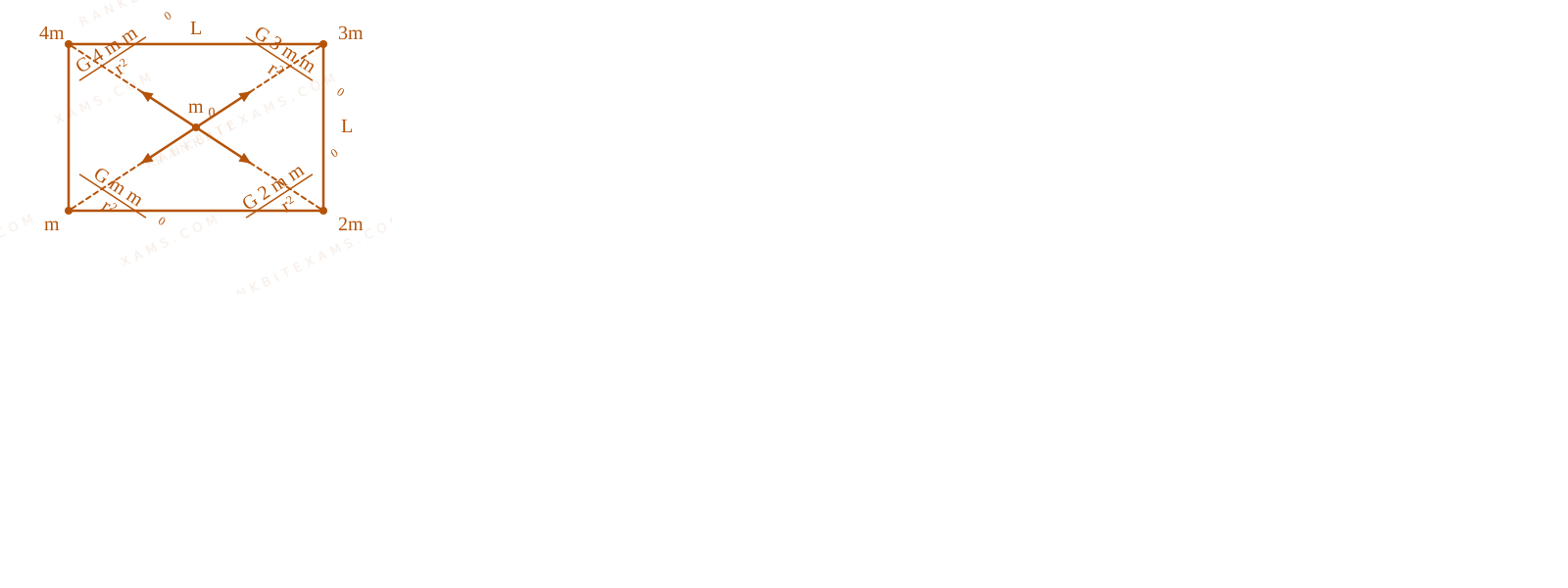
Solution diagram for Q35 - JEE Main 2026 Morning
Four point masses placed at the corners of a square.
Initial configuration: F_1 = 2sqrt2 fracGmm_0r^2$| New configuration (after interchanging 3M and 4M): F_2 = \sqrt{10} \frac{Gmm_0}{r^2}Ratio:\frac{F_1}{F_2} = \frac{2\sqrt{2}}{\sqrt{10}} = \frac{2}{\sqrt{5}} \implies \alpha = 2$$ ### Pattern Recognition Sees: Gravitational force vector sum at center of square. Shortcut: Compute net vector resultants for both mass configurations and take ratio. Check: Matches option (1). ✓ ### Chapter Mix Class 11 Physics: Gravitation

Q39 jee_main_2026_22_january_evening Satellite Motion and Time Period
Given below are two statements : Statement I : A satellite is moving around earth in the orbit very close to the earth surface. The time period of revolution of satellite depends upon the density of earth. Statement II: The time period of revolution of the satellite is T = 2pi sqrtfracR_eg (for satellite very close to the earth surface), where R_e radius of earth and g acceleration due to gravity. In the light of the above statements, choose the correct answer from the options given below :
  • A. Both Statement I and Statement II are false
  • B. Both Statement I and Statement II are true
  • C. Statement I is true but Statement II is false
  • D. Statement I is false but Statement II is true

Solution

### Related Formula T = 2pi sqrtfracR^3GM M = rho cdot frac43pi R^3 g = fracGMR^2 ### Core Logic Evaluating Statement I: Substituting total mass M = rho cdot frac43pi R^3 into time period formula: T = 2pi sqrtfracR^3G left(rho cdot frac43pi R^3right) = sqrtfrac3piG rho Hence, time period depends inversely on the square root of Earth's density rho. Statement I is true. Evaluating Statement II: Substituting g = fracGMR_e^2 into T = 2pi sqrtfracR_e^3GM: T = 2pi sqrtfracR_eg Statement II is also true. ### Step 1: Final Conclusion Both Statement I and Statement II are true. ### Pattern Recognition Near-surface satellite shortcut: T = sqrt3pi / (Grho) approx 84.6 text min. Shows direct dependence on Earth's density rho and formula T = 2pi sqrtR_e / g. ### Evaluation Rubric / Model Answer null ### Chapter Mix Class 11 Physics: Gravitation

More Gravitation Questions — jee_main_2026_24_january_morning

Practice all Gravitation previous-year questions →

Rankbit System
JEE Physics: Waves (+15.5%) | Electrostatics: Concentric Shells (-29.7%) | Modern Physics: Photoelectric Clones (+34.2%) | Mathematics: Definite Integrals (+18.1%) | Chemistry: Coordination Splitting (-11.4%) | JEE Physics: Waves (+15.5%) | Electrostatics: Concentric Shells (-29.7%) | Modern Physics: Photoelectric Clones (+34.2%) | Mathematics: Definite Integrals (+18.1%) | Chemistry: Coordination Splitting (-11.4%)