
Rankbit System
JEE Physics: Waves (+15.5%) | Electrostatics: Concentric Shells (-29.7%) | Modern Physics: Photoelectric Clones (+34.2%) | Mathematics: Definite Integrals (+18.1%) | Chemistry: Coordination Splitting (-11.4%) | JEE Physics: Waves (+15.5%) | Electrostatics: Concentric Shells (-29.7%) | Modern Physics: Photoelectric Clones (+34.2%) | Mathematics: Definite Integrals (+18.1%) | Chemistry: Coordination Splitting (-11.4%)

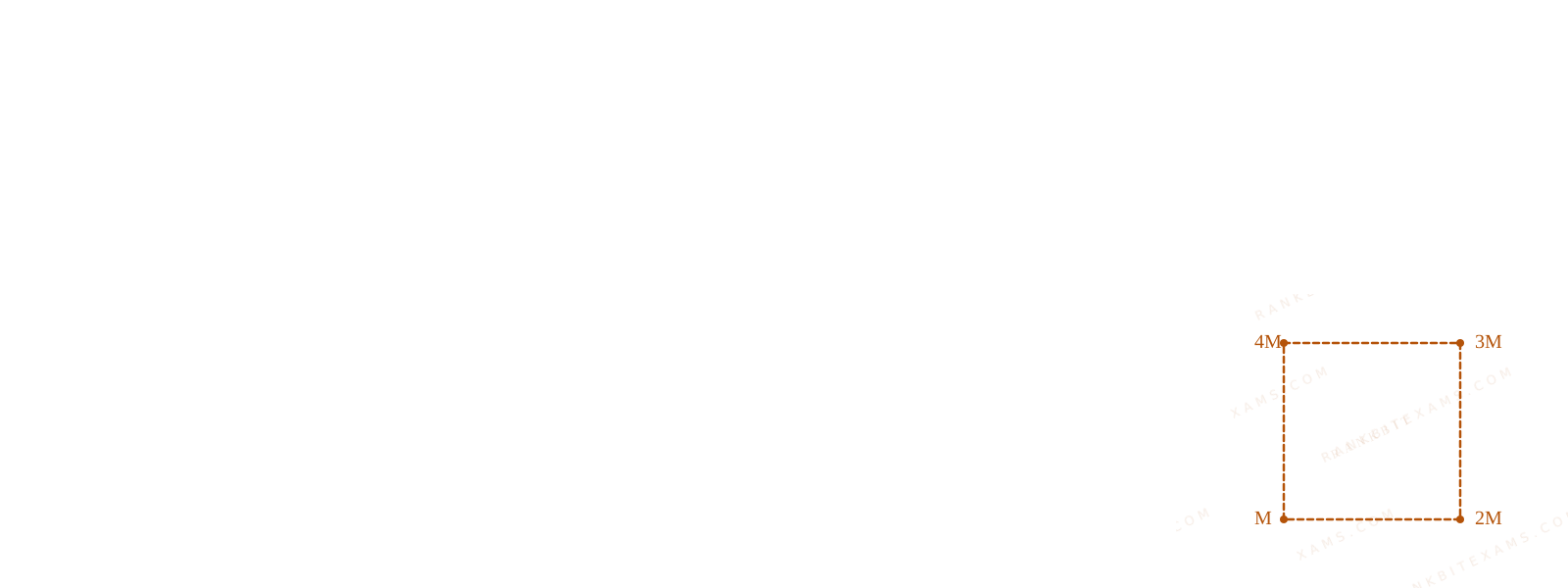
An object is kept at rest at a distance of 3R above the earth's surface where R is earth's radius. The minimum speed with which it must be projected so that it does not return to earth is: (Assume M= mass of earth, G= Universal gravitational constant)

Solution & Explanation

### Related Formula Conservation of Total Mechanical Energy: E_i = E_f U_i + K_i = U_f + K_f ### Core Logic The initial distance from the center of the earth is r = R + 3R = 4R. Initial mechanical energy: E_i = -fracGMm4R + frac12mv^2 To just escape to infinity, the final mechanical energy at infinity must be at least zero: E_f = 0 ### Step 1: Apply Energy Conservation Setting initial energy equal to zero: -fracGMm4R + frac12mv^2 = 0 frac12v^2 = fracGM4R implies v = sqrtfracGM2R
Escape projection trajectory from height 3R
### Pattern Recognition Be extremely careful with the phrase 'above the earth's surface'. Distance from center r = R + h. Escape condition always sets net mechanical energy ge 0. ### Evaluation Rubric / Model Answer null ### Chapter Mix Class 11 Physics: Gravitation
Reference Study Guides

More Gravitation Previous-Year Questions

Q25 2025 Satellite Motion and Orbital Energy
A satellite of mass 1000mathrmkg is launched to revolve around the earth in an orbit at a height of 270mathrmkm from the earth's surface. Kinetic energy of the satellite in this orbit is \_ \times 10^{10}\mathrm{J} . (Mass of earth = 6\times 10^{24}\mathrm{kg}, Radius of earth = 6.4 \times 10^{6} \mathrm{~m} , Gravitational constant = 6.67 \times 10^{-11} \mathrm{Nm}^2 \mathrm{kg}^{-2}$)
Numerical Answer. Answer: 3 to 3

Solution

### Related Formula 1. Orbital speed (v_0) of a satellite at distance r from earth's center: v_0 = sqrtfracG M_er 2. Orbital Radius: r = R_e + h 3. Kinetic Energy of the orbiting satellite: mathrmKE = frac12 m v_0^2 = fracG M_e m2(R_e + h) ### Core Logic Given parameters: - Mass of satellite m = 1000 \ mathrmkg = 10^3 \ mathrmkg - Orbit altitude h = 270 \ mathrmkm = 0.27 times 10^6 \ mathrmm - Earth Radius R_e = 6.4 times 10^6 \ mathrmm - Earth Mass M_e = 6 times 10^24 \ mathrmkg - Gravitational constant G = 6.67 times 10^-11 \ mathrmN cdot m^2 / kg^2 ### Step 1: Calculate kinetic energy First, compute the orbital radius r: r = R_e + h = 6.4 times 10^6 \ mathrmm + 0.27 times 10^6 \ mathrmm = 6.67 times 10^6 \ mathrmm Substitute r = 6.67 times 10^6 \ mathrmm into the kinetic energy equation: mathrmKE = fracG M_e m2 r mathrmKE = frac6.67 times 10^-11 times 6 times 10^24 times 10^32 times 6.67 times 10^6 Notice that the value 6.67 cancels out directly: mathrmKE = frac6 times 10^162 times 10^6 = 3 times 10^10 \ mathrmJ Thus, the kinetic energy coefficient is 3. ### Pattern Recognition Sees: Kinetic energy of a satellite orbiting at an altitude above earth's surface. Trap: Doing long division calculation for 6.67/2. Check for clean cancellations in formulas first! Shortcut: Notice that R_e + h = 6.4 times 10^6 + 0.27 times 10^6 = 6.67 times 10^6, which matches the value of the Gravitational constant G = 6.67 times 10^-11 perfectly. This clean cancellation leaves behind simple integer math to give 3 times 10^10 mathrm~J immediately. ### Evaluation Rubric / Model Answer null ### Chapter Mix Class 11 Physics: Gravitation
Q24 2025 Kepler's Laws and Planetary Motion
Two planets, A and B are orbiting a common star in circular orbits of radii R_mathrmA and R_mathrmB , respectively, with R_mathrmB = 2R_mathrmA . The planet B is 4sqrt2 times more massive than planet A. The ratio left(fracL_mathrmBL_mathrmAmathrmright) of angular momentum (L_mathrmB) of planet B to that of planet mathrmA(L_mathrmA) is closest to integer ______.
Numerical Answer. Answer: 8 to 8

Solution

### Related Formula v_0 = sqrtfracGM_textstarR L = m v_0 R = m sqrtG M_textstar R ### Core Logic The orbital angular momentum scales as L propto m sqrtR, where m is the mass of the orbiting planet and R is its orbital radius. Setting up the ratio for planet B to planet A: fracL_BL_A = left(fracm_Bm_Aright) cdot sqrtfracR_BR_A Substitute the relative constraints provided by the text: - m_B = 4sqrt2 m_A - R_B = 2 R_A fracL_BL_A = (4sqrt2) times sqrt2 = 4 times 2 = 8 ### Pattern Recognition Orbital velocity goes down as 1/sqrtR, but angular momentum features an explicit distance product multiplier (m v R), shifting the baseline radius factor to a clean numerator scaling profile: sqrtR. ### Evaluation Rubric / Model Answer null ### Chapter Mix Class 11 Physics: Gravitation
Q21 2025 Gravitational Interaction and Scaling
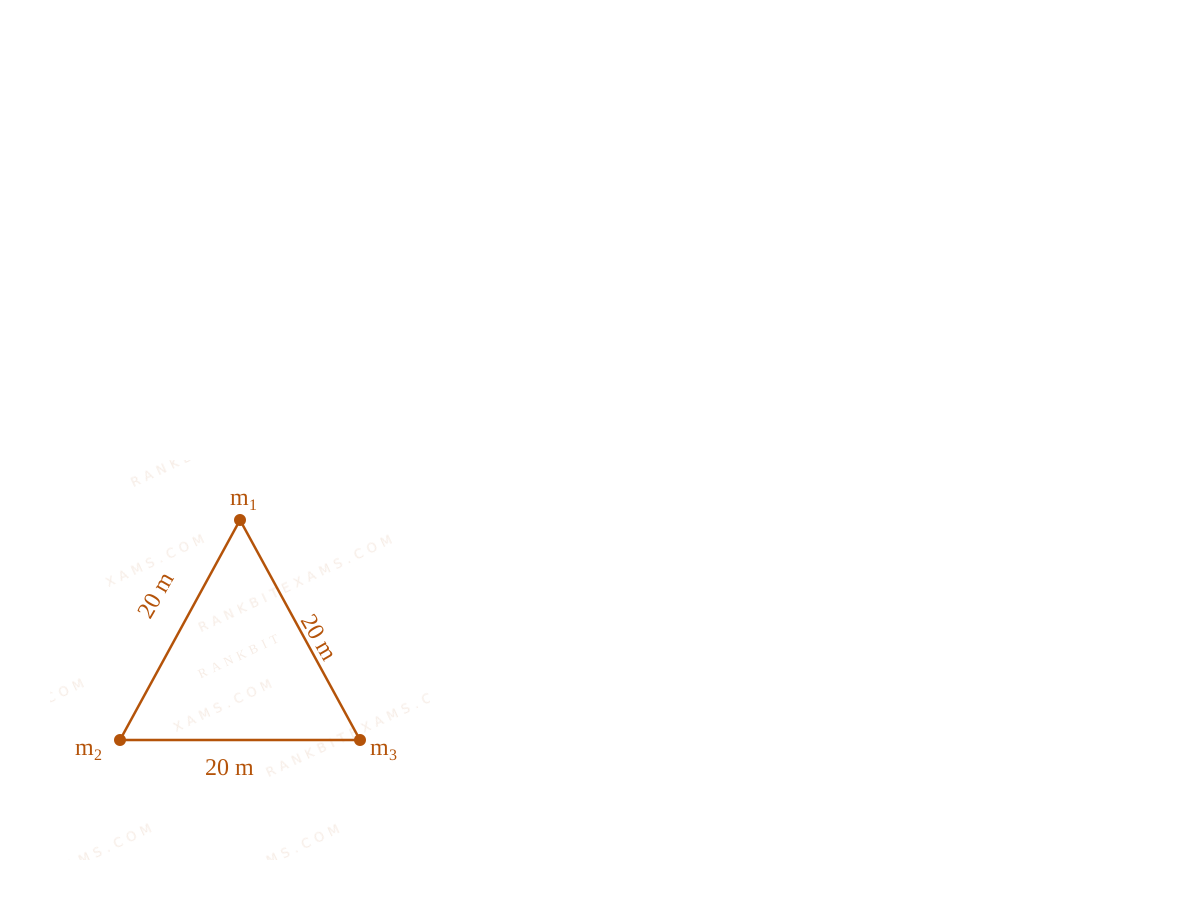
Three identical spheres of mass m, are placed at the vertices of an equilateral triangle of length a. When released, they interact only through gravitational force and collide after a time T=4 seconds. If the sides of the triangle are increased to length 2a and also the masses of the spheres are made 2m, then they will collide after ________ seconds.
Numerical Answer. Answer: 8 to 8

Solution

### Related Formula By Dimensional Analysis or Scaling of Kepler's Third Law: T propto m^x G^y a^z ### Core Logic Let's perform a dimensional matching to express the collision time T in terms of physical scaling variables m, G, and a: [T] = [M]^x [M^-1L^3T^-2]^y [L]^z Equating dimensions on both sides: - Mass (M): x - y = 0 implies x = y - Length (L): 3y + z = 0 implies z = -3y - Time (T): -2y = 1 implies y = -1/2 Solving these equations: x = -1/2, quad y = -1/2, quad z = 3/2 ### Step 1: Scaling Formula of Time Therefore, the scaling relationship for time T is: T propto m^-1/2 G^-1/2 a^3/2 implies T propto sqrtfraca^3m Let's write the ratio for two cases: fracT_2T_1 = sqrtleft(fraca_2a_1right)^3 cdot left(fracm_1m_2right) ### Step 2: Calculating Final Time Given values: - a_1 = a, a_2 = 2a - m_1 = m, m_2 = 2m - T_1 = 4mathrm~s fracT_24 = sqrtleft(frac2aaright)^3 cdot left(fracm2mright) = sqrt2^3 cdot frac12 = sqrt4 = 2 T_2 = 4 times 2 = 8mathrm~seconds ### Pattern Recognition Kepler's Third Law / free-fall collapse scaling: whenever a orbit or a direct gravitational collapse scale is involved, the time scales as T propto sqrtfracR^3GM. Thus doubling R multiplies time by sqrt8 and doubling M divides time by sqrt2. The combination results in a clean doubling of time: sqrt8/sqrt2 = 2. ### Evaluation Rubric / Model Answer null ### Chapter Mix Class 11 Physics: Gravitation Class 11 Physics: Units and Measurements: Dimensional Analysis
Q14 2025 Escape Velocity and Potential Energy
Given below are two statements: one is labelled as Assertion A and the other is labelled as Reason R. Assertion A: The kinetic energy needed to project a body of mass m from earth surface to infinity is frac12mgR, where R is the radius of earth. Reason R: The maximum potential energy of a body is zero when it is projected to infinity from earth surface. In the light of the above statements, choose the correct answer from the option given below
  • A. A is False but R is true
  • B. Both A and R are true and R is the correct explanation of A
  • C. A is true but R is false
  • D. Both A and R are true but R is NOT the correct explanation of A

Solution

### Related Formula Escape kinetic energy requirement formulation: textKEtextescape = fracG M mR = m g R Gravitational potential energy field definition: U = -fracG M mr At r to infty, Utextmax = 0. ### Core Logic * **Assertion Check:** The work required to move an object from R to infty is Delta U = 0 - left(-fracGMmR ight) = fracGMmR = mgR. The Assertion states it is frac12mgR, which represents only the orbital velocity metric or binding equivalent. Thus, Assertion A is **false**. * **Reason Check:** Since gravitational energy is attractive and negative, it strictly ascends asymptotically up to a ceiling limit value of zero at infinity. Hence, Reason R is **true**. ### Pattern Recognition Escape energy = mgR. Binding energy magnitude = frac12mgR (for circular orbiters). Zero represents the reference point ceiling of a negative bound system state. ### Evaluation Rubric / Model Answer null ### Chapter Mix Class 11 Physics: Gravitation

More Gravitation Questions — jee_main_2025_04_april_evening

Practice all Gravitation previous-year questions →

YOUR FIRST PREP STEP STARTS HERE

We Map Every Repeating Question in Competitive Exams.

Say goodbye to generic mock test fatigue. RankBit uses smart analysis to group past exam questions into their foundational Repeating Question Types. Find chapter weightage, track repeating questions, and score higher with targeted practice.

Select Your Target Exam

Choose an exam track below to find formulas per chapter and patterns.

Syncing Exam Intelligence

Mapping formulas and patterns across all tracks…

PATH A — FULL LENGTH PRACTICE

Full Mock Test Hub

Simulate real NTA exam conditions with fully tracked mocks. Time yourself against past papers.

Under Development
PATH B — TARGETED PRACTICE

Topic-wise Practice Hub

Practice past-year questions one chapter at a time. Pick an exam → subject → chapter and get every PYQ for that topic — pulled together from all past papers — with the chapter's key formulas alongside.

Loading Questions... Browse Topics
Latest from the Blog
View all →

Loading articles...