Let a$\hat{\mathbf{a}}$ be a unit vector perpendicular to the vectors b = i -2 j +3 k$\vec{\mathsf{b}} = \hat{\mathsf{i}} -2\hat{\mathsf{j}} +3\hat{\mathsf{k}}$ and c = 2 i +3 j - k$\vec{\mathbf{c}} = 2\hat{\mathbf{i}} +3\hat{\mathbf{j}} -\hat{\mathbf{k}}$, and makes an angle of ⁻¹(-(1)/(3))$\cos^{-1}\left(-\frac{1}{3}\right)$ with the vector i + j + k$\hat{\mathrm{i}} +\hat{\mathrm{j}} +\hat{\mathrm{k}}$. If a$\hat{\mathbf{a}}$ makes an angle of (π)/(3)$\frac{\pi}{3}$ with the vector i +α j + k$\hat{\mathrm{i}} +\alpha \hat{\mathrm{j}} +\hat{\mathrm{k}}$, then the value of α$\alpha$ is :
A.-√(3)$-\sqrt{3}$
B.√(6)$\sqrt{6}$
C.-√(6)$-\sqrt{6}$
D.√(3)$\sqrt{3}$
Solution & Explanation
Related Formula
Cross product for vector perpendicular direction alignment:
Keep strict track of signs when dealing with algebra containing square roots. Checking value constraints early on allows you to drop phantom positive/negative branches seamlessly.
Keywords:#unit vector perpendicular angle#JEE Main 2025 Evening Q69#Vector Algebra JEE Main 2025#Vector Products and Angles JEE Main 2025
More Vector Algebra Previous-Year Questions — Page 6
Q52jee_main_2025_07_april_eveningVector Magnitude and Operations
Let a$\vec{a}$ and b$\vec{b}$ be the vectors of the same magnitude such that | a + b| + | a - b|| a + b| - | a - b| = √(2) + 1$\frac{|\vec{a} + \vec{b}| + |\vec{a} - \vec{b}|}{|\vec{a} + \vec{b}| - |\vec{a} - \vec{b}|} = \sqrt{2} + 1$. Then | a + b|²| a|²$\frac{|\vec{a} + \vec{b}|^2}{|\vec{a}|^2}$ is:
A.2 + 4√(2)$2 + 4\sqrt{2}$
B.1 + √(2)$1 + \sqrt{2}$
C.2 + √(2)$2 + \sqrt{2}$
D.4 + 2√(2)$4 + 2\sqrt{2}$
Solution
Related Formula
Componendo and Dividendo rule states that if (x)/(y) = (p)/(q)$\frac{x}{y} = \frac{p}{q}$, then:
Whenever symmetric sums and differences like | x|+| y|$|\vec{x}|+|\vec{y}|$ and | x|-| y|$|\vec{x}|-|\vec{y}|$ occur in ratios, Componendo-Dividendo should be applied immediately to isolate the ratio of the individual magnitudes.
Chapter Mix
Class 12 Physics: Vector Algebra
Class 12 Mathematics: Vector Algebra
Q56jee_main_2025_24_jan_eveningCentroid, Orthocenter, and Circumcenter
Let the position vectors of three vertices of a $$$$$$\triangle$$$be$ be $4\vec{p}+\vec{q}-3\vec{r},$, $-5\vec{p}+\vec{q}+2\vec{r}and$ and $2\vec{p}-\vec{q}+2\vec{r}If the position vectors of the orthocenter and the circumcenter of the$ If the position vectors of the orthocenter and the circumcenter of the $\triangleare$ are $\frac{\vec{p}+\vec{q}+\vec{r}}{4}and$ and $\alpha\vec{p}+\beta\vec{q}+\gamma\vec{r}respectively, then$ respectively, then $\alpha+2\beta+5\gamma$ is equal to:
A.3$3$
B.1$1$
C.6$6$
D.4$4$
Solution
Related Formula
Centroid (G$G$) of a $$$$$$\triangle$$with vertices $A, B, C$ is given by:
$$ with vertices $A, B, C$ is given by:
$$\vec{G} = \frac{\vec{A} + \vec{B} + \vec{C}}{3}
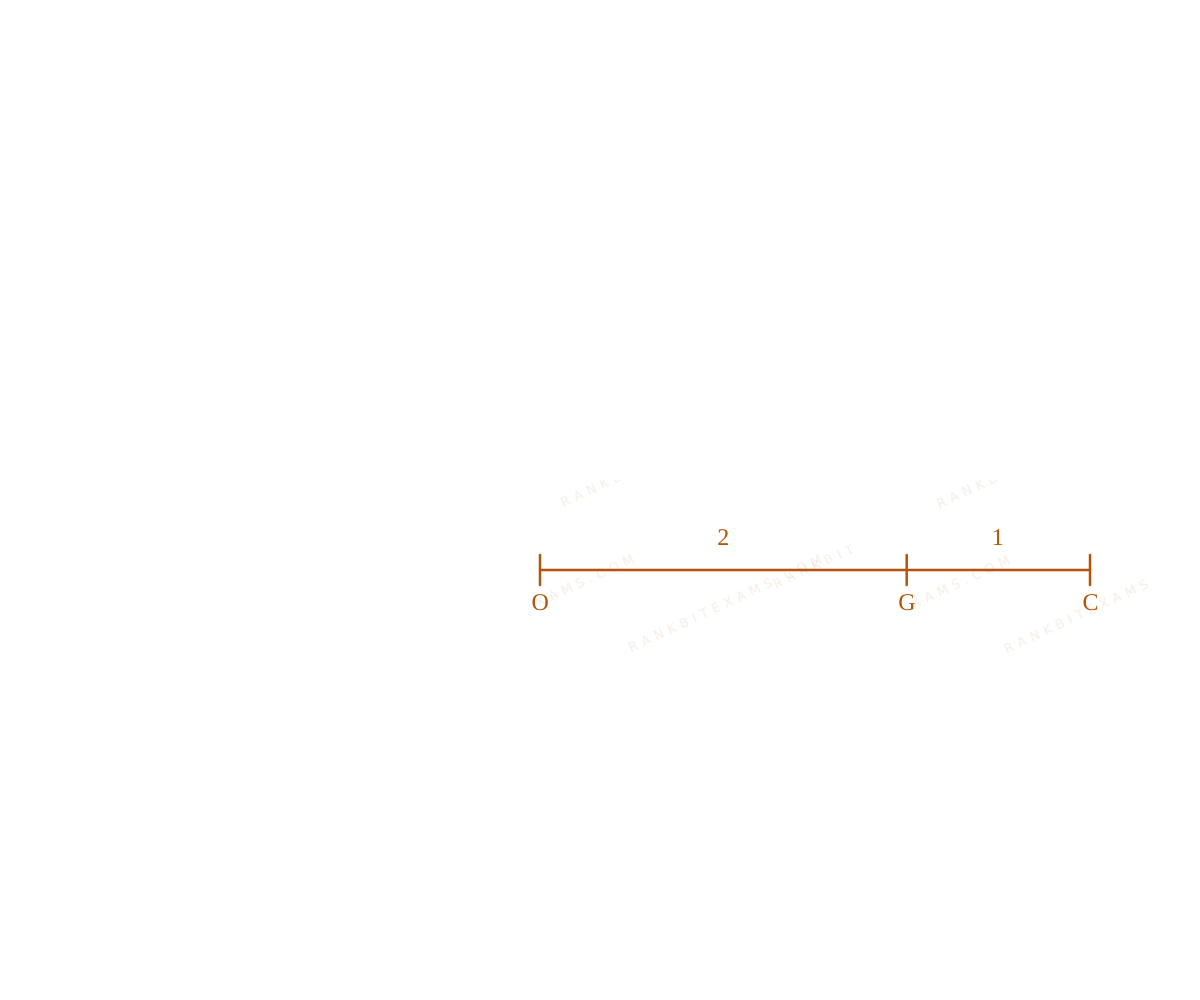
Euler's line property: The orthocenter ($O$), centroid ($G$), and circumcenter ($C$) are collinear, and $G$ divides the segment $OC$ internally in the ratio $2:1$.
Step 1: Compute the Centroid Vector
Sum the vectors of the three given vertices:
$$
Euler's line property: The orthocenter ($O$), centroid ($G$), and circumcenter ($C$) are collinear, and $G$ divides the segment $OC$ internally in the ratio $2:1$.
O-G-Cin$ in $2:1. Remember the mnemonic 'Oil-Gas-Company' or simply$. Remember the mnemonic 'Oil-Gas-Company' or simply $3G = 2C + O$ to prevent swapping structural coefficients under exam stress.
Chapter Mix
Class 12 Mathematics: Vector Algebra

Class 11 Mathematics: Properties of Triangles
Q64jee_main_2025_24_jan_eveningVector Triple Product and Projection
Let a=3 i- j+2 k,$\vec{a}=3\hat{i}-\hat{j}+2\hat{k},$b= a×( i-2 k)$\vec{b}=\vec{a}\times(\hat{i}-2\hat{k})$ and c= b× k$\vec{c}=\vec{b}\times\hat{k}$. Then the projection of c-2 j$\vec{c}-2\hat{j}$ on a$\vec{a}$ is:
A.3√(7)$3\sqrt{7}$
B.√(14)$\sqrt{14}$
C.2√(14)$2\sqrt{14}$
D.2√(7)$2\sqrt{7}$
Solution
Related Formula
The scalar projection of vector v$\vec{v}$ onto vector w$\vec{w}$ is calculated as:
Projection = v · w| w|$$\text{Projection} = \frac{\vec{v} \cdot \vec{w}}{|\vec{w}|}$$
Step 1: Calculate b$\vec{b}$
Compute the cross product using standard matrix expansion:
Keep cyclic unit cross products clear: i × k = - j$\hat{i} \times \hat{k} = -\hat{j}$ and j × k = i$\hat{j} \times \hat{k} = \hat{i}$. Missing a negative sign during basic cross multiplications ruins multi-step vector projections easily.
Chapter Mix
Class 12 Mathematics: Vector Algebra
Q51jee_main_2025_24_jan_morningCoplanar Vectors and Vector Products
Let a = i + 2 j + 3 k$\vec{\mathbf{a}} = \hat{\mathbf{i}} + 2\hat{\mathbf{j}} + 3\hat{\mathbf{k}}$ , b = 3 i + j - k$\vec{\mathbf{b}} = 3\hat{\mathbf{i}} + \hat{\mathbf{j}} - \hat{\mathbf{k}}$ and \|\vec{\mathbf{c}}\| be three vectors such that c$\vec{\mathbf{c}}$ is coplanar with a$\vec{\mathbf{a}}$ and b$\vec{\mathbf{b}}$ . If the vector c$\vec{\mathbf{c}}$ is perpendicular to b$\vec{\mathbf{b}}$ and a · c = 5$\vec{\mathbf{a}} \cdot \vec{\mathbf{c}} = 5$ , then | c|$\|\vec{\mathbf{c}}\|$ is equal to :
A.13√(2)$\frac{1}{3\sqrt{2}}$
B.18$18$
C.16$16$
D.√((11)/(6))$\sqrt{\frac{11}{6}}$
Solution
Related Formula
A vector c$\vec{\mathbf{c}}$ coplanar with a$\vec{\mathbf{a}}$ and b$\vec{\mathbf{b}}$ and perpendicular to b$\vec{\mathbf{b}}$ can be expressed using the vector triple product command template:
c = λ ( b × ( a × b)) = λ [( b · b) a - ( a · b) b]$$\vec{\mathbf{c}} = \lambda (\vec{\mathbf{b}} \times (\vec{\mathbf{a}} \times \vec{\mathbf{b}})) = \lambda [(\vec{\mathbf{b}} \cdot \vec{\mathbf{b}})\vec{\mathbf{a}} - (\vec{\mathbf{a}} \cdot \vec{\mathbf{b}})\vec{\mathbf{b}}]$$
Core Logic
First, find the dot products of the given vectors:
Whenever a vector is specified to be coplanar with a, b$\vec{\mathbf{a}}, \vec{\mathbf{b}}$ and perpendicular to b$\vec{\mathbf{b}}$, direct setup with the cross-product template b × ( a × b)$\vec{\mathbf{b}} \times (\vec{\mathbf{a}} \times \vec{\mathbf{b}})$ circumvents solving cumbersome linear systems of scalar variables.
Chapter Mix
Class 12 Mathematics: Vector Algebra
Q52jee_main_2025_28_jan_eveningVector Operations and Components
Let A, B, C be three points in xy-plane, whose position vector are given by √(3) i+ j$\sqrt{3}\hat{i}+\hat{j}$, i+√(3) j$\hat{i}+\sqrt{3}\hat{j}$ and a i+(1-a) j$a\hat{i}+(1-a)\hat{j}$ respectively with respect to the origin O. If the distance of the point C from the line bisecting the angle between the vectors OA$\overline{OA}$ and OB$\overline{OB}$ is 9√(2)$\frac{9}{\sqrt{2}}$ then the sum of all the possible values of a is:
A.1$1$
B.9/2$9/2$
C.0$0$
D.2$2$
Solution
Related Formula
The line bisecting the angle between two symmetric vectors passing through the origin in the first quadrant is given by y = x$y = x$ or x - y = 0$x - y = 0$.
Distance from point (x₁, y₁)$(x_1, y_1)$ to line Ax + By + C = 0$Ax + By + C = 0$ is:
Vectors OA = √(3) i+ j$\overline{OA} = \sqrt{3}\hat{i}+\hat{j}$ and OB = i+√(3) j$\overline{OB} = \hat{i}+\sqrt{3}\hat{j}$ are symmetric about the line y = x$y = x$.
Therefore, the angle bisector of OA$\overline{OA}$ and OB$\overline{OB}$ is the line x - y = 0$x - y = 0$.
Point C has coordinates (a, 1 - a)$(a, 1 - a)$.
Step 1: Calculate Distance and Solve for a
The perpendicular distance from C(a, 1 - a)$C(a, 1 - a)$ to x - y = 0$x - y = 0$ is:
Notice that OA$\overline{OA}$ and OB$\overline{OB}$ have swapped coordinates, meaning they are symmetric with respect to y=x$y=x$. Thus, the angle bisector equation is immediate (x-y=0$x-y=0$), simplifying the problem to a standard point-to-line distance calculation.
Chapter Mix
Class 11 Mathematics: Straight Lines
Class 12 Mathematics: Vector Algebra
More Vector Algebra Questions — jee_main_2025_29_jan_evening
Practice past-year questions one chapter at a time. Pick an exam → subject → chapter and get every PYQ for that topic — pulled together from all past papers — with the chapter's key formulas alongside.