If sin x + sin^2 x = 1, x in left(0, fracpi2right), then (cos^12 x + tan^12 x) + 3 (cos^10 x + tan^10 x + cos^8 x + tan^8 x) + (cos^6 x + tan^6 x) is equal to

Solution & Explanation

### Related Formula Fundamental identities: sin^2 x + cos^2 x = 1 tan x = fracsin xcos x Algebraic identity for a perfect cube: (A + B)^3 = A^3 + 3A^2B + 3AB^2 + B^3 ### Core Logic Given equation: sin x + sin^2 x = 1 implies sin x = 1 - sin^2 x = cos^2 x Dividing both sides by cos^2 x: fracsin xcos^2 x = 1 implies tan x sec x = 1 implies tan x = cos x ### Step 1: Simplify the Expression Since tan x = cos x, we can substitute tan x with cos x throughout the given expression: (cos^12 x + cos^12 x) + 3(cos^10 x + cos^10 x + cos^8 x + cos^8 x) + (cos^6 x + cos^6 x) = 2cos^12 x + 6cos^10 x + 6cos^8 x + 2cos^6 x = 2left[cos^12 x + 3cos^10 x + 3cos^8 x + cos^6 xright] ### Step 2: Apply the Cubic Identity Notice that the expression inside the brackets matches the expansion of a perfect cube: = 2left[(cos^4 x + cos^2 x)^3right] Since cos^2 x = sin x, it follows that cos^4 x = sin^2 x. Substituting these back in: = 2left[(sin^2 x + sin x)^3right] We know from the problem statement that sin x + sin^2 x = 1. Therefore: = 2(1)^3 = 2 ### Pattern Recognition When given sin x + sin^2 x = 1, the substitution cos^2 x = sin x or tan x = cos x is a classic identity trick. Recognizing binomial coefficients (1, 3, 3, 1) immediately signals to condense into a full cube structure. ### Evaluation Rubric / Model Answer null ### Chapter Mix Class 11 Mathematics: Trigonometric Functions
Reference Study Guides

More Trigonometric Functions Previous-Year Questions — Page 4

Q2 jee_main_2024_30_january_evening Compound Angles
For alpha, beta in left(0, fracpi2right) , let 3sin (alpha + beta) = 2sin (alpha - beta) and a real number k be such that tan alpha = ktan beta . Then the value of k is equal to:
  • A. -frac23
  • B. -5
  • C. frac23
  • D. 5

Solution

### Related Formula sin(A pm B) = sin A cos B pm cos A sin B ### Core Logic Given equation: 3sin(alpha + beta) = 2sin(alpha - beta) Expanding both sides: 3(sinalphacosbeta + cosalphasinbeta) = 2(sinalphacosbeta - cosalphasinbeta) 3sinalphacosbeta + 3cosalphasinbeta = 2sinalphacosbeta - 2cosalphasinbeta ### Step 1: Rearranging Terms Grouping like terms together: 3sinalphacosbeta - 2sinalphacosbeta = -2cosalphasinbeta - 3cosalphasinbeta sinalphacosbeta = -5cosalphasinbeta Dividing both sides by cosalphacosbeta: fracsinalphacosalpha = -5fracsinbetacosbeta tanalpha = -5tanbeta ### Step 2: Conclusion Comparing with the given equation tanalpha = ktanbeta, we get k = -5. *Note by our answer (Bonus)*: Since alpha, beta in (0, fracpi2), both tanalpha and tanbeta must be positive. Hence, tanalpha = -5tanbeta is not possible. The data is inconsistent, but the NTA key marks option (2) as correct. ### Pattern Recognition Standard expansion of sin(Apm B) and grouping identical products to isolate tan(A) and tan(B). ### Evaluation Rubric / Model Answer null ### Chapter Mix Class 11 Maths: Trigonometric Functions
Q19 jee_main_2024_30_jan_morning Trigonometric Equations
If 2 sin^3 x + sin 2x cos x + 4 sin x - 4 = 0 has exactly 3 solutions in the interval left[0,fracnpi2right], nin mathbbN, then the roots of the equation x^2 + nx + (n - 3) = 0 belong to :
  • A. (0,infty)
  • B. (-infty,0)
  • C. left(-fracsqrt172, fracsqrt172right)
  • D. mathbbZ

Solution

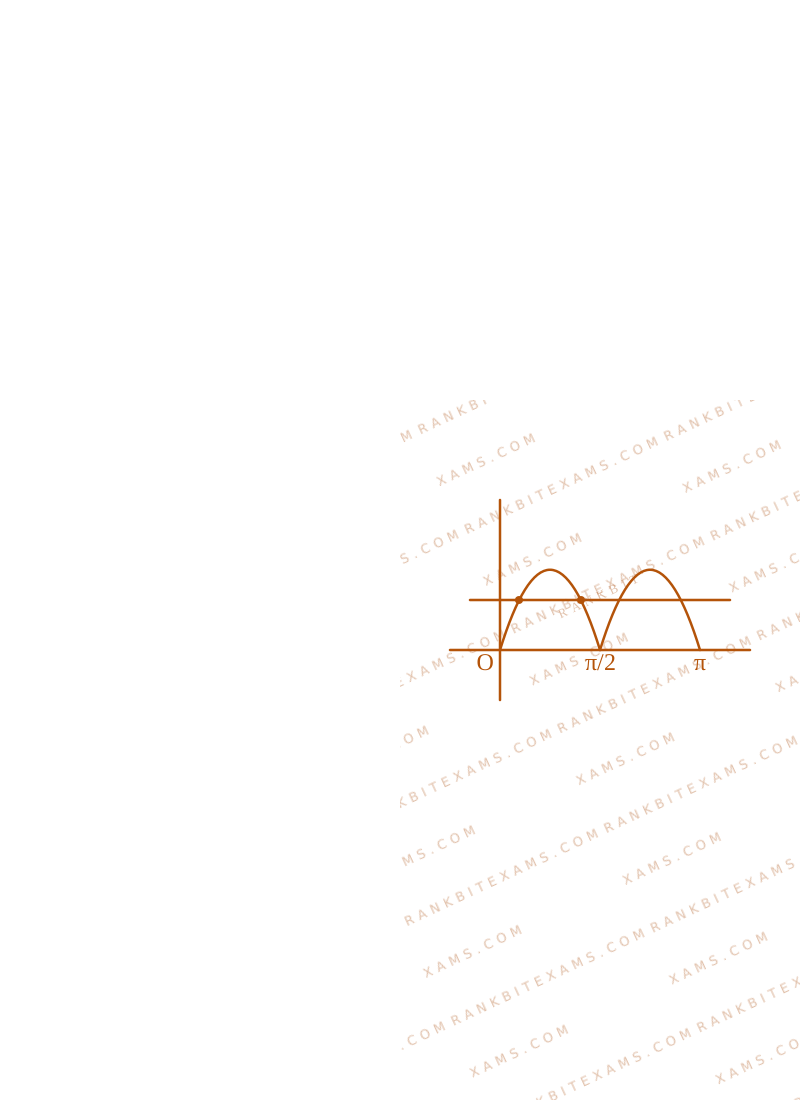
### Related Formula sin 2x = 2 sin x cos x ### Core Logic Given equation: 2 sin^3 x + sin 2x cos x + 4 sin x - 4 = 0 Expand sin 2x: 2 sin^3 x + 2 sin x cos^2 x + 4 sin x - 4 = 0 Factor out 2 sin x from the first two terms: 2 sin x (sin^2 x + cos^2 x) + 4 sin x - 4 = 0 Since sin^2 x + cos^2 x = 1: 2 sin x (1) + 4 sin x - 4 = 0 6 sin x - 4 = 0 Rightarrow sin x = frac46 = frac23 ### Step 1: Finding appropriate interval for exactly 3 roots We need exactly 3 solutions in left[0, fracnpi2right]. The line y = 2/3 intersects the sine wave y = sin x twice in every 2pi interval. In [0, pi], there are 2 solutions. In [pi, 2pi], there are 0 solutions. In [2pi, 3pi], there are 2 solutions (total 4 solutions). To get exactly 3 solutions, the interval must stretch past the first root in [2pi, 3pi], but not reach the second root in that interval. However, the interval is defined as fracnpi2. Let's check endpoints fracnpi2: For n=4: [0, 2pi] has 2 solutions. For n=5: [0, frac5pi2] includes [2pi, 2pi + fracpi2]. Since sin x = 2/3 happens in (0, pi/2), there is exactly 1 solution in [2pi, 5pi/2]. Thus, total solutions = 3 for n=5. ### Step 2: Solving quadratic equation Given n = 5, the quadratic equation is: x^2 + 5x + 2 = 0 Using quadratic formula: x = frac-5 pm sqrt25 - 82 = frac-5 pm sqrt172 The roots are approximately frac-5 pm 4.122, which evaluates to roughly -0.44 and -4.56. Both roots are strictly negative. ### Step 3: Determining interval membership Since both roots are negative, they belong to the interval (-infty, 0). ### Pattern Recognition Collapsing complex trigonometric expressions often yields c_1sin x = c_2. Overlaying horizontal line intersections on the sine graph bounds n rapidly by counting nodes. ### Evaluation Rubric / Model Answer null ### Chapter Mix Class 11 Maths: Trigonometric Functions Class 11 Maths: Complex Numbers and Quadratic Equations
Q15 jee_main_2024_31_jan_evening Trigonometric Equations
The number of solutions, of the equation e^sin x - 2e^-sin x = 2 is
  • A. 2
  • B. textmore than 2
  • C. 1
  • D. 0

Solution

### Core Logic Let e^sin x = t, where t > 0 because exponential functions are strictly positive. Substitute into the equation: t - frac2t = 2 t^2 - 2t - 2 = 0 Solve for t using the quadratic formula: t = frac2 pm sqrt4 - 4(1)(-2)2 = 1 pm sqrt3 Since t > 0, we discard 1 - sqrt3. Thus, t = 1 + sqrt3 approx 2.732. Now, equate back: e^sin x = 1 + sqrt3 implies sin x = ln(1 + sqrt3) We know e approx 2.718. Since 1 + sqrt3 > e, it follows that ln(1 + sqrt3) > 1. But the range of sin x is [-1, 1]. Therefore, sin x cannot equal a value strictly greater than 1. No real solution exists. ### Evaluation Rubric / Model Answer null ### Chapter Mix Class 11 Maths: Trigonometric Functions Class 12 Maths: Continuity and Differentiability

More Trigonometric Functions Questions — jee_main_2025_29_jan_evening

Practice all Trigonometric Functions previous-year questions →

Rankbit System
JEE Physics: Waves (+15.5%) | Electrostatics: Concentric Shells (-29.7%) | Modern Physics: Photoelectric Clones (+34.2%) | Mathematics: Definite Integrals (+18.1%) | Chemistry: Coordination Splitting (-11.4%) | JEE Physics: Waves (+15.5%) | Electrostatics: Concentric Shells (-29.7%) | Modern Physics: Photoelectric Clones (+34.2%) | Mathematics: Definite Integrals (+18.1%) | Chemistry: Coordination Splitting (-11.4%)