Let
A=xin(0,π)-(π)/(2): (2/π)| x|+ (2/π)| x|=2$A=\left\{x\in(0,\pi)-\left\{\frac{\pi}{2}\right\}:\log_{(2/\pi)}|\sin x|+\log_{(2/\pi)}|\cos x|=2\right\}$
and
B=x≥0:√(x)(√(x)-4)-3|√(x)-2|+6=0.$B=\left\{x\ge0:\sqrt{x}(\sqrt{x}-4)-3|\sqrt{x}-2|+6=0\right\}.$
Then n(A B)$n(A\cup B)$ is equal to:
A.4$4$
B.2$2$
C.8$8$
D.6$6$
Solution & Explanation
Related Formula
Logarithmic addition property: (a) + (b) = (ab)$\log(a) + \log(b) = \log(ab)$.
Double angle sine formula: 2 x x = 2x$2\sin x \cos x = \sin 2x$.
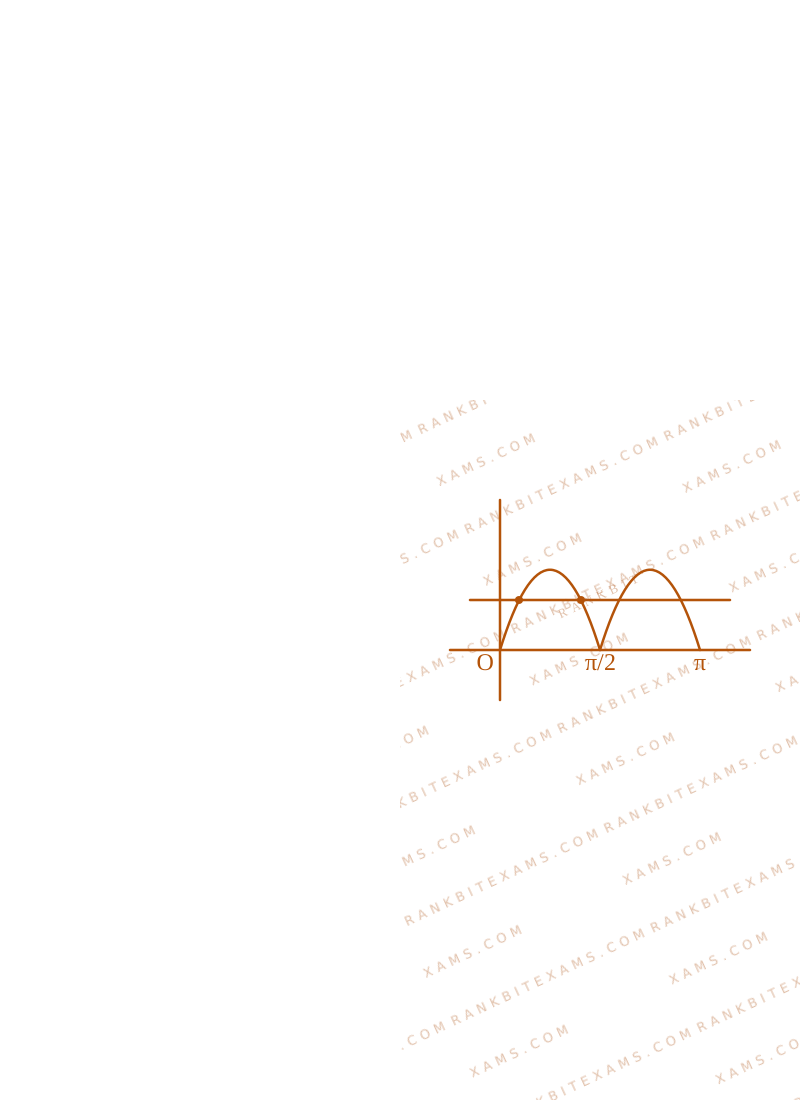
Since π² ≈ 9.87$\pi^2 \approx 9.87$, (8)/(π²) ≈ 0.81$\frac{8}{\pi^2} \approx 0.81$, which is less than 1. Plotting | 2x| = (8)/(π²)$|\sin 2x| = \frac{8}{\pi^2}$ over the specified range x in (0, π)$x \in (0, \pi)$ yields exactly 4 real intersection points.
Trigonometric Equations graph for Q55 - JEE Main 2025 Evening
Hence, n(A) = 4$n(A) = 4$.
Step 2: Simplify Set B
Let √(x) = t$\sqrt{x} = t$ where t ≥ 0$t \ge 0$. The equation becomes:
Hence, set B = 0, 1, 9, 16$B = \{0, 1, 9, 16\}$, giving n(B) = 4$n(B) = 4$.
Step 3: Calculate Union
Since all elements of set A are non-integral angles in (0, π)$(0, \pi)$ and elements of set B are pure integers, the sets are completely disjoint (A B =$A \cap B = \emptyset$).
Always separate functions into disjoint numeric domains (e.g., angles vs. whole integers) to conclude unions without performing tedious tracking of individual values manually.
Chapter Mix
Class 11 Physics: Trigonometric Functions
Class 11 Mathematics: Sets
Any expression structured as A θ - B θ$A \csc \theta - B \sec \theta$ instantly signals a fraction collapse to 2 (α - θ) / (2θ)$2 \sin(\alpha - \theta) / \sin(2\theta)$ via multiplication by 2. When constants are 1$1$ and √(3)$\sqrt{3}$, the anchor is always 30°$30^{\circ}$ or 60°$60^{\circ}$.
Chapter Mix
Class 11 Maths: Trigonometric Functions
Q23jee_main_2026_21_jan_eveningProperties of ITF
Let the maximum value of( ⁻¹x)² + ( ⁻¹x)²$(\sin^{-1}x)^{2} + (\cos^{-1}x)^{2}$ for x in [- √(3)2, 1√(2)]$x \in \left[-\frac{\sqrt{3}}{2}, \frac{1}{\sqrt{2}}\right]$ be \frac{m}{n}\pi^{2}, where (m, n) = 1$\gcd(m, n) = 1$.
Then m + n$m + n$ is equal to ____.
Given domain x in [ - √(3)2, 1√(2) ]$x \in \left[ -\frac{\sqrt{3}}{2}, \frac{1}{\sqrt{2}} \right]$.
The range of t = ⁻¹x$t = \sin^{-1}x$ for this domain is [ -(π)/(3), (π)/(4) ]$\left[ -\frac{\pi}{3}, \frac{\pi}{4} \right]$.
So the expression is f(t) = 2( t - (π)/(4) )² + (π²)/(8)$f(t) = 2\left( t - \frac{\pi}{4} \right)^2 + \frac{\pi^2}{8}$.
Step 2: Find the Maximum
The function f(t)$f(t)$ is a downward-opening distance squared logic? No, leading coefficient is positive, it's an upward parabola.
Max value occurs at the boundary furthest from the vertex t = (π)/(4)$t = \frac{\pi}{4}$.
The boundaries are -(π)/(3)$-\frac{\pi}{3}$ and (π)/(4)$\frac{\pi}{4}$. The distance from -(π)/(3)$-\frac{\pi}{3}$ to (π)/(4)$\frac{\pi}{4}$ is greatest.
At t = -(π)/(3)$t = -\frac{\pi}{3}$:
Here m = 29, n = 36$m = 29, n = 36$.
Check (29, 36) = 1$\gcd(29, 36) = 1$.
m + n = 29 + 36 = 65$m + n = 29 + 36 = 65$.
Pattern Recognition
Expressions shaped like f(x)² + g(x)²$f(x)^2 + g(x)^2$ where f(x)+g(x) = C$f(x)+g(x) = C$ will always map to a simple parabola. Analyze strictly based on vertex distance in the restricted f(x)$f(x)$ domain bounds.
Chapter Mix
Class 12 Maths: Inverse Trigonometric Functions
Class 11 Maths: Quadratic Equations
The number of solutions of⁻¹4x + ⁻¹6x = (π)/(6)$\tan^{-1}4x + \tan^{-1}6x = \frac{\pi}{6}$, where - 12√(6) < x < 12√(6)$-\frac{1}{2\sqrt{6}} < x < \frac{1}{2\sqrt{6}}$ is equal to
A.3$3$
B.0$0$
C.1$1$
D.2$2$
Solution
Related Formula
⁻¹a + ⁻¹b = ⁻¹((a + b)/(1 - ab)) for ab < 1$$\tan^{-1}a + \tan^{-1}b = \tan^{-1}\left(\frac{a + b}{1 - ab}\right) \quad \text{for } ab < 1$$
Core Logic
Given x in (- 12√(6), 12√(6))$x \in \left(-\frac{1}{2\sqrt{6}}, \frac{1}{2\sqrt{6}}\right)$, the product (4x)(6x) = 24x² < 24((1)/(24)) = 1$(4x)(6x) = 24x^2 < 24\left(\frac{1}{24}\right) = 1$. Thus, the standard identity holds without additive phase shifts.
We need to check which roots fall within (- 12√(6), 12√(6))$\left(-\frac{1}{2\sqrt{6}}, \frac{1}{2\sqrt{6}}\right)$.
The positive root is x₁ = √(396) - 10√(3)48$x_1 = \frac{\sqrt{396} - 10\sqrt{3}}{48}$.
Since √(396) > √(300) = 10√(3)$\sqrt{396} > \sqrt{300} = 10\sqrt{3}$, x₁ > 0$x_1 > 0$, making it a valid positive fraction.
The negative root is x₂ = -√(396) - 10√(3)48$x_2 = \frac{-\sqrt{396} - 10\sqrt{3}}{48}$. This is extremely negative and falls well outside the tight bound of - 12√(6)$-\frac{1}{2\sqrt{6}}$.
Only 1 solution exists in the specified domain.
Pattern Recognition
Checking the valid domain for ab < 1$ab < 1$ prevents phantom solutions. A quadratic always yields two roots, but the strict interval provided in the question stems directly from the convergence limits of the inverse tangent addition identity, aggressively discarding the far-flung negative root.
Chapter Mix
Class 12 Maths: Inverse Trigonometric Functions
Class 11 Maths: Quadratic Equations
If ²48°- ²12° ²24°- ²6°= α+β√(5)2$\frac{\cos^{2}48^{\circ}-\sin^{2}12^{\circ}}{\sin^{2}24^{\circ}-\sin^{2}6^{\circ}}=\frac{\alpha+\beta\sqrt{5}}{2}$, where α,βin N$\alpha,\beta\in \mathbb{N}$, then α+β$\alpha+\beta$ is equal to ____.
Numerical Answer.Answer: 4 to 4
Solution
Related Formula
(A+B) (A-B) = ² A - ² B$$\cos(A+B)\cos(A-B) = \cos^2 A - \sin^2 B$$(A+B) (A-B) = ² A - ² B$$\sin(A+B)\sin(A-B) = \sin^2 A - \sin^2 B$$
Core Logic
Evaluate numerator: ² 48^° - ² 12^°$\cos^2 48^\circ - \sin^2 12^\circ$
Let A = 48^°$A = 48^\circ$ and B = 12^°$B = 12^\circ$.
Using the identity: (48^° + 12^°) (48^° - 12^°) = 60^° 36^°$\cos(48^\circ + 12^\circ)\cos(48^\circ - 12^\circ) = \cos 60^\circ \cos 36^\circ$
Evaluate denominator: ² 24^° - ² 6^°$\sin^2 24^\circ - \sin^2 6^\circ$
Let A = 24^°$A = 24^\circ$ and B = 6^°$B = 6^\circ$.
Using the identity: (24^° + 6^°) (24^° - 6^°) = 30^° 18^°$\sin(24^\circ + 6^\circ)\sin(24^\circ - 6^\circ) = \sin 30^\circ \sin 18^\circ$
Step 1: Substituting Standard Trigonometric Values
Comparing 3 + √(5)2$\frac{3 + \sqrt{5}}{2}$ to the given form α + β√(5)2$\frac{\alpha + \beta\sqrt{5}}{2}$:
α = 3$\alpha = 3$β = 1$\beta = 1$
Both are natural numbers. Their sum is α + β = 3 + 1 = 4$\alpha + \beta = 3 + 1 = 4$.
Pattern Recognition
Difference of squares of sines/cosines is a massive neon sign to use product-to-sum composite identities. Always commit 18^°$\sin 18^\circ$ and 36^°$\cos 36^\circ$ to memory as they form complementary golden ratio components in geometry and algebra.
Chapter Mix
Class 11 Maths: Trigonometric Functions
Q23jee_main_2026_22_january_eveningCompound Angles and Tangent Identities
Let (α + β) = -(1)/(10)$\cos(\alpha + \beta) = -\frac{1}{10}$ and (α - β) = (3)/(8)$\sin(\alpha - \beta) = \frac{3}{8}$, where 0 < α < (π)/(3)$0 < \alpha < \frac{\pi}{3}$ and 0 < β < (π)/(4)$0 < \beta < \frac{\pi}{4}$. If 2α = 3(1 - r√(5))√(11)(s + √(5))$\tan 2\alpha = \frac{3(1 - r\sqrt{5})}{\sqrt{11}(s + \sqrt{5})}$, r, s in N$r, s \in \mathbb{N}$, then r + s$r + s$ is equal to ____.
Practice past-year questions one chapter at a time. Pick an exam → subject → chapter and get every PYQ for that topic — pulled together from all past papers — with the chapter's key formulas alongside.