If the set of all a in mathbbR, for which the equation 2x^2 + (a - 5)x + 15 = 3a has no real root, is the interval (alpha, beta), and X = \x in mathbbZ : alpha < x < beta\, then sum_x in X x^2 is equal to

Solution & Explanation

### Related Formula For a quadratic equation Ax^2 + Bx + C = 0 to have no real roots, its discriminant must be strictly negative: D = B^2 - 4AC < 0 ### Core Logic Rearranging the given equation into standard quadratic form: 2x^2 + (a - 5)x + (15 - 3a) = 0 Here, A = 2, B = a - 5, and C = 15 - 3a. Setting the discriminant less than zero: (a - 5)^2 - 4(2)(15 - 3a) < 0 (a^2 - 10a + 25) - 8(15 - 3a) < 0 a^2 - 10a + 25 - 120 + 24a < 0 a^2 + 14a - 95 < 0 ### Step 1: Solve for the Interval Factorizing the quadratic inequality: (a + 19)(a - 5) < 0 Thus, a in (-19, 5). This gives alpha = -19 and \beta = 5. ### Step 2: Calculate the Sum of Squares The set X consists of integers strictly between -19 and 5: X = \-18, -17, dots, 0, 1, 2, 3, 4\ sum_x in X x^2 = (-18)^2 + (-17)^2 + dots + 4^2 = (1^2 + 2^2 + 3^2 + 4^2) + (1^2 + 2^2 + dots + 18^2) = frac4 times 5 times 96 + frac18 times 19 times 376 = 30 + 2109 = 2139 ### Pattern Recognition Recognize that the negative terms squared are identical to the positive terms squared. Splitting the summation avoids calculating large numbers manually or allows using standard formula templates like fracn(n+1)(2n+1)6 efficiently. ### Evaluation Rubric / Model Answer null ### Chapter Mix Class 11 Mathematics: Quadratic Equations Class 11 Mathematics: Sequences and Series

Reference Study Guides

More Quadratic Equations Previous-Year Questions — Page 2

Q65 jee_main_2025_28_jan_morning Equations Involving Modulus
The sum, of the squares of all the roots of the equation x^2 + |2x - 3| - 4 = 0, is: (1) 3(3 - sqrt2) (2) 6(3 - sqrt2) (3) 6(2 - sqrt2) (4) 3(2 - sqrt2)
  • A. 3(3 - sqrt2)
  • B. 6(3 - sqrt2)
  • C. 6(2 - sqrt2)
  • D. 3(2 - sqrt2)

Solution

### Related Formula Modulus definition rule: |x| = begincases x, & x ge 0 \\ -x, & x < 0 endcases ### Core Logic Analyze the roots by splitting into cases around the critical threshold x = frac32: **Case I:** x ge frac32 x^2 + 2x - 3 - 4 = 0 implies x^2 + 2x - 7 = 0 implies x = 2sqrt2 - 1 (We select the positive root since 2sqrt2-1 ge 1.5). ### Step 1: Evaluating the alternate domain branch **Case II:** x < frac32 x^2 - (2x - 3) - 4 = 0 implies x^2 - 2x - 1 = 0 implies x = 1 - sqrt2 (We select 1-sqrt2 since it satisfies the inequality constraint). ### Step 2: Summing the Squares of the Roots textSum of Squares = (2sqrt2 - 1)^2 + (1 - sqrt2)^2 = (8 - 4sqrt2 + 1) + (1 - 2sqrt2 + 2) = 12 - 6sqrt2 = 6(2 - sqrt2) ### Pattern Recognition Always validate absolute root values against their domain restrictions to avoid including phantom solutions. ### Evaluation Rubric / Model Answer null ### Chapter Mix Class 11 Maths: Quadratic Equations
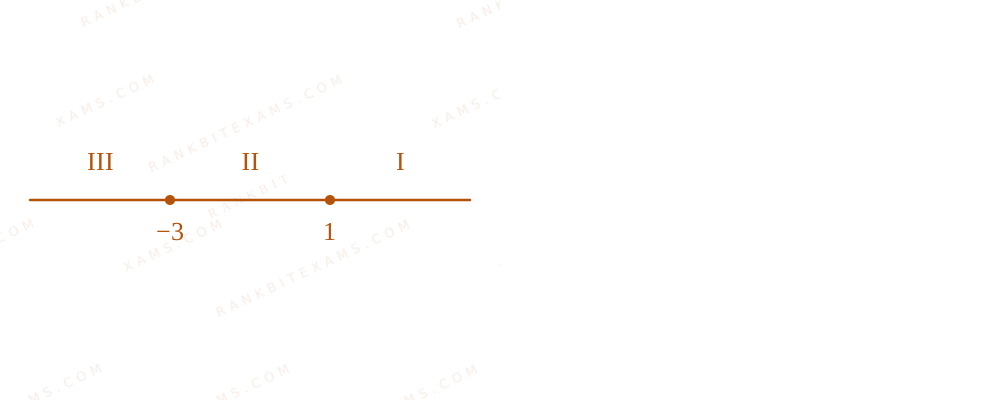
Q53 jee_main_2025_03_april_morning Newton's Theorem on Roots
Let alpha and beta be the roots of x^2 + sqrt3x - 16 = 0 [cite: 533], and gamma and delta be the roots of x^2 + 3x - 1 = 0[cite: 534]. If P_n = alpha^n + beta^n and Q_n = gamma^n + delta^n [cite: 534], then fracP_25 + sqrt3P_242P_23 + fracQ_25 - Q_23Q_24 is equal to[cite: 535]:
  • A. 3
  • B. 4
  • C. 5
  • D. 7

Solution

### Related Formula Newton's Theorem for roots: If alpha, beta satisfy ax^2+bx+c=0 and S_n = alpha^n + beta^n, then: aS_n + bS_n-1 + cS_n-2 = 0 ### Core Logic Apply Newton's Theorem directly to the first equation x^2+sqrt3x-16=0 [cite: 1247]: P_n + sqrt3P_n-1 - 16P_n-2 = 0 [cite: 1248] For n=25 [cite: 1248]: P_25 + sqrt3P_24 - 16P_23 = 0 implies P_25 + sqrt3P_24 = 16P_23 [cite: 1248] Dividing both sides by 2P_23 [cite: 1249]: fracP_25 + sqrt3P_242P_23 = frac16P_232P_23 = 8 [cite: 1249] ### Step 1: Evaluation of the second part Now look at the second relation for x^2+3x-1=0 [cite: 1252]: gamma^2 + 3gamma - 1 = 0 implies gamma^2 - 1 = -3gamma delta^2 + 3delta - 1 = 0 implies delta^2 - 1 = -3delta Expand Q_25 - Q_23 explicitly [cite: 1253]: Q_25 - Q_23 = (gamma^25 + delta^25) - (gamma^23 + delta^23) = gamma^23(gamma^2 - 1) + delta^23(delta^2 - 1) [cite: 1253] Substitute the root property transitions [cite: 1254]: = gamma^23(-3gamma) + delta^23(-3delta) = -3(gamma^24 + delta^24) = -3Q_24 [cite: 1254, 1255] Dividing by Q_24 gives [cite: 1256]: fracQ_25 - Q_23Q_24 = -3 [cite: 1256] ### Step 2: Total Calculation Add both components evaluated above [cite: 1256]: textTotal Expression Value = 8 + (-3) = 5 [cite: 1256] ### Pattern Recognition Expressions containing high sequential indices (like 25, 24, 23) indicate recurrent functional applications. Always substitute fundamental characteristic polynomials instead of computing powers directly. ### Evaluation Rubric / Model Answer null ### Chapter Mix Class 11 Mathematics: Quadratic Equations
Q68 jee_main_2025_04_april_morning Nature of Roots
Consider the equation x^2 + 4x - n = 0, where n in [20, 100] is a natural number. Then the number of all distinct values of n, for which the given equation has integral roots, is equal to
  • A. 7
  • B. 8
  • C. 6
  • D. 5

Solution

### Related Formula For quadratic equations with integer coefficients to have integral roots, the discriminant D = b^2 - 4ac must be a perfect square. ### Core Logic Rewrite using perfect square completing methods: x^2 + 4x + 4 = n + 4 implies (x + 2)^2 = n + 4 implies x = -2 pm sqrtn + 4 For x to be an integer, n + 4 must be a perfect square. Given range constraint 20 le n le 100: 24 le n + 4 le 104 ### Step 1: Identify Perfect Squares in Range Find perfect squares between 24 and 104: 5^2 = 25 6^2 = 36 7^2 = 49 8^2 = 64 9^2 = 81 10^2 = 100 This gives exactly 6 distinct valid perfect squares. ### Step 2: Conclusion Thus, there are exactly 6 distinct integer values for n. ### Pattern Recognition Completing the square provides intuitive bounds quicker than running full discriminant inequalities. Match integer root sets directly to explicit numerical sequence counts. ### Evaluation Rubric / Model Answer null ### Chapter Mix Class 10 Mathematics: Quadratic Equations Class 11 Mathematics: Complex Numbers and Quadratic Equations
Q67 jee_main_2025_07_april_evening Equations with Modulus
The number of real roots of the equation mathrmx left| mathrmx - 2 right| + 3 left| mathrmx - 3 right| + 1 = 0 is :
  • A. 4
  • B. 2
  • C. 1
  • D. 3

Solution

### Related Formula The definition of modulus function handles sub-intervals via critical points: |x - a| = begincases x - a & textif x ge a \\ -(x - a) & textif x < a endcases ### Core Logic The critical points are x = 2 and x = 3. We check the three distinct structural intervals: **Case I: x < 2** x(-(x - 2)) + 3(-(x - 3)) + 1 = 0 -x^2 + 2x - 3x + 9 + 1 = 0 implies x^2 + x - 10 = 0 x = frac-1 pm sqrt1 + 402 = frac-1 pm sqrt412 Checking domain constraint x < 2: frac-1 - sqrt412 approx frac-1 - 6.42 = -3.7 < 2 (Valid root) frac-1 + sqrt412 approx frac-1 + 6.42 = 2.7 not< 2 (Rejected) ### Step 1: Intermediate Interval Check **Case II: 2 le x < 3** x(x - 2) + 3(-(x - 3)) + 1 = 0 x^2 - 2x - 3x + 9 + 1 = 0 implies x^2 - 5x + 10 = 0 Discriminant check: D = (-5)^2 - 4(1)(10) = 25 - 40 = -15 < 0. No real roots exist in this interval. ### Step 2: Upper Interval Check **Case III: x ge 3** x(x - 2) + 3(x - 3) + 1 = 0 x^2 - 2x + 3x - 9 + 1 = 0 implies x^2 + x - 8 = 0 x = frac-1 pm sqrt1 + 322 = frac-1 pm sqrt332 Checking domain constraint x ge 3: frac-1 + sqrt332 approx frac-1 + 5.742 = 2.37 < 3 (Rejected) frac-1 - sqrt332 < 0 (Rejected) Thus, only 1 valid real root satisfies the conditional layout across all ranges. ### Pattern Recognition Always perform case-by-case boundaries checks on algebraic roots found inside absolute modulus problems to discard ghost solutions quickly. ### Evaluation Rubric / Model Answer null ### Chapter Mix Class 11 Mathematics: Quadratic Equations
Q67 jee_main_2025_24_jan_morning Roots of Advanced Polynomial Equations
The product of all the rational roots of the equation (x^2 - 9x + 11)^2 - (x - 4)(x - 5) = 3 is equal to :
  • A. 14
  • B. 7
  • C. 28
  • D. 41

Solution

### Related Formula For equations with repeating polynomial expressions, applying a variable substitution like t = P(x) reduces high-degree polynomials down to standard quadratics. ### Core Logic Expand the linear binomial product in the given equation equation: (x-4)(x-5) = x^2 - 9x + 20 Rewrite the full expression in terms of the common variable pattern x^2 - 9x: (x^2 - 9x + 11)^2 - (x^2 - 9x + 20) = 3 Let t = x^2 - 9x. Substituting this into the equation gives: (t + 11)^2 - (t + 20) = 3 t^2 + 22t + 121 - t - 20 - 3 = 0 t^2 + 21t + 98 = 0 ### Step 1: Solve the Polynomial for Variable t Factorize the quadratic expression: (t + 14)(t + 7) = 0 implies t = -14 text or t = -7 ### Step 2: Back-substitute and Isolate Rational Roots Case 1: x^2 - 9x = -7 implies x^2 - 9x + 7 = 0 Check the discriminant value: D = (-9)^2 - 4(1)(7) = 81 - 28 = 53 (not a perfect square, so the roots are irrational). Case 2: x^2 - 9x = -14 implies x^2 - 9x + 14 = 0 Factorize the quadratic expression: (x - 7)(x - 2) = 0 implies x = 7 text or x = 2 Both values are rational numbers. ### Step 3: Calculate the Product of Rational Roots Multiply the true rational roots together: textProduct = 7 cdot 2 = 14 ### Pattern Recognition Always check the discriminant D = b^2 - 4ac to filter out irrational radical components whenever the problem specifically asks for the product of *rational* roots only. ### Evaluation Rubric / Model Answer null ### Chapter Mix Class 11 Mathematics: Quadratic Equations

More Quadratic Equations Questions — jee_main_2025_29_jan_evening

Practice all Quadratic Equations previous-year questions →

Rankbit System
JEE Physics: Waves (+15.5%) | Electrostatics: Concentric Shells (-29.7%) | Modern Physics: Photoelectric Clones (+34.2%) | Mathematics: Definite Integrals (+18.1%) | Chemistry: Coordination Splitting (-11.4%) | JEE Physics: Waves (+15.5%) | Electrostatics: Concentric Shells (-29.7%) | Modern Physics: Photoelectric Clones (+34.2%) | Mathematics: Definite Integrals (+18.1%) | Chemistry: Coordination Splitting (-11.4%)
