JEE Main · Chemistry ↓ Falling

Organic Chemistry - Some Basic Principles and Techniques appeared 93 times across 3 years — 10.8% of Chemistry. This question is from Chromatographic Techniques.

Year 2026 2025 2024 Total
Questions 19 49 25 93

Given below are two statements: Statement (I): In partition chromatography, stationary phase is thin film of liquid present in the inert support. Statement (II): In paper chromatography, the material of paper acts as a stationary phase. In the light of the above statements, choose the correct answer from the options given below:

Solution & Explanation

Core Logic

Statement I is true: In partition chromatography, the stationary phase is indeed a thin film of liquid held on the surface of an inert solid support. Statement II is false: In paper chromatography, the water molecules trapped inside the cellulose network of the paper act as the stationary phase, not the paper material itself.

Pattern Recognition

Remember that paper chromatography is a type of partition chromatography where moisture content (water) adsorbed on the paper serves as the stationary liquid phase.

Chapter Mix

Class 11 Chemistry: Organic Chemistry - Some Basic Principles and Techniques

Reference Study Guides

More Organic Chemistry - Some Basic Principles and Techniques Previous-Year Questions — Page 10

Q jee_main_2025_03_april_morning Quantitative Analysis - Estimation of Carbon
0.5 g of an organic compound on combustion gave 1.46 g of CO₂ and 0.9 g of H₂O. The percentage of carbon in the compound is _____. (Nearest integer) [Given: Molar mass (in g mol⁻¹) C: 12, H: 1, O: 16]
Numerical Answer. Answer: 80 to 80

Solution

Related Formula

The percentage of carbon via combustion analysis is given by:

% C = (12)/(44) × Mass of CO₂Mass of organic compound × 100
Core Logic

Let us substitute the given parameters:

  • Mass of organic compound = 0.5 g
  • Mass of CO₂ collected = 1.46 g
Step 1: Numerical Calculation
% C = (12)/(44) × (1.46)/(0.5) × 100 % C = (12 × 1.46)/(22) × 100 ≈ 79.64%

Rounding to the nearest integer gives 80.

Pattern Recognition

Shortcut: (12)/(44) ≈ 0.2727. Multiply 0.2727 × 1.46 to find the mass of carbon (≈ 0.398 g). Since 0.398 g out of 0.5 g is roughly (4)/(5), the value is right around 80%.

Evaluation Rubric / Model Answer

80

Chapter Mix

Class 11 Chemistry: Organic Chemistry - Some Basic Principles and Techniques
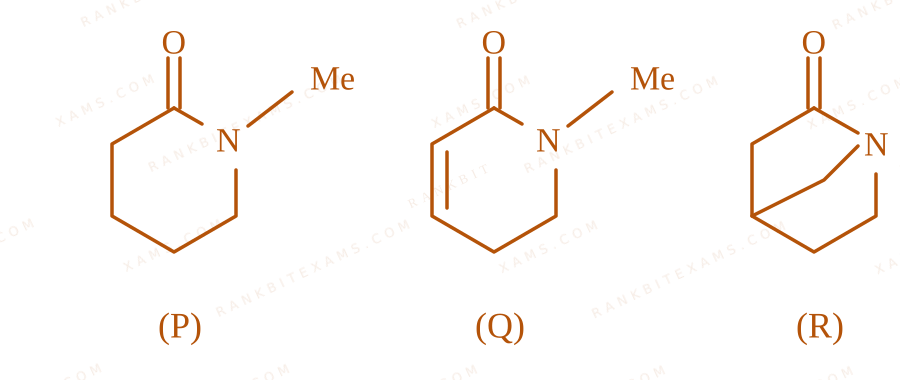
Q jee_main_2025_04_april_evening Basicity of Organic Bases
The correct order of basicity for the following molecules is:
Basicity of Organic Bases diagram for Q26 - JEE Main 2025 Evening
The diagram displays three nitrogen-containing organic structures labeled P, Q, and R for basicity comparison.
Basicity of Organic Bases diagram for Q26 - JEE Main 2025 Evening
The diagram displays three nitrogen-containing organic structures labeled P, Q, and R for basicity comparison.
Basicity of Organic Bases diagram for Q26 - JEE Main 2025 Evening
The diagram displays three nitrogen-containing organic structures labeled P, Q, and R for basicity comparison.
Basicity of Organic Bases diagram for Q26 - JEE Main 2025 Evening
The diagram displays three nitrogen-containing organic structures labeled P, Q, and R for basicity comparison.
  • A. P > Q > R
  • B. R > P > Q
  • C. Q > P > R
  • D. R > Q > P

Solution

Related Formula
Basicity ∝ Availability of lone pair of electrons on Nitrogen
Core Logic

Analyzing the molecules:

  • In molecule (R), according to Bredt's rule, the bridgehead nitrogen has a localized lone pair which cannot participate in resonance. Thus, it is highly available and most basic.
  • In molecule (Q), the nitrogen lone pair is involved in cross-conjugation with the carbonyl group, reducing its availability.
  • In molecule (P), the lone pair on nitrogen is directly conjugated with the carbonyl group (amide resonance), making it the least available.
  • Therefore, the correct basicity order is: R > Q > P

Step 1: Final Identification

Basicity breakdown explanation diagram for Q26
The diagram displays three nitrogen-containing organic structures labeled P, Q, and R for basicity comparison.

Basicity breakdown explanation diagram for Q26
The diagram displays three nitrogen-containing organic structures labeled P, Q, and R for basicity comparison.

Basicity breakdown explanation diagram for Q26
The diagram displays three nitrogen-containing organic structures labeled P, Q, and R for basicity comparison.

Comparing availability, structure R has localized electrons, Q has cross-conjugation, and P has standard amide resonance. Hence, option (4) is correct.

Pattern Recognition

Look for localized vs delocalized lone pairs on nitrogen. Bridgehead nitrogen lone pairs that violate Bredt's rule for double bond formation remain strictly localized, drastically increasing basicity compared to conjugated amides.

Chapter Mix

Class 11 Chemistry: Some Basic Principles of Organic Chemistry

Q jee_main_2025_04_april_evening Carbocation and Carbanion Stability
In which pairs, the first ion is more stable than the second?
Stability pair A components for Q30
The prompt displays visual comparisons of organic ionic species to judge the relative stability within pairs (A), (B), (C), and (D).
Stability pair A components for Q30
The prompt displays visual comparisons of organic ionic species to judge the relative stability within pairs (A), (B), (C), and (D).
Stability pair A components for Q30
The prompt displays visual comparisons of organic ionic species to judge the relative stability within pairs (A), (B), (C), and (D).
Stability pair A components for Q30
The prompt displays visual comparisons of organic ionic species to judge the relative stability within pairs (A), (B), (C), and (D).
Stability pair A components for Q30
The prompt displays visual comparisons of organic ionic species to judge the relative stability within pairs (A), (B), (C), and (D).
Stability pair A components for Q30
The prompt displays visual comparisons of organic ionic species to judge the relative stability within pairs (A), (B), (C), and (D).
  • A. (B) & (D) only
  • B. (A) & (B) only
  • C. (B) & (C) only
  • D. (A) & (C) only

Solution

Related Formula
Stability ∝ Delocalization of charge via resonance, mesomeric, and back-bonding effects
Core Logic

Evaluating each specific structural pair:

  • Pair (A): The first carbocation is stabilized by strong +M back-bonding from the methoxy (-OMe) oxygen lone pair, making it significantly more stable than the second.
  • Pair (B): The first carbanion is strongly stabilized by the -M and -I electronic effects of the nitro (-NO₂) group situated at the ortho position, whereas a carbocation in that spot would be destabilized. Thus, the first ion is more stable.
  • Pair (C): The second cation has extended allylic resonance stabilization, meaning the first is less stable.
  • Pair (D): Cation with -OMe backbonding is more stable than tertiary aliphatic carbocation, making the first less stable than the second.
  • Thus, only in (A) & (B) is the first ion more stable than the second.

Pattern Recognition

Back-bonding from an adjacent oxygen lone pair always triumphs over standard inductive or hyperconjugative alkyl stability templates. For carbanions, ensure electron-withdrawing groups like -NO₂ match the sign of the charge.

Chapter Mix

Class 11 Chemistry: Some Basic Principles of Organic Chemistry

Q jee_main_2025_04_april_evening Organic Reactions and Mechanisms
Consider the following molecule (X).
Organic reactant hydrocarbon layout for Q43
The prompt visually depicts a polycyclic unsaturated hydrocarbon system reacting to form compound X.
The structure of X is
Organic reactant hydrocarbon layout for Q43
The prompt visually depicts a polycyclic unsaturated hydrocarbon system reacting to form compound X.
Organic reactant hydrocarbon layout for Q43
The prompt visually depicts a polycyclic unsaturated hydrocarbon system reacting to form compound X.
Organic reactant hydrocarbon layout for Q43
The prompt visually depicts a polycyclic unsaturated hydrocarbon system reacting to form compound X.
Organic reactant hydrocarbon layout for Q43
The prompt visually depicts a polycyclic unsaturated hydrocarbon system reacting to form compound X.
Organic reactant hydrocarbon layout for Q43
The prompt visually depicts a polycyclic unsaturated hydrocarbon system reacting to form compound X.
  • A. Structure (1)
  • B. Structure (2)
  • C. Structure (3)
  • D. Structure (4)

Solution

Core Logic

Analyzing the mechanism:

  • Protonation (H^+ attack) on the double bond occurs to generate the most stable intermediate carbocation.
  • The system forms a highly stable tertiary (3^°) carbocation at the bridge junction ring site.
  • Nucleophilic attack by bromide ion (Br^-) captures this bridge junction center selectively, yielding the major brominated structure designated as Structure (2).
Step 1: Mechanism Breakdown

Carbocation intermediate step illustration for Q43
The prompt visually depicts a polycyclic unsaturated hydrocarbon system reacting to form compound X.

Carbocation intermediate step illustration for Q43
The prompt visually depicts a polycyclic unsaturated hydrocarbon system reacting to form compound X.

Electrophilic addition follows Markovnikov-like stability rules, directing the halide specifically to the bridgehead junction carbocation position.

Pattern Recognition

Whenever adding hydrohalic acids across cyclic non-conjugated dienes or isolated double bonds, always convert the alkene into the most stable, un-strained tertiary carbocation before attaching the nucleophile.

Chapter Mix

Class 11 Chemistry: Some Basic Principles of Organic Chemistry Class 11 Chemistry: Hydrocarbons

Q33 jee_main_2025_04_april_evening IUPAC Nomenclature
The IUPAC name of the following compound is - arrayc O H H C ≡ C - C H _ 2 - C H - C H _ 2 - C H = C H _ 2 array
  • A. 4-Hydroxyhept-1-en-6-yne
  • B. 4-Hydroxyhept-6-en-1-yne
  • C. Hept-6-en-1-yn-4-ol
  • D. Hept-1-en-6-yn-4-ol

Solution

Related Formula
Principal Functional Group Priority: -OH > Double bond (=) ≥ Triple bond (≡)
Core Logic

Number the seven-carbon parent chain from the side that gives the principal functional group (-OH) and double bond the lowest locants:

  • Numbering from right-to-left gives locants: alkene at position 1, alcohol at 4, and alkyne at 6.
  • Numbering from left-to-right gives locants: alkyne at 1, alcohol at 4, alkene at 6.
  • According to IUPAC rules, when choices are symmetric for the principal group, the lower locant is given to the double bond over the triple bond. Hence, right-to-left numbering is correct:

7H 6C≡ 5C- 4CH₂- 3CH(OH)- 2CH₂- 1CH=CH₂

This gives: Hept-1-en-6-yn-4-ol.

Pattern Recognition

When terminal unsaturations are tied symmetrically (positions 1 and 6), the alkene ('en') takes prefix allocation priority over the alkyne ('yn'). The secondary alcohol suffix '-ol' forms the principal name ending.

Chapter Mix

Class 11 Chemistry: Some Basic Principles of Organic Chemistry

More Organic Chemistry - Some Basic Principles and Techniques Questions — jee_main_2025_29_jan_evening

Practice all Organic Chemistry - Some Basic Principles and Techniques previous-year questions →

Rankbit System
JEE Physics: Waves (+15.5%) | Electrostatics: Concentric Shells (-29.7%) | Modern Physics: Photoelectric Clones (+34.2%) | Mathematics: Definite Integrals (+18.1%) | Chemistry: Coordination Splitting (-11.4%) | JEE Physics: Waves (+15.5%) | Electrostatics: Concentric Shells (-29.7%) | Modern Physics: Photoelectric Clones (+34.2%) | Mathematics: Definite Integrals (+18.1%) | Chemistry: Coordination Splitting (-11.4%)
