
JEE Main · Chemistry ↓ Falling

Organic Chemistry - Some Basic Principles and Techniques appeared 101 times across 3 years — 11.8% of Chemistry. This question is from Sigma and Pi Bond Counting.

Year 2026 2025 2024 Total
Questions 22 49 30 101

Total number of sigma (sigma) and pi(pi) bonds respectively present in hex-1-en-4-yne are:

Solution & Explanation

Core Logic

The structural formula of hex-1-en-4-yne is given by:

CH₂ = CH - CH₂ - C equiv C - CH₃

Let's count the chemical bonds chronologically:

  • Number of C-H sigma bonds = 2 + 1 + 2 + 3 = 8
  • Number of C-C sigma bonds = 5
  • Total sigma bonds = 8 + 5 = 13.

    Sigma and Pi Bond Counting diagram for Q38 - JEE Main 2025 Evening
    Sigma and Pi Bond Counting diagram for Q38 - JEE Main 2025 Evening

  • Number of pi bonds: 1 from double bond + 2 from triple bond = 3 pi bonds.
Pattern Recognition

Every single bond is 1sigma, every double bond contains 1sigma + 1pi, and every triple bond contains 1sigma + 2pi.

Chapter Mix

Class 11 Chemistry: Organic Chemistry - Some Basic Principles and Techniques

Reference Study Guides

More Organic Chemistry - Some Basic Principles and Techniques Previous-Year Questions — Page 7

Q jee_main_2025_03_april_evening Stoichiometry of Nitration
X~g of nitrobenzene on nitration gave 4.2~g of m-dinitrobenzene. The value of X is ________ g. (nearest integer) [Given: molar mass (in g~mol⁻¹ ) C: 12, H: 1, O: 16, N: 14]
Numerical Answer. Answer: 3 to 3

Solution

Related Formula

Balanced reaction for nitration of nitrobenzene:

C₆H₅NO₂ + HNO₃ arrow C₆H₄(NO₂)₂ + H₂O Moles = MassMolar Mass
Core Logic

From the balanced stoichiometry:

  • 1 mole of nitrobenzene yields 1 mole of m-dinitrobenzene.
Step 1: Determine molar masses
  • Molar mass of Nitrobenzene (C₆H₅NO₂):
M₁ = 6(12) + 5(1) + 14 + 2(16) = 72 + 5 + 14 + 32 = 123~g/mol
  • Molar mass of m-Dinitrobenzene (C₆H₄(NO₂)₂):
M₂ = 6(12) + 4(1) + 2(14) + 4(16) = 72 + 4 + 28 + 64 = 168~g/mol

Stoichiometry of Nitration

Step 2: Calculate moles and find X

Moles of m-dinitrobenzene produced:

n = 4.2~g168~g/mol = 0.025~mol

Since stoichiometry is

Since stoichiometry is $1:1, the moles of nitrobenzene required is also0.025\mathrm{~mol}:

Mass of nitrobenzene X = 0.025~mol × 123~g/mol = 3.075~g

Rounding to the nearest integer gives

Rounding to the nearest integer gives $3$.

Pattern Recognition

Electrophilic aromatic substitution stoichiometry is straightforward: each aromatic precursor ring converts to exactly one product ring. Finding moles from the heavier substituted product and converting back using the reactant's molecular weight quickly yields the answer.

Chapter Mix

Class 11 Chemistry: Organic Chemistry - Some Basic Principles and Techniques Class 12 Chemistry: Amines
Q jee_main_2025_03_april_evening Isomerism in Benzene Derivatives
The total number of structural isomers possible for the substituted benzene derivatives with the molecular formula C₉H₁₂ is ________.
Numerical Answer. Answer: 8 to 8

Solution

Related Formula

Degrees of Unsaturation (Double Bond Equivalents, DBE):

DBE = C + 1 - (H)/(2) + (N)/(2)

For formula C₉H₁₂:

DBE = 9 + 1 - (12)/(2) = 4

These 4 degrees of unsaturation match a benzene ring exactly (one ring + three double bonds).

Core Logic

Since the question specifies 'substituted benzene derivatives', we must keep the benzene core (C₆H₅- or similar) intact. This leaves 3 carbon atoms to be distributed as alkyl substituents.

Step 1: Categorize by substitution patterns
  • Mono-substituted benzene (one propyl group containing 3 carbons):
  • n-Propylbenzene: C₆H₅-CH₂-CH₂-CH₃ (Isomer 1)
  • Isopropylbenzene (Cumene): C₆H₅-CH(CH₃)₂ (Isomer 2)
  • Di-substituted benzene (one ethyl group and one methyl group):
  • 1-Ethyl-2-methylbenzene (ortho-ethylmethylbenzene) (Isomer 3)
  • 1-Ethyl-3-methylbenzene (meta-ethylmethylbenzene) (Isomer 4)
  • 1-Ethyl-4-methylbenzene (para-ethylmethylbenzene) (Isomer 5)
Step 2: Tri-substituted benzenes
  • Tri-substituted benzene (three methyl groups):
  • 1,2,3-Trimethylbenzene (Hemimellitene) (Isomer 6)
  • 1,2,4-Trimethylbenzene (Pseudocumene) (Isomer 7)
  • 1,3,5-Trimethylbenzene (Mesitylene) (Isomer 8)
Step 3: Total Count

Summing all options:

Total structural isomers = 2 + 3 + 3 = 8
Pattern Recognition

For alkyl benzenes with N extra carbons, systematically group them as single chain substituents down to multiple methyl substituents. This hierarchical sorting prevents duplicates or missing patterns.

Chapter Mix

Class 11 Chemistry: Organic Chemistry - Some Basic Principles and Techniques Class 11 Chemistry: Hydrocarbons

Q36 jee_main_2025_03_april_evening Dumas' Method for Nitrogen Estimation
In Dumas' method for estimation of nitrogen 0.4~g of an organic compound gave 60~mL of nitrogen collected at 300~K temperature and 715~mm~Hg pressure. The percentage composition of nitrogen in the compound is : (Given: Aqueous tension at 300~K = 15~mm~Hg)
  • A. 15.71%
  • B. 20.95%
  • C. 17.46%
  • D. 7.85%

Solution

Related Formula

Pressure of dry nitrogen gas:

PN₂ = Ptotal - Aqueous tension

Using Ideal Gas Law:

nN₂ = PN₂ VR T %N = Mass of nitrogenMass of organic compound × 100
Core Logic

Given parameters:

  • Mass of compound m = 0.4~g
  • Volume of nitrogen V = 60~mL = 0.060~L
  • Total pressure Ptotal = 715~mm~Hg
  • Temperature T = 300~K
  • Aqueous tension = 15~mm~Hg
Step 1: Calculate dry nitrogen pressure
PN₂ = 715~mm~Hg - 15~mm~Hg = 700~mm~Hg PN₂ = (700)/(760)~atm ≈ 0.921~atm
Step 2: Calculate moles of nitrogen gas

Using

Step 2: Calculate moles of nitrogen gas

Using $R = 0.0821\mathrm{~L\cdot atm\cdot K^{-1}\cdot mol^{-1}}:

nN₂ = (((700)/(760)) × 0.060)/(0.0821 × 300) = (0.05526)/(24.63) ≈ 2.2436 × 10⁻³~mol

Mass of

Mass of $\mathrm{N}_2gas:

Mass = 2.2436 × 10⁻³ × 28~g ≈ 0.06282~g
Step 3: Calculate percentage of Nitrogen
\%\mathrm{N} = \frac{0.06282\mathrm{~g}}{0.4\mathrm{~g}} \times 100 \approx 15.71\%$$

This matches Option (1).

Pattern Recognition

In Dumas' method calculations, always subtract the aqueous tension to obtain the pressure of dry nitrogen gas. Do not use the raw moist gas pressure, as doing so will overestimate the nitrogen content.

Chapter Mix

Class 11 Chemistry: Organic Chemistry - Some Basic Principles and Techniques

Q40 jee_main_2025_03_april_evening Hyperconjugation and Cation Stability
Given below are two statements: Statement I: Hyperconjugation is not a permanent effect. Statement II: In general, greater the number of alkyl groups attached to a positively charged C-atom, greater is the hyperconjugation interaction and stabilization of the cation. In the light of the above statements, choose the correct answer from the options given below :
  • A. Statement I is true but Statement II is false
  • B. Both Statement I and Statement II are false
  • C. Statement I is false but Statement II is true
  • D. Both Statement I and Statement II are true

Solution

Related Formula

The number of hyperconjugation structures is directly related to the count of α-hydrogen atoms:

Number of hyperconjugative structures = Number of α-hydrogens
Core Logic

Statement I Analysis:

  • Hyperconjugation (no-bond resonance) involves the delocalization of σ electrons of C-H bonds of an alkyl group directly attached to an atom of unsaturated system or a positively charged carbon atom. This is a permanent ground-state electronic effect, not dependent on external reagents. Thus, Statement I is False.
Step 1: Analyze Statement II
  • Statement II states that more alkyl groups attached to a carbocation center increase hyperconjugative stabilization. Each alkyl group brings additional σC-H bonds adjacent to the empty p-orbital, increasing the total count of α-hydrogens and enhancing charge delocalization. Thus, Statement II is True.
Step 2: Conclusion

Therefore, Statement I is False but Statement II is True, matching Option (3).

Pattern Recognition

Permanent organic effects include: Inductive, Mesomeric (Resonance), and Hyperconjugation effects. Temporary electronic effects include: Electromeric and Inductomeric effects (which require an attacking reagent to manifest).

Chapter Mix

Class 11 Chemistry: Organic Chemistry - Some Basic Principles and Techniques

Q33 jee_main_2025_07_april_morning IUPAC Nomenclature
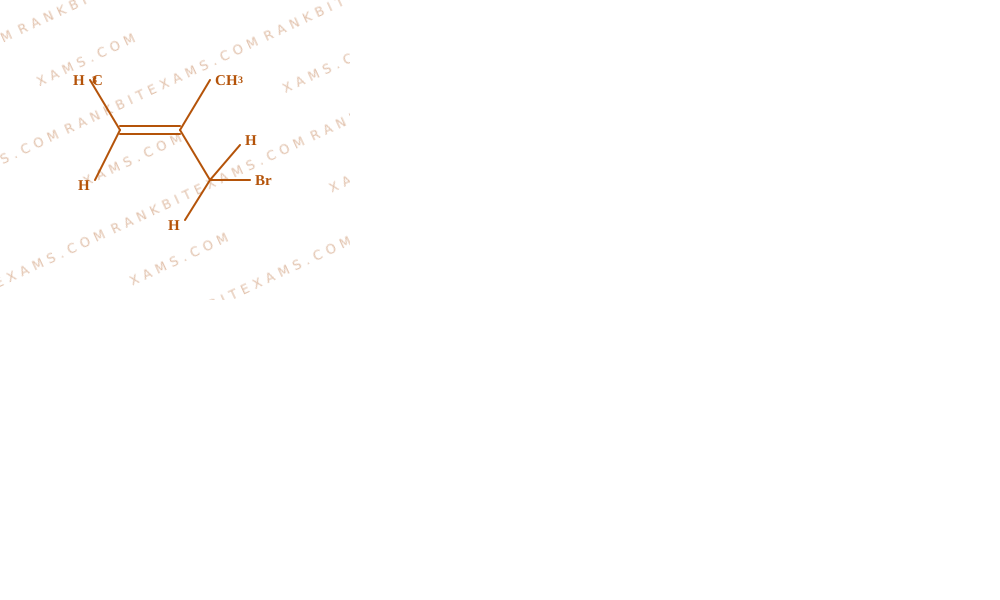
Which of the following is the correct IUPAC name of given organic compound (X)?
Organic haloalkene structure X for Q33 - JEE Main 2025
The image shows structural representation of compound X with a double bond and a bromine substituent.
  • A. 2-Bromo-2-methylbut-2-ene
  • B. 3-Bromo-3-methylprop-2-ene
  • C. 1-Bromo-2-methylbut-2-ene
  • D. 4-Bromo-3-methylbut-2-ene

Solution

Core Logic

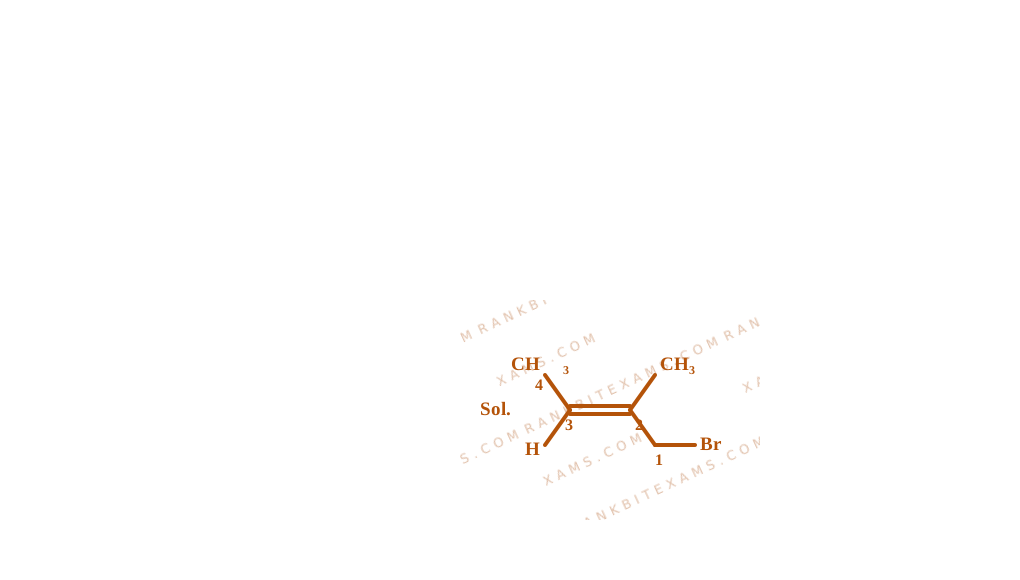
To determine the IUPAC name of the compound shown in

Organic haloalkene structure X for Q33 - JEE Main 2025
The image shows structural representation of compound X with a double bond and a bromine substituent.
:

  • Identify the principal functional group, which is the double bond (alkene).
  • Find the longest carbon chain containing the double bond:
C1(H₂Br) - C2(CH₃) = C3(H) - C4(H₃)

The longest chain has 4 carbons, which means the parent alkane is butane, and with a double bond it's "but-2-ene".

  • Number the chain from the end that gives lower locants to the double bond. Starting from left or right both give the double bond at position 2. However, starting from left gives substituent locants as 1 (for bromo) and 2 (for methyl), whereas starting from right gives substituent locants as 3 and 4.
  • Hence, correct numbering is:
  • C1: bonded to Bromine (-Br)
  • C2: bonded to Methyl (-CH₃)
  • C3: alkene carbon
  • C4: terminal methyl group
  • IUPAC numbered chain diagram for Q33
    The image shows structural representation of compound X with a double bond and a bromine substituent.

    Combining these rules, the name is: 1-Bromo-2-methylbut-2-ene.

Pattern Recognition

Double bond takes precedence over halogen substituent in numbering direction. If double bond is symmetrical (at position 2 in a 4-carbon chain), use the substituent positions to break the tie, choosing lowest possible locants (1 and 2 vs 3 and 4).

Chapter Mix

Class 11 Chemistry: Organic Chemistry - Some Basic Principles and Techniques Class 12 Chemistry: Haloalkanes and Haloarenes

More Organic Chemistry - Some Basic Principles and Techniques Questions — jee_main_2025_29_jan_evening

Practice all Organic Chemistry - Some Basic Principles and Techniques previous-year questions →

Rankbit System
JEE Physics: Waves (+15.5%) | Electrostatics: Concentric Shells (-29.7%) | Modern Physics: Photoelectric Clones (+34.2%) | Mathematics: Definite Integrals (+18.1%) | Chemistry: Coordination Splitting (-11.4%) | JEE Physics: Waves (+15.5%) | Electrostatics: Concentric Shells (-29.7%) | Modern Physics: Photoelectric Clones (+34.2%) | Mathematics: Definite Integrals (+18.1%) | Chemistry: Coordination Splitting (-11.4%)
