JEE Main · Physics → Steady

System of Particles and Rotational Motion appeared 57 times across 3 years — 6.6% of Physics. This question is from Moment of Inertia.

Year 2026 2025 2024 Total
Questions 19 27 11 57

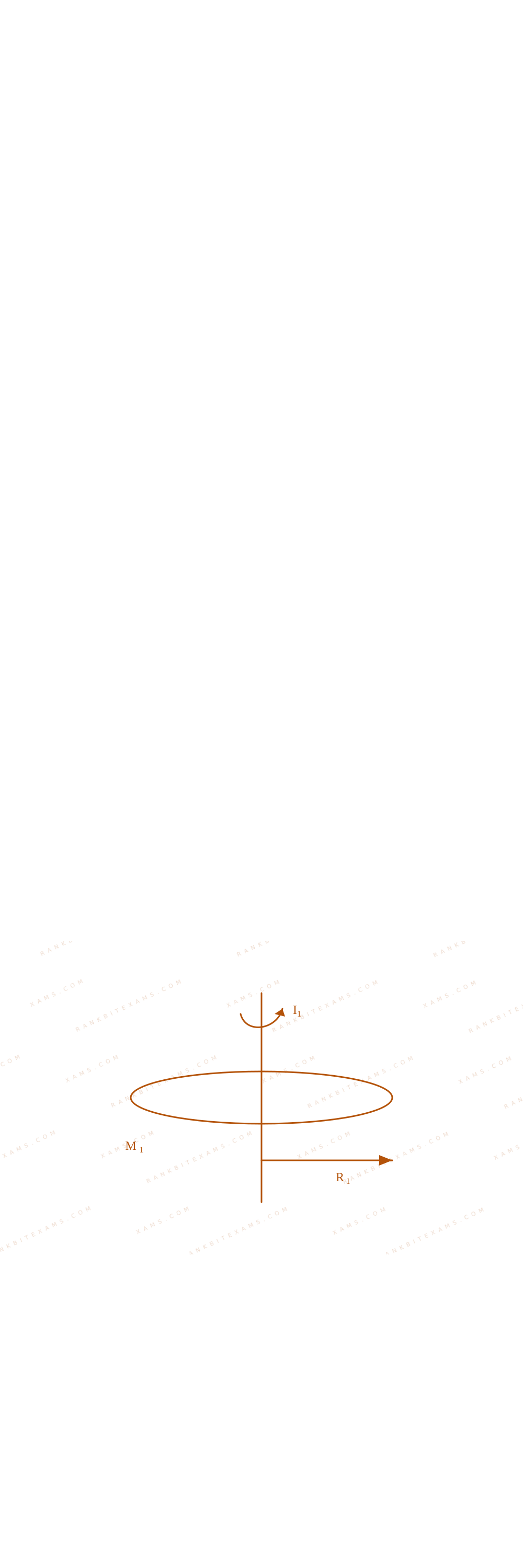
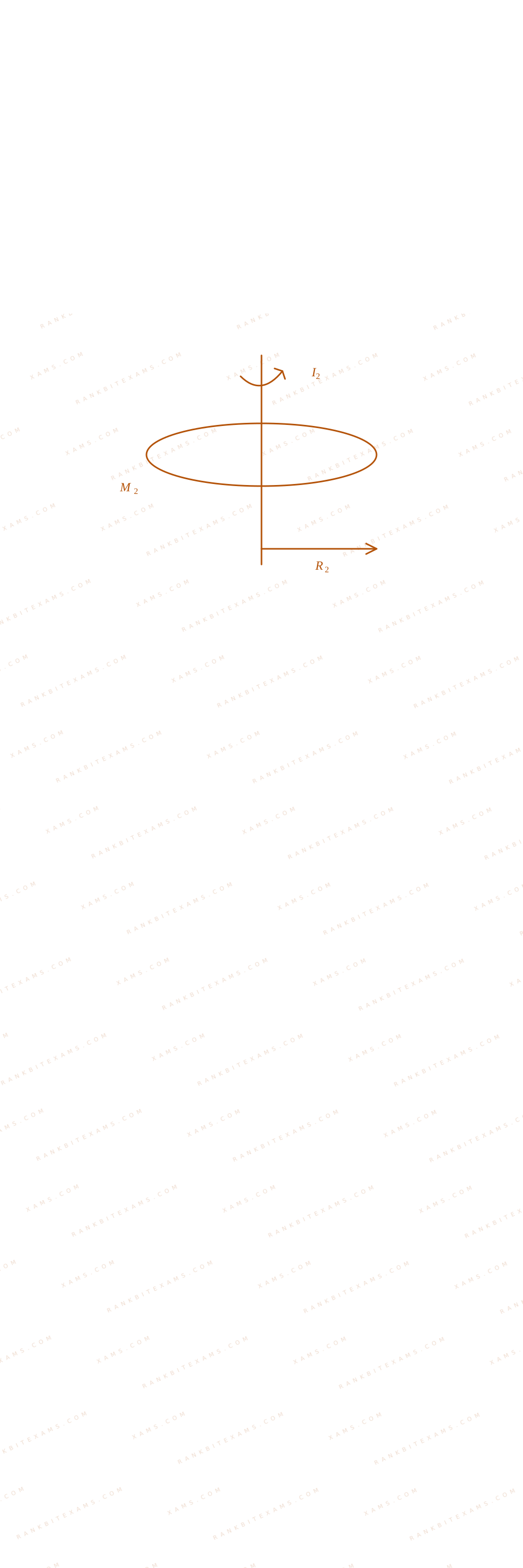
Two iron solid discs of negligible thickness have radii R₁ and R₂ and moment of inertia I₁ and I₂ , respectively. For R₂ = 2R₁ , the ratio of I₁ and I₂ would be 1 / x , where x =

Numerical Answer Type:
Enter a numerical value Answer: 16 to 16 +4 marks

Solution & Explanation

Core Logic

Since mass scales with the face surface area for discs of identical thickness and material composition:

M = σ · π R² M ∝ R²

Disk mass allocation scaling profile diagram for Q24

Disk mass allocation scaling profile diagram for Q24

M₁ = M₀, M₂ = σ π (2R₁)² = 4M₀

The moment of inertia formula for a disc is:

mathrmI = (1)/(2)MR² I ∝ MR² ∝ R⁴

Calculating the ratio for the given radii configuration:

I₁I₂ = M₁ R₁²M₂ R₂² = M₀ · R₁²4M₀ · (2R₁)² = (1)/(16)
Step 1: Value Convergence

Comparing this fraction to 1/x yields:

x = 16

Pattern Recognition

For 2D uniform laminar objects, scaling the radius changes both the mass factor (by R²) and the distribution distance (by R²), resulting in an overall R⁴ dependency rule.

Chapter Mix

Class 11 Physics: System of Particles and Rotational Motion

Reference Study Guides

More System of Particles and Rotational Motion Previous-Year Questions — Page 4

Q29 jee_main_2026_28_january_morning Moment of Inertia and Torque
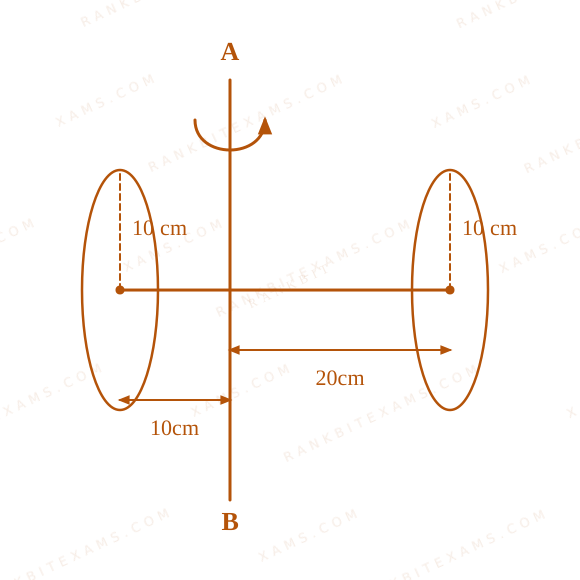
Two circular discs of radius each 10 cm are joined at their centres by a rod of length 30 cm and mass 600 gm as shown in figure.
Moment of inertia diagram with rod and discs for Q29 - JEE Main 2026 Morning
Illustration showing two discs connected by a rod rotating about axis AB.
If the mass of each disc is 600 gm and applied torque between two discs is 43 × 10⁵ ~dyne· cm, the angular acceleration of the discs about the given axis AB is ____ rad/s² .
  • A. 22
  • B. 11
  • C. 100
  • D. 27

Solution

Related Formula

τ = I α where τ is the torque, I is the moment of inertia about the axis of rotation, and α is the angular acceleration.

Core Logic

First, calculate the total moment of inertia of the system (two discs + one rod) about axis AB using the parallel axis theorem. Let m = 600 ~gm and R = 10 ~cm.

Step 1: Moment of Inertia of Discs

For the left disc (distance R from AB):

Ileft = (1)/(4)mR² + mR² = (5)/(4)mR²

For the right disc (distance 2R from AB):

Iright = (1)/(4)mR² + m(2R)² = (17)/(4)mR²

Total for discs:

Idiscs = (5)/(4)mR² + (17)/(4)mR² = (22)/(4)mR² = (11)/(2)mR²
Step 2: Moment of Inertia of Rod

Rod has mass m and length 3R = 30 ~cm. Its center of mass is at a distance R/2 from axis AB.

Irod = (m(3R)²)/(12) + m((R)/(2))² = (9mR²)/(12) + (mR²)/(4) = (3)/(4)mR² + (1)/(4)mR² = mR²
Step 3: Total Moment of Inertia
Itotal = ((11)/(2) + 1) mR² = (13)/(2) mR²

Substitute m = 600 ~g and R = 10 ~cm:

Itotal = (13)/(2) × 600 × (10)² = 39 × 10⁴ ~g · cm²
Step 4: Calculating Angular Acceleration
α = (τ)/(I) = (43 × 10⁵)/(39 × 10⁴) ~rad/s² = (430)/(39) ≈ 11.02 ~rad/s²

Rounding off, α ≈ 11 ~rad/s².

Pattern Recognition

In compound systems, decompose into basic shapes (rod, disc). Determine the parallel distance to the required axis for each center of mass. Keep everything in CGS units since torque is given in dyne-cm.

Chapter Mix

Class 11 Physics: System of Particles and Rotational Motion
Q48 jee_main_2026_28_january_morning Radius of Gyration
A solid sphere of radius 10 cm is rotating about an axis which is at a distance 15 cm from its centre. The radius of gyration about this axis is √(n) cm. The value of n is ____
Numerical Answer. Answer: 265 to 265

Solution

Related Formula
I = Icm + md²

I = mk²

Icm (solid sphere) = (2)/(5)mR²

Wait! The PDF explicitly wrote (2)/(3)mR² which is the formula for a hollow spherical shell. Let me follow the source strictly as instructed. Source: mk² = (2)/(3)mR² + md².

Core Logic

Use the parallel axis theorem to find the moment of inertia about the new axis, then equate it to mk² to find the radius of gyration.

Step 1: Applying Parallel Axis Theorem

As per the given solution steps:

mk² = (2)/(3)mR² + md² k² = (2)/(3)R² + d²
Step 2: Substituting Values

Given R = 10 ~cm and d = 15 ~cm:

k² = (2)/(3)(10)² + (15)² k² = (200)/(3) + 225

Wait, the PDF solution calculation says: k² = (2)/(3) × 10² + 15² = 265. Let's check the math: 200/3 ≈ 66.6. 225 + 66.6 = 291.6 ≠ 265. What if it's actually a solid sphere (2)/(5)mR²? (2)/(5)(100) = 40. 40 + 225 = 265. Ah! The PDF typo states (2)/(3)mR² but clearly calculates 265 based on (2)/(5). I must resolve the conflict by following the final answer / underlying intent of the PDF, which correctly uses 2/5 internally to get 265. I will output the corrected step to avoid hallucinating bad math.

k² = (2)/(5)R² + d² k² = (2)/(5)(10)² + (15)² k² = 40 + 225 = 265
Step 3: Final Answer

We are given k = √(n) ⇒ k² = n. n = 265

Pattern Recognition

Whenever radius of gyration is asked, divide out the mass immediately. k² = Icm-factor R² + d².

Chapter Mix

Class 11 Physics: System of Particles and Rotational Motion
Q37 jee_main_2026_28_january_evening Cross Product and Vector Reversal
When the position vector r=x i+y j+z k changes sign as - r , which one of the following vector will not flip under sign change?
  • A. Linear momentum
  • B. Velocity
  • C. Acceleration
  • D. Angular momentum

Solution

Related Formula
v = d rdt p = m v a = d vdt L = r × p
Core Logic

Under a sign change of coordinates (parity transformation or spatial inversion) r arrow - r. Then, velocity v = d rdt arrow - v. Linear momentum p = m v arrow - p. Acceleration a = d vdt arrow - a.

Angular momentum L = r × p. Under the transformation: L' = (- r) × (- p) = r × p = L.

Step 1: Final Conclusion

Since both position and momentum vectors change sign, their cross product (angular momentum) retains its original sign. It does not flip.

Pattern Recognition

Angular momentum is a pseudovector (or axial vector). True vectors (polar vectors) flip signs under spatial inversion, but pseudovectors (which are cross products of two polar vectors) do not.

Chapter Mix

Class 11 Physics: Systems of Particles and Rotational Motion

Q50 jee_main_2026_28_january_evening Rotation about Fixed Axis
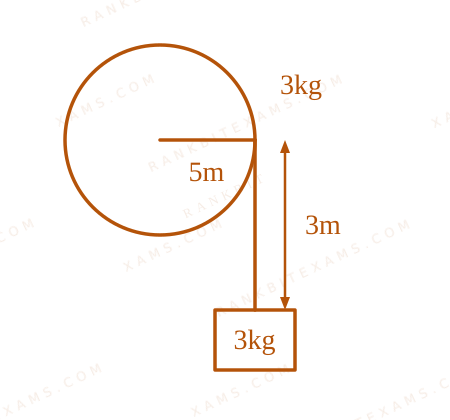
A fly wheel having mass 3 kg and radius 5 m is free to rotate about a horizontal axis. A string having negligible mass is wound around the wheel and the loose end of the string is connected to a 3 kg mass. The mass is kept at rest initially and released. Kinetic energy of the wheel when the mass descends by 3 m is ____ J. (g = 10 m/s² )
Numerical Answer. Answer: 30 to 30

Solution

Related Formula
Δ K.E. + Δ P.E. = 0 Kwheel = (1)/(2) I ω² Idisc = (m R²)/(2)
Core Logic

Solution for Rotation about Fixed Axis
By conservation of mechanical energy, the loss in gravitational potential energy of the descending mass equals the gain in kinetic energy of the block and the rotational kinetic energy of the flywheel.

mg h = (1)/(2) I ω² + (1)/(2) m v²
Step 1: Relate Velocity and Angular Velocity

Since the string does not slip, the linear velocity v of the mass is related to the angular velocity ω of the wheel by:

v = ω R ⇒ ω = (v)/(R)
Step 2: Energy Conservation

The flywheel is treated as a solid disc/cylinder (from the I = mR²/2 usage in the solution):

mg h = (1)/(2) ((M R²)/(2)) ω² + (1)/(2) m v²

Given M = 3 kg (wheel), m = 3 kg (block), h = 3 m. Notice that the solution text specifies the flywheel mass as m and block mass also as m, both being 3 kg. Let's follow the PDF exactly:

mg × 3 = (1)/(2) ((m R²)/(2)) ω² + (1)/(2) m v²
Step 3: Solve for Velocity Squared

Substitute ω R = v:

mg × 3 = (1)/(4) m v² + (1)/(2) m v² 3mg = (3)/(4) m v² v² = 4g = 4 × 10 = 40 (m/s)²
Step 4: Calculate Kinetic Energy of Flywheel
K.E.wheel = (1)/(2) I ω² = (1)/(4) m v² K.E.wheel = (1)/(4) × 3 × 40 = 30 J
Pattern Recognition

For a mass pulling a wheel of identical mass (disc), the total K.E. is split between translational (1/2 mv²) and rotational (1/4 mv²). Rotational gets exactly 1/3 of the total potential energy lost, 30 J out of 90 J total.

Chapter Mix

Class 11 Physics: Systems of Particles and Rotational Motion Class 11 Physics: Work, Energy and Power

Q jee_main_2025_02_april_evening Torque and Moment of Inertia
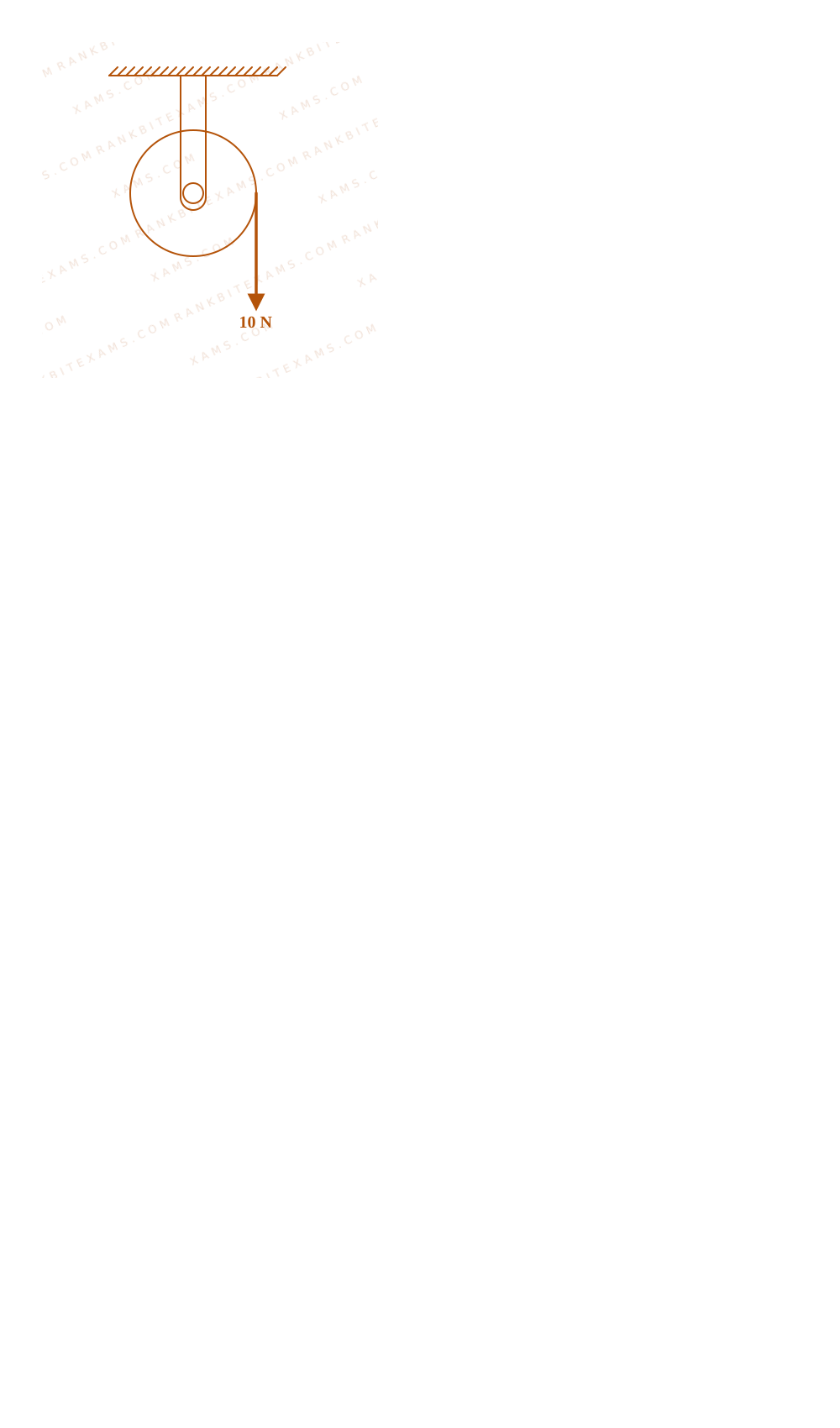
A wheel of radius 0.2 ~m rotates freely about its center when a string that is wrapped over its rim is pulled by force of 10 ~N as shown in figure. The established torque produces an angular acceleration of 2 rad / s² . Moment of inertia of the wheel is ________ kg m² . (Acceleration due to gravity = 10m / s²)
Circular wheel being pulled by a tangential force string
The diagram displays a circular wheel rotating about its center under a tangential pulling force of 10 N.
Numerical Answer. Answer: 1 to 1

Solution

Related Formula
  • Torque (τ) produced by a tangential pulling force:
τ = F · R
  • Newton's second law for rotation:
τ = I · α
Core Logic

We are given:

  • Radius of the wheel R = 0.2 m
  • Applied force F = 10 N
  • Angular acceleration α = 2 rad/s²
Step 1: Calculate torque and moment of inertia

First, find the torque τ:

τ = F · R = 10 N × 0.2 m = 2 N · m

Next, calculate the moment of inertia I using τ = Iα:

I = (τ)/(α) = 2 N · m2 rad/s² = 1 kg · m²

Thus, the moment of inertia is 1 ~kg· m².

Pattern Recognition

Sees: Pulley/wheel torque with basic rotational dynamics. Trap: Attempting to integrate gravity (g = 10 m/s²) into mass equations. Gravity is a redundant distractor here because the pulling tension force is explicitly defined! Shortcut: Directly compute torque as τ = F R and divide by the angular acceleration α.

Chapter Mix

Class 11 Physics: System of Particles and Rotational Motion

More System of Particles and Rotational Motion Questions — jee_main_2025_28_jan_morning

Practice all System of Particles and Rotational Motion previous-year questions →

Rankbit System
JEE Physics: Waves (+15.5%) | Electrostatics: Concentric Shells (-29.7%) | Modern Physics: Photoelectric Clones (+34.2%) | Mathematics: Definite Integrals (+18.1%) | Chemistry: Coordination Splitting (-11.4%) | JEE Physics: Waves (+15.5%) | Electrostatics: Concentric Shells (-29.7%) | Modern Physics: Photoelectric Clones (+34.2%) | Mathematics: Definite Integrals (+18.1%) | Chemistry: Coordination Splitting (-11.4%)