JEE Main · Physics → Steady

System of Particles and Rotational Motion appeared 57 times across 3 years — 6.6% of Physics. This question is from Moment of Inertia.

Year 2026 2025 2024 Total
Questions 19 27 11 57

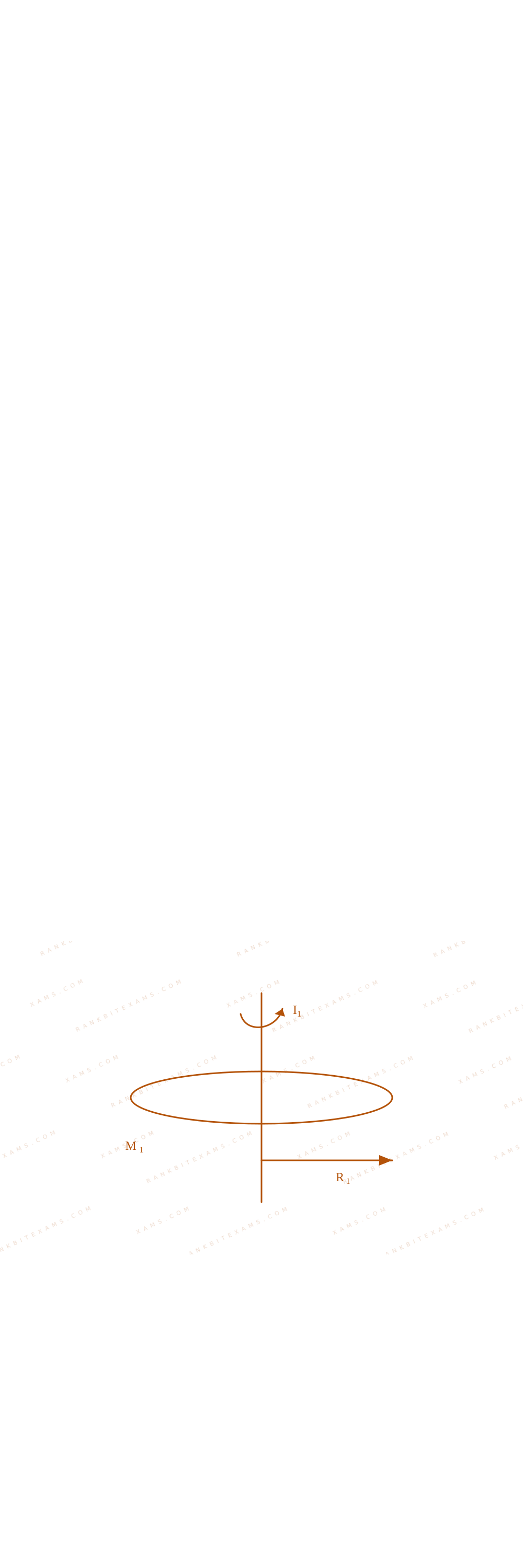
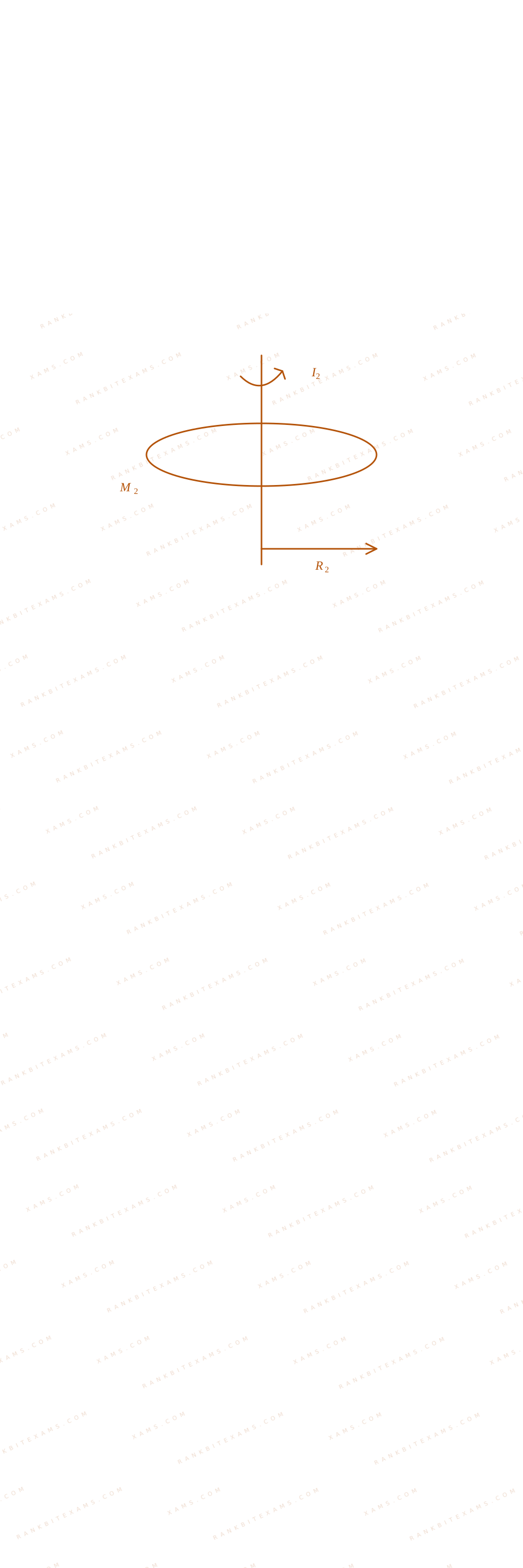
Two iron solid discs of negligible thickness have radii R₁ and R₂ and moment of inertia I₁ and I₂ , respectively. For R₂ = 2R₁ , the ratio of I₁ and I₂ would be 1 / x , where x =

Numerical Answer Type:
Enter a numerical value Answer: 16 to 16 +4 marks

Solution & Explanation

Core Logic

Since mass scales with the face surface area for discs of identical thickness and material composition:

M = σ · π R² M ∝ R²

Disk mass allocation scaling profile diagram for Q24

Disk mass allocation scaling profile diagram for Q24

M₁ = M₀, M₂ = σ π (2R₁)² = 4M₀

The moment of inertia formula for a disc is:

mathrmI = (1)/(2)MR² I ∝ MR² ∝ R⁴

Calculating the ratio for the given radii configuration:

I₁I₂ = M₁ R₁²M₂ R₂² = M₀ · R₁²4M₀ · (2R₁)² = (1)/(16)
Step 1: Value Convergence

Comparing this fraction to 1/x yields:

x = 16

Pattern Recognition

For 2D uniform laminar objects, scaling the radius changes both the mass factor (by R²) and the distribution distance (by R²), resulting in an overall R⁴ dependency rule.

Chapter Mix

Class 11 Physics: System of Particles and Rotational Motion

Reference Study Guides

More System of Particles and Rotational Motion Previous-Year Questions — Page 3

Q42 jee_main_2026_23_january_morning Angular Momentum
Two small balls with masses m and 2m are attached to both ends of a rigid rod of length d and negligible mass. If angular momentum of this system is L about an axis (A) passing through its centre of mass and perpendicular to the rod then angular velocity of the system about A is:
  • A. (3)/(2) Lmd²
  • B. 2Lmd²
  • C. (4)/(3) Lmd²
  • D. 2L5md²

Solution

Related Formula
rcm = m₁r₁ + m₂r₂m₁ + m₂ Icm = μ d² = ( m₁m₂m₁ + m₂)d²

L = Iω

Step 1: Calculate Moment of Inertia about COM

Let mass m be at the origin. Position of 2m is d.

Xcm = (m(0) + 2m(d))/(m + 2m) = (2d)/(3)

Distance of mass m from COM is (2d)/(3). Distance of mass 2m from COM is d - (2d)/(3) = (d)/(3).

I = m((2d)/(3))² + 2m((d)/(3))² I = 4md²9 + 2md²9 = 6md²9 = 2md²3
Step 2: Calculate Angular Velocity

L = Iω

ω = (L)/(I) ω = L 2md²3 = 3L2md²
Pattern Recognition

Sees: "two point masses" + "rotation about COM" → Quickly use reduced mass μ moment of inertia shortcut: Icm = μ d² = ((m · 2m)/(3m))d² = (2)/(3)md² to save time.

Chapter Mix

Class 11 Physics: Systems of Particles and Rotational Motion

Q49 jee_main_2026_23_january_evening Moment of Inertia
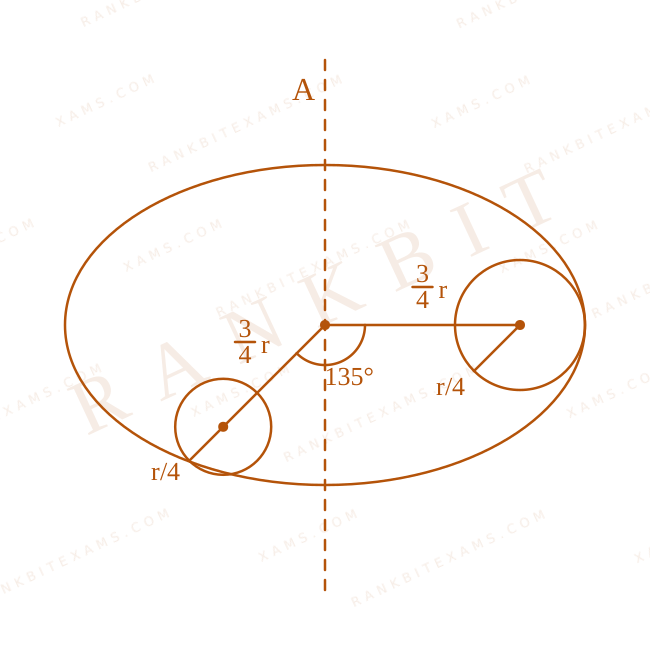
Suppose there is a uniform circular disc of mass M kg and radius r m shown in figure. The shaded regions are cut out from the disc. The moment of inertia of the remainder about the axis A of the disc is given by (x)/(256) Mr ² . The value of x is ____.
Moment of Inertia diagram for Q49 - JEE Main 2026 Evening
Diagram showing a large circular disc with two smaller circular sections removed.
Numerical Answer. Answer: 109 to 109

Solution

Related Formula
Iremaining = Itotal - Σ Icut

Parallel axis theorem: I = Icm + md²

Core Logic

Total mass of original disc is M = σ π r². Two identical smaller discs are removed. From the diagram, each small cut-out disc has radius r' = (r)/(4). The center of each cut-out disc is at distance d = (3)/(4)r from the main axis A. Mass of each cut-out disc:

m = σ π ((r)/(4))² = (σ π r²)/(16) = (M)/(16)
Step 1: Moment of Inertia of Total Disc

For the main solid disc about its central axis A:

Itotal = (1)/(2) M r²
Step 2: Moment of Inertia of Cut-out Discs

Using parallel axis theorem for one cut-out disc about axis A:

Icut = (1)/(2) m (r')² + m d² Icut = (1)/(2) m ((r)/(4))² + m ((3)/(4)r)² Icut = (mr²)/(32) + (9mr²)/(16) = m r² ( (1 + 18)/(32) ) = (19)/(32) m r²

Since there are 2 cut-out discs, the total subtracted inertia is:

Iremoved = 2 × (19)/(32) m r² = (19)/(16) m r²
Step 3: Calculate Final Inertia in Terms of M

Substitute m = (M)/(16):

Iremoved = (19)/(16) ( (M)/(16) ) r² = (19)/(256) M r²

Now, subtract from total:

Iremaining = (1)/(2) M r² - (19)/(256) M r² Iremaining = (128 - 19)/(256) M r² = (109)/(256) M r²

Thus, x = 109.

Pattern Recognition

In cavity problems, mass is strictly proportional to area (R²). Use parallel axis theorem perfectly on the 'negative mass' segments and subtract.

Chapter Mix

Class 11 Physics: System of Particles and Rotational Motion
Q41 jee_main_2026_24_january_morning Dynamics of Rotational Motion
Two masses 400 g and 350 g are suspended from the ends of a light string passing over a heavy pulley of radius 2 cm. When released from rest the heavier mass is observed to fall 81 cm in 9 s. The rotational inertia of the pulley is ____ kg ². (g = 9.8 m/s²)
  • A. 9.5 × 10⁻³
  • B. 4.75 × 10⁻³
  • C. 1.86 × 10⁻²
  • D. 8.3 × 10⁻³

Solution

Related Formula
s = ut + (1)/(2)at² a = ((m₁ - m₂)g)/(m₁ + m₂ + (I)/(R²))
Core Logic

Atwood machine with a massive pulley

First, calculate the acceleration of the system using kinematics:

s = ut + (1)/(2)at² 0.81 = 0 + (1)/(2) a (9)² a = (2 × 0.81)/(81) = 0.02 m/s²

Applying Newton's second law for masses and rotation:

m₁ g - T₁ = m₁ a T₂ - m₂ g = m₂ a (T₁ - T₂)R = I · α = I ((a)/(R))

This leads to the standard Atwood machine acceleration with massive pulley:

a = ((m₁ - m₂)g)/(m₁ + m₂ + (I)/(R²))
Step 1: Calculate Moment of Inertia

Substitute known values (m₁=0.4 kg, m₂=0.35 kg, R=0.02 m):

0.02 = ((0.4 - 0.35) × 9.8)/((0.4 + 0.35) + (I)/(R²)) 0.02 = (0.05 × 9.8)/(0.75 + (I)/(R²)) 0.75 + (I)/(R²) = (0.49)/(0.02) = 24.5 (I)/(R²) = 24.5 - 0.75 = 23.75 I = 23.75 × (0.02)² = 23.75 × 4 × 10⁻⁴ I = 95 × 10⁻⁴ = 9.5 × 10⁻³ kg ²
Pattern Recognition

For massive pulley problems, the "effective mass" of the system increases by the pulley's equivalent translating mass I/R². Simply use a = Fₙₑₜ / Meffective.

Chapter Mix

Class 11 Physics: System of Particles and Rotational Motion Class 11 Physics: Laws of Motion
Q31 jee_main_2026_24_january_evening Rigid Body Rotation and Energy Conservation
A thin uniform rod (X) of mass M and length L is pivoted at a height ((L)/(3)) as shown in the figure. The rod is allowed to fall from a vertical position and lie horizontally on the table. The angular velocity of this rod when it hits the table top, is ____. (g = gravitational acceleration)
Rigid Body Rotation and Energy Conservation diagram for Q31 - JEE Main 2026 Evening
A uniform rod is pivoted at a distance of L/3 from the table surface and falls from a vertical position to horizontal.
  • A. (3)/(2) gL
  • B. 3√(2) gL
  • C. 1√(2) gL
  • D. 3gL

Solution

Related Formula
Δ K.E. = Δ P.E. mg Δ hcom = (1)/(2) I ω²
Core Logic

The rod falls such that its center of mass lowers by a distance. The rod is pivoted at (L)/(3) from the bottom, meaning the distance from the pivot to the center of mass (which is at (L)/(2) from either end) is:

hcom = (L)/(2) - (L)/(3) = (L)/(6)
Step 1: Moment of Inertia

Using the parallel axis theorem, the moment of inertia about the pivot is:

I = Icom + m d² I = (mL²)/(12) + m((L)/(6))² = (mL²)/(12) + (mL²)/(36) = (mL²)/(9)
Step 2: Energy Conservation

Equating the loss in potential energy to the gain in rotational kinetic energy:

mg (L)/(6) = (1)/(2) ((mL²)/(9)) ω² mg (L)/(6) = (mL²)/(18) ω² ω² = (3g)/(L) ω = √((3g)/(L))
Pattern Recognition

For a hinged rod falling from a vertical orientation to horizontal, always track the displacement of the center of mass and calculate rotational inertia strictly about the hinge using Ipivot = Icm + md².

Chapter Mix

Class 11 Physics: System of Particles and Rotational Motion
Q49 jee_main_2026_24_january_evening Moment of Inertia of Continuous Bodies
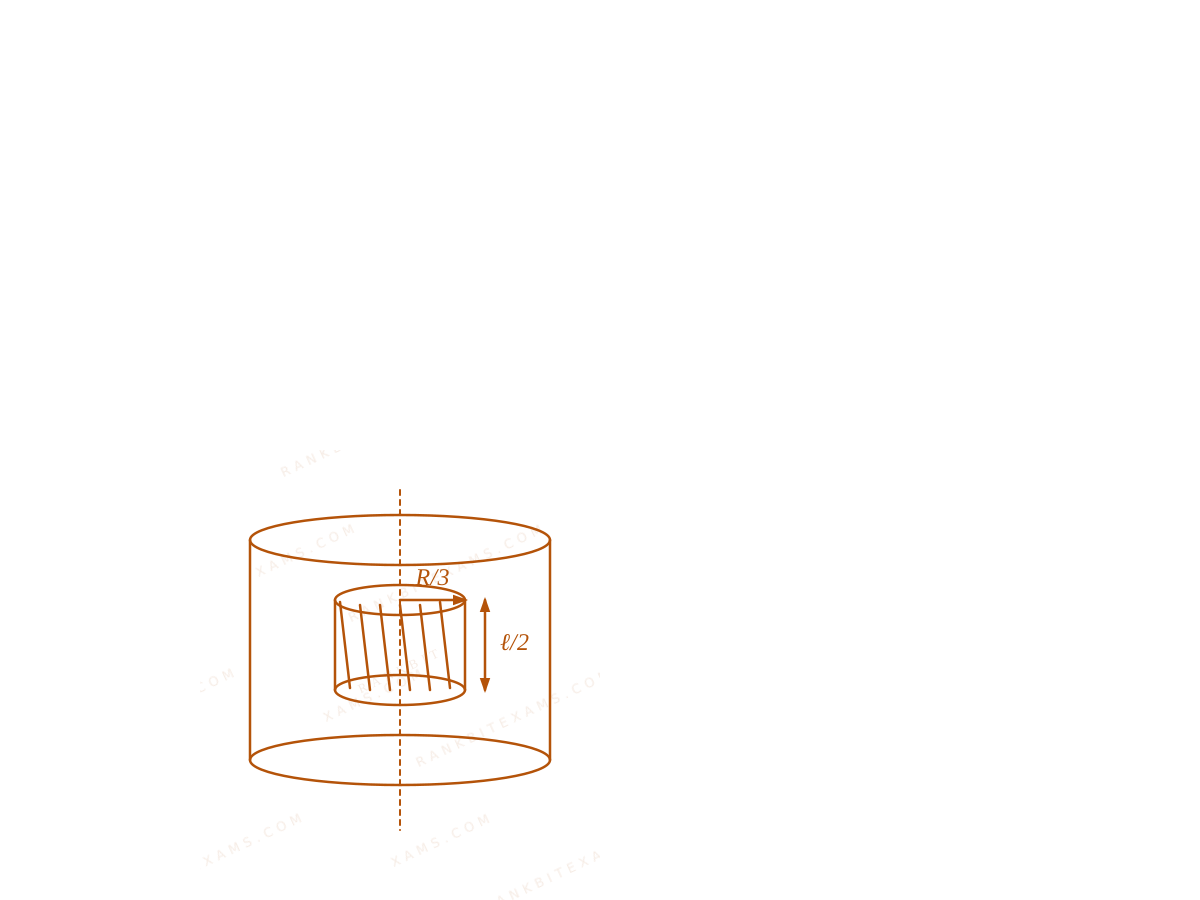
A uniform solid cylinder of length L and radius R has moment of inertia about its axis equal to I₁ . A small co-centric cylinder of length L/2 and radius R/3 carved from this cylinder has moment of inertia about its axis equals to I₂ . The ratio I₁/I₂ is
Numerical Answer. Answer: 162 to 162

Solution

Related Formula
I = (1)/(2) M R² M = ρ · V = ρ · π R² L
Core Logic

Moment of Inertia of Continuous Bodies diagram for Q49 - JEE Main 2026 Evening

For the original cylinder (mass M):

I₁ = (1)/(2) M R²

For the carved cylinder, its mass m is:

m = ρ × π ((R)/(3))² × (L)/(2)
Step 1: Calculate Mass of Carved Cylinder
m = (ρ π R² L)/(18) = (M)/(18)
Step 2: Calculate Inertia of Carved Cylinder
I₂ = (1)/(2) m ((R)/(3))² I₂ = (1)/(2) ( (M)/(18) ) ( (R²)/(9) ) I₂ = (1)/(324) M R²
Step 3: Finding the Ratio
(I₁)/(I₂) = ((1)/(2) M R²)/((1)/(324) M R²) = (324)/(2) = 162
Pattern Recognition

For similar geometries, mass scales as R² L. Inertia scales as M R² which ultimately means I ∝ R⁴ L. Here R arrow R/3 (factor of 1/81) and L arrow L/2 (factor of 1/2), so I₂ is 1/162 of I₁.

Chapter Mix

Class 11 Physics: System of Particles and Rotational Motion

More System of Particles and Rotational Motion Questions — jee_main_2025_28_jan_morning

Practice all System of Particles and Rotational Motion previous-year questions →
Rankbit System
JEE Physics: Waves (+15.5%) | Electrostatics: Concentric Shells (-29.7%) | Modern Physics: Photoelectric Clones (+34.2%) | Mathematics: Definite Integrals (+18.1%) | Chemistry: Coordination Splitting (-11.4%) | JEE Physics: Waves (+15.5%) | Electrostatics: Concentric Shells (-29.7%) | Modern Physics: Photoelectric Clones (+34.2%) | Mathematics: Definite Integrals (+18.1%) | Chemistry: Coordination Splitting (-11.4%)
