JEE Main · Physics → Steady

System of Particles and Rotational Motion appeared 57 times across 3 years — 6.6% of Physics. This question is from Moment of Inertia.

Year 2026 2025 2024 Total
Questions 19 27 11 57

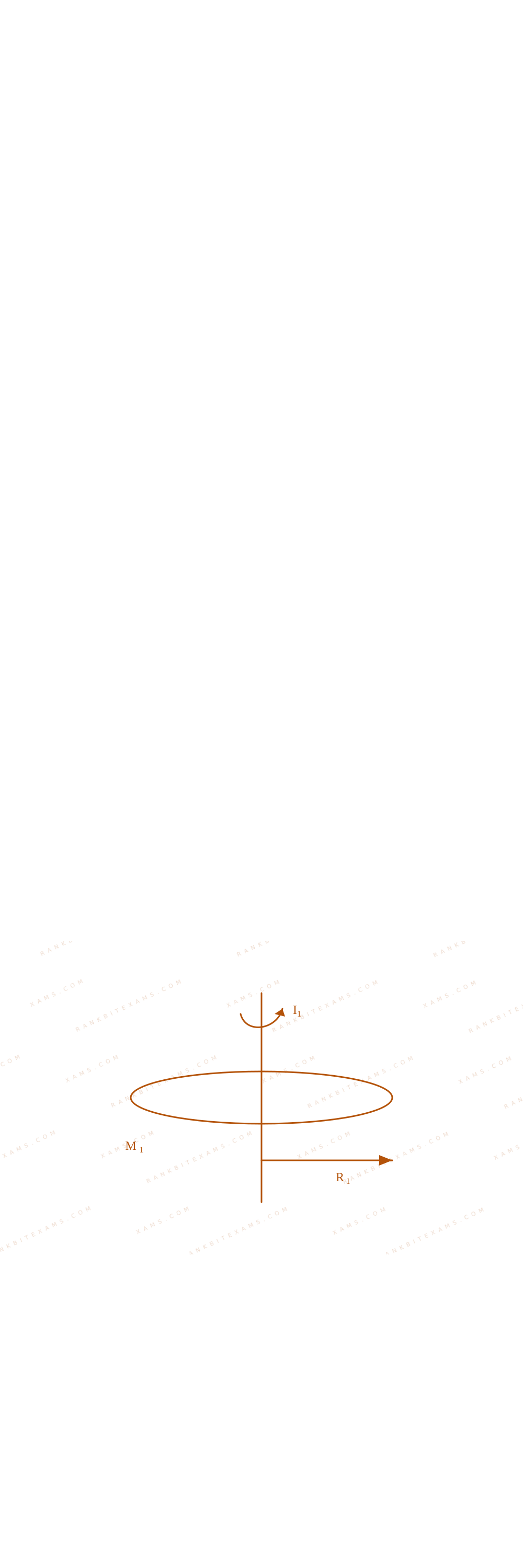
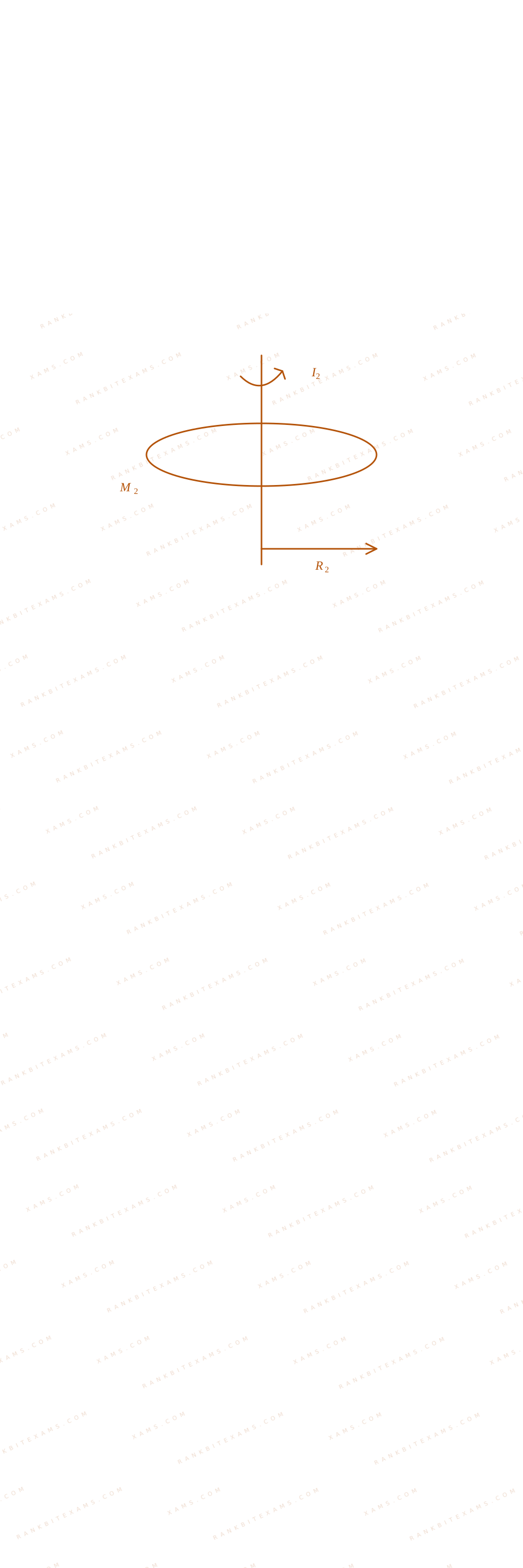
Two iron solid discs of negligible thickness have radii R₁ and R₂ and moment of inertia I₁ and I₂ , respectively. For R₂ = 2R₁ , the ratio of I₁ and I₂ would be 1 / x , where x =

Numerical Answer Type:
Enter a numerical value Answer: 16 to 16 +4 marks

Solution & Explanation

Core Logic

Since mass scales with the face surface area for discs of identical thickness and material composition:

M = σ · π R² M ∝ R²

Disk mass allocation scaling profile diagram for Q24

Disk mass allocation scaling profile diagram for Q24

M₁ = M₀, M₂ = σ π (2R₁)² = 4M₀

The moment of inertia formula for a disc is:

mathrmI = (1)/(2)MR² I ∝ MR² ∝ R⁴

Calculating the ratio for the given radii configuration:

I₁I₂ = M₁ R₁²M₂ R₂² = M₀ · R₁²4M₀ · (2R₁)² = (1)/(16)
Step 1: Value Convergence

Comparing this fraction to 1/x yields:

x = 16

Pattern Recognition

For 2D uniform laminar objects, scaling the radius changes both the mass factor (by R²) and the distribution distance (by R²), resulting in an overall R⁴ dependency rule.

Chapter Mix

Class 11 Physics: System of Particles and Rotational Motion

Reference Study Guides

More System of Particles and Rotational Motion Previous-Year Questions — Page 5

Q3 jee_main_2025_02_april_evening Moment of Inertia of Ring
The moment of inertia of a circular ring of mass M and diameter r about a tangential axis lying in the plane of the ring is:
  • A. (1)/(2) M r²
  • B. (3)/(8) M r²
  • C. (3)/(2) M r²
  • D. 2 M r²

Solution

Related Formula
  • Moment of inertia of a circular ring of mass M and radius R about a diametrical axis in its plane:
Idia = (1)/(2) M R²
  • Parallel Axis Theorem:
I = Icm + M d²

where d is the perpendicular distance between the center of mass axis and the parallel axis.

Core Logic

The axis of rotation is tangential and lies in the plane of the ring. Thus, the distance from the center of mass axis (which is also diametrical and in-plane) is equal to the radius R.

Using the parallel axis theorem:

Itangent = Idia + M R² = (1)/(2) M R² + M R² = (3)/(2) M R²
Step 1: Express in terms of diameter r

The question specifies the diameter of the ring is r. Therefore, the radius R is:

R = (r)/(2)

Substitute R = (r)/(2) into the moment of inertia formula:

Itangent = (3)/(2) M ((r)/(2))² = (3)/(8) M r²

Thus, the moment of inertia is (3)/(8) M r².

Pattern Recognition

Sees: Circular ring tangential axis in-plane. Trap: Directly using radius r instead of diameter r. Read variables carefully: often r is radius, but here it is explicitly given as diameter! Shortcut: Standard in-plane tangent is (3)/(2)MR². Substitute R = (r)/(2) to get (3)/(8)Mr².

Chapter Mix

Class 11 Physics: System of Particles and Rotational Motion
Q jee_main_2025_02_april_morning Moment of Inertia and Torque
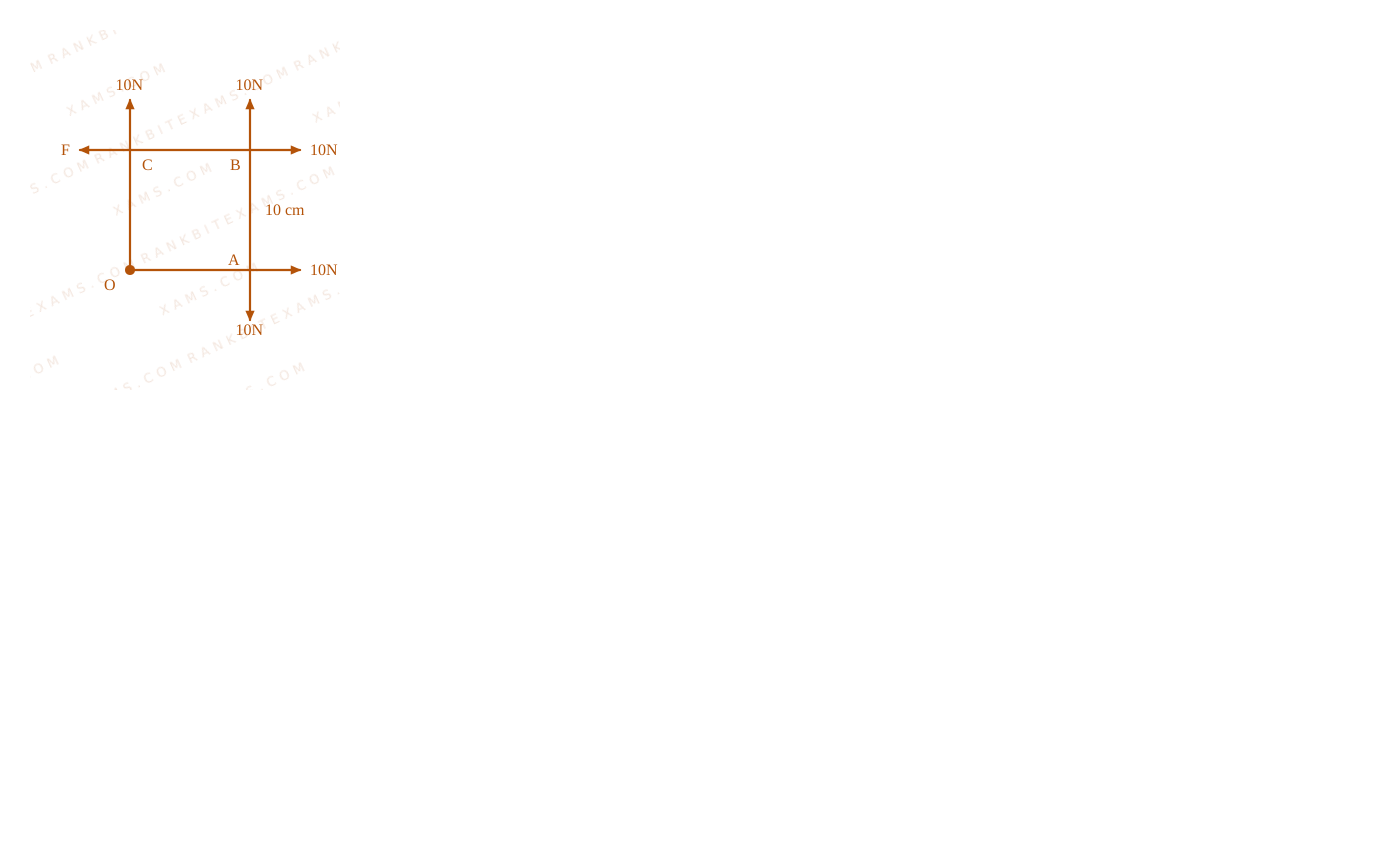
A square Lamina OABC of length 10~cm is pivoted at 'O'. Forces act on the Lamina as shown in the figure. If the Lamina remains stationary, then the magnitude of F is:
Square lamina pivoted at O diagram for Q13
A square lamina OABC with multiple force vectors acting on its vertices, pivoted at O.
  • A. 20~N
  • B. 0 (zero)
  • C. 10~N
  • D. 10√(2)~N

Solution

Related Formula
τO = F · r⊥ Σ τO = 0 (for rotational equilibrium)
Core Logic

Let the side length of the square lamina be l = 10~cm. The lamina is pivoted at point O(0,0) and remains stationary under rotational equilibrium. Therefore, the net torque about O must be zero.

Evaluating torque contributions about point O:

  • Forces acting directly at pivot O produce zero torque.
  • Forces whose lines of action pass through O produce zero torque.
  • The 10~N force perpendicular to side OA produces torque:
τ₁ = 10 × l (Counter-Clockwise)
  • The unknown force F acting perpendicular to side OC produces torque:
τ₂ = F × l (Clockwise)

Setting Σ τO = 0:

10 · l - F · l = 0 F = 10~N
Step 1: Final Conclusion

The magnitude of the force F is 10~N.

Pattern Recognition

In pivoted laminas, focus on the pivot and disregard any force vector whose line of action passes through the pivot. For symmetric placements, equate Clockwise torque = Counter-Clockwise torque directly.

Chapter Mix

Class 11 Physics: Rotational Motion

Q3 jee_main_2025_02_april_morning Moment of Inertia and Torque
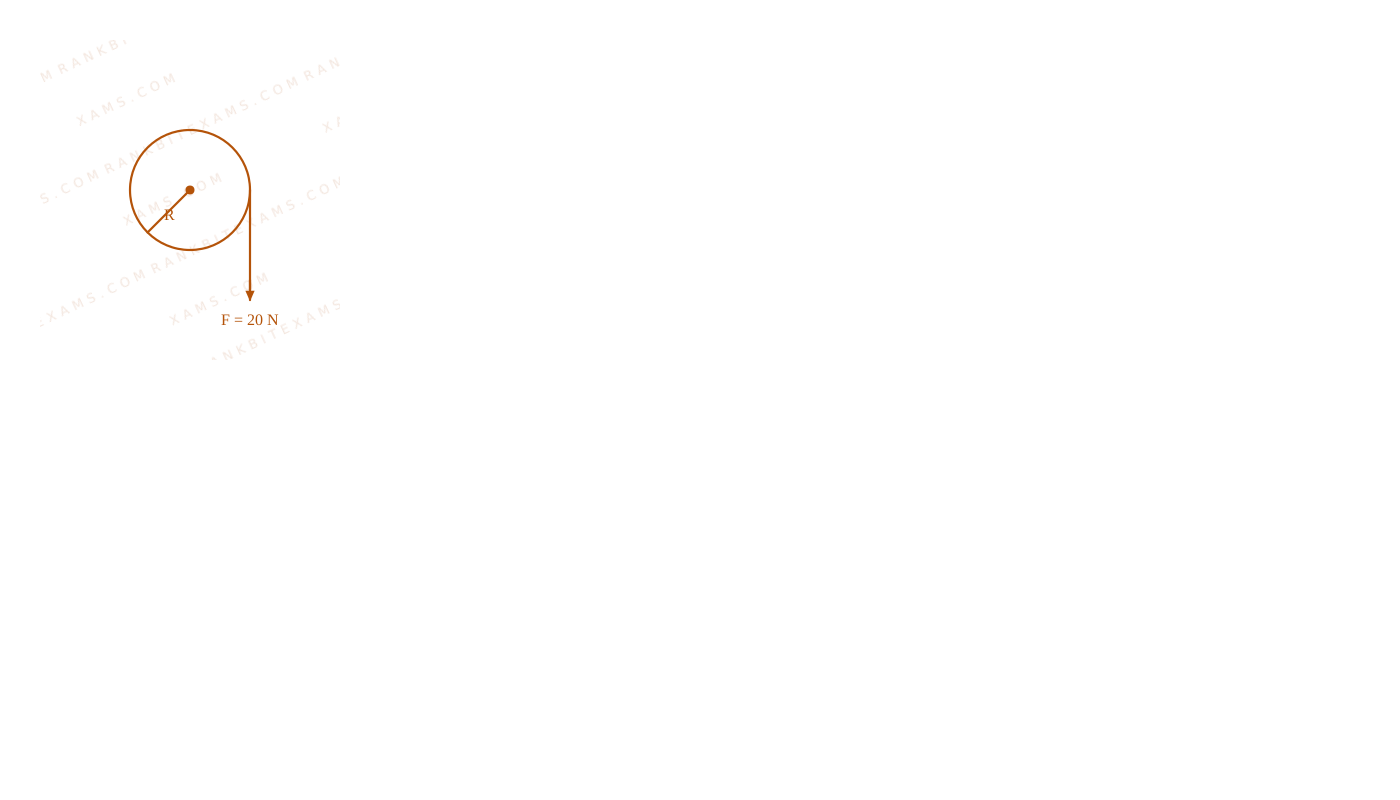
A cord of negligible mass is wound around the rim of a wheel supported by spokes with negligible mass. The mass of wheel is 10~kg and radius is 10~cm and it can freely rotate without any friction. Initially the wheel is at rest. If a steady pull of 20~N is applied on the cord, the angular velocity of the wheel, after the cord is unwound by 1~m, would be:
Wheel diagram for Q3 - JEE Main 2025 Morning
A wheel rotating with a pull force of 20 N acting on the cord.
  • A. 20~rad/s
  • B. 30~rad/s
  • C. 10~rad/s
  • D. 0~rad/s

Solution

Related Formula

WF = F · s

KR = (1)/(2) I ω² I = M R² (Moment of inertia of a ring/rim)
Core Logic

The work done by the constant pulling force F = 20~N through distance s = 1~m is completely converted into the rotational kinetic energy of the wheel.

Work done by force:

WF = F · s = 20 × 1 = 20~J

Since the spokes are of negligible mass, all mass M = 10~kg is distributed on the outer rim of radius R = 10~cm = 0.1~m. The wheel acts as a thin ring:

I = M R² = 10 × (0.1)² = 0.1~kg· m²

Using the work-energy theorem:

WF = Δ KR = (1)/(2) I ω² 20 = (1)/(2) × 0.1 × ω² 40 = 0.1 ω² ω² = 400 ω = 20~rad/s
Step 1: Final Conclusion

The angular velocity of the wheel after the cord is unwound by 1~m is 20~rad/s.

Pattern Recognition

Work done in unwinding a string is F · s. Under pure rotation with zero friction, this is exactly (1)/(2) I ω². Always identify the mass distribution (here, rim with massless spokes acts as a thin cylinder/ring I = MR²).

Chapter Mix

Class 11 Physics: Rotational Motion Class 11 Physics: Work, Energy and Power

Q16 jee_main_2025_02_april_morning Moment of Inertia and Torque
Moment of inertia of a rod of mass 'M' and length 'L' about an axis passing through its center and normal to its length is 'α'. Now the rod is cut into two equal parts and these parts are joined symmetrically to form a cross shape. Moment of inertia of cross about an axis passing through its center and normal to plane containing cross is:
  • A. α
  • B. α / 4
  • C. α / 8
  • D. α / 2

Solution

Related Formula
I = (1)/(12) M L²
Core Logic

Initially, the moment of inertia is:

α = (M L²)/(12)

When cut into two equal parts, each smaller rod has:

  • Mass, m = (M)/(2)
  • Length, l = (L)/(2)
  • When joined symmetrically as a cross, the target axis passes through their joint intersection perpendicular to their plane. For each rod, this axis passes through its individual center of mass and is perpendicular to its length.

    Thus, the total moment of inertia of the cross is the sum of the moments of inertia of the two rods:

Icross = I₁ + I₂ = 2 × ((1)/(12) m l²) = (1)/(6) m l²

Substituting m = (M)/(2) and l = (L)/(2):

Icross = (1)/(6) × ((M)/(2)) × ((L)/(2))² = (1)/(6) × (M)/(2) × (L²)/(4) = (M L²)/(48)

Comparing with α:

Icross = (1)/(4) ((M L²)/(12)) = (α)/(4)
Step 1: Final Conclusion

The moment of inertia of the cross is

Step 1: Final Conclusion

The moment of inertia of the cross is $\alpha / 4.

Pattern Recognition

Since mass scales linearly (

Pattern Recognition

Since mass scales linearly ($M \propto L), cutting a rod intonequal segments scales the length by1/nand mass by1/n. The moment of inertia of each segment scales as1/n^3. Reassemblingnsegments linearly sums their contributions, so the final moment of inertia scales asn \times \frac{1}{n^3} = \frac{1}{n^2}$.

Chapter Mix

Class 11 Physics: Rotational Motion

Q6 jee_main_2025_07_april_morning Centre of Mass
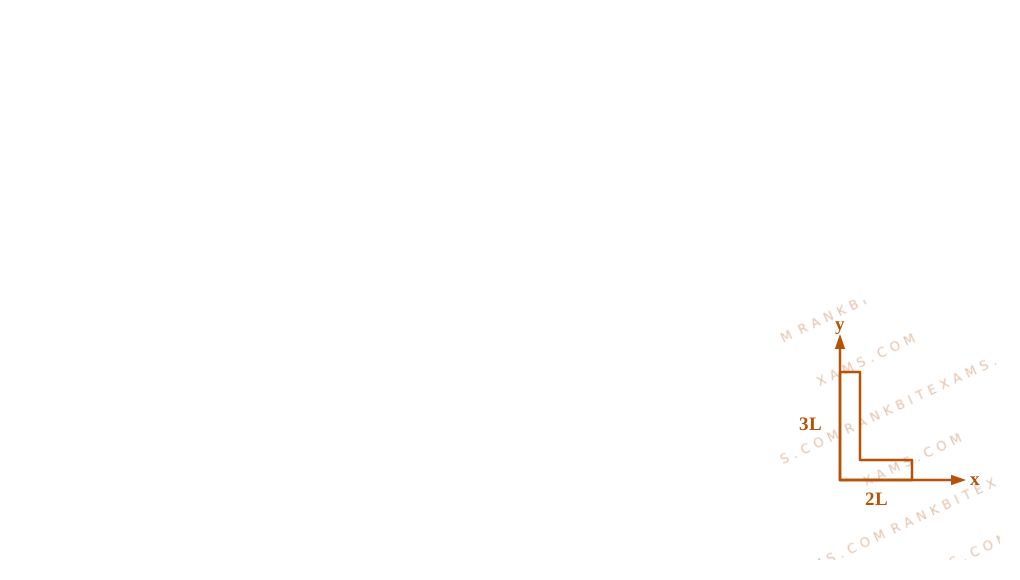
A rod of length 5 ~L is bent right angle keeping one side length as 2 ~L .
L-shaped bent rod geometry for Q6 - JEE Main 2025 Morning
Diagram of an L-shaped rod aligned with the x and y axes, with lengths 2L and 3L respectively.
The position of the centre of mass of the system : (Consider L = 10cm )
  • A. 2 i + 3 j
  • B. 3 i + 7 j
  • C. 5 i + 8 j
  • D. 4 i + 9 j

Solution

Related Formula

For a continuous system modeled as discrete point masses located at their respective centers of mass:

xcom = (m₁x₁ + m₂x₂)/(m₁ + m₂) ycom = (m₁y₁ + m₂y₂)/(m₁ + m₂)
Core Logic

Let the uniform linear mass density of the rod be λ.

  • Total length is 5L.
  • One segment of length 2L lies on the x-axis. Its mass is 2m = λ(2L) and its center of mass is at (L, 0).
  • The remaining segment of length 3L lies on the y-axis. Its mass is 3m = λ(3L) and its center of mass is at (0, 1.5L).
Step 1: Calculate COM Coordinates

Find the coordinates of the system's center of mass:

xcom = (2m(L) + 3m(0))/(2m + 3m) = (2L)/(5) = 0.4L ycom = (2m(0) + 3m(1.5L))/(2m + 3m) = (4.5L)/(5) = 0.9L

Given L = 10 ~cm:

xcom = 0.4 × 10 = 4 ~cm ycom = 0.9 × 10 = 9 ~cm
Step 2: Vector Form

Expressing in vector notation:

rcom = 4 i + 9 j
Pattern Recognition

Sees: L-shaped rod formed by bending a total length Ltotal. Shortcut: Treat each arm as a point mass at its geometric midpoint. For segments of ratio 2:3, the COM divides the distance between their midpoints in the inverse ratio 3:2 closer to the heavier segment on the y-axis.

Chapter Mix

Class 11 Physics: System of Particles and Rotational Motion
More System of Particles and Rotational Motion Questions — jee_main_2025_28_jan_morning
Practice all System of Particles and Rotational Motion previous-year questions →

Rankbit System
JEE Physics: Waves (+15.5%) | Electrostatics: Concentric Shells (-29.7%) | Modern Physics: Photoelectric Clones (+34.2%) | Mathematics: Definite Integrals (+18.1%) | Chemistry: Coordination Splitting (-11.4%) | JEE Physics: Waves (+15.5%) | Electrostatics: Concentric Shells (-29.7%) | Modern Physics: Photoelectric Clones (+34.2%) | Mathematics: Definite Integrals (+18.1%) | Chemistry: Coordination Splitting (-11.4%)