Related Formula
For a solid cylinder:
Parallel to its length passing through center: I = M'R²2$I = \frac{M'R^{2}}{2}$
Perpendicular to length through center: I = M'R²4 + M'L²12$I = \frac{M'R^{2}}{4} + \frac{M'L^{2}}{12}$
Parallel Axis Theorem: I = Icm + M'd²$I = I_{\text{cm}} + M'd^{2}$
Core Logic
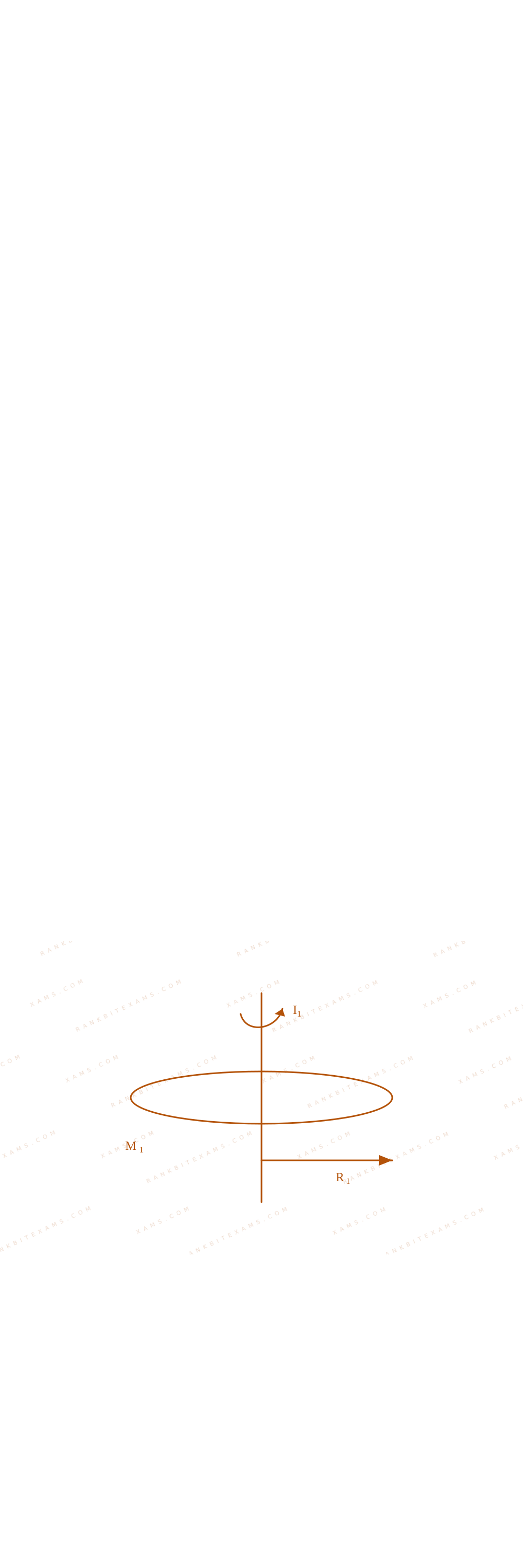
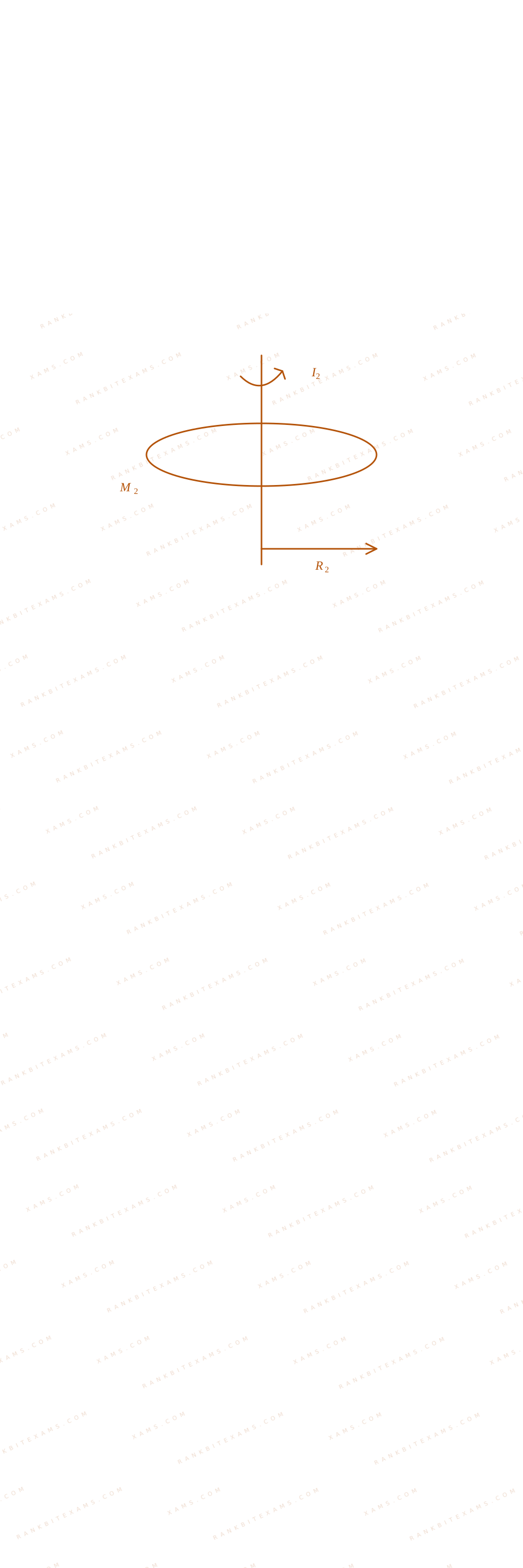
The square loop is formed by four identical solid cylinders, each of mass M' = (M)/(4)$M' = \frac{M}{4}$. The given axis passes through the mid-points of two opposite cylinders. This means two cylinders have the axis passing perpendicularly through their centers, and the other two cylinders are parallel to the axis at a distance of L/2$L/2$.
Step 1: Moment of Inertia for cylinders bisected perpendicularly
For the two cylinders perpendicular to the axis of rotation:
I₁ = 2 × ( M'R²4 + M'L²12)$$I_{1} = 2 \times \left(\frac{M'R^{2}}{4} + \frac{M'L^{2}}{12}\right)$$
Step 2: Moment of Inertia for cylinders parallel to axis
For the two cylinders parallel to the axis, distance d = L/2$d = L/2$. Apply the parallel axis theorem:
I₂ = 2 × [ M'R²2 + M'((L)/(2))²]$$I_{2} = 2 \times \left[\frac{M'R^{2}}{2} + M'\left(\frac{L}{2}\right)^{2}\right]$$
Step 3: Total Moment of Inertia
Iₙₑₜ = I₁ + I₂ = 2( M'R²4 + M'L²12) + 2( M'R²2 + M'L²4)$$I_{\text{net}} = I_{1} + I_{2} = 2\left(\frac{M'R^{2}}{4} + \frac{M'L^{2}}{12}\right) + 2\left(\frac{M'R^{2}}{2} + \frac{M'L^{2}}{4}\right)$$
Iₙₑₜ = M'R²2 + M'L²6 + M'R² + M'L²2$$I_{\text{net}} = \frac{M'R^{2}}{2} + \frac{M'L^{2}}{6} + M'R^{2} + \frac{M'L^{2}}{2}$$
Iₙₑₜ = 3M'R²2 + 4M'L²6 = 3M'R²2 + 2M'L²3$$I_{\text{net}} = \frac{3M'R^{2}}{2} + \frac{4M'L^{2}}{6} = \frac{3M'R^{2}}{2} + \frac{2M'L^{2}}{3}$$
Step 4: Substitute Total Mass
Substitute M' = M/4$M' = M/4$:
I = (3)/(2)((M)/(4))R² + (2)/(3)((M)/(4))L²$$I = \frac{3}{2}\left(\frac{M}{4}\right)R^{2} + \frac{2}{3}\left(\frac{M}{4}\right)L^{2}$$
I = (3)/(8)MR² + (1)/(6)ML²$$I = \frac{3}{8}MR^{2} + \frac{1}{6}ML^{2}$$
Pattern Recognition
Sees: "square loop of cylinders" + "mass M of entire loop" → Always remember Mᵢ = M/4$M_{i} = M/4$. Calculate individual moment of inertia carefully considering whether the cylinder is oriented parallel or perpendicular.
Chapter Mix
Class 11 Physics: Systems of Particles and Rotational Motion