

JEE Main · Physics → Steady

Ray Optics and Optical Instruments appeared 63 times across 3 years — 7.3% of Physics. This question is from Total Internal Reflection.

Year 2026 2025 2024 Total
Questions 19 34 10 63

A hemispherical vessel is completely filled with a liquid of refractive index μ . A small coin is kept at the lowest point (O) of the vessel as shown in figure. The minimum value of the refractive index of the liquid so that a person can see the coin from point E (at the level of the vessel) is
Total Internal Reflection diagram for Q5 - JEE Main 2025 Morning
A coin at the base of a hemispherical liquid filled container viewed from the grazing edge point E.

Solution & Explanation

Related Formula
c = (1)/(μ)
Core Logic

To see the coin from edge point E at grazing emergency, the light ray travelling from mathrmO to mathrmE must strike the flat upper boundary at the critical angle.

Ray tracing verification layout for Q5
A coin at the base of a hemispherical liquid filled container viewed from the grazing edge point E.

Given the hemispherical layout geometry, the ray's angle of incidence at the center of the surface plane satisfies:

θ = c = 45°

Substituting this value into the critical value expression:

μ = 1 45° = √(2)
Step 1: Final Conclusion

The minimum refractive index required is √(2), matching option (3).

Pattern Recognition

Grazing boundary ray vision configurations dictate evaluating the specific systemic geometric configuration to compute the critical boundary angle. Here, the radius profile fixes θ = 45° deterministically.

Chapter Mix

Class 12 Physics: Ray Optics and Optical Instruments

Reference Study Guides

More Ray Optics and Optical Instruments Previous-Year Questions — Page 9

Q jee_main_2025_04_april_morning Spherical Mirrors
Distance between object and its image (magnified by -(1)/(3)) is 30 cm. The focal length of the mirror used is ((x)/(4)) cm, where magnitude of value of x is
Numerical Answer. Answer: 45 to 45

Solution

Related Formula

Magnification relation for spherical mirrors:

m = -(v)/(u)

Mirror equation:

(1)/(f) = (1)/(v) + (1)/(u)
Core Logic

Given m = -(1)/(3):

-(v)/(u) = -(1)/(3) implies u = 3v

Since magnification is negative, a real inverted image is formed on the same side as the object in a concave mirror layout configuration.
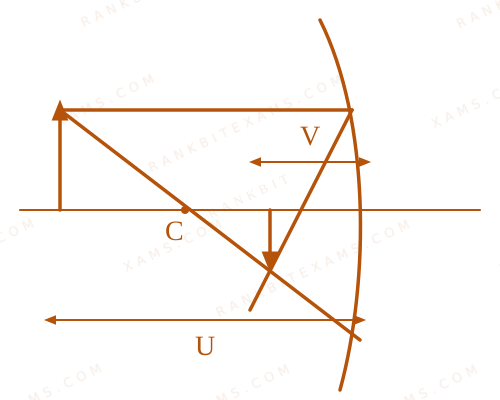
Concave mirror real image trace tracking for Q23 - JEE Main 2025 Morning

Step 1: Formulate Position Distances

The distance between the object and image is given as 30~cm:

|u| - |v| = 30 implies 3v - v = 30 implies 2v = 30 implies v = 15~cm

This gives u = 3(15) = 45~cm.

Step 2: Solve for Focal Length and x

Apply standard sign conventions (u = -45~cm, v = -15~cm):

(1)/(f) = -(1)/(15) - (1)/(45) = (-3 - 1)/(45) = -(4)/(45) |f| = (45)/(4)~cm

Matching this with the prompt pattern form (x)/(4) yields: x = 45

Pattern Recognition

Real inverted diminished images (|m| < 1) mean the image forms closer to the mirror surface than the object, situated between the focal center F and center of curvature C.

Chapter Mix

Class 12 Physics: Ray Optics and Optical Instruments
Q9 jee_main_2025_07_april_evening Spherical Mirrors
A mirror is used to produce an image with magnification of (1)/(4) If the distance between object and its image is 40 cm, then the focal length of the mirror is [cite: 113, 114, 116]
  • A. 10 cm [cite: 117]
  • B. 12.7 cm [cite: 119]
  • C. 10.7 cm [cite: 118]
  • D. 15 cm [cite: 119]

Solution

Related Formula

m = -(v)/(u) [cite: 700]

(1)/(v) + (1)/(u) = (1)/(f) [cite: 707]

Core Logic

Given magnification magnitude |m| = (1)/(4)[cite: 113]. Assuming a real image formed by a concave mirror: [cite: 701]

(v)/(u) = (1)/(4) u = 4v [cite: 701]

The distance between the object and the image is given as 40 cm [cite: 114, 116]:

u - v = 40 4v - v = 40 3v = 40 v = (40)/(3) cm u = 4 × (40)/(3) = (160)/(3) cm

Applying mirror sign conventions (u = -(160)/(3), v = -(40)/(3)): [cite: 701, 704]

(1)/(f) = -(3)/(40) - (3)/(160) = -(12 + 3)/(160) = -(15)/(160)

f = -(160)/(15) ≈ -10.67 cm [cite: 712]

Rounding to the matching options choice gives 10.7 cm[cite: 118, 712].

Pattern Recognition

Pay attention to sign conventions in mirror systems. A smaller real image formed by a concave mirror sits between the focus and center of curvature, resulting in u > v configurations.

Chapter Mix

Class 12 Physics: Ray Optics and Optical Instruments

Q14 jee_main_2025_07_april_evening Refractive Index
Given below are two statements: one is labelled as Assertion (A) and the other is labelled as Reason (R). Assertion (A) : Refractive index of glass is higher than that of air. [cite: 130] Reason (R): Optical density of a medium is directly proportionate to its mass density which results in a proportionate refractive index. [cite: 131] In the light of the above statements, choose the most appropriate answer from the options given below: [cite: 132]
  • A. (A) is not correct but (R) is correct [cite: 133]
  • B. Both (A) and (R) are correct and (R) is the correct explanation of (A) [cite: 134]
  • C. (A) is correct but (R) is not correct [cite: 135]
  • D. Both (A) and (R) are correct but (R) is not the correct explanation of (A) [cite: 136]

Solution

Core Logic

Refractive index represents the ratio of the speed of light in vacuum to its speed in a given medium[cite: 719]. Glass slows light down more than air does, hence μglass ≈ 1.5 > μₐᵢᵣ ≈ 1.0, which makes Assertion (A) correct[cite: 130]. However, optical density is defined by a medium's capacity to refract light and is completely conceptually distinct from inertial mass density (mass per unit volume)[cite: 719]. For example, turpentine has a lower mass density than water but possesses a higher optical density and refractive index. Therefore, Reason (R) is fundamentally incorrect[cite: 722].

Pattern Recognition

Optical density vs mass density is a signature conceptual trick in refraction theory[cite: 719]. They share the word 'density' but have entirely different physical meanings and no fixed mathematical proportionality[cite: 719, 722].

Chapter Mix

Class 12 Physics: Ray Optics and Optical Instruments

Q20 jee_main_2025_07_april_evening Total Internal Reflection
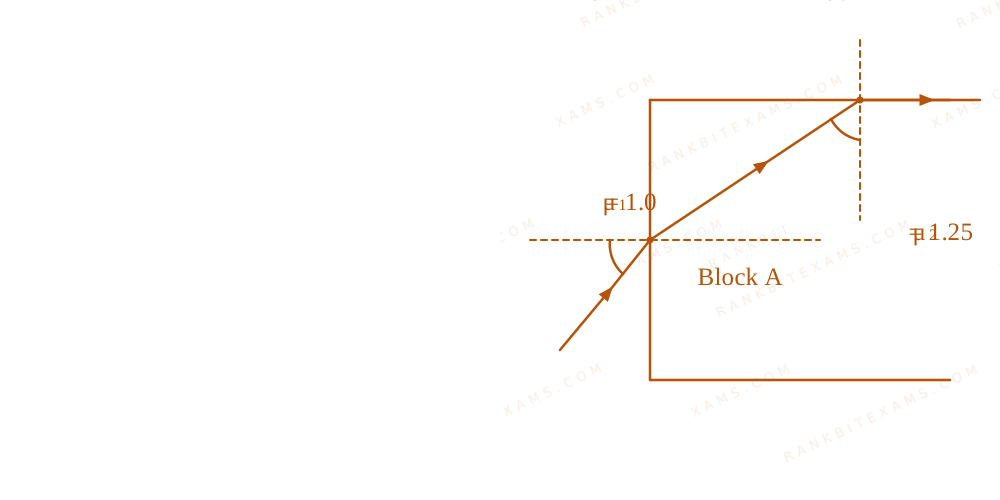
A transparent block A having refractive index μ=1.25 is surrounded by another medium of refractive index μ=1.0 as shown in figure. A light ray is incident on the flat face of the block with incident angle θ as shown in figure. What is the maximum value of θ for which light suffers total internal reflection at the top surface of the block?
Total Internal Reflection diagram for Q20 - JEE Main 2025 Evening
The diagram displays a light ray entering a rectangular block from a medium of lower refractive index, hitting the top wall at the critical boundary angle.
[cite: 169, 170, 171]
  • A. ⁻¹(4/3) [cite: 175]
  • B. ⁻¹(3/4) [cite: 176]
  • C. ⁻¹(3/4) [cite: 177]
  • D. ⁻¹(3/4) [cite: 178]

Solution

Related Formula

θc = (μ₁)/(μ₂) [cite: 810]

μ₁ θ = μ₂ r [cite: 807]

Core Logic

From the boundary geometry at the top interface, the angle of refraction r at the first surface satisfies: [cite: 806]

r + θc = 90° r = 90° - θc [cite: 806]

Applying Snell's law at the first entry interface: [cite: 170, 807]

μ₁ θ = μ₂ r = μ₂ (90° - θc) = μ₂ θc [cite: 172, 173, 807, 809]

Since θc = (μ₁)/(μ₂) = (1.0)/(1.25) = (4)/(5), we have θc = √(1 - ((4)/(5))²) = (3)/(5)[cite: 169, 810, 811]. Substituting back into the expression: [cite: 811]

1.0 · θ = 1.25 × (3)/(5) = (5)/(4) × (3)/(5) = (3)/(4) [cite: 169, 811]

θ = ⁻¹((3)/(4)) [cite: 811]

Pattern Recognition

Maximum angle at the entry face ensures minimum angle of incidence at the subsequent wall[cite: 806, 807]. Setting that exact internal angle equal to the critical threshold condition values solves for the operational scanning range edge directly[cite: 808].

Chapter Mix

Class 12 Physics: Ray Optics and Optical Instruments

Q14 jee_main_2025_24_jan_evening Lenses and Magnification
A photograph of a landscape is captured by a drone camera at a height of 18 km. The size of the camera film is 2 cm × 2 cm and the area of the landscape photographed is 400 km² . The focal length of the lens in the drone camera is:
  • A. 1.8 cm
  • B. 2.8 cm
  • C. 2.5 cm
  • D. 0.9 cm

Solution

Related Formula

Areal Magnification:

m² = AimageAobject = ((f)/(f+u))² ≈ ((f)/(u))²

since object distance u = -18 km is vastly larger than f.

Core Logic

Given parameters:

Ray context geometry for drone camera scaling layout Q14

  • Object height distance, H = 18 km = 18 × 10³ m
  • Film size area, Aimage = 2 cm × 2 cm = 4 cm² = 4 × 10⁻⁴ m²
  • Landscape area, Aobject = 400 km² = 400 × 10⁶ m²
  • Linear magnification factor:

(y)/(x) = AimageAobject = 4 × 10⁻⁴400 × 10⁶ = 10⁻¹² = 10⁻⁶

Using the simple pinhole/thin lens perspective ratio:

(f)/(H) = 10⁻⁶ f = 18 × 10³ × 10⁻⁶ = 18 × 10⁻³ m = 1.8 cm
Pattern Recognition

For aerial satellite imaging contexts where u gg f, linear sizing scales directly as film sideground side = (f)/(H).

Chapter Mix

Class 12 Physics: Ray Optics and Optical Instruments

More Ray Optics and Optical Instruments Questions — jee_main_2025_28_jan_morning

Practice all Ray Optics and Optical Instruments previous-year questions →

Rankbit System
JEE Physics: Waves (+15.5%) | Electrostatics: Concentric Shells (-29.7%) | Modern Physics: Photoelectric Clones (+34.2%) | Mathematics: Definite Integrals (+18.1%) | Chemistry: Coordination Splitting (-11.4%) | JEE Physics: Waves (+15.5%) | Electrostatics: Concentric Shells (-29.7%) | Modern Physics: Photoelectric Clones (+34.2%) | Mathematics: Definite Integrals (+18.1%) | Chemistry: Coordination Splitting (-11.4%)
