JEE Main · Physics → Steady

Ray Optics and Optical Instruments appeared 63 times across 3 years — 7.3% of Physics. This question is from Prism and Dispersion.

Year 2026 2025 2024 Total
Questions 19 34 10 63

A thin prism P₁ with angle 4° made of glass having refractive index 1.54, is combined with another thin prism P₂ made of glass having refractive index 1.72 to get dispersion without deviation. The angle of the prism P₂ in degrees is

Solution & Explanation

Related Formula
δ = (μ - 1)A
Core Logic

To achieve dispersion without deviation, the net deviation produced by the prism combination must be zero:

δₙₑₜ = 0 (μ₁ - 1)A₁ - (μ₂ - 1)A₂ = 0

Substituting the given parameters into the equation:

(1.54 - 1) · 4° - (1.72 - 1)A₂ = 0 0.54 · 4 = 0.72 · A₂ A₂ = (2.16)/(0.72) = 3°
Step 1: Final Angle Value

The required angle for the second thin prism is 3°, which matches option (2).

Pattern Recognition

For zero deviation conditions using thin components, balance the deviation equations directly: (μ-1)A = (μ'-1)A'.

Chapter Mix

Class 12 Physics: Ray Optics and Optical Instruments

Reference Study Guides

More Ray Optics and Optical Instruments Previous-Year Questions — Page 6

Q9 jee_main_2025_03_april_evening Refraction of Light and Refractive Index
A monochromatic light of frequency 5×10¹⁴~Hz travelling through air, is incident on a medium of refractive index '2'. Wavelength of the refracted light will be :
  • A. 300 nm
  • B. 600 nm
  • C. 400 nm
  • D. 500 nm

Solution

Related Formula

For light propagation, wave velocity, frequency, and wavelength are related by:

v = f λ ⇒ λₐᵢᵣ = (c)/(f)

When light passes into a medium of refractive index μ, the frequency remains constant, but the wavelength scales down to:

λmedium = λₐᵢᵣμ
Core Logic

Given parameters:

  • Frequency f = 5 × 10¹⁴~Hz
  • Speed of light in vacuum/air c ≈ 3 × 10⁸~m/s
  • Refractive index of medium μ = 2
Step 1: Calculate Wavelength in Air (Vacuum)
λₐᵢᵣ = 3 × 10⁸~m/s5 × 10¹⁴~Hz = 0.6 × 10⁻⁶~m = 600~nm
Step 2: Calculate Refracted Wavelength in Medium
λmedium = λₐᵢᵣμ = 600~nm2 = 300~nm
Pattern Recognition

Remember: Frequency is a source characteristic and never changes during refraction. Speed and wavelength both decrease by a factor of μ inside the medium.

Chapter Mix

Class 12 Physics: Ray Optics and Optical Instruments

Q jee_main_2025_07_april_morning Refraction at Plane Surfaces
A container contains a liquid with refractive index of 1.2 up to a height of 60~cm and another liquid having refractive index 1.6 is added to height H above first liquid. If viewed from above, the apparent shift in the position of bottom of container is 40~cm . The value of H is ______cm . (Consider liquids are immisible)
Numerical Answer. Answer: 80 to 80

Solution

Related Formula

The apparent shift Δ x in depth through multiple immiscible liquid layers viewed normally is the sum of the individual layer shifts:

Δ x = Σ dᵢ ( 1 - (1)/(μᵢ) )

Layer stack apparent depth diagram

Core Logic

For two liquid layers:

  • Layer 1: d₁ = 60 ~cm, μ₁ = 1.2
  • Layer 2: d₂ = H ~cm, μ₂ = 1.6
  • Total apparent shift is given as Δ x = 40 ~cm.

Step 1: Set Up and Solve the Equation

Substitute the parameters into the equation:

40 = 60 ( 1 - (1)/(1.2) ) + H ( 1 - (1)/(1.6) )

Calculate the fractional factors:

1 - (1)/(1.2) = 1 - (5)/(6) = (1)/(6) 1 - (1)/(1.6) = 1 - (5)/(8) = (3)/(8)

Substitute back:

40 = 60 ( (1)/(6) ) + H ( (3)/(8) ) 40 = 10 + (3)/(8) H (3)/(8) H = 30 H = (30 × 8)/(3) = 80 ~cm
Pattern Recognition

Sees: Two immiscible liquid layers with normal viewing shift. Shortcut: First layer has real depth 60, index 1.2

Pattern Recognition

Sees: Two immiscible liquid layers with normal viewing shift. Shortcut: First layer has real depth 60, index 1.2 $\impliesapparent shift is60 \times (1 - 5/6) = 10 \mathrm{~cm}. Since total shift is 40, the second layer must contribute30 \mathrm{~cm}of shift. Thus,H \times (1 - 5/8) = 30 \implies H \times (3/8) = 30 \implies H = 80 \mathrm{~cm}$.

Chapter Mix

Class 12 Physics: Ray Optics and Optical Instruments

Q8 jee_main_2025_07_april_morning Refraction at Spherical Surfaces and by Lenses
A lens having refractive index 1.6 has focal length of 12cm , when it is in air. Find the focal length of the lens when it is placed in water. (Take refractive index of water as 1.28)
  • A. 355mm
  • B. 288mm
  • C. 555mm
  • D. 655mm

Solution

Related Formula

Lens Maker's Formula in a surrounding medium with refractive index μm is:

(1)/(f) = ( (μL)/(μm) - 1 ) ( (1)/(R₁) - (1)/(R₂) )
Core Logic

In air (μm = 1):

(1)/(12) = (1.6 - 1) ( (1)/(R₁) - (1)/(R₂) ) (1)/(12) = 0.6 ( (1)/(R₁) - (1)/(R₂) ) ( (1)/(R₁) - (1)/(R₂) ) = (1)/(12 × 0.6) = (10)/(72)
Step 1: Calculate Focal Length in Water

In water (μm = 1.28):

(1)/(fw) = ( (1.6)/(1.28) - 1 ) ( (10)/(72) )

Simplify the relative index factor:

(1.6)/(1.28) = (160)/(128) = 1.25 (1)/(fw) = (1.25 - 1) ( (10)/(72) ) = 0.25 × (10)/(72) = (1)/(4) × (10)/(72) = (10)/(288) fw = 28.8 ~cm = 288 ~mm
Pattern Recognition

Sees: Lens index

Pattern Recognition

Sees: Lens index $\mu_L = 1.6, focal length in airf_a, and focal length in mediumf_m. Shortcut: Use the ratio of focal lengths directly:

(fm)/(fₐ) = (μL - 1)/((μL)/(μm) - 1) = (0.6)/((1.6)/(1.28) - 1) = (0.6)/(0.25) = 2.4fm = 2.4 × 12 = 28.8 ~cm = 288 ~mm$
Chapter Mix

Class 12 Physics: Ray Optics and Optical Instruments

Q10 jee_main_2025_07_april_morning Refraction at Spherical Surfaces and by Lenses
Two thin convex lenses of focal lengths 30~cm and 10~cm are placed coaxially, 10~cm apart. The power of this combination is :
  • A. 5 D
  • B. 1 ~D
  • C. 20D
  • D. 10D

Solution

Related Formula

The equivalent focal length feq of two thin coaxially aligned lenses separated by distance d is given by:

1feq = (1)/(f₁) + (1)/(f₂) - (d)/(f₁ f₂)

The equivalent power in diopters (D) when focal lengths are in meters is:

P = 1feq
Core Logic

Given parameters:

  • f₁ = 30 ~cm = 0.3 ~m
  • f₂ = 10 ~cm = 0.1 ~m
  • d = 10 ~cm = 0.1 ~m
Step 1: Calculate Power

Substitute parameters into the equivalent focal length equation:

1feq = (1)/(0.3) + (1)/(0.1) - (0.1)/(0.3 × 0.1) 1feq = (1)/(0.3) + 10 - (1)/(0.3) 1feq = 10 ~m⁻¹ P = 10 ~D
Pattern Recognition

Sees: Lenses separated by distance d where d = f₂. Shortcut: Notice that d = f₂ = 10 ~cm. When the separation distance between two thin lenses equals the focal length of the second lens, the equivalent power simplifies directly to P = P₂ = 1/f₂ = 10 ~D since the terms 1/f₁ and d/(f₁ f₂) cancel out.

Chapter Mix

Class 12 Physics: Ray Optics and Optical Instruments

Q jee_main_2025_08_april_evening Refraction through Lenses
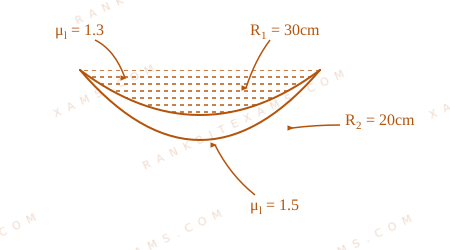
A concave-convex lens of refractive index 1.5 and the radii of curvature of its surfaces are 30~cm and 20~cm, respectively. The concave surface is upwards and is filled with a liquid of refractive index 1.3. The focal length of the liquid-glass combination will be
  • A. (500)/(11)~cm
  • B. (800)/(11)~cm
  • C. (700)/(11)~cm
  • D. (600)/(11)~cm

Solution

Related Formula
1feq = 1fliquid + 1fglass (1)/(f) = (μ - 1)((1)/(R₁) - (1)/(R₂))
Core Logic

Let's find the focal length of each individual lens in the combination:

  • Liquid Lens:
  • Refractive index, μl = 1.3
  • The upper surface is flat (exposed to air): R₁ = ∞
  • The lower surface matches the upward concave surface of the glass lens: R₂ = -30~cm
1fliquid = (1.3 - 1) ((1)/(∞) - (1)/(-30)) = 0.3 × (1)/(30) = (1)/(100)~cm⁻¹
  • Glass Lens:
  • Refractive index, μg = 1.5
  • First surface radius (concave upward), R₁ = -30~cm
  • Second surface radius (convex downward), R₂ = -20~cm (following light path downward)
1fglass = (1.5 - 1) ((1)/(-30) - (1)/(-20)) = 0.5 (-(1)/(30) + (1)/(20)) = 0.5 ((1)/(60)) = (1)/(120)~cm⁻¹

Ray Optics combination diagram

Step 1: Combination Focal Length

Add the powers of both lenses:

1feq = (1)/(100) + (1)/(120) = (6 + 5)/(600) = (11)/(600) feq = (600)/(11)~cm
Pattern Recognition

Sees: Glass lens with liquid poured on top → Think of it as a double lens system (liquid lens + glass lens). Trap: Be extremely careful with sign conventions for radii of curvature of the boundaries! Assume light travels from air through the liquid and then through the glass. This defines a consistent spatial propagation direction. ✓

Chapter Mix

Class 12 Physics: Ray Optics

More Ray Optics and Optical Instruments Questions — jee_main_2025_28_jan_morning

Practice all Ray Optics and Optical Instruments previous-year questions →

Rankbit System
JEE Physics: Waves (+15.5%) | Electrostatics: Concentric Shells (-29.7%) | Modern Physics: Photoelectric Clones (+34.2%) | Mathematics: Definite Integrals (+18.1%) | Chemistry: Coordination Splitting (-11.4%) | JEE Physics: Waves (+15.5%) | Electrostatics: Concentric Shells (-29.7%) | Modern Physics: Photoelectric Clones (+34.2%) | Mathematics: Definite Integrals (+18.1%) | Chemistry: Coordination Splitting (-11.4%)