JEE Main · Physics → Steady

Ray Optics and Optical Instruments appeared 63 times across 3 years — 7.3% of Physics. This question is from Prism and Dispersion.

Year 2026 2025 2024 Total
Questions 19 34 10 63

A thin prism P₁ with angle 4° made of glass having refractive index 1.54, is combined with another thin prism P₂ made of glass having refractive index 1.72 to get dispersion without deviation. The angle of the prism P₂ in degrees is

Solution & Explanation

Related Formula
δ = (μ - 1)A
Core Logic

To achieve dispersion without deviation, the net deviation produced by the prism combination must be zero:

δₙₑₜ = 0 (μ₁ - 1)A₁ - (μ₂ - 1)A₂ = 0

Substituting the given parameters into the equation:

(1.54 - 1) · 4° - (1.72 - 1)A₂ = 0 0.54 · 4 = 0.72 · A₂ A₂ = (2.16)/(0.72) = 3°
Step 1: Final Angle Value

The required angle for the second thin prism is 3°, which matches option (2).

Pattern Recognition

For zero deviation conditions using thin components, balance the deviation equations directly: (μ-1)A = (μ'-1)A'.

Chapter Mix

Class 12 Physics: Ray Optics and Optical Instruments

Reference Study Guides

More Ray Optics and Optical Instruments Previous-Year Questions — Page 4

Q36 jee_main_2026_28_january_morning Lens Maker's Formula
The magnitudes of power of a biconvex lens (refractive index 1.5) and that of a plano-concave lens (refractive index = 1.7) are same. If the curvature of plano-concave lens exactly matches with the curvature of back surface of the biconvex lens, then ratio of radius of curvature of front and back surface of the biconvex lens is ____.
  • A. 5:2
  • B. 5:12
  • C. 12:5
  • D. 2:5

Solution

Related Formula
P = (1)/(f) = (μ - 1)((1)/(R₁) - (1)/(R₂))
Core Logic

Equate the magnitudes of the power of the two lenses using the Lens Maker's formula.
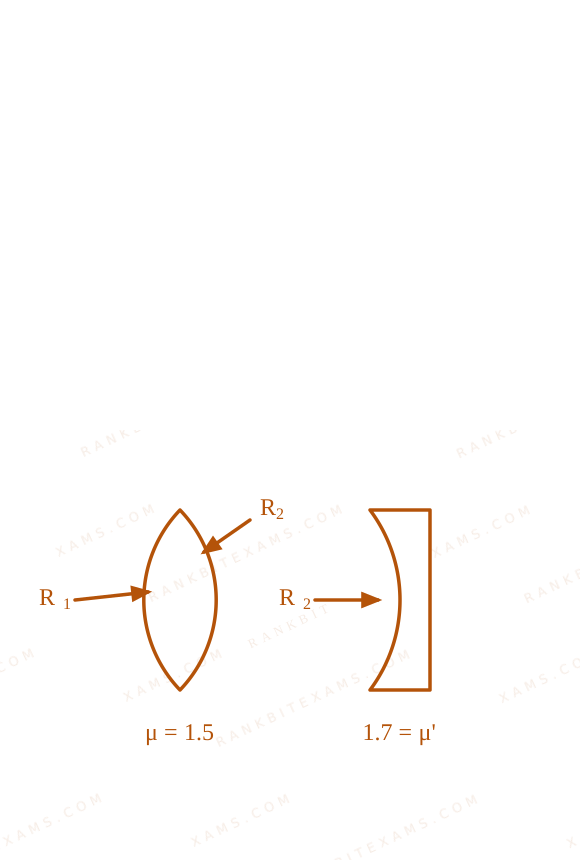
Lens geometry diagram

Step 1: Power of Biconvex Lens

For a biconvex lens (μ = 1.5), let the front radius be R₁ and back radius be R₂. By sign convention, R₁ > 0 and R₂ < 0.

|PA| = (1.5 - 1)((1)/(R₁) - (1)/(-R₂)) = 0.5 ((1)/(R₁) + (1)/(R₂))
Step 2: Power of Plano-Concave Lens

For a plano-concave lens (μ' = 1.7), the flat surface has radius ∞. The curved surface matches the back surface of the biconvex lens, so its radius is R₂.

|PB| = (1.7 - 1)| (1)/(-R₂) - (1)/(∞) | = (0.7)/(R₂)
Step 3: Equating Powers

Given |PA| = |PB|:

0.5 ((1)/(R₁) + (1)/(R₂)) = (0.7)/(R₂) (0.5)/(R₁) + (0.5)/(R₂) = (0.7)/(R₂) (0.5)/(R₁) = (0.2)/(R₂)
Step 4: Finding the Ratio
(5)/(R₁) = (2)/(R₂) (R₁)/(R₂) = (5)/(2)
Pattern Recognition

Matching curvatures means treating the absolute value of the radius as the same variable R₂ across the two equations. Always use magnitude equations when explicitly stated 'magnitudes of power are same'.

Chapter Mix

Class 12 Physics: Ray Optics and Optical Instruments
Q49 jee_main_2026_28_january_morning Lens in Liquid
A convex lens of refractive index 1.5 and focal length f = 18 ~cm is immersed in water. The difference in focal lengths of the given lens when it is in water and in air is α × f . The value of α is ____. (refractive index of water = 4/3)
Numerical Answer. Answer: 3 to 3

Solution

Related Formula
1fmedium = ( (μL)/(μm) - 1 ) ( (1)/(R₁) - (1)/(R₂) )
Core Logic

Use the Lens Maker's formula for the lens in air, and then for the lens in water. Divide the two equations to eliminate the radius terms and solve for the focal length in water.

Step 1: Lens in Air
1fₐᵢᵣ = ( (1.5)/(1) - 1 ) ( (1)/(R₁) - (1)/(R₂) ) = 0.5 ( (1)/(R₁) - (1)/(R₂) )
Step 2: Lens in Water
1fwater = ( (1.5)/(4/3) - 1 ) ( (1)/(R₁) - (1)/(R₂) ) = ( (4.5)/(4) - 1 ) ( (1)/(R₁) - (1)/(R₂) ) = ( (0.5)/(4) ) ( (1)/(R₁) - (1)/(R₂) )
Step 3: Ratio and Difference
fwaterfₐᵢᵣ = (0.5)/(0.5 / 4) = 4 fwater = 4fₐᵢᵣ = 4f

Difference in focal length:

fwater - fₐᵢᵣ = 4f - f = 3f

Therefore, α = 3.

Pattern Recognition

Standard result to memorize: A glass lens (μ = 1.5) immersed in water (μ = 4/3) has its focal length become exactly 4 times its focal length in air.

Chapter Mix

Class 12 Physics: Ray Optics and Optical Instruments
Q28 jee_main_2026_28_january_evening Lens Maker's Formula
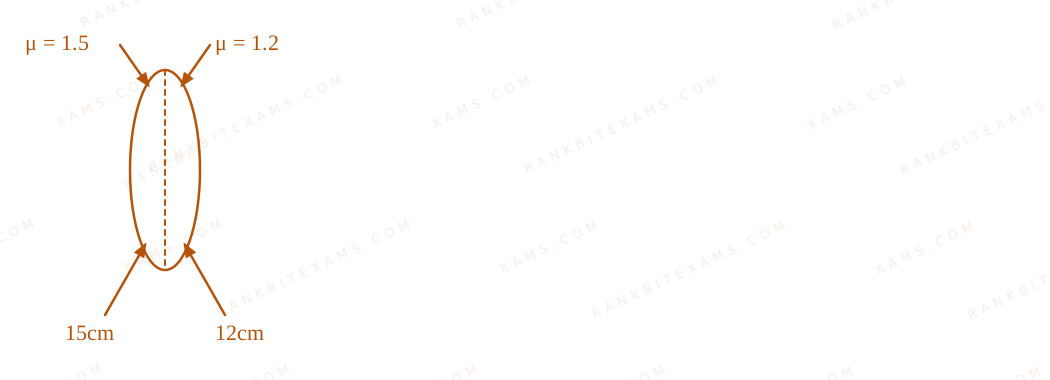
A biconvex lens is formed by using two thin planoconvex lenses, as shown in the figure.
Lens Maker's Formula diagram for Q28 - JEE Main 2026 Evening
Two planoconvex lenses joined to form a biconvex lens with distinct refractive indices.
The refractive index and radius of curved surfaces are also mentioned in figure. When an object is placed on the left side of lens at a distance of 30 cm from the biconvex lens, the magnification of the image will be :
  • A. -2
  • B. +2
  • C. +2.5
  • D. -2.5

Solution

Related Formula
(1)/(f) = (μ - 1) ((1)/(R₁) - (1)/(R₂)) 1fₙₑₜ = (1)/(f₁) + (1)/(f₂) (1)/(v) - (1)/(u) = 1fₙₑₜ m = (v)/(u)
Core Logic

The biconvex lens acts as a combination of two thin lenses in contact. For lens 1 (left): μ₁ = 1.5, R₁ = 15 cm, flat side radius R₂ = ∞. For lens 2 (right): μ₂ = 1.2, flat side radius R₁ = ∞, curved side radius R₂ = -12 cm (applying sign convention).

Step 1: Calculate Focal Lengths
(1)/(f₁) = (1.5 - 1) ((1)/(15) - (1)/(∞)) = 0.5 × (1)/(15) = (1)/(30) (1)/(f₂) = (1.2 - 1) ((1)/(∞) - (1)/(-12)) = 0.2 × (1)/(12) = (1)/(60)
Step 2: Calculate Equivalent Focal Length
1fₙₑₜ = (1)/(30) + (1)/(60) = (2 + 1)/(60) = (3)/(60) = (1)/(20)

So, fₙₑₜ = +20 cm.

Step 3: Image Distance and Magnification

Given object distance u = -30 cm.

(1)/(v) - (1)/(-30) = (1)/(20) (1)/(v) = (1)/(20) - (1)/(30) = (3 - 2)/(60) = (1)/(60) v = +60 cm

Magnification m = (v)/(u) = (60)/(-30) = -2.

Pattern Recognition

Combination of thin lenses in contact: simply add their powers 1/fₙₑₜ = 1/f₁ + 1/f₂. Apply lens maker's formula carefully with correct sign conventions for the planar boundary (R=∞).

Chapter Mix

Class 12 Physics: Ray Optics and Optical Instruments
Q43 jee_main_2026_28_january_evening Prism
For a transparent prism, if the angle of minimum deviation is equal to its refracting angle, the refractive index n of the prism satisfies.
  • A. √(2) < n < 2√(2)
  • B. 1 < n < 2
  • C. n ≥ 2
  • D. √(2) < n < 2

Solution

Related Formula
μ = ( δ + A2) ((A)/(2)) δ = 2i - A
Core Logic

Given δ = A.

μ = n = ( ((A + A)/(2)))/( ((A)/(2))) = ( A)/( (A/2)) n = (2 (A/2) (A/2))/( (A/2)) = 2 (A/2)

Since A > 0, (A/2) < 1. Thus, n < 2.

Step 1: Applying Physical Bounds

At minimum deviation, i = δ + A2. Since δ = A, we have i = (2A)/(2) = A. For light to enter the prism, the angle of incidence must be less than 90^° (grazing incidence is the limit). Thus, i < 90^° ⇒ A < 90^°.

Step 2: Calculate Limits for n

Since A < 90^°, we have A/2 < 45^°. The cosine function is strictly decreasing in the first quadrant, so: If A/2 < 45^°, then (A/2) > (45^°) = 1√(2).

Therefore:

n = 2 (A/2) > 2 × 1√(2) = √(2)

Combining the limits:

√(2) < n < 2
Pattern Recognition

When δmin = A, μ = 2 (A/2). The extreme bounding conditions arise from A > 0 and i < 90^°. This guarantees the theoretical range √(2) < μ < 2.

Chapter Mix

Class 12 Physics: Ray Optics and Optical Instruments

Q jee_main_2025_02_april_evening Spherical Mirrors and Magnification
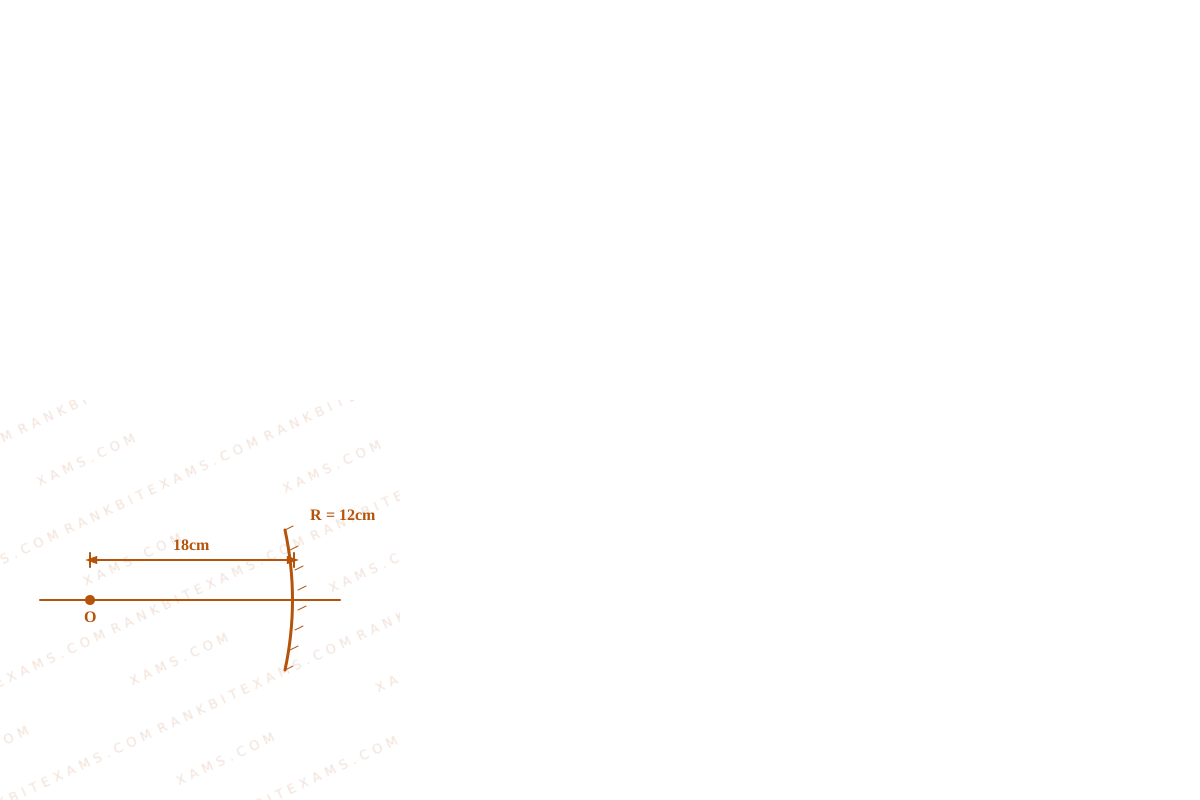
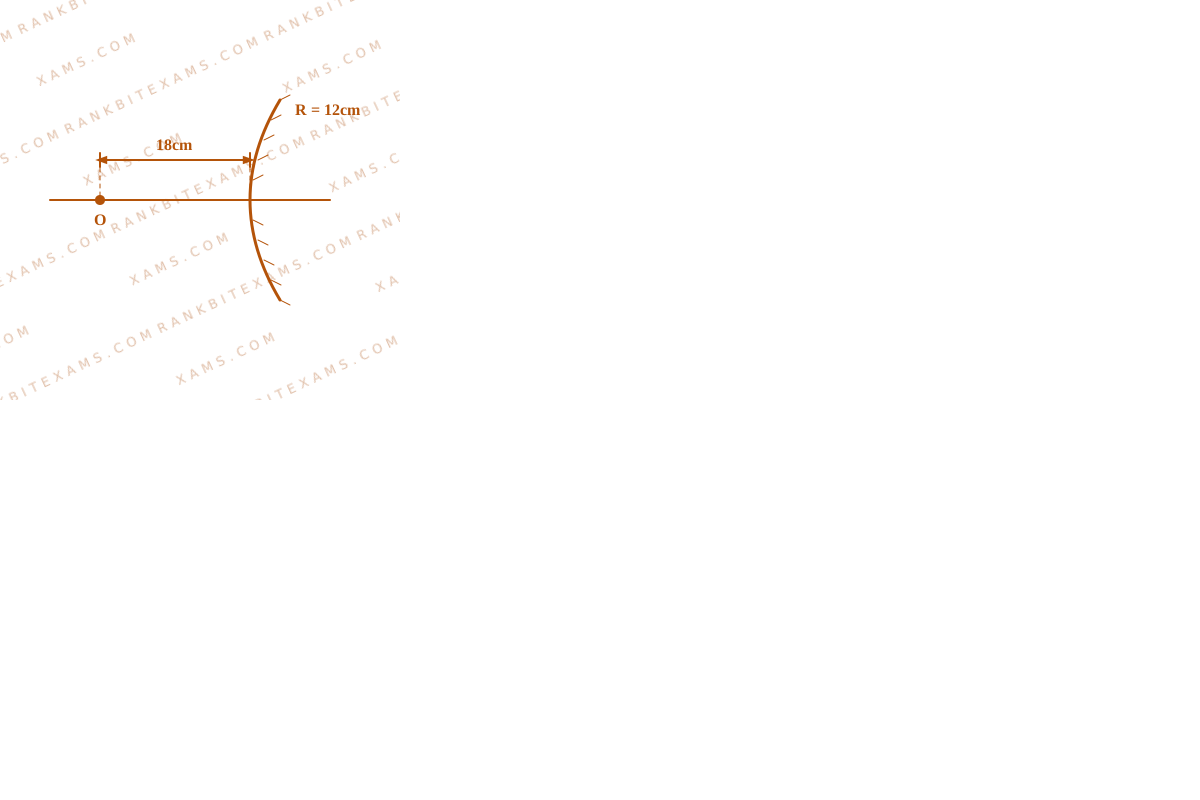
Two identical objects are placed in front of convex mirror and concave mirror having same radii of curvature of 12 cm , at the same distance of 18 cm from the respective mirrors. The ratio of sizes of the images formed by convex mirror and by concave mirror is:
  • A. 1 / 2
  • B. 2
  • C. 3
  • D. 1 / 3

Solution

Related Formula
  • Mirror focal length:
f = (R)/(2)
  • Magnification (image size relative to object size):
m = (hᵢ)/(hₒ) = (f)/(f - u)

where u is the object distance.

Core Logic

Given parameters:

  • Radius of curvature R = 12 cm |f| = 6 cm
  • Object distance u = -18 cm
  • Let's calculate magnification for both mirrors:

  • For Convex Mirror:
  • Focal length fconvex = +6 cm (using Cartesian sign convention)
  • Magnification:
m₁ = fconvexfconvex - u = (6)/(6 - (-18)) = (6)/(24) = (1)/(4)

Thus, image size is (1)/(4) hₒ.

Step 1: Calculate magnification of concave mirror
  • For Concave Mirror:
  • Focal length fconcave = -6 cm
  • Magnification:
  • Convex and concave mirror ray diagram representations
    Convex and concave mirror ray diagram representations

m₂ = fconcavefconcave - u = (-6)/(-6 - (-18)) = (-6)/(12) = -(1)/(2)

Thus, image size is (1)/(2) hₒ.

Step 2: Calculate the ratio of image sizes

Since the objects are identical (same height hₒ), the ratio of the sizes of the images is:

Convex and concave mirror ray diagram representations

Ratio = |hᵢ₁||hᵢ₂| = (|m₁|)/(|m₂|) = (1/4)/(1/2) = (1)/(2)

Thus, the ratio of sizes is 1/2.

Pattern Recognition

Sees: Parallel convex vs concave mirror magnification. Trap: Reversing the signs of focal lengths (Convex focal length is +, Concave is - in standard coordinate systems). Shortcut: Use direct magnification equation m = (f)/(f-u). For convex, m = (6)/(24) = (1)/(4). For concave, m = (-6)/(12) = -(1)/(2). Ratio of absolute values is (1/4)/(1/2) = 1/2.

Chapter Mix

Class 12 Physics: Ray Optics and Optical Instruments

More Ray Optics and Optical Instruments Questions — jee_main_2025_28_jan_morning

Practice all Ray Optics and Optical Instruments previous-year questions →

Rankbit System
JEE Physics: Waves (+15.5%) | Electrostatics: Concentric Shells (-29.7%) | Modern Physics: Photoelectric Clones (+34.2%) | Mathematics: Definite Integrals (+18.1%) | Chemistry: Coordination Splitting (-11.4%) | JEE Physics: Waves (+15.5%) | Electrostatics: Concentric Shells (-29.7%) | Modern Physics: Photoelectric Clones (+34.2%) | Mathematics: Definite Integrals (+18.1%) | Chemistry: Coordination Splitting (-11.4%)