JEE Main · Physics ↓ Falling

Mechanical Properties of Fluids appeared 31 times across 3 years — 3.6% of Physics. This question is from Surface Tension and Viscosity.

Year 2026 2025 2024 Total
Questions 9 14 8 31

Consider following statements: A. Surface tension arises due to extra energy of the molecules at the interior as compared to the molecules at the surface, of a liquid. B. As the temperature of liquid rises, the coefficient of viscosity increases. C. As the temperature of gas increases, the coefficient of viscosity increases. D. The onset of turbulence is determined by Reynold's number. E. In a steady flow two stream lines never intersect. Choose the correct answer from the options given below:

Solution & Explanation

Core Logic

Let's audit each fluid mechanics assertion:

Statement A: Incorrect. Surface tension arises because surface molecules possess higher potential energy compared to interior bulk molecules due to net cohesive forces pulling inward.

Statement B: Incorrect. With rising temperatures, cohesive forces in liquids weaken, causing viscosity to decrease.

Statement C: Correct. In gases, viscosity is governed by molecular collisions. Higher temperature leads to increased thermal activity and momentum exchange, increasing viscosity.

Statement D: Correct. Critical velocity and turbulence parameters are completely defined by the dimensionless Reynolds number.

Statement E: Correct. If streamlines intersected, a fluid particle at that spatial node would have two distinct velocity directions, violating steady-state constraints.

Step 1: Final Conclusion

Statements C, D, and E are correct, leading to option (2).

Pattern Recognition

Contrast Liquid vs Gas viscosity trends under temperature increments: Liquids down (intermolecular bounds weaken), Gases up (random thermal diffusion and collision rates escalate).

Chapter Mix

Class 11 Physics: Mechanical Properties of Fluids

Reference Study Guides

More Mechanical Properties of Fluids Previous-Year Questions — Page 7

Q jee_main_2024_31_jan_morning Viscosity And Terminal Velocity
A small steel ball is dropped into a long cylinder containing glycerine. Which one of the following is the correct representation of the velocity time graph for the transit of the ball?
  • A.
  • B.
  • C.
  • D.

Solution

Related Formula
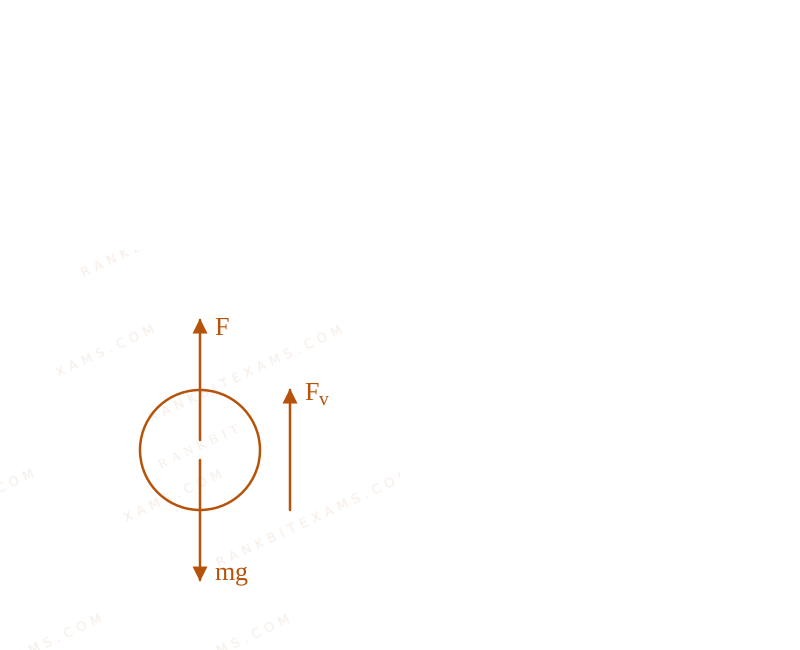
mg - FB - Fv = ma Fv = 6πη r v
Core Logic

Viscosity And Terminal Velocity diagram for Q46 - JEE Main 2024 Morning

When dropped, three forces act on the ball: Gravity downwards, Buoyant force upwards, and Viscous drag upwards.

mg - FB - Fv = m (dv)/(dt) (ρ (4)/(3)π r³)g - (ρL (4)/(3)π r³)g - 6πη rv = m (dv)/(dt)

Let (4π r³ g(ρ - ρL))/(3m) = K₁ and (6πη r)/(m) = K₂.

(dv)/(dt) = K₁ - K₂ v

Integrating from t=0, v=0:

∫₀^v (dv)/(K₁ - K₂ v) = ∫₀^t dt -(1)/(K₂) ln ((K₁ - K₂ v)/(K₁)) = t v = (K₁)/(K₂) ( 1 - e-K₂ t )

This is an exponential curve starting from the origin and asymptotically approaching the terminal velocity VT = K₁ / K₂.

Chapter Mix

Class 11 Physics: Mechanical Properties Of Fluids

More Mechanical Properties of Fluids Questions — jee_main_2025_28_jan_morning

Practice all Mechanical Properties of Fluids previous-year questions →

Rankbit System
JEE Physics: Waves (+15.5%) | Electrostatics: Concentric Shells (-29.7%) | Modern Physics: Photoelectric Clones (+34.2%) | Mathematics: Definite Integrals (+18.1%) | Chemistry: Coordination Splitting (-11.4%) | JEE Physics: Waves (+15.5%) | Electrostatics: Concentric Shells (-29.7%) | Modern Physics: Photoelectric Clones (+34.2%) | Mathematics: Definite Integrals (+18.1%) | Chemistry: Coordination Splitting (-11.4%)