A wire of resistance R$R$ is bent into an equilateral triangle and an identical wire is bent into a square. The ratio of resistance between the two end points of an edge of the triangle to that of the square is
A.9 / 8$9 / 8$
B.8 / 9$8 / 9$
C.27/32
D.32/27
Solution & Explanation
Related Formula
R = ρ A R ∝$$\mathrm{R} = \frac{\rho\ell}{\mathrm{A}} \implies \mathrm{R} \propto \ell$$
Core Logic
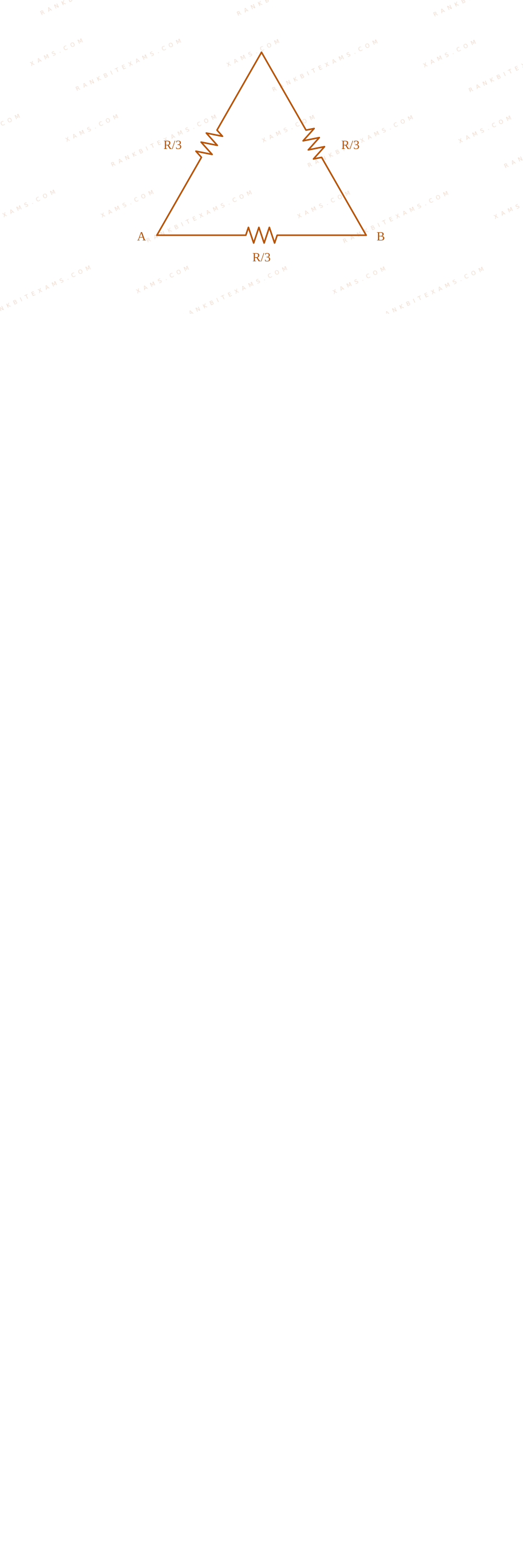
For the equilateral triangle, the total resistance R$\mathrm{R}$ is divided into three equal line parts of value R3$\frac{\mathrm{R}}{3}$ each:
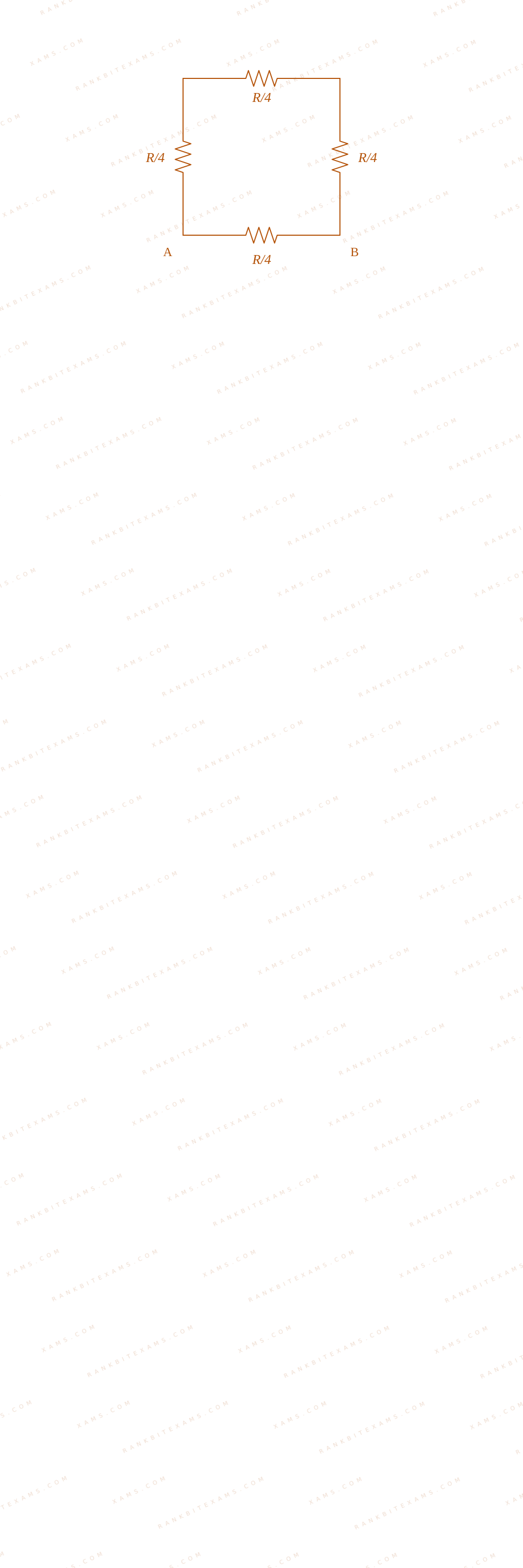
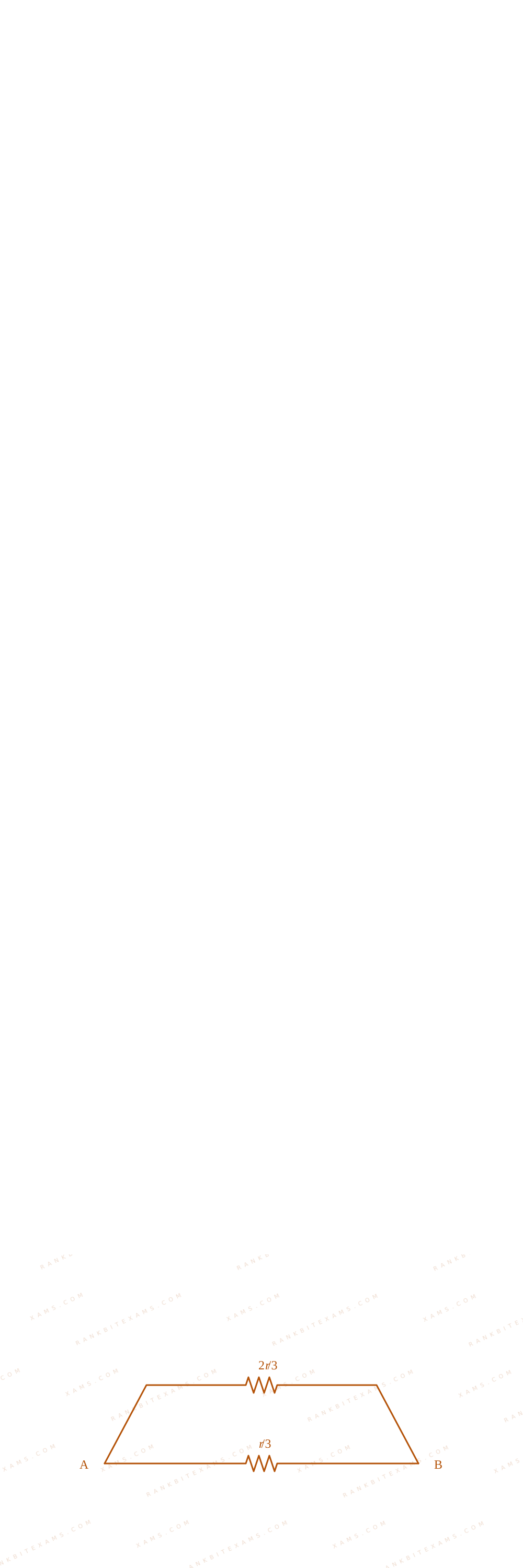
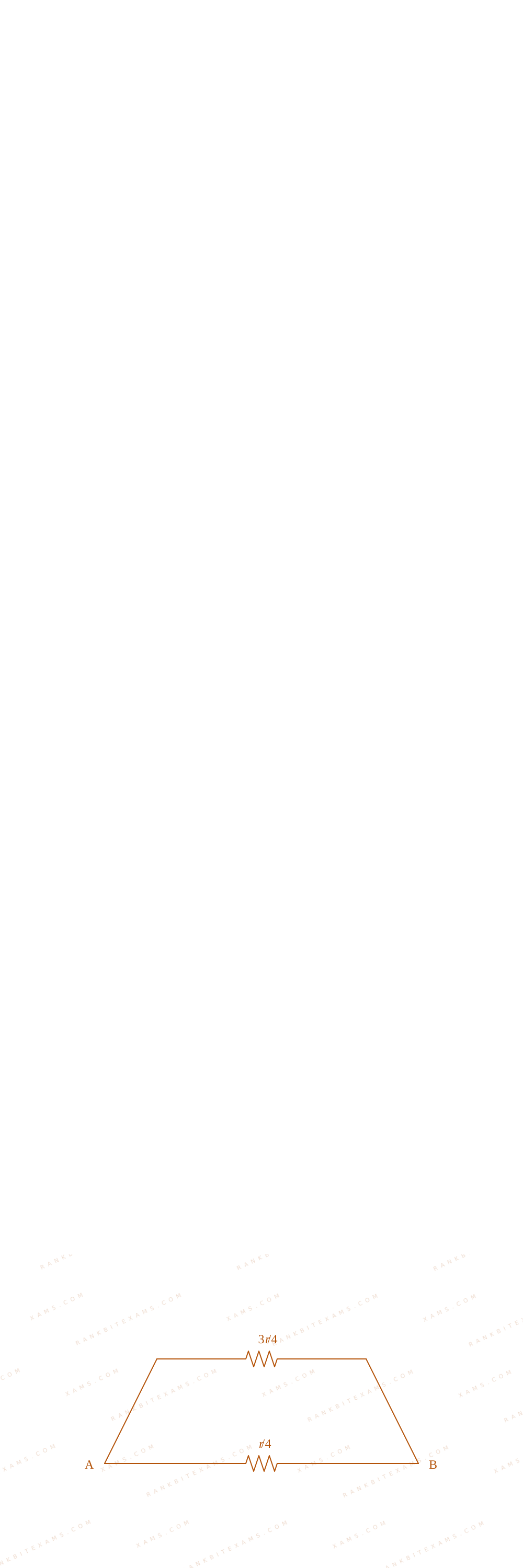
Visual representation of triangle and square edge divisions for Q15
Visual representation of triangle and square edge divisions for Q15
An edge configuration places one part in parallel with the other two series steps:
For a regular polygon with N$\mathrm{N}$ identical sides formed from a wire of resistance R$\mathrm{R}$, the resistance across one edge is always given by (N-1)N²R$\frac{(\mathrm{N}-1)}{\mathrm{N}^2}\mathrm{R}$.
Keywords:#wire bent into equilateral triangle and square#JEE Main 2025 Morning Q15#Current Electricity JEE Main 2025#Combination of Resistors JEE Main 2025
More Current Electricity Previous-Year Questions — Page 2
Q36jee_main_2026_22_january_eveningPower Transmission and Efficiency
An electric power line having total resistance of 2 Ω$2 \Omega$, delivers 1 kW of power of 250 V. The percentage efficiency of transmission line is ____.
A.96.9$96.9$
B.86.5$86.5$
C.100$100$
D.92.5$92.5$
Solution
Related Formula
Pout = V · I$$P_{\text{out}} = V \cdot I$$Ploss = I² R$$P_{\text{loss}} = I^2 R$$η = ( PoutPₙₑₜ) × 100%$$\eta = \left(\frac{P_{\text{out}}}{P_{\text{net}}}\right) \times 100\%$$
Core Logic
Calculating total current I$I$:
1000 = 250 × I I = 4 ~A$$1000 = 250 \times I \implies I = 4 \mathrm{~A}$$
Calculating power loss along the line Ploss$P_{\text{loss}}$:
The percentage efficiency of the transmission line is 96.9%$96.9\%$.
Pattern Recognition
Efficiency formula: η = PoutPout + I² R × 100%$\eta = \frac{P_{\text{out}}}{P_{\text{out}} + I^2 R} \times 100\%$.
Current I = 1000/250 = 4~A$I = 1000/250 = 4\mathrm{~A}$. Loss = 16 × 2 = 32~W$= 16 \times 2 = 32\mathrm{~W}$. η = 1000/1032 = 96.9%$\eta = 1000/1032 = 96.9\%$.
Chapter Mix
Class 12 Physics: Current Electricity
Q49jee_main_2026_22_january_eveningDrift Velocity and Electron Mobility
A cylindrical conductor of length 2m and area of cross-section 0.2 ~mm²$0.2 \mathrm{~mm}^2$ carries an electric current of 1.6 A when its ends are connected to a 2V battery. Mobility of electrons in the conductor is α × 10⁻³ ~m²/V⋯$\alpha \times 10^{-3} \mathrm{~m}^2/\mathrm{V}\cdot\mathrm{s}$. The value of α$\alpha$ is :
(electron concentration = 5 × 10²⁸/m³$5 \times 10^{28}/\mathrm{m}^3$ and electron charge = 1.6 × 10⁻¹⁹$1.6 \times 10^{-19}$ C)
Numerical Answer.Answer: 1 to 1
Solution
Related Formula
I = n e A vd$I = n e A v_d$
vd = μ E = μ (V)/(l)$$v_d = \mu E = \mu \frac{V}{l}$$μ = (I l)/(n e A V)$$\mu = \frac{I l}{n e A V}$$
Core Logic
Combining current density and mobility equations:
I = n e A (μ (V)/(l)) μ = (I · l)/(n · e · A · V)$$I = n e A \left(\mu \frac{V}{l}\right) \implies \mu = \frac{I \cdot l}{n \cdot e \cdot A \cdot V}$$
Substituting given values I = 1.6 ~A, l = 2 ~m, n = 5 × 10²⁸ /m³, e = 1.6 × 10⁻¹⁹ ~C, A = 0.2 × 10⁻⁶ ~m², V = 2 ~V$I = 1.6 \mathrm{~A}, l = 2 \mathrm{~m}, n = 5 \times 10^{28} /\mathrm{m}^3, e = 1.6 \times 10^{-19} \mathrm{~C}, A = 0.2 \times 10^{-6} \mathrm{~m}^2, V = 2 \mathrm{~V}$:
Mobility formula: μ = I l / (n e A V)$\mu = I l / (n e A V)$. Direct parameter plug-in yields α = 1$\alpha = 1$.
Chapter Mix
Class 12 Physics: Current Electricity
Q34jee_main_2026_23_january_morningResistance and Ohm's Law
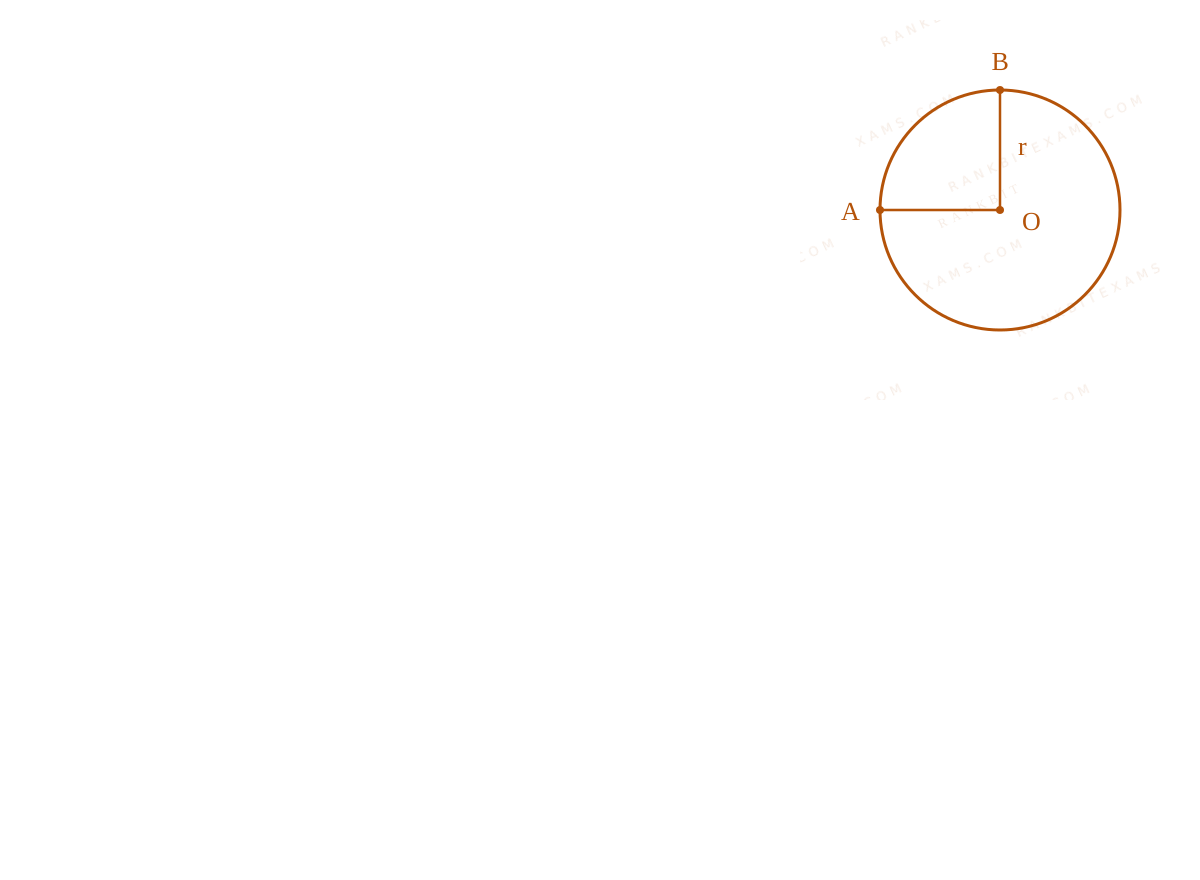
A wire of uniform resistance λΩ/m$\lambda\Omega/m$ is bent into a circle of radius r and another piece of wire with length 2r is connected between points A and B (AOB) as shown in figure. The equivalent resistance between points A and B is ____ Ω$\Omega$.
A ring with nodes A and B connected across a diameter forming parallel branches.
The system represents three resistors connected in parallel between nodes A and B: the upper arc, the lower arc, and the straight diameter wire. Using R = λ L$R = \lambda L$ where λ$\lambda$ is resistance per unit length.
RAB = λ r ((6π)/(16 + 3π))$$R_{AB} = \lambda r \left(\frac{6\pi}{16 + 3\pi}\right)$$
Pattern Recognition
Sees: "Uniform resistance wire bent into shape" → immediately break the shape down into parallel/series segments defined purely by their arc/line lengths multiplied by the linear density λ$\lambda$.
To compare EMF of two cells using potentiometer the balancing lengths obtained are 200 cm and 150 cm. The least count of scale is 1 cm. The percentage error in the ratio of EMFs is ____
Note: The calculated exact percentage error is 1.16%, which does not match any of the provided options exactly. The closest official option provided was tracked as index (2) marking 1.65 by some keys, though technically a bonus question.
Chapter Mix
Class 12 Physics: Current Electricity
Class 11 Physics: Units and Measurements
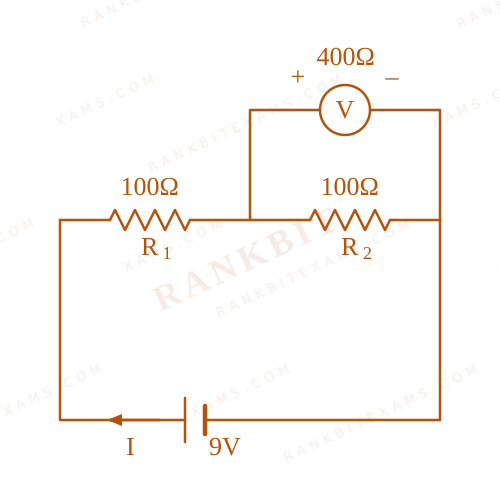
Two resistors of 100 Ω$100 \, \Omega$ each are connected in series with a 9V battery. A voltmeter of 400Ω$400\Omega$ resistance is connected to measure the voltage drop across one of the resistors. The voltmeter reading is ____ V.
Practice past-year questions one chapter at a time. Pick an exam → subject → chapter and get every PYQ for that topic — pulled together from all past papers — with the chapter's key formulas alongside.