JEE Main · Chemistry → Steady

Electrochemistry appeared 40 times across 3 years — 4.7% of Chemistry. This question is from Molar Conductivity and Cell Resistance.

Year 2026 2025 2024 Total
Questions 13 19 8 40

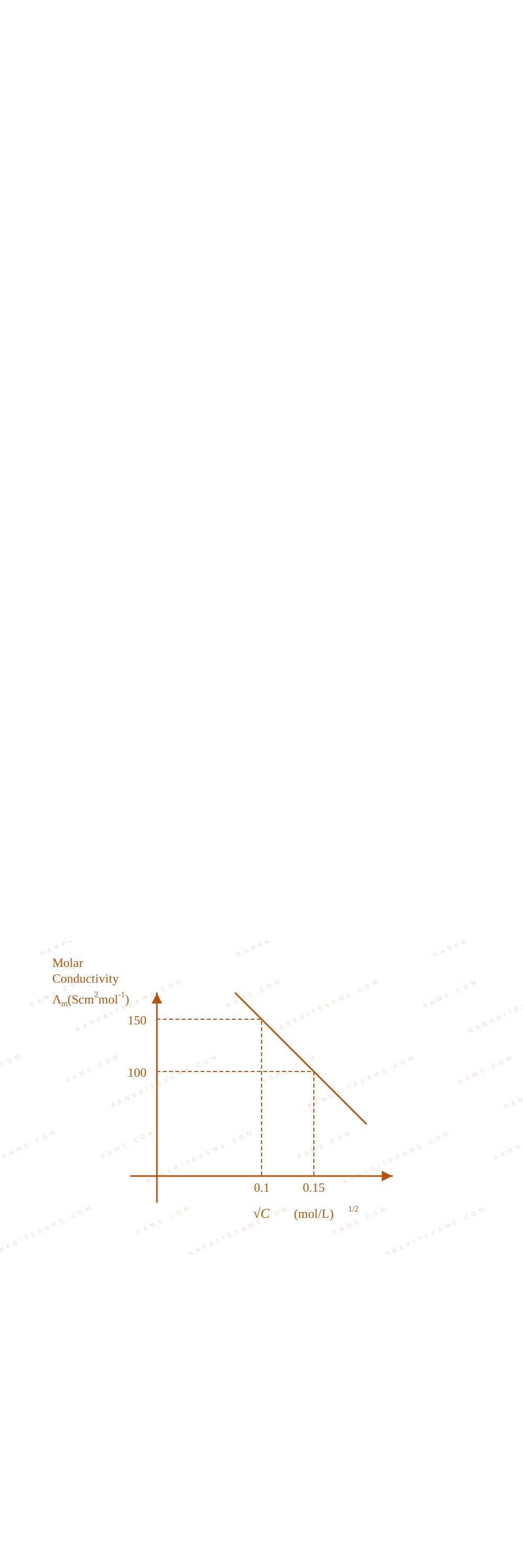
Given below is the plot of the molar conductivity vs concentration for KCl in aqueous solution.
Molar conductivity vs root concentration graph for Q46 - JEE Main 2025 Morning
The image features a standard linear plot tracing electrolytic molar conductance trends over root concentration variations.
If, for the higher concentration of KCl solution, the resistance of the conductivity cell is 100Ω then the resistance of the same cell with the dilute solution is xΩ The value of x is (Nearest integer)

Numerical Answer Type:
Enter a numerical value Answer: 150 to 150 +4 marks

Solution & Explanation

Related Formula

Conductivity relationship with cell parameters:

κ = G · G^* = (G^*)/(R) λm = (κ × 1000)/(C)

where G^* represents the static cell constant.

Step 1: Setting Up Ratios

Using concentration subscripts c (concentrated) and d (dilute):

(κc)/(κd) = (Rd)/(Rc)

Expressing conductivity through molar conductivity values:

κ = (λm · C)/(1000) ((λm · C)c)/((λm · C)d) = (Rd)/(Rc)

Substituting the graphical read coordinates (Cc = 0.15², Cd = 0.1² with scaled λm parameters):

(100 · (0.15)²)/(150 · (0.1)²) = (Rd)/(100) Rd = 150 Ω
Pattern Recognition

Sees: Resistance correlation across specific graph coordinates. Shortcut: Equate cell parameters through κ ∝ (1)/(R) and solve for the target resistance directly.

Chapter Mix

Class 12 Chemistry: Electrochemistry

Reference Study Guides

More Electrochemistry Previous-Year Questions — Page 8

Q82 jee_main_2024_29_jan_morning Faradays Laws of Electrolysis
The mass of zinc produced by the electrolysis of zinc sulphate solution with a steady current of 0.015 A for 15 minutes is ______ × 10⁻⁴ g. (Atomic mass of zinc = 65.4 amu)
Numerical Answer. Answer: 45.75 to 46

Solution

Related Formula
W = Z · I · t = (M)/(n · F) · I · t

where, W = mass deposited Z = electrochemical equivalent I = current in amperes t = time in seconds M = molar mass n = n-factor (electrons exchanged) F = Faraday's constant (96500 C/mol)

Core Logic

The electrolysis of zinc sulphate (ZnSO₄) involves the reduction of zinc ions at the cathode:

Zn⁺² + 2e^- arrow Zn

Here, the n-factor (n) is 2.

Step 1: Calculation

Given values: I = 0.015 A t = 15 minutes = 15 × 60 seconds = 900 s M = 65.4 g/mol F ≈ 96500 C

Plugging the values into Faraday's First Law:

W = (65.4)/(2 × 96500) × 0.015 × 15 × 60 W = (65.4)/(193000) × 13.5 W = 3.3886 × 10⁻⁴ × 13.5 W = 45.746 × 10⁻⁴ g

Rounding to two decimal places (or nearest integer depending on convention), we get 45.75 × 10⁻⁴ g.

Chapter Mix

Class 12 Chemistry: Electrochemistry

Q80 jee_main_2024_30_january_evening Standard Electrode Potential
Reduction potential of ions are given below: ClO₄^- E° = 1.19V IO₄^- E° = 1.65V BrO₄^- E° = 1.74V The correct order of their oxidising power is:
  • A. ClO₄^- > IO₄^- > BrO₄^-
  • B. BrO₄^- > IO₄^- > ClO₄^-
  • C. BrO₄^- > ClO₄^- > IO₄^-
  • D. IO₄^- > BrO₄^- > ClO₄^-

Solution

Core Logic

The Standard Reduction Potential (E^°) measures a species' tendency to undergo reduction (gain electrons). A higher, more positive E^° value means the species has a stronger tendency to be reduced, which in turn makes it a stronger oxidizing agent.

Comparing the given E^° values: BrO₄^-: 1.74V IO₄^-: 1.65V ClO₄^-: 1.19V

The order of oxidizing power follows the magnitude of the reduction potential: BrO₄^- > IO₄^- > ClO₄^-

Pattern Recognition

Higher +ve Standard Reduction Potential (SRP) = Stronger Oxidising Agent.

Chapter Mix

Class 12 Chemistry: Electrochemistry Class 12 Chemistry: The p Block Elements

Q65 jee_main_2024_31_jan_morning Batteries
The metals that are employed in the battery industries are A. Fe B. Mn C. Ni D. Cr E. Cd Choose the correct answer from the options given below:
  • A. B, C and E only
  • B. A, B, C, D and E
  • C. A, B, C and D only
  • D. B, D and E only

Solution

Core Logic

Mn, Ni, and Cd metals are predominantly used in battery industries.

  • Mn is used in dry cells (Leclanche cell).
  • Ni and Cd are used in Nickel-Cadmium (Ni-Cd) rechargeable batteries.
Chapter Mix

Class 12 Chemistry: Electrochemistry

Q67 jee_main_2024_31_jan_morning Electrolytic Conductance
Identify the factor from the following that does not affect electrolytic conductance of a solution.
  • A. The nature of the electrolyte added.
  • B. The nature of the electrode used.
  • C. Concentration of the electrolyte.
  • D. The nature of solvent used.

Solution

Core Logic

Conductivity of an electrolytic cell is affected by the concentration of the electrolyte, the nature of the electrolyte, and the nature of the solvent. It does not depend on the nature of the electrode used.

Chapter Mix

Class 12 Chemistry: Electrochemistry

Q90 jee_main_2024_31_jan_morning Faraday's Laws of Electrolysis
One Faraday of electricity liberates x × 10⁻¹ gram atom of copper from copper sulphate, x is
Numerical Answer. Answer: 5 to 5

Solution

Core Logic

The reduction reaction for copper is:

Cu²⁺ + 2e^- arrow Cu

This shows that 2 moles of electrons (2 Faraday) are required to deposit 1 mole (or 1 gram atom) of Cu.

Therefore, 1 Faraday of electricity will deposit:

(1)/(2) = 0.5 moles of Cu
Step 1: Finding x
0.5 mole = 0.5 gram atom = 5 × 10⁻¹ gram atom

Hence, x = 5.

Chapter Mix

Class 12 Chemistry: Electrochemistry

More Electrochemistry Questions — jee_main_2025_28_jan_morning

Practice all Electrochemistry previous-year questions →

Rankbit System
JEE Physics: Waves (+15.5%) | Electrostatics: Concentric Shells (-29.7%) | Modern Physics: Photoelectric Clones (+34.2%) | Mathematics: Definite Integrals (+18.1%) | Chemistry: Coordination Splitting (-11.4%) | JEE Physics: Waves (+15.5%) | Electrostatics: Concentric Shells (-29.7%) | Modern Physics: Photoelectric Clones (+34.2%) | Mathematics: Definite Integrals (+18.1%) | Chemistry: Coordination Splitting (-11.4%)