JEE Main · Chemistry → Steady

Electrochemistry appeared 40 times across 3 years — 4.7% of Chemistry. This question is from Molar Conductivity and Cell Resistance.

Year 2026 2025 2024 Total
Questions 13 19 8 40

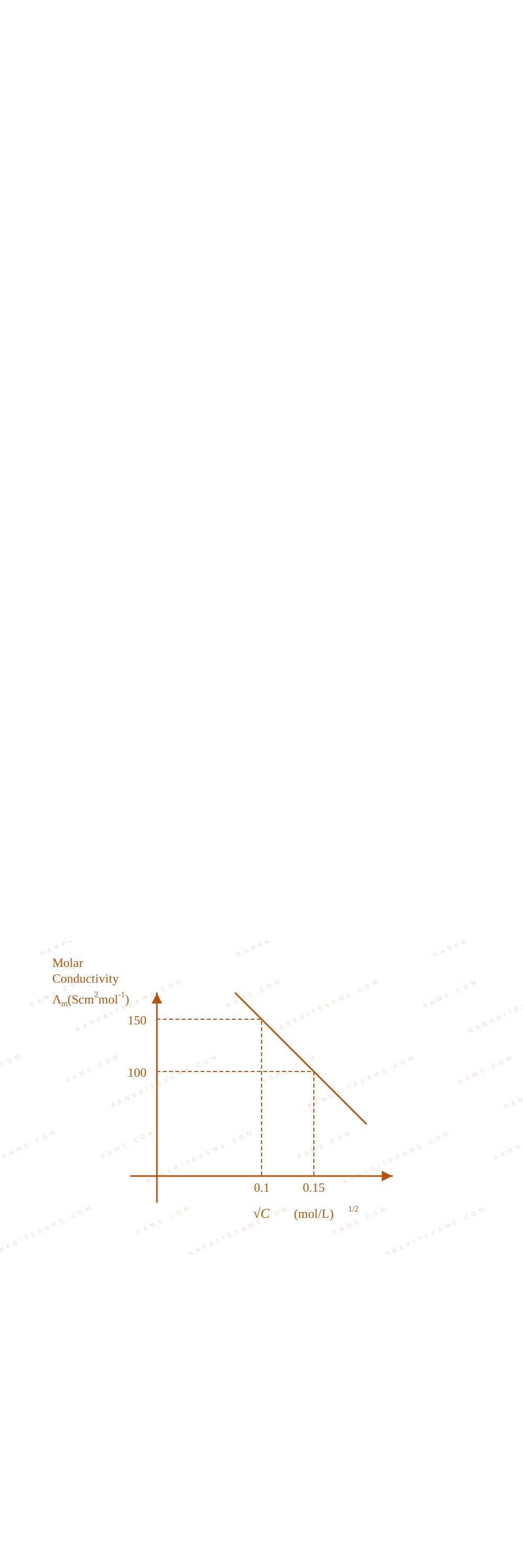
Given below is the plot of the molar conductivity vs concentration for KCl in aqueous solution.
Molar conductivity vs root concentration graph for Q46 - JEE Main 2025 Morning
The image features a standard linear plot tracing electrolytic molar conductance trends over root concentration variations.
If, for the higher concentration of KCl solution, the resistance of the conductivity cell is 100Ω then the resistance of the same cell with the dilute solution is xΩ The value of x is (Nearest integer)

Numerical Answer Type:
Enter a numerical value Answer: 150 to 150 +4 marks

Solution & Explanation

Related Formula

Conductivity relationship with cell parameters:

κ = G · G^* = (G^*)/(R) λm = (κ × 1000)/(C)

where G^* represents the static cell constant.

Step 1: Setting Up Ratios

Using concentration subscripts c (concentrated) and d (dilute):

(κc)/(κd) = (Rd)/(Rc)

Expressing conductivity through molar conductivity values:

κ = (λm · C)/(1000) ((λm · C)c)/((λm · C)d) = (Rd)/(Rc)

Substituting the graphical read coordinates (Cc = 0.15², Cd = 0.1² with scaled λm parameters):

(100 · (0.15)²)/(150 · (0.1)²) = (Rd)/(100) Rd = 150 Ω
Pattern Recognition

Sees: Resistance correlation across specific graph coordinates. Shortcut: Equate cell parameters through κ ∝ (1)/(R) and solve for the target resistance directly.

Chapter Mix

Class 12 Chemistry: Electrochemistry

Reference Study Guides

More Electrochemistry Previous-Year Questions — Page 7

Q jee_main_2025_29_jan_morning Variation of Molar Conductivity with Concentration
The molar conductivity of a weak electrolyte when plotted against the square root of its concentration, which of the following is expected to be observed?
  • A. A small decrease in molar conductivity is observed at infinite dilution.
  • B. A small increase in molar conductivity is observed at infinite dilution.
  • C. Molar conductivity increases sharply with increase in concentration.
  • D. Molar conductivity decreases sharply with increase in concentration.

Solution

Related Formula

For weak electrolytes, the degree of dissociation α increases sharply near infinite dilution according to Ostwald's Dilution Law:

α = √((Kₐ)/(C))
Core Logic

When a weak electrolyte is diluted (concentration C arrow 0), its molar conductivity increases steeply. Conversely, when plotted against √(C), as concentration increases, the degree of dissociation drops rapidly, causing a sharp decrease in molar conductivity. This matches the curve given below:

Variation of Molar Conductivity with Concentration diagram for Q28 - JEE Main 2025 Morning

Pattern Recognition

Weak electrolyte plots feature a steep asymptotic exponential-like rise towards the y-axis as C arrow 0, meaning a sharp decrease occurs with increasing concentration.

Chapter Mix

Class 12 Chemistry: Electrochemistry

Q jee_main_2025_29_jan_morning Nernst Equation
For a Mg Mg²⁺ (aq) ∥ Ag⁺(aq) Ag the correct Nernst Equation is :
  • A. Ecell = Ecello - (RT)/(2F)ln [Ag⁺][Mg2 +]
  • B. Ecell = Ecell° + RT2 ~F ln [Ag⁺]²[Mg²⁺]
  • C. Ecell = Ecello - (RT)/(2F)ln [Mg2 +][Ag⁺]
  • D. Ecell = Ecello - (RT)/(2F)ln [Ag⁺]²[Mg2 +]

Solution

Related Formula
Ecell = Ecell° - (RT)/(nF) ln Q
Core Logic

Let us explicitly formulate the complete chemical oxidation-reduction equations : Anode oxidation: Mg(s) arrow Mg²⁺(aq) + 2e^- Cathode reduction: 2Ag⁺(aq) + 2e^- arrow 2Ag(s)

Net total equation :

Mg(s) + 2Ag⁺(aq) leftharpoons Mg²⁺(aq) + 2Ag(s)

Total transferred moles of electrons n = 2 . Reaction quotient :

Q = [Mg²⁺][Ag⁺]²

Substituting into Nernst form :

Ecell = Ecell° - (RT)/(2F) ln( [Mg²⁺][Ag⁺]² )

Inverting the inside quotient changes the sign of the logarithm term from negative to positive:

Ecell = Ecell° + (RT)/(2F) ln( [Ag⁺]²[Mg²⁺] )
Pattern Recognition

A standard negative logarithmic quotient can always toggle into an addition configuration by inverting the products/reactants variables concentration ratio.

Q82 jee_main_2024_01_february_morning Nernst Equation
The potential for the given half cell at 298K is (-) × 10⁻² ~V. 2H^+(aq) + 2e^- arrow H₂(g) [H^+] = 1 M, PH₂ = 2 ~atm Given: 2.303RT/F = 0.06V, 2 = 0.3
Numerical Answer. Answer: 0.9 to 1

Solution

Related Formula
E = E^° - (2.303RT)/(nF) Q

For the Standard Hydrogen Electrode half-reaction: 2H^+ + 2e^- arrow H₂

EH^+/H₂ = E^°H^+/H₂ - (0.06)/(2) PH₂[H^+]²
Step 1: Substitute the given values

E^°H^+/H₂ = 0.00 ~V (by definition) [H^+] = 1 ~M PH₂ = 2 ~atm n = 2 electrons

E = 0.00 - (0.06)/(2) ( (2)/(1²) )
Step 2: Solve the calculation

E = -0.03 2 Given 2 = 0.3 E = -0.03 × 0.3 E = -0.009 ~V E = -0.9 × 10⁻² ~V

Step 3: Match the requested format

The question asks for (-) × 10⁻² ~V. This gives exactly 0.9. For NAT type with integer expected, 0.9 can be rounded to 1. However, exact calculation yields 0.9. According to official JEE rounding, 0.9 ≈ 1.

Pattern Recognition

Hydrogen electrode non-standard potential depends strictly on pressure of H₂ and concentration of H^+. If [H^+]=1, increasing H₂ pressure lowers the potential below zero (makes it negative).

Chapter Mix

Class 12 Chemistry: Electrochemistry

Q jee_main_2024_29_january_evening Faraday's Laws of Electrolysis
A constant current was passed through a solution of AuCl₄^- ion between gold electrodes. After a period of 10.0 minutes, the increase in mass of cathode was 1.314g. The total charge passed through the solution is ________ × 10⁻²F. (Given atomic mass of Au = 197)
Numerical Answer. Answer: 2 to 2

Solution

Related Formula
Number of equivalents deposited = (W)/(E) = (Q)/(F) Equivalent Weight (E) = Atomic Massn-factor
Core Logic

In the reduction of gold from the tetrachloroaurate(III) complex anion:

AuCl₄^- + 3e^- arrow Au(s) + 4Cl^- n-factor = 3

Calculate the equivalent weight (E) of Gold:

E = (197)/(3)

Set up the Faraday equivalence relation to solve for charge (Q in Faradays):

(1.314)/(((197)/(3))) = Q
Step 1: Arithmetic Resolution
Q = (1.314 × 3)/(197) = (3.942)/(197) = 0.02 F = 2 × 10⁻² F

Thus, the required integer value is 2.

Pattern Recognition

Always determine the correct change in oxidation state (+3 to 0) to establish the proper n-factor value for calculations using Faraday's laws.

Chapter Mix

Class 12 Chemistry: Electrochemistry

Q81 jee_main_2024_27_jan_morning Faraday's Laws of Electrolysis
The mass of silver (Molar mass of Ag: 108 g mol⁻¹) displaced by a quantity of electricity which displaces 5600 mL of O₂ at S.T.P. will be g.
Numerical Answer. Answer: 107 to 108

Solution

Related Formula

By Faraday's Second Law of Electrolysis:

Equivalents of Ag = Equivalents of O₂ Equivalents = MassEquivalent Mass = Moles × n-factor
Step 1: Calculate equivalents using standard metrics

Let x grams of Silver be displaced. Using the older STP molar volume baseline (22.4 L or 22400 mL):

Moles of O₂ = (5600)/(22400) = 0.25 moles

Since the n-factor of O₂ is 4 (2O²⁻ arrow O₂ + 4e^-):

Equivalents of O₂ = 0.25 × 4 = 1
Step 2: Equating equivalents for silver mass
Equivalents of Ag = (x)/(108) × 1 = 1 x = 108 g
Step 3: Alternative calculation using current STP metric

Using modern STP volume metrics (22.7 L):

(x × 1)/(108) = (5.6)/(22.7) × 4 x ≈ 106.57 g arrow 107 g
Pattern Recognition

Equivalents equations bypass complex current/time measurements. Always link volume fractions directly to n-factor equivalents.

Chapter Mix

Class 12 Chemistry: Electrochemistry Class 11 Chemistry: Some Basic Concepts of Chemistry

More Electrochemistry Questions — jee_main_2025_28_jan_morning

Practice all Electrochemistry previous-year questions →

Rankbit System
JEE Physics: Waves (+15.5%) | Electrostatics: Concentric Shells (-29.7%) | Modern Physics: Photoelectric Clones (+34.2%) | Mathematics: Definite Integrals (+18.1%) | Chemistry: Coordination Splitting (-11.4%) | JEE Physics: Waves (+15.5%) | Electrostatics: Concentric Shells (-29.7%) | Modern Physics: Photoelectric Clones (+34.2%) | Mathematics: Definite Integrals (+18.1%) | Chemistry: Coordination Splitting (-11.4%)