


JEE Main · Chemistry ↓ Falling

Chemical Bonding and Molecular Structure appeared 42 times across 3 years — 4.9% of Chemistry. This question is from Molecular Geometry and VSEPR.

Year 2026 2025 2024 Total
Questions 12 14 16 42

The molecules having square pyramidal geometry are

Solution & Explanation

Core Logic

Let us check the steric details using VSEPR theory:

  • BrF₅: Bromine has 7 valence electrons. It forms 5 single bonds with Fluorine and retains 1 lone pair. Steric number = 6 (sp³d²), geometry is square pyramidal.
  • XeOF₄: Xenon has 8 valence electrons. It forms 1 double bond with Oxygen, 4 single bonds with Fluorine, and retains 1 lone pair. Steric number = 6 (sp³d²), geometry is square pyramidal.
  • SbF₅ & PCl₅: Central element has 5 valence electrons, forming 5 bonds with no lone pairs. Steric number = 5 (sp³d), geometry is trigonal bipyramidal.
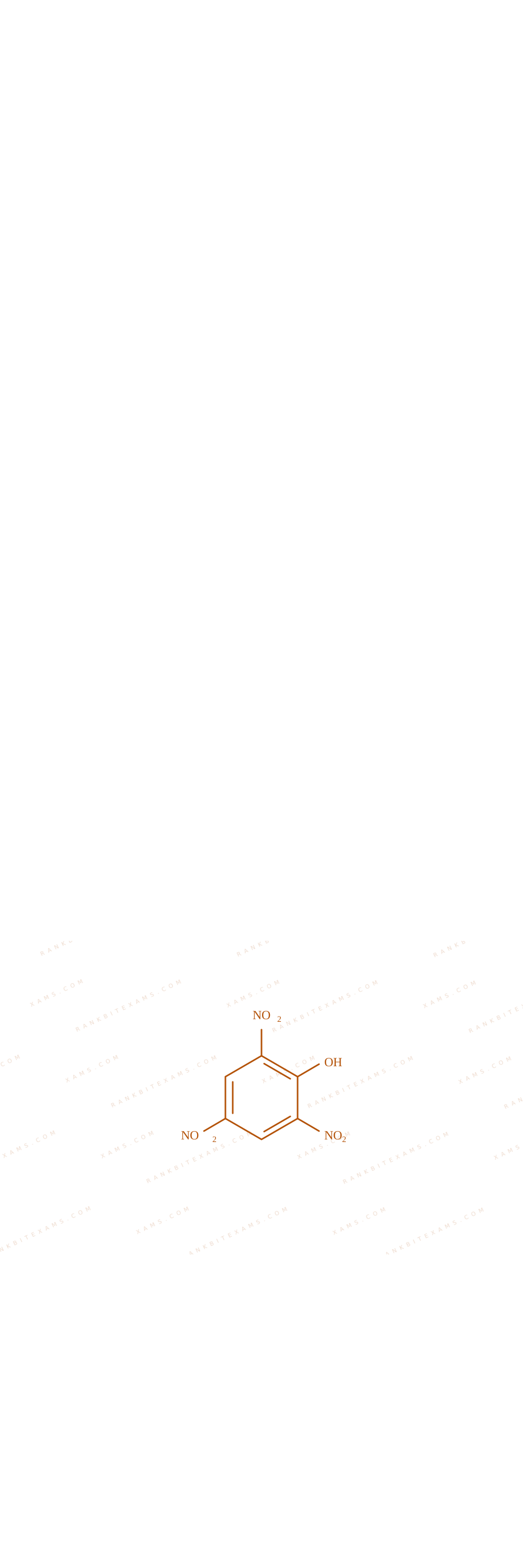
  • Visual representations of geometries:

    Geometry structure diagram 1 for Q35 - JEE Main 2025 Morning
    Geometry structure diagram 1 for Q35 - JEE Main 2025 Morning
    Geometry structure diagram 1 for Q35 - JEE Main 2025 Morning
    Geometry structure diagram 1 for Q35 - JEE Main 2025 Morning
    Geometry structure diagram 1 for Q35 - JEE Main 2025 Morning
    Geometry structure diagram 1 for Q35 - JEE Main 2025 Morning
    Geometry structure diagram 1 for Q35 - JEE Main 2025 Morning
    Geometry structure diagram 1 for Q35 - JEE Main 2025 Morning

Pattern Recognition

Sees: Steric count 6 with 5 bonded segments + 1 lone pair arrow always square pyramidal geometry.

Chapter Mix

Class 11 Chemistry: Chemical Bonding and Molecular Structure

Reference Study Guides

More Chemical Bonding and Molecular Structure Previous-Year Questions — Page 8

Q jee_main_2024_30_january_evening Dipole Moment
Given below are two statements: Statement-I: Since fluorine is more electronegative than nitrogen, the net dipole moment of NF₃ is greater than NH₃. Statement-II: In NH₃, the orbital dipole due to lone pair and the dipole moment of NH bonds are in opposite direction, but in NF₃ the orbital dipole due to lone pair and dipole moments of N-F bonds are in same direction. In the light of the above statements. Choose the most appropriate from the options given below.
  • A. Statement I is true but Statement II is false.
  • B. Both Statement I and Statement II are false.
  • C. Both statement I and Statement II is are true.
  • D. Statement I is false but Statement II is are true.

Solution

Core Logic

Statement I: The net dipole moment of NH₃ (1.47 D) is actually greater than that of NF₃ (0.23 D). Therefore, Statement I is false.

Statement II: In NH₃, the N-H bond dipole moments (pointing towards the more electronegative N) reinforce the orbital dipole moment of the lone pair. In NF₃, the N-F bond dipole moments point away from N (towards the more electronegative F), opposing the orbital dipole moment of the lone pair. This partial cancellation in NF₃ makes its net dipole moment lower. Therefore, Statement II is also false, as it reverses the correct orientations.
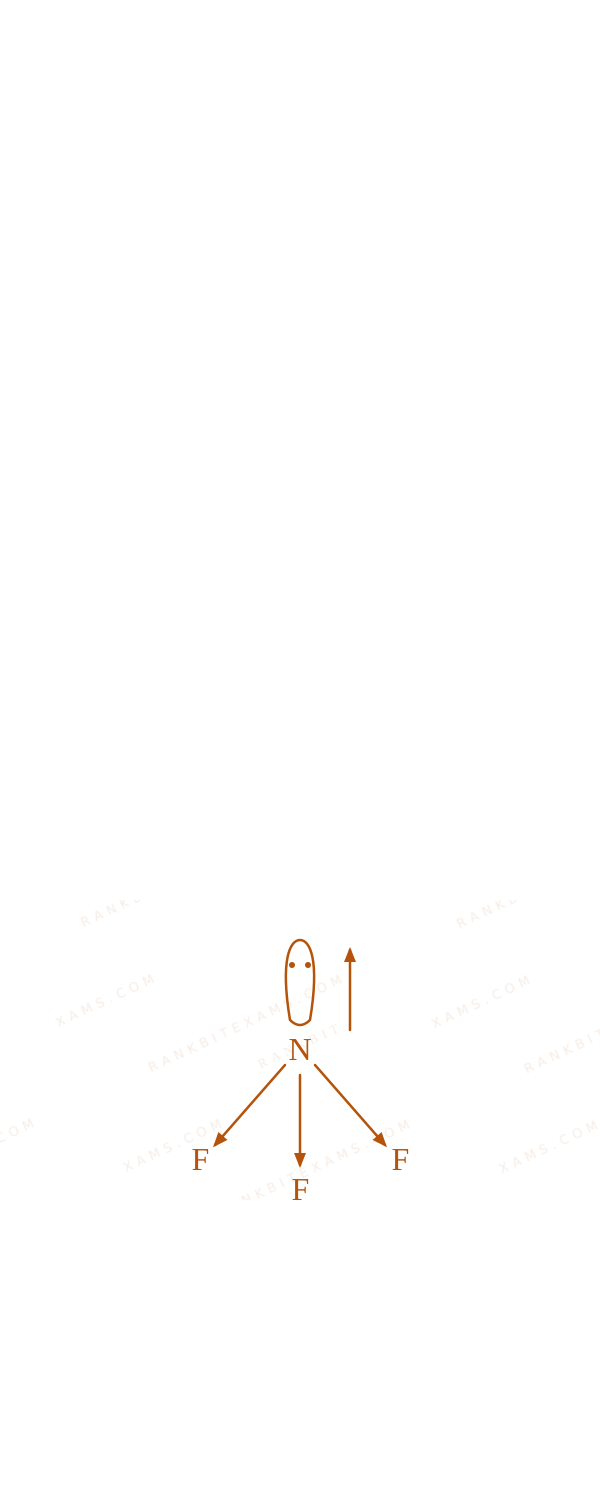
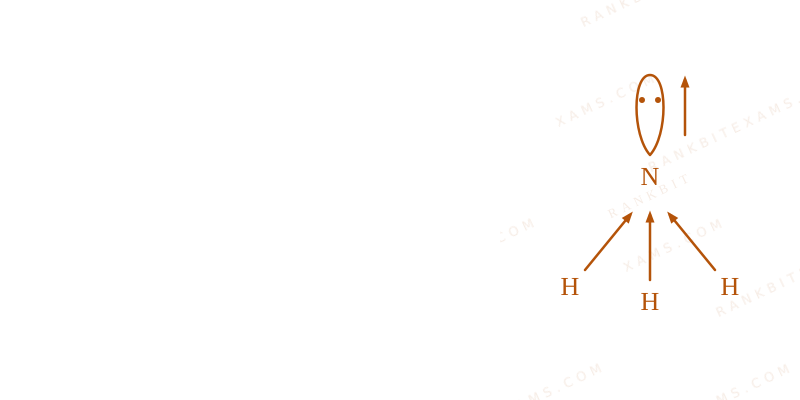
Dipole moments in NH3 and NF3 diagram for Q75 - JEE Main 2024 Evening

Step 1: Final Conclusion

Since both statements assert the opposite of established facts regarding NH₃ and NF₃, both are false.

Chapter Mix

Class 11 Chemistry: Chemical Bonding and Molecular Structure

Q jee_main_2024_30_jan_morning VSEPR Theory
Match List-I with List-II.
List-I (Molecule)List-II (Shape)
(A) BrF₅(I) T-shape
(B) H₂O(II) See saw
(C) ClF₃(III) Bent
(D) SF₄(IV) Square pyramidal
  • A. (A)-(I), (B)-(II), (C)-(IV), (D)-(III)
  • B. (A)-(II), (B)-(I), (C)-(III), (D)-(IV)
  • C. (A)-(III), (B)-(IV), (C)-(I), (D)-(II)
  • D. (A)-(IV), (B)-(III), (C)-(I), (D)-(II)

Solution

Core Logic

Using VSEPR theory: (A) BrF₅: Br has 7 valence electrons. 5 form bonds with F, leaving 1 lone pair. (5 bp + 1 lp) arrow sp³d² hybridization arrow Square pyramidal shape. (B) H₂O: O has 6 valence electrons. 2 form bonds with H, leaving 2 lone pairs. (2 bp + 2 lp) arrow sp³ hybridization arrow Bent shape. (C) ClF₃: Cl has 7 valence electrons. 3 form bonds with F, leaving 2 lone pairs. (3 bp + 2 lp) arrow sp³d hybridization arrow T-shape. (D) SF₄: S has 6 valence electrons. 4 form bonds with F, leaving 1 lone pair. (4 bp + 1 lp) arrow sp³d hybridization arrow See-saw shape.

Step 1: Matching

(A) - (IV) (B) - (III) (C) - (I) (D) - (II)

VSEPR Theory solution diagram for Q71 - JEE Main 2024 Morning

Chapter Mix

Class 11 Chemistry: Chemical Bonding and Molecular Structure

Q85 jee_main_2024_30_jan_morning Molecular Orbital Theory
The total number of molecular orbitals formed from 2s and 2p atomic orbitals of a diatomic molecule
Numerical Answer. Answer: 8 to 8

Solution

Core Logic

According to Molecular Orbital Theory (MOT), the number of molecular orbitals (MOs) formed is equal to the total number of atomic orbitals (AOs) combined.

Step 1: Counting atomic orbitals

For a single atom in the 2nd period, the valence shell has: One 2s orbital Three 2p orbitals (2pₓ, 2py, 2pz) Total = 4 atomic orbitals per atom. For a diatomic molecule, two such atoms combine. Total atomic orbitals = 4 × 2 = 8.

Step 2: Forming molecular orbitals

Combining these 8 atomic orbitals yields 8 molecular orbitals:

  • From 2s: σ₂ₛ and σ^*₂ₛ (2 MOs)
  • From 2p: σ2pz, π2pₓ, π2py, π^2pₓ, π^2py, σ^*2pz (6 MOs)
  • Total MOs = 2 + 6 = 8.

Chapter Mix

Class 11 Chemistry: Chemical Bonding and Molecular Structure

Q jee_main_2024_31_jan_evening Ionic Bond and Lattice Energy
Which of the following is least ionic?
  • A. BaCl₂
  • B. AgCl
  • C. KCl
  • D. CoCl₂

Solution

Core Logic

According to Fajan's rules, covalent character is favored by high charge and small size of the cation, and by cations with a pseudo-noble gas configuration. Ag^+ has a pseudo-noble gas configuration (ns²np⁶nd¹⁰), which results in high polarizing power compared to s-block and typical transition elements. Therefore, AgCl has the maximum covalent character and is the least ionic among the given options.

Ionic character order: AgCl < CoCl₂ < BaCl₂ < KCl

Step 1: Final Selection

Because AgCl is the most covalent, it is the least ionic. Hence, option (2) is correct.

Chapter Mix

Class 11 Chemistry: Chemical Bonding and Molecular Structure

Q81 jee_main_2024_31_jan_evening Dipole Moment and Fractional Charge
A diatomic molecule has a dipole moment of 1.2 D. If the bond distance is 1AA, then fractional charge on each atom is _________ × 10⁻¹⁰ esu. (Given: 1 D = 10⁻¹⁸ esu cm)
Numerical Answer. Answer: 1.2 to 1.2

Solution

Related Formula
μ = q × d
Core Logic

Given dipole moment, μ = 1.2 D = 1.2 × 10⁻¹⁸ esu cm. Bond distance, d = 1AA = 10⁻⁸ cm.

We need to find the fractional charge q.

Step 1: Calculation
q = (μ)/(d) q = 1.2 × 10⁻¹⁸ esu cm10⁻⁸ cm q = 1.2 × 10⁻¹⁰ esu
Step 2: Final Formatting

The question asks for the fractional charge in the form x × 10⁻¹⁰ esu. Therefore, the value is 1.2.

Note: Based on NTA officially accepting 12 (if asked for x × 10⁻¹¹) or 1.2. We will format it exactly as calculated.

Chapter Mix

Class 11 Chemistry: Chemical Bonding and Molecular Structure

More Chemical Bonding and Molecular Structure Questions — jee_main_2025_28_jan_morning

Practice all Chemical Bonding and Molecular Structure previous-year questions →

Rankbit System
JEE Physics: Waves (+15.5%) | Electrostatics: Concentric Shells (-29.7%) | Modern Physics: Photoelectric Clones (+34.2%) | Mathematics: Definite Integrals (+18.1%) | Chemistry: Coordination Splitting (-11.4%) | JEE Physics: Waves (+15.5%) | Electrostatics: Concentric Shells (-29.7%) | Modern Physics: Photoelectric Clones (+34.2%) | Mathematics: Definite Integrals (+18.1%) | Chemistry: Coordination Splitting (-11.4%)