Q47
jee_main_2024_31_jan_evening
Viscosity and Terminal Velocity
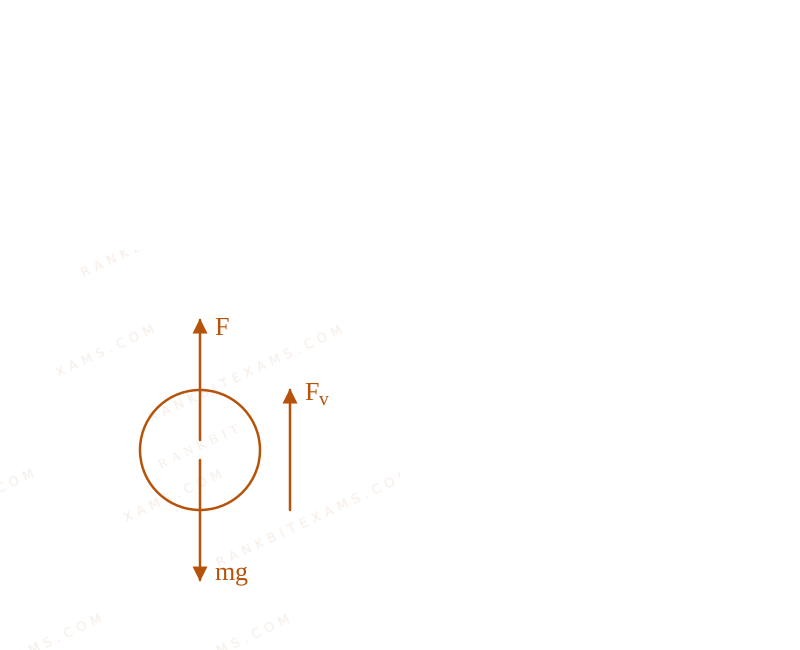
A small spherical ball of radius r, falling through a viscous medium of negligible density has terminal velocity 'v'. Another ball of the same mass but of radius 2r, falling through the same viscous medium will have terminal velocity:
Solution
Related Formula
At terminal velocity, downward force equals upward drag (assuming negligible buoyancy):
Mg = 6π η r v v = (Mg)/(6π η r)Core Logic
Since the density of the medium is negligible, we ignore buoyant forces. The mass M of the ball is specified to remain the same in both cases, despite the change in radius (implying the material density of the second ball is lower).
Step 1: Setup Proportionality
Since M, g, and η are all constants:
v ∝ (1)/(r)Step 2: Evaluating the Ratio
For the second ball, r' = 2r. Therefore, the new terminal velocity v' is:
v' = v × ((r)/(r')) = v × ((r)/(2r)) = (v)/(2)Pattern Recognition
Read the constraints carefully. Usually, questions keep material density uniform (v ∝ r²). However, this specifically says "same mass". This shifts the formula dependency from v ∝ r² entirely to v ∝ 1/r because M acts as a constant numerator.
Chapter Mix
Class 11 Physics: Mechanical Properties of Fluids