JEE Main · Physics ↓ Falling

Mechanical Properties of Fluids appeared 32 times across 3 years — 3.7% of Physics. This question is from Archimedes Principle.

Year 2026 2025 2024 Total
Questions 9 15 8 32

A 400g solid cube having an edge of length 10cm floats in water. How much volume of the cube is outside the water? (Given: density of water = 1000kgm⁻³ )

Solution & Explanation

Related Formula

By the law of flotation, the weight of a floating body must exactly balance the buoyant force exerted by the displaced fluid volume:

M · g = ρfluid · Vsubmerged · g
Core Logic

Given parameters:

  • Mass of the cube, M = 400 g = 0.4 kg
  • Total volume of the cube, Vtotal = (10 cm)³ = 1000 cm³ = 10⁻³ m³
  • Density of water, ρwater = 1000 kg/m³
  • Equating weight to buoyant force to find the submerged volume Vd :

0.4 = 1000 × Vsubmerged Vsubmerged = (0.4)/(1000) = 4 × 10⁻⁴ m³ = 400 cm³

Calculate the volume remaining outside the water surface :

Voutside = Vtotal - Vsubmerged Voutside = 1000 cm³ - 400 cm³ = 600 cm³
Pattern Recognition

The fraction of a floating body's volume that is submerged equals the ratio of the body's density to the fluid's density: VsubmergedVtotal = ρbodyρfluid. Here, the cube's effective density is 0.4 g/cm³, meaning 40% is submerged and 60% stays outside.

Chapter Mix

Class 11 Physics: Mechanical Properties of Fluids

Reference Study Guides

More Mechanical Properties of Fluids Previous-Year Questions — Page 5

Q jee_main_2025_24_jan_morning Surface Energy
The amount of work done to break a big water drop of radius 'R' into 27 small drops of equal radius is 10 J. The work done required to break the same big drop into 64 small drops of equal radius will be :-
  • A. 15 J
  • B. 10 J
  • C. 20 J
  • D. 5 J

Solution

Related Formula

The work done W in expanding surface area with surface tension S is given by:

W = S · Δ A
Core Logic

By volume conservation during splitting :

(4)/(3)π R³ = n ((4)/(3)π r³) r = Rn1/3

Total change in area gives work expression:

W = S (n · 4π r² - 4π R²) = 4π R²S (n1/3 - 1)
Step 1: Set up Proportions

For n = 27 drops:

W = 4π R²S (271/3 - 1) = 4π R²S (3 - 1) = 2(4π R²S) = 10 J 4π R²S = 5 J

For n = 64 drops:

W' = 4π R²S (641/3 - 1) = 4π R²S (4 - 1) = 3(4π R²S) W' = 3 × 5 = 15 J
Pattern Recognition

Work scales scaling-wise linearly with the key multiplier index (n1/3 - 1). Taking ratios between targets directly avoids calculations of constants.

Chapter Mix

Class 11 Physics: Mechanical Properties of Fluids
Q3 jee_main_2025_24_jan_morning Excess Pressure and Surface Tension
An air bubble of radius 0.1 cm lies at a depth of 20 cm below the free surface of a liquid of density 1000 kg/m³ If the pressure inside the bubble is 2100 N/m² greater than the atmospheric pressure, then the surface tension of the liquid in SI unit is (use g=10 m/s²)
  • A. 0.02
  • B. 0.1
  • C. 0.25
  • D. 0.04

Solution

Related Formula

The absolute pressure inside an air bubble submerged in a liquid is given by :

Pᵢₙ = P₀ + ρ gh + (2T)/(R)

where P₀ is atmospheric pressure, ρ is the liquid density, g is gravity, h is depth, T is surface tension, and R is the radius.

Core Logic

We are given that the difference between the inside pressure and atmospheric pressure is 2100 N/m²:

Pᵢₙ - P₀ = ρ gh + (2T)/(R) = 2100
Step 1: Numerical Evaluation

Substitute the given values into the relation :

ρ gh = 1000 × 10 × 0.20 = 2000 N/m²

Now find the excess pressure from surface tension:

(2T)/(R) = 2100 - 2000 = 100 N/m² T = (100 × R)/(2) = 50 × (0.1 × 10⁻²) = 0.05 N/m
Pattern Recognition

Total inside pressure accounts for both the hydrostatic pressure of the fluid column (ρ gh) and the spherical geometry boundary constraint pressure ((2T)/(R)).

Chapter Mix

Class 11 Physics: Mechanical Properties of Fluids

Q jee_main_2025_29_jan_morning Pascal\'s Law
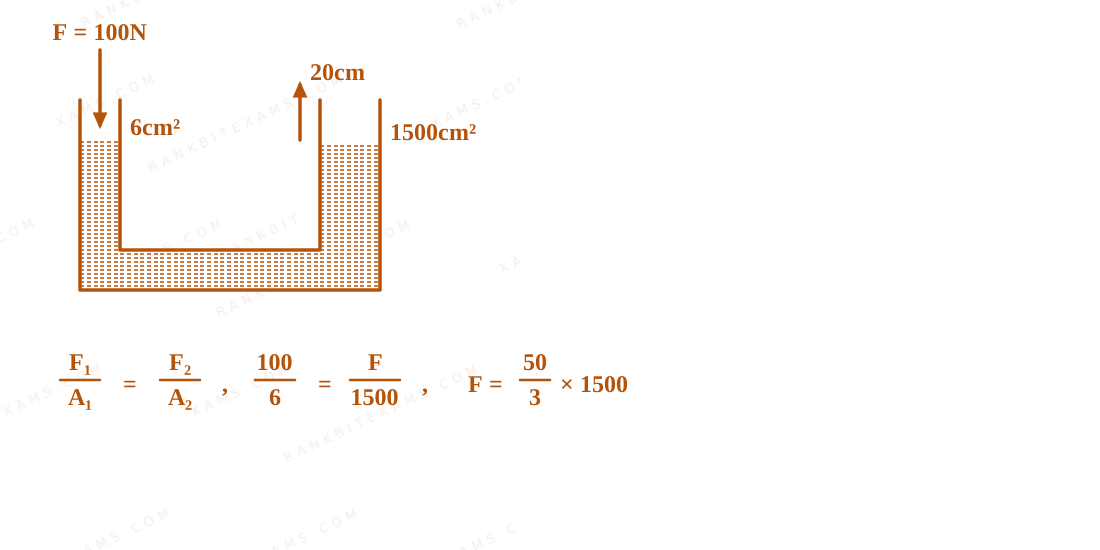
In a hydraulic lift, the surface area of the input piston is 6cm² and that of the output piston is 1500cm² . If 100N force is applied to the input piston to raise the output piston by 20cm , then the work done is ________ kJ.
Numerical Answer. Answer: 5 to 5

Solution

Related Formula
W = F₁ · s₁ = F₂ · s₂
Core Logic

By conservation of liquid volume displacement during output piston elevation :

A₁ · s₁ = A₂ · s₂ 6 · s₁ = 1500 · 20 s₁ = 5000 cm = 50 m

Work performed on input boundary matches :

W = F₁ · s₁ = 100 N · 50 m = 5000 J = 5 kJ

Alternatively via output force profile calculation:

Hydraulic lift work diagram allocation

F₂ = F₁ (A₂)/(A₁) = 100 (1500)/(6) = 25000 N W = F₂ · s₂ = 25000 · 0.2 = 5000 J = 5 kJ
Chapter Mix

Class 11 Physics: Mechanical Properties of Fluids

Q58 jee_main_2024_01_february_morning Bernoulli's Principle
A plane is in level flight at constant speed and each of its two wings has an area of 40~m². If the speed of the air is 180~km/h over the lower wing surface and 252~km/h over the upper wing surface, the mass of the plane is _______ kg. (Take air density to be 1~kg m⁻³ and g = 10~ms⁻²)
Numerical Answer. Answer: 9600 to 9600

Solution

Related Formula

Bernoulli's pressure balance equation for aerofoils:

Δ P = P₁ - P₂ = (1)/(2)ρ(v₂² - v₁²)

Dynamic Lift force balancing plane weight:

Flift = Δ P · Atotal = mg
Core Logic

Convert velocity limits to SI units:

v₁ = 180~km/h = 180 × (5)/(18) = 50~ms⁻¹ v₂ = 252~km/h = 252 × (5)/(18) = 70~ms⁻¹

Total effective wing area layout (2 wings):

Atotal = 2 × 40 = 80~m²
Step 1: Calculate Mass Balance

Substitute these values into the dynamic lift equation:

mg = (1)/(2) ρ (v₂² - v₁²) Atotal m(10) = (1)/(2) × 1 × (70² - 50²) × 80 10m = 40 × (4900 - 2500) = 40 × 2400 = 96000 m = 9600~kg
Pattern Recognition

Remember to multiply individual wing areas by 2 for standard multi-wing lift structures (Atotal = 2A).

Chapter Mix

Class 11 Physics: Mechanical Properties of Fluids

More Mechanical Properties of Fluids Questions — jee_main_2025_28_jan_evening

Practice all Mechanical Properties of Fluids previous-year questions →

Rankbit System
JEE Physics: Waves (+15.5%) | Electrostatics: Concentric Shells (-29.7%) | Modern Physics: Photoelectric Clones (+34.2%) | Mathematics: Definite Integrals (+18.1%) | Chemistry: Coordination Splitting (-11.4%) | JEE Physics: Waves (+15.5%) | Electrostatics: Concentric Shells (-29.7%) | Modern Physics: Photoelectric Clones (+34.2%) | Mathematics: Definite Integrals (+18.1%) | Chemistry: Coordination Splitting (-11.4%)