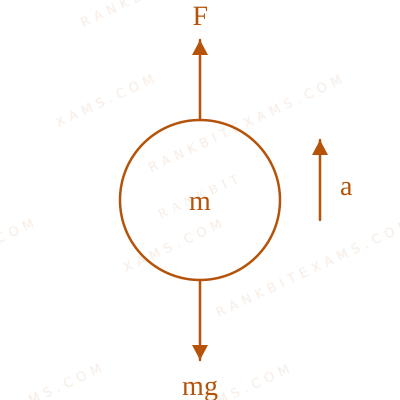
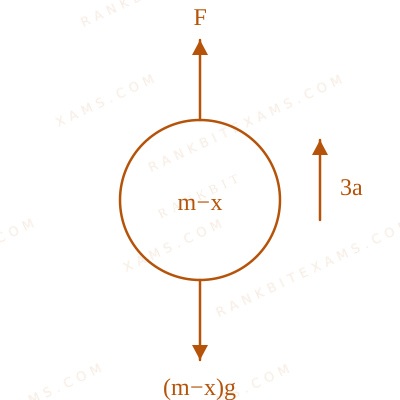
A balloon and its content having mass M is moving up with an acceleration 'a'. The mass that must be released from the content so that the balloon starts moving up with an acceleration '3a' will be : (Take 'g' as acceleration due to gravity) [cite: 174, 175]
Substitute the value of F$F$ from Case 1 into Case 2 [cite: 836, 839]:
M(g + a) - (M - x)g = (M - x)3a$$M(g + a) - (M - x)g = (M - x)3a$$M g + M a - M g + x g = 3 M a - 3 x a$$M g + M a - M g + x g = 3 M a - 3 x a \quad \text{}$$M a + x g = 3 M a - 3 x a$$M a + x g = 3 M a - 3 x a$$x(g + 3a) = 2 M a$$x(g + 3a) = 2 M a$$x = (2 M a)/(3a + g)$$x = \frac{2 M a}{3a + g} \quad \text{}$$
Step 1: Visual Context
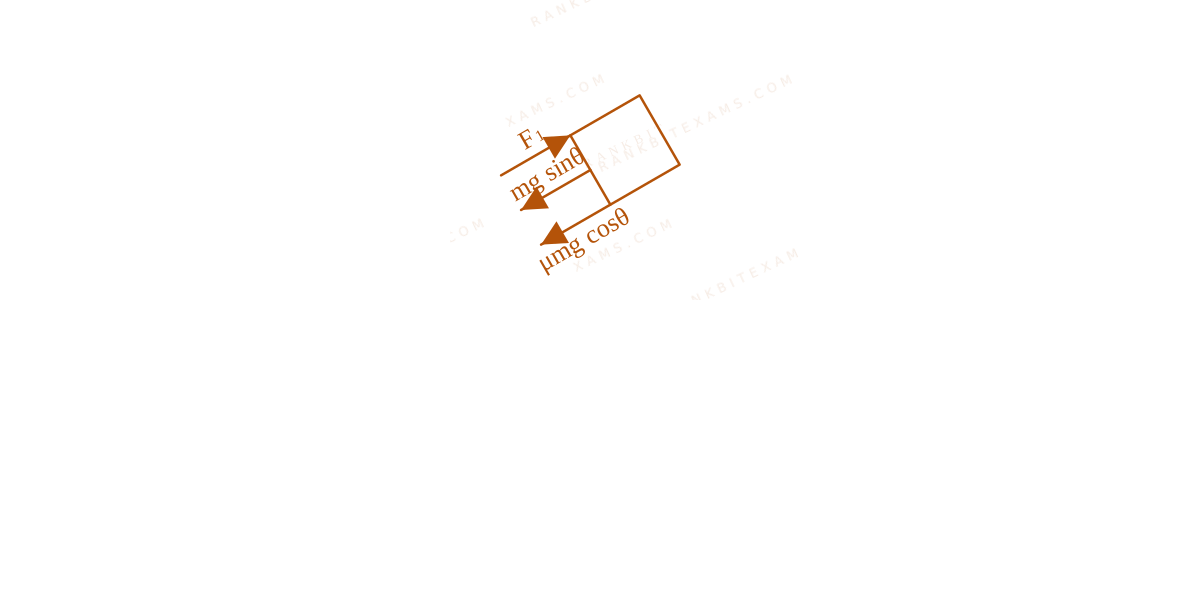
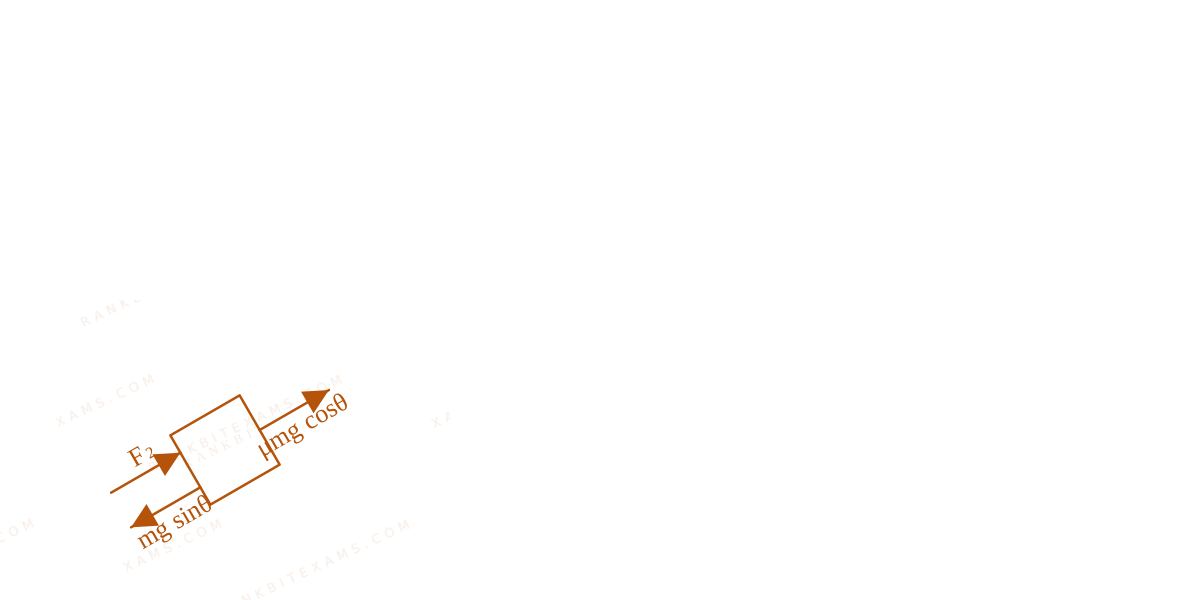
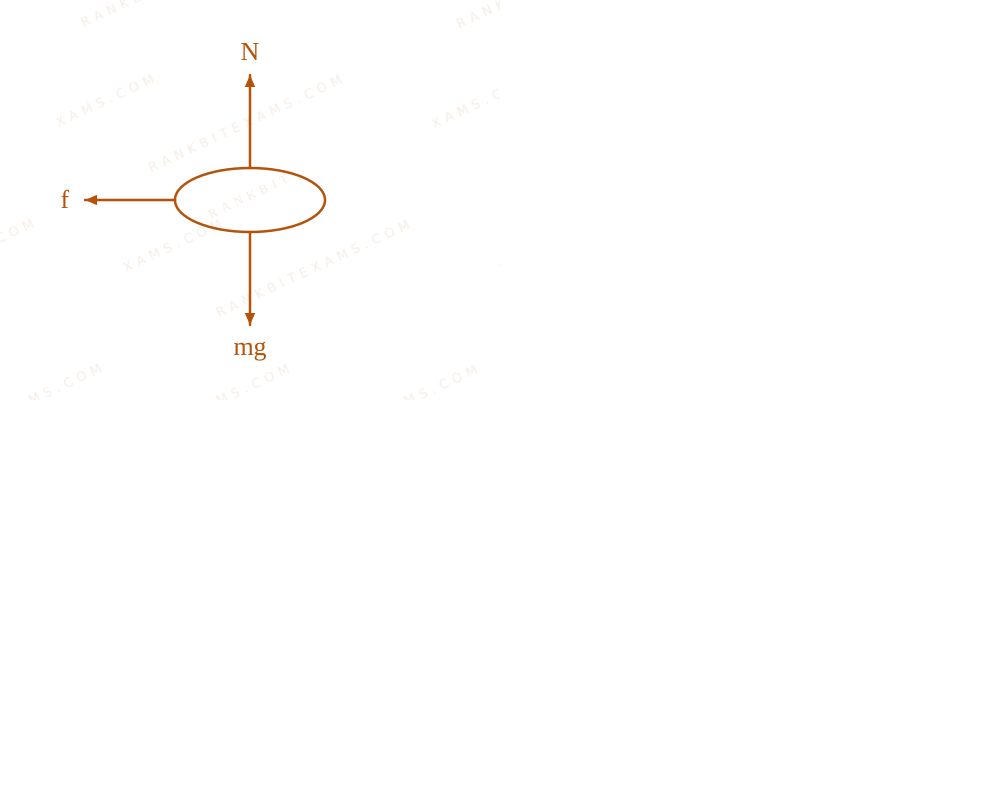
The free-body force layout for both accelerating phases is shown below:
Newton Second Law Applications free body diagrams for Q20
Newton Second Law Applications free body diagrams for Q20
Pattern Recognition
Since the upward buoyant force is completely determined by the balloon's volume, it remains constant. Expressing this constant force in terms of the initial conditions allows you to quickly solve for mass changes when acceleration states vary.
Keywords:#mass to be released from accelerating balloon#JEE Main 2025 Evening Q20#Laws of Motion JEE Main 2025#buoyant force free body equations
More Laws of Motion Previous-Year Questions — Page 7
Q31jee_main_2024_31_jan_eveningPulley Systems and Tension
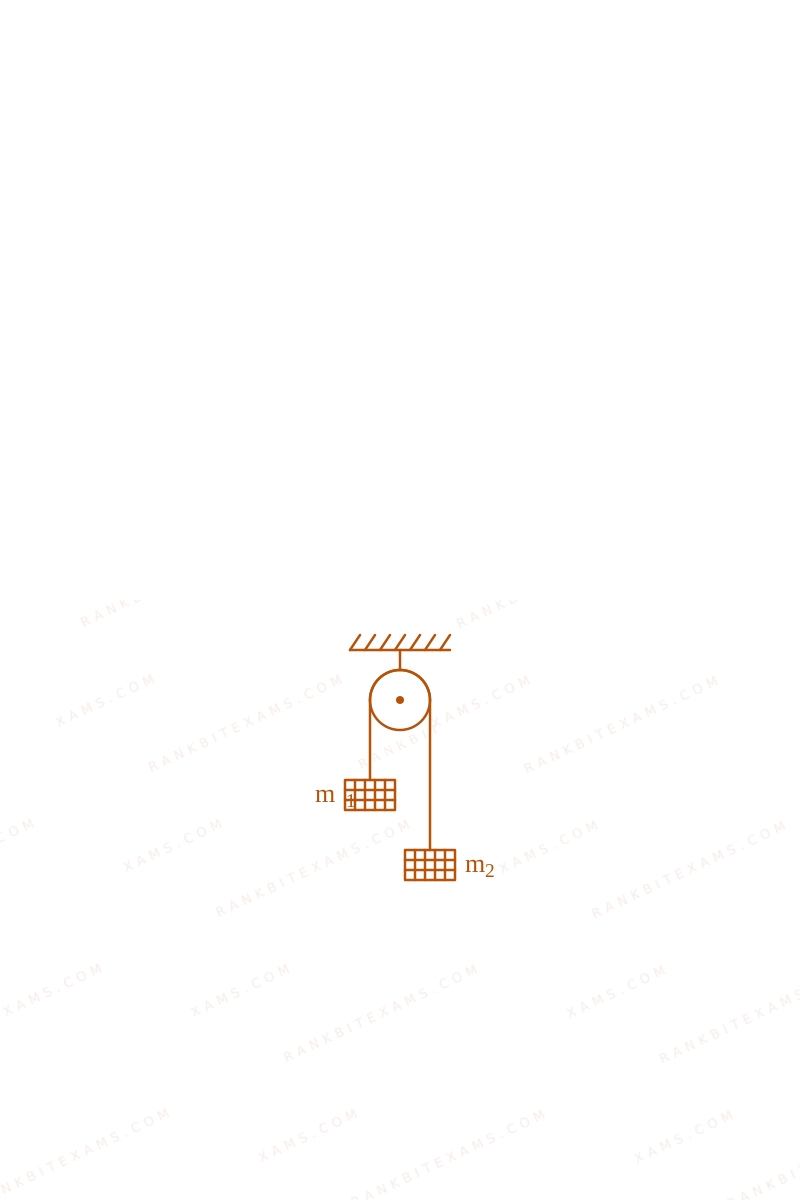
A light string passing over a smooth light fixed pulley connects two blocks of masses m₁$m_1$ and m₂$m_2$. If the acceleration of the system is g/8$g/8$, then the ratio of masses is
The image displays two masses suspended over a single fixed smooth pulley.
For standard Atwood machines, a = g × Difference in massSum of mass$a = g \times \frac{\text{Difference in mass}}{\text{Sum of mass}}$. If a/g = 1/8$a/g = 1/8$, then (m₁-m₂)/(m₁+m₂) = 1/8$(m_1-m_2)/(m_1+m_2) = 1/8$, which can be solved using componendo and dividendo: m₁/m₂ = (8+1)/(8-1) = 9/7$m_1/m_2 = (8+1)/(8-1) = 9/7$.
Chapter Mix
Class 11 Physics: Laws of Motion
Q42jee_main_2024_31_jan_eveningFriction on an Inclined Plane
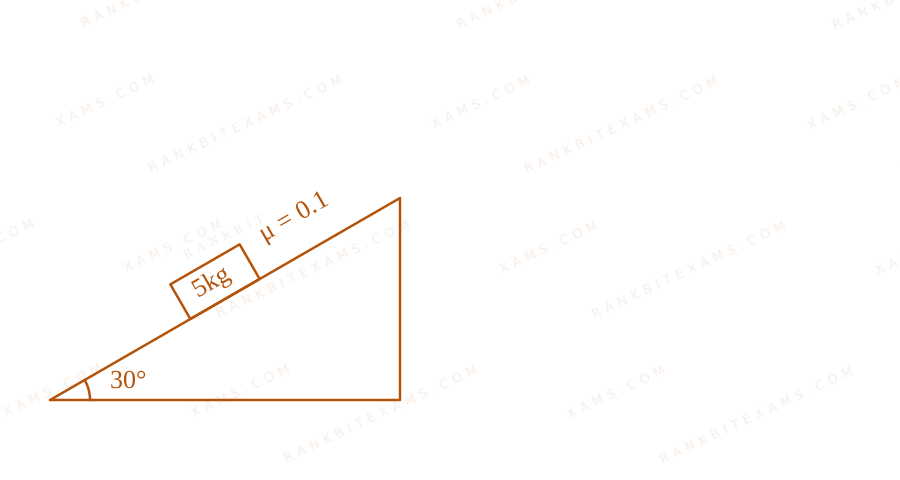
A block of mass 5 kg$5 \text{ kg}$ is placed on a rough inclined surface as shown in the figure.
The image shows a 5 kg block on a rough plane inclined at 30 degrees, with coefficient of friction mu = 0.1.
If F₁$\vec{F}_1$ is the force required to just move the block up the inclined plane and F₂$\vec{F}_2$ is the force required to just prevent the block from sliding down, then the value of | F₁| - | F₂|$|\vec{F}_1| - |\vec{F}_2|$ is: [Use g = 10 m/s²$g = 10 \text{ m/s}^2$]
To move the block up, the applied force F₁$F_1$ must overcome both the downward gravitational component and the downward frictional force.
To prevent it from sliding down, the applied force F₂$F_2$ acts upwards and is aided by friction which acts upwards to oppose impending downward slip.
The image shows a 5 kg block on a rough plane inclined at 30 degrees, with coefficient of friction mu = 0.1.
The image shows a 5 kg block on a rough plane inclined at 30 degrees, with coefficient of friction mu = 0.1.
Note: The official options had an anomaly where 5√(3) N$5\sqrt{3} \text{ N}$ was missing or evaluated as a bonus. Option 2 was listed as 50√(3)$50\sqrt{3}$ in the primary text. We track the closest logic path indicating Bonus.
Pattern Recognition
The difference between 'push up' and 'hold from sliding' forces on an incline is always precisely 2 fk$2 f_k$ (2 μ mg θ$2 \mu mg \cos \theta$). Bypass calculating the mg θ$mg \sin \theta$ terms entirely.
Chapter Mix
Class 11 Physics: Laws of Motion
Qjee_main_2024_31_jan_morningPulley And Incline Friction
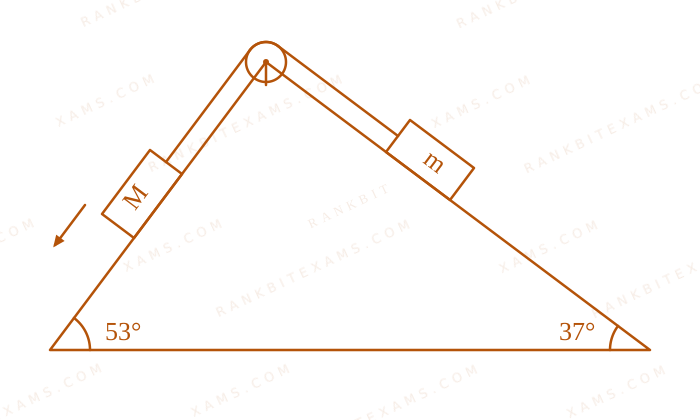
In the given arrangement of a doubly inclined plane two blocks of masses M$M$ and m$m$ are placed. The blocks are connected by a light string passing over an ideal pulley as shown. The coefficient of friction between the surface of the plane and the blocks is 0.25$0.25$. The value of m$m$, for which M = 10 kg$M = 10\mathrm{\ kg}$ will move down with an acceleration of 2 m/s²$2\mathrm{\ m/s^2}$ is : (take g = 10 m/s²$g = 10\mathrm{\ m/s^2}$ and 37° = 3 / 4$\tan 37^{\circ} = 3 / 4$)
Two blocks M and m on opposite sides of a double inclined plane linked by a rope over a top pulley. M is on the 53-degree slope and moving downwards, m is on the 37-degree slope.
A.9 kg$9\mathrm{\ kg}$
B.4.5 kg$4.5\mathrm{\ kg}$
C.6.5 kg$6.5\mathrm{\ kg}$
D.2.25 kg$2.25\mathrm{\ kg}$
Solution
Related Formula
Σ F = ma$$\sum F = ma$$fk = μk N = μk mg θ$$f_k = \mu_k N = \mu_k mg \cos\theta$$
Core Logic
Two blocks M and m on opposite sides of a double inclined plane linked by a rope over a top pulley. M is on the 53-degree slope and moving downwards, m is on the 37-degree slope.
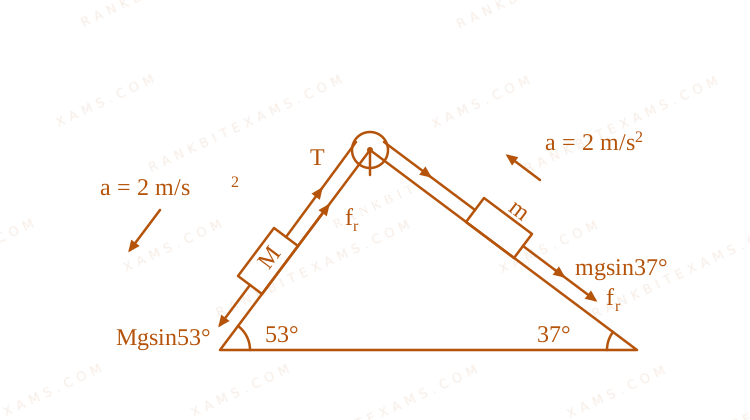
Since block M$M$ moves down the incline, kinetic friction opposes its motion (acts upwards).
Block m$m$ is pulled up the incline, so kinetic friction opposes its motion (acts downwards).
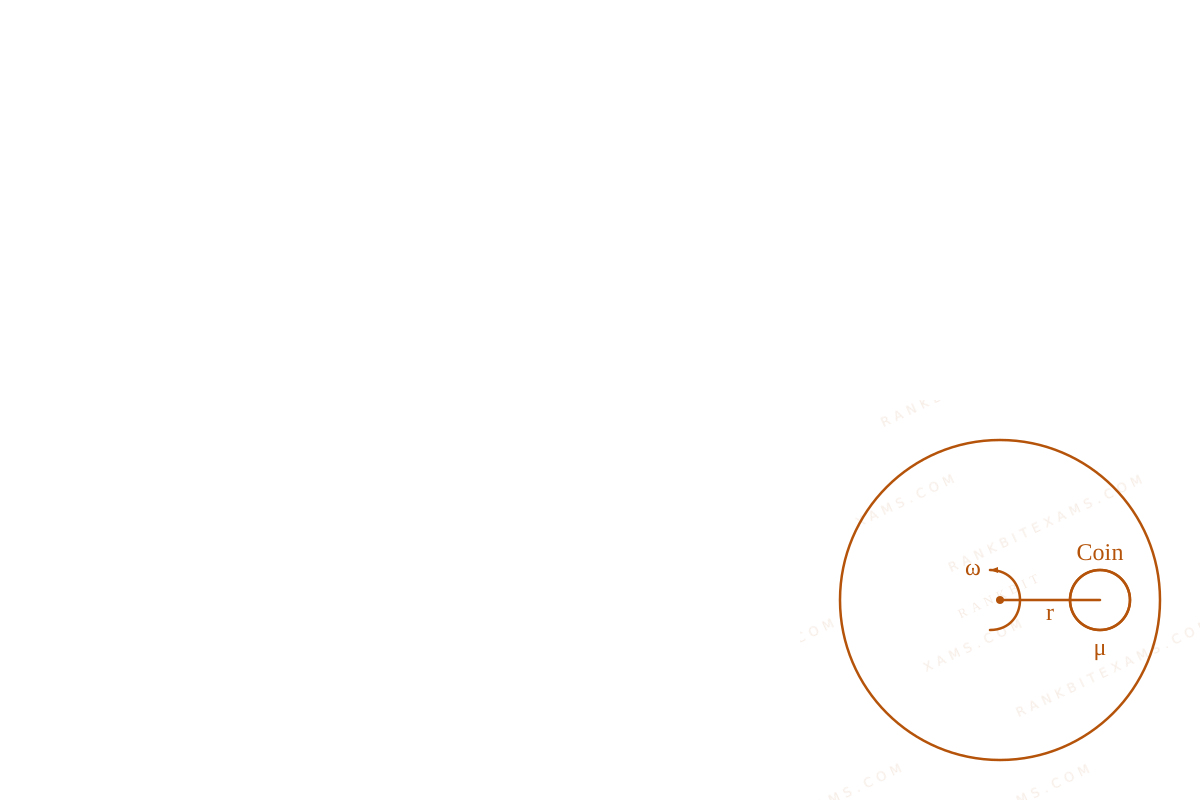
A coin is placed on a disc. The coefficient of friction between the coin and the disc is μ$\mu$. If the distance of the coin from the center of the disc is r$r$, the maximum angular velocity which can be given to the disc, so that the coin does not slip away, is:
Practice past-year questions one chapter at a time. Pick an exam → subject → chapter and get every PYQ for that topic — pulled together from all past papers — with the chapter's key formulas alongside.