JEE Main · Mathematics → Steady

Sequences and Series appeared 55 times across 3 years — 6.4% of Mathematics. This question is from Telescopic Series Summation.

Year 2026 2025 2024 Total
Questions 17 24 14 55

For positive integers n, if 4aₙ=(n²+5n+6) and Sₙ=Σk=1ⁿ( 1ak) then the value of 507 S₂₀₂₅ is:

Solution & Explanation

Related Formula

Telescopic series decomposition via method of differences:

(1)/((k+2)(k+3)) = (1)/(k+2) - (1)/(k+3)
Core Logic

Given:

aₙ = (n²+5n+6)/(4) = ((n+2)(n+3))/(4)

Therefore, the reciprocal term is:

(1)/(ak) = (4)/((k+2)(k+3)) = 4 [ (1)/(k+2) - (1)/(k+3) ]
Step 1: Compute the Partial Sum
Sₙ = Σk=1ⁿ (1)/(ak) = 4 Σk=1ⁿ ( (1)/(k+2) - (1)/(k+3) )

Expanding the sum terms:

Sₙ = 4 [ ((1)/(3) - (1)/(4)) + ((1)/(4) - (1)/(5)) + + ((1)/(n+2) - (1)/(n+3)) ]

All intermediate terms cancel out:

Sₙ = 4 [ (1)/(3) - (1)/(n+3) ] = 4 [ (n+3 - 3)/(3(n+3)) ] = (4n)/(3(n+3))
Step 2: Calculate for n = 2025

For n = 2025:

S₂₀₂₅ = (4 × 2025)/(3 × (2025 + 3)) = (4 × 2025)/(3 × 2028)

We need to find 507 × S₂₀₂₅:

507 × S₂₀₂₅ = 507 × (4 × 2025)/(3 × 2028)

Notice that 2028 = 4 × 507:

507 × S₂₀₂₅ = 507 × (4 × 2025)/(3 × (4 × 507)) = (2025)/(3) = 675
Pattern Recognition

Always look for arithmetic factor groupings at the end of large number sequence questions in JEE. Here recognizing 2028 = 4 × 507 avoids large multi-digit multiplication.

Chapter Mix

Class 11 Mathematics: Sequences and Series

Reference Study Guides

More Sequences and Series Previous-Year Questions — Page 5

Q70 jee_main_2025_03_april_evening Special Series
The sum 1 + (1+3)/(2!) + (1+3+5)/(3!) + (1+3+5+7)/(4!) + is equal to
  • A. 6e
  • B. 4e
  • C. 3e
  • D. 2e

Solution

Related Formula

Sum of first r odd natural numbers:

Σk=1r (2k-1) = r²

Exponential series expansion:

Σr=0∞ (1)/(r!) = e
Core Logic

Let's find the general r-th term of the series:

Tᵣ = (1 + 3 + 5 + + (2r-1))/(r!) = (r²)/(r!) = (r)/((r-1)!)
Step 1: Expressing term in terms of sum limits

Let's write r = (r-1) + 1:

Tᵣ = (r-1+1)/((r-1)!) = (1)/((r-2)!) + (1)/((r-1)!)

Our infinite sum is:

S = Σr=1∞ Tᵣ = Σr=2∞ (1)/((r-2)!) + Σr=1∞ (1)/((r-1)!)

Both sums are standard representations of the exponential expansion.

Step 2: Summing the parts
  • First part: Σr=2∞ (1)/((r-2)!) = 1 + (1)/(1!) + (1)/(2!) + = e
  • Second part: Σr=1∞ (1)/((r-1)!) = 1 + (1)/(1!) + (1)/(2!) + = e
Total Sum S = e + e = 2e
Pattern Recognition

The general term containing r² in summation with factorials converges to 2e. Remember the shortcut: Σ (r²)/(r!) = 2e, Σ (r³)/(r!) = 5e. It is extremely useful to memorize these common limits.

Chapter Mix

Class 11 Mathematics: Sequences and Series Class 12 Mathematics: Limits, Continuity and Differentiability

Q63 jee_main_2025_07_april_morning Arithmetico-Geometric Progression
Let x₁, x₂, x₃, x₄ be in a geometric progression. If 2, 7, 9, 5 are subtracted respectively from x₁, x₂, x₃, x₄ then the resulting numbers are in an arithmetic progression. Then the value of (1)/(24) (x₁ x₂ x₃ x₄) is:
  • A. 72
  • B. 18
  • C. 36
  • D. 216

Solution

Related Formula

For a geometric progression, the terms can be set as a, ar, ar², ar³. For three terms A, B, C to be in arithmetic progression, they must satisfy: 2B = A + C

Core Logic

Let the elements be x₁ = a, x₂ = ar, x₃ = ar², x₄ = ar³. After the specified subtractions, the sequence becomes:

a - 2, ar - 7, ar² - 9, ar³ - 5

Since this sequence is in AP, we form two separate common difference linear linkages:

2(ar - 7) = (a - 2) + (ar² - 9) 2ar - 14 = ar² + a - 11 ar² - 2ar + a + 3 = 0 (1) 2(ar² - 9) = (ar - 7) + (ar³ - 5) 2ar² - 18 = ar³ + ar - 12 ar³ - 2ar² + ar + 6 = 0 (2)
Step 1: Solve the Simultaneous Polynomials

Multiply equation (1) by r:

ar³ - 2ar² + ar + 3r = 0 (3)

Subtract equation (3) from equation (2):

(ar³ - 2ar² + ar + 6) - (ar³ - 2ar² + ar + 3r) = 0 6 - 3r = 0 3r = 6 r = 2

Substitute r = 2 back into equation (1):

a(2)² - 2a(2) + a + 3 = 0 4a - 4a + a + 3 = 0 a = -3
Step 2: Find the Continuous Product Value

The continuous product term is:

x₁x₂x₃x₄ = a · ar · ar² · ar³ = a⁴ r⁶ x₁x₂x₃x₄ = (-3)⁴ · (2)⁶ = 81 × 64 = 5184

Now divide by 24 as required:

(1)/(24)(5184) = 216
Pattern Recognition

Notice that multiplying the first AP condition equation by r perfectly mimics the structure of the second condition equation except for the absolute scalar value, allowing direct elimination of all polynomial variable indices simultaneously.

Chapter Mix

Class 11 Mathematics: Sequences and Series

Q jee_main_2025_08_april_evening Infinite Series
If (1)/(1⁴) + (1)/(2⁴) + (1)/(3⁴) + ∞ = (π⁴)/(90), and (1)/(1⁴) + (1)/(3⁴) + (1)/(5⁴) + ∞ = α (1)/(2⁴) + (1)/(4⁴) + (1)/(6⁴) + ∞ = β then (α)/(β) is equal to
  • A. 23
  • B. 18
  • C. 15
  • D. 14

Solution

Related Formula
Total Sum = α + β
Core Logic

Factor out common fractions from the even terms component (β) to represent it as a scalar multiple of the universal sum sequence.

Step 1: Simplify the Even Terms Series
β = (1)/(2⁴) + (1)/(4⁴) + (1)/(6⁴) + = (1)/(2⁴) ( (1)/(1⁴) + (1)/(2⁴) + (1)/(3⁴) + ) β = (1)/(16) ( (π⁴)/(90) )
Step 2: Express Alpha by Remainder Deduction

Since total sum equals α + β:

α = Total Sum - β = (π⁴)/(90) - (1)/(16) ( (π⁴)/(90) ) = (15)/(16) ( (π⁴)/(90) )
Step 3: Compute the Relative Ratio

(α)/(β) = ((15)/(16) ( (π⁴)/(90) ))/((1)/(16) ( (π⁴)/(90) )) = 15

Pattern Recognition

For alternating p-series powers like Σ n-p, the even component fractions always condense via factor steps to 2-p · Stotal, decoupling power values cleanly from final simple scalar quotients.

Chapter Mix

Class 11 Mathematics: Sequences and Series

Q57 jee_main_2025_29_jan_evening Infinite Geometric Progression
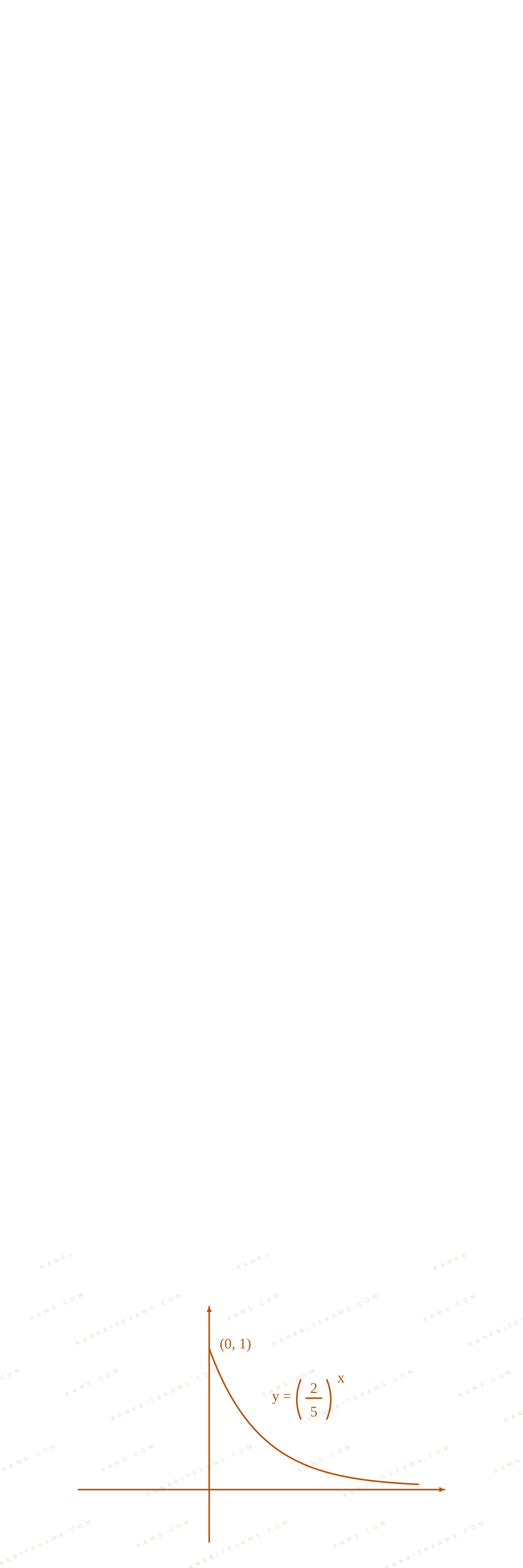
Let S = N 0. Define a relation \mathbf{R} from S to R by: R = (x, y): ₑ y = x ₑ ((2)/(5)), x in S, y in R . Then, the sum of all the elements in the range of R is equal to
  • A. (3)/(2)
  • B. (5)/(3)
  • C. (10)/(9)
  • D. (5)/(2)

Solution

Related Formula

Sum of an infinite geometric progression with |r| < 1:

S∞ = (a)/(1 - r)
Core Logic

From the definition of the relation:

ₑ y = x ₑ((2)/(5)) ₑ y = ₑ((2)/(5))^x y = ((2)/(5))^x

Infinite Geometric Progression diagram for Q57 - JEE Main 2025 Evening

Since x in S = 0, 1, 2, 3,, the output values of y represent elements of the range.

Step 1: Compute Infinite Sum

Generating elements by plugging in values of x: For x = 0 y = 1 For x = 1 y = (2)/(5) For x = 2 y = ((2)/(5))²

Sum of elements in the range:

Sum = 1 + ((2)/(5))¹ + ((2)/(5))² + = (1)/(1 - (2)/(5)) = (5)/(3)
Pattern Recognition

Convert log equations into standard exponential equations right away. A variable index belonging to whole numbers indicates an infinite GP summation scenario.

Chapter Mix

Class 11 Mathematics: Sequences and Series Class 11 Mathematics: Relations and Functions

Q73 jee_main_2025_29_jan_evening Arithmetic Progression Properties
Let a₁, a₂, …, a₂₀₂₄ be an Arithmetic Progression such that a₁ + (a₅ + a₁₀ + a₁₅ + … + a₂₀₂₀) + a₂₀₂₄ = 2233. Then a₁ + a₂ + a₃ + … + a₂₀₂₄ is equal to
Numerical Answer. Answer: 11132 to 11132

Solution

Related Formula

Symmetry identity rule inside Arithmetic Progressions:

ak + an-k+1 = a₁ + aₙ
Core Logic

Group matching paired steps equidistant from sequence boundary ends:

a₁ + a₂₀₂₄ = a₅ + a₂₀₂₀ = a₁₀ + a₂₀₁₅ =

The sequence of inner indices follows an AP tracking loop:

5, 10, 15, , 2020

Calculate internal block element count N:

2020 = 5 + (N-1)5 2015 = 5(N-1) N - 1 = 403 N = 404 terms
Step 1: Simplify Expression Equations

Since the inner sequence contains 404 terms, they form exactly 202 symmetrical pairs. Adding a₁ and a₂₀₂₄ introduces one more pair, resulting in 203 identical sum blocks:

203(a₁ + a₂₀₂₄) = 2233 a₁ + a₂₀₂₄ = (2233)/(203) = 11
Step 2: Evaluate the Total Sum

Using the standard AP sum formula:

S₂₀₂₄ = (2024)/(2)(a₁ + a₂₀₂₄) = 1012 × 11 = 11132
Pattern Recognition

Progressions possess natural positional balance. Grouping symmetrical index pairs (ak + an-k+1) allows factoring out variable steps right away.

Chapter Mix

Class 11 Mathematics: Sequences and Series

More Sequences and Series Questions — jee_main_2025_28_jan_evening

Practice all Sequences and Series previous-year questions →

Rankbit System
JEE Physics: Waves (+15.5%) | Electrostatics: Concentric Shells (-29.7%) | Modern Physics: Photoelectric Clones (+34.2%) | Mathematics: Definite Integrals (+18.1%) | Chemistry: Coordination Splitting (-11.4%) | JEE Physics: Waves (+15.5%) | Electrostatics: Concentric Shells (-29.7%) | Modern Physics: Photoelectric Clones (+34.2%) | Mathematics: Definite Integrals (+18.1%) | Chemistry: Coordination Splitting (-11.4%)