Given below are two statements:
Statement (I): Oxacyclobutane and prop-2-en-1-ol are isomeric compounds.
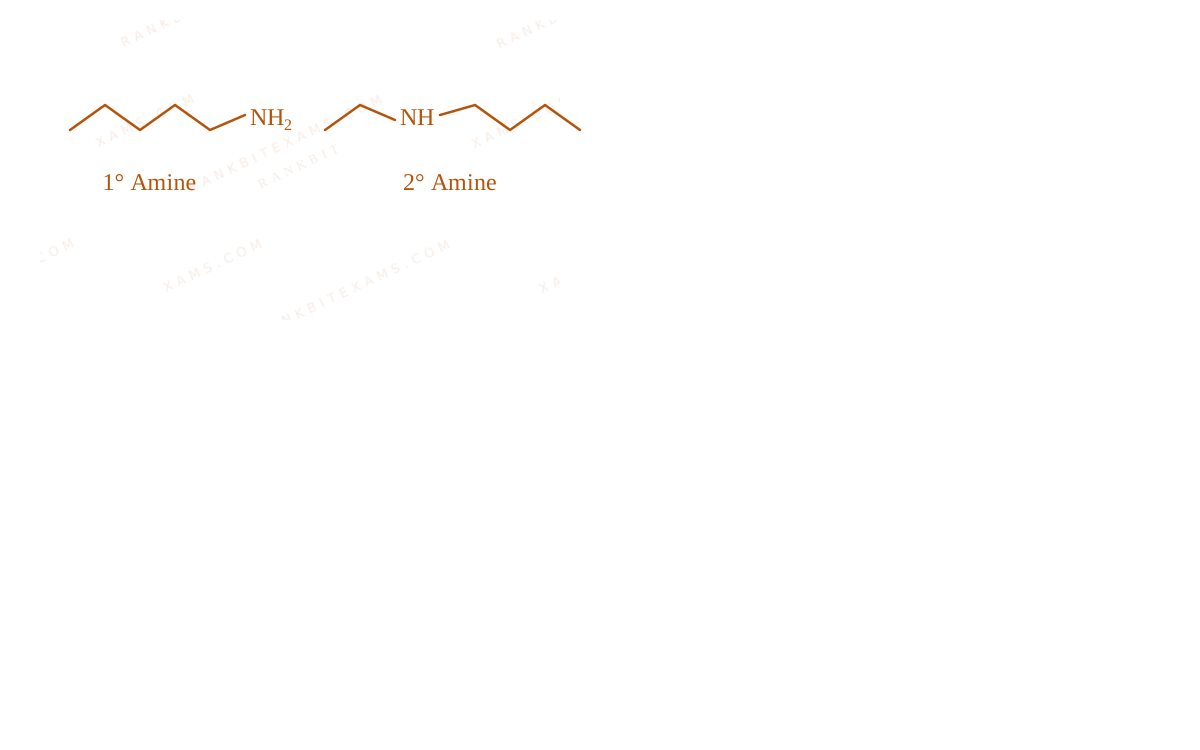
Statement (II): Propan-1-amine and N-methylethanamine are functional group isomers.
In the light of the above statements, choose the correct answer from the options given below :
A.Both Statement I and Statement II are false
B.Both Statement I and Statement II are true
C.Statement I is true but Statement II is false
D.Statement I is false but Statement II is true
Solution & Explanation
Related Formula
Isomers share an identical molecular formula but differ in structural arrangement or functional groups:
Same Mf ≠ Same structural layout$$\text{Same } M_f \neq \text{Same structural layout}$$
Core Logic
Evaluating the structural parameters:
Statement I: Oxacyclobutane (a cyclic ether) and prop-2-en-1-ol (an unsaturated alcohol) both possess the molecular formula C₃H₆O$C_3H_6O$. They are functional/ring-chain isomers, so Statement I is true.
Statement II: Propan-1-amine (1^°$1^\circ$ amine) and N-methylethanamine (2^°$2^\circ$ amine) both share the molecular formula C₃H₉N$C_3H_9N$. Because primary, secondary, and tertiary amines contain different functional groups, they act as functional group isomers. Thus, Statement II is true.
Step 1: Conclusion Match
Since both structural statements are valid, both Statement I and Statement II are true.
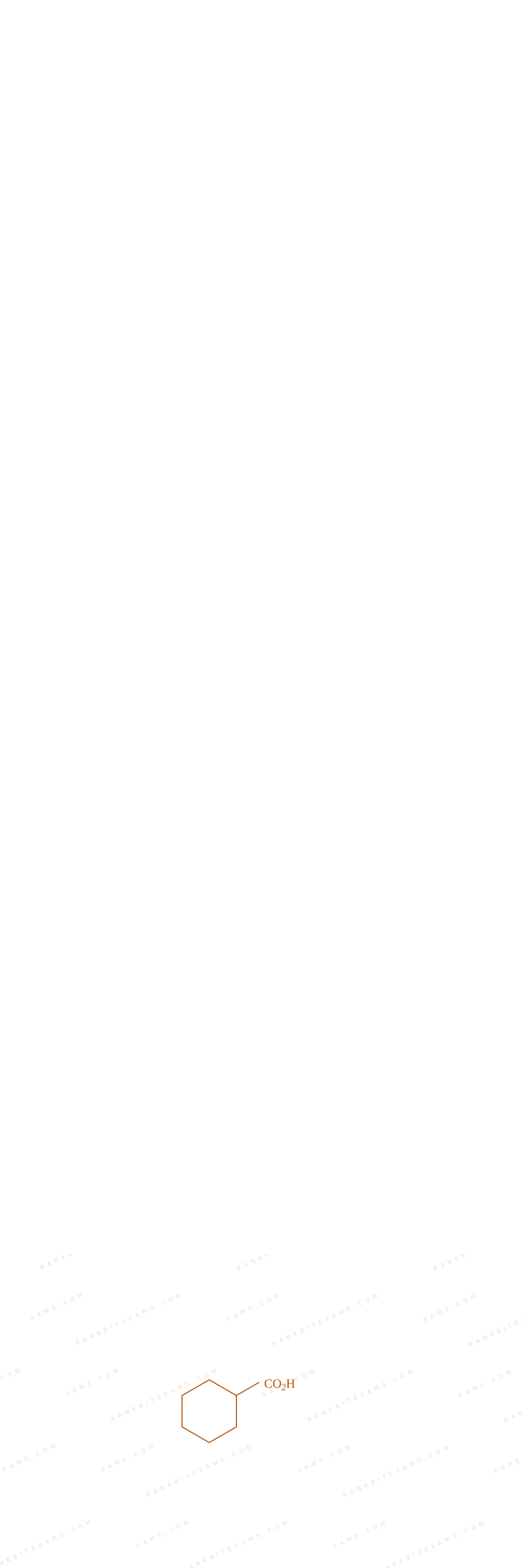
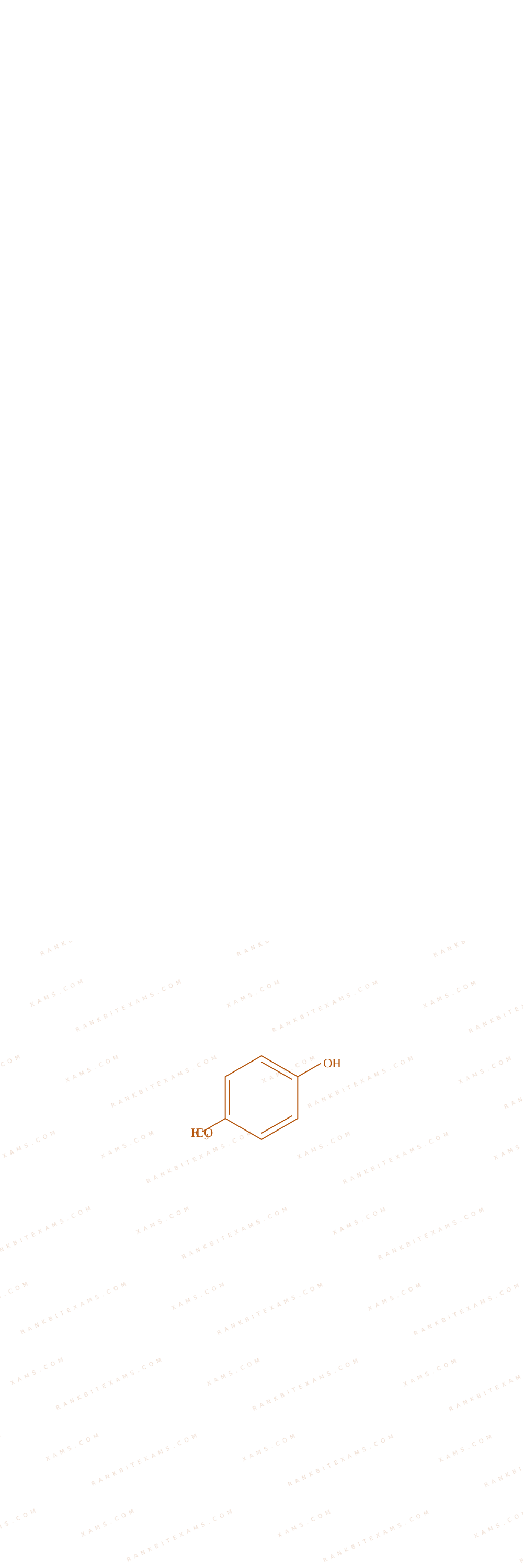
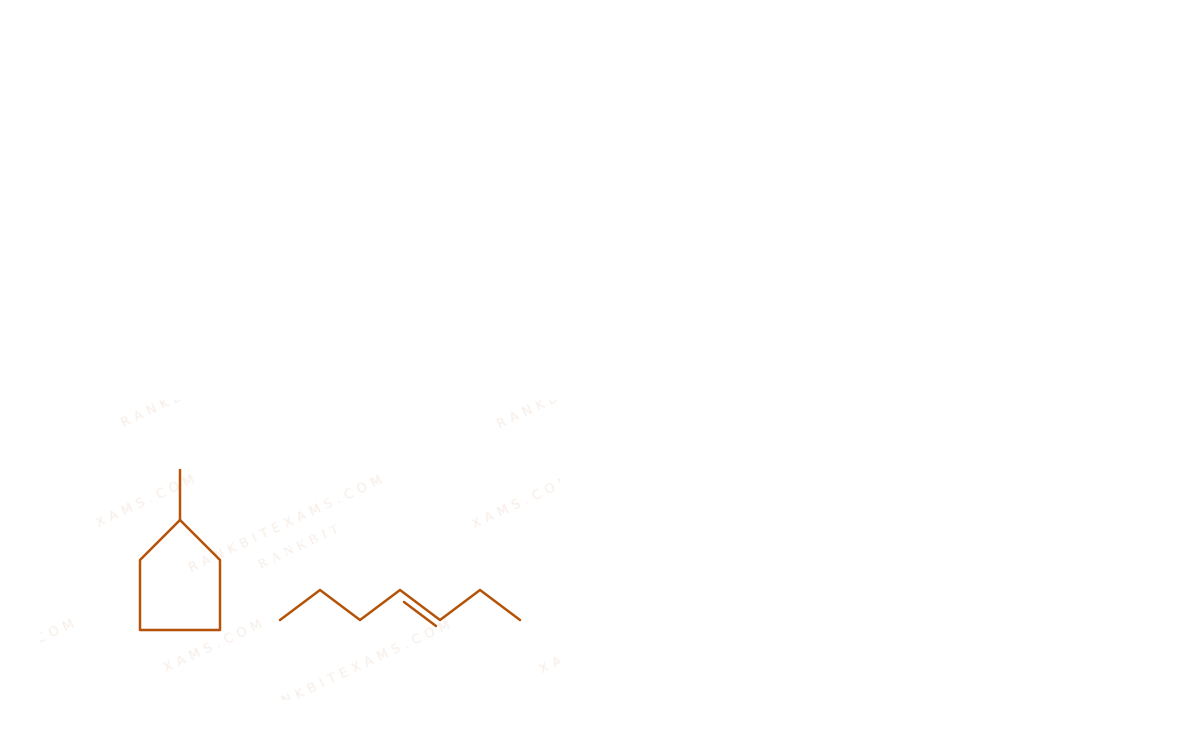
Skeletal representations for the specified organic isomers
Pattern Recognition
Always remember that 1^°$1^\circ$, 2^°$2^\circ$, and 3^°$3^\circ$ amines are classified as different functional groups in IUPAC nomenclature. Consequently, structural shifts between them with a constant carbon count represent functional group isomerism.
Chapter Mix
Class 11 Chemistry: Organic Chemistry - Some Basic Principles and Techniques
Skeletal representations for the specified organic isomers
Given below are two statements:
Statement (I): In partition chromatography, stationary phase is thin film of liquid present in the inert support.
Statement (II): In paper chromatography, the material of paper acts as a stationary phase.
In the light of the above statements, choose the correct answer from the options given below:
A. Both Statement I and Statement II are false
B. Statement I is true but Statement II is false
C. Both Statement I and Statement II are true
D. Statement I is false but Statement II is true
Solution
Core Logic
Statement I is true: In partition chromatography, the stationary phase is indeed a thin film of liquid held on the surface of an inert solid support.
Statement II is false: In paper chromatography, the water molecules trapped inside the cellulose network of the paper act as the stationary phase, not the paper material itself.
Pattern Recognition
Remember that paper chromatography is a type of partition chromatography where moisture content (water) adsorbed on the paper serves as the stationary liquid phase.
Chapter Mix
Class 11 Chemistry: Organic Chemistry - Some Basic Principles and Techniques

Q38jee_main_2025_29_jan_eveningSigma and Pi Bond Counting
Total number of sigma (sigma)$(sigma)$ and pi(pi)$pi(pi)$ bonds respectively present in hex-1-en-4-yne are:
Sigma and Pi Bond Counting diagram for Q38 - JEE Main 2025 Evening
Number of pi$pi$ bonds: 1$1$ from double bond + 2$2$ from triple bond = 3$3$pi$pi$ bonds.
Pattern Recognition
Every single bond is 1sigma$1sigma$, every double bond contains 1sigma + 1pi$1sigma + 1pi$, and every triple bond contains 1sigma + 2pi$1sigma + 2pi$.
Chapter Mix
Class 11 Chemistry: Organic Chemistry - Some Basic Principles and Techniques

Q49jee_main_2025_29_jan_eveningQuantitative Estimation of Sulphur
In the sulphur estimation, 0.20 g$0.20\text{ g}$ of a pure organic compound gave 0.40 g$0.40\text{ g}$ of barium sulphate.
The percentage of sulphur in the compound is x × 10⁻¹%$x \times 10^{-1}\%$, where x$x$ = ________.
(Molar mass: O=16$O=16$, S=32$S=32$, Ba=137 in g mol⁻¹$Ba=137\text{ in g mol}^{-1}$)
Numerical Answer.Answer: 275 to 275
Solution
Related Formula
%S = (32)/(233) × Mass of BaSO₄Mass of organic compound × 100$$%S = \frac{32}{233} \times \frac{\text{Mass of } BaSO_4}{\text{Mass of organic compound}} \times 100$$
Core Logic
Let's substitute the given values into the formula:
Mass of BaSO₄ = 0.40 g$$\text{Mass of } BaSO_4 = 0.40\text{ g}$$Mass of organic compound = 0.20 g$$\text{Mass of organic compound} = 0.20\text{ g}$$Molar mass of BaSO₄ = 137 + 32 + (4 × 16) = 233 g/mol$$\text{Molar mass of } BaSO_4 = 137 + 32 + (4 \times 16) = 233\text{ g/mol}$$%S = (32)/(233) × (0.40)/(0.20) × 100 = (32 × 2 × 100)/(233) approx 27.468%$$%S = \frac{32}{233} \times \frac{0.40}{0.20} \times 100 = \frac{32 \times 2 \times 100}{233} approx 27.468%$$
Step 1: Match with the Question Layout
Rounding to the standard value given in the official key:
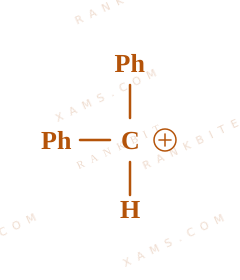
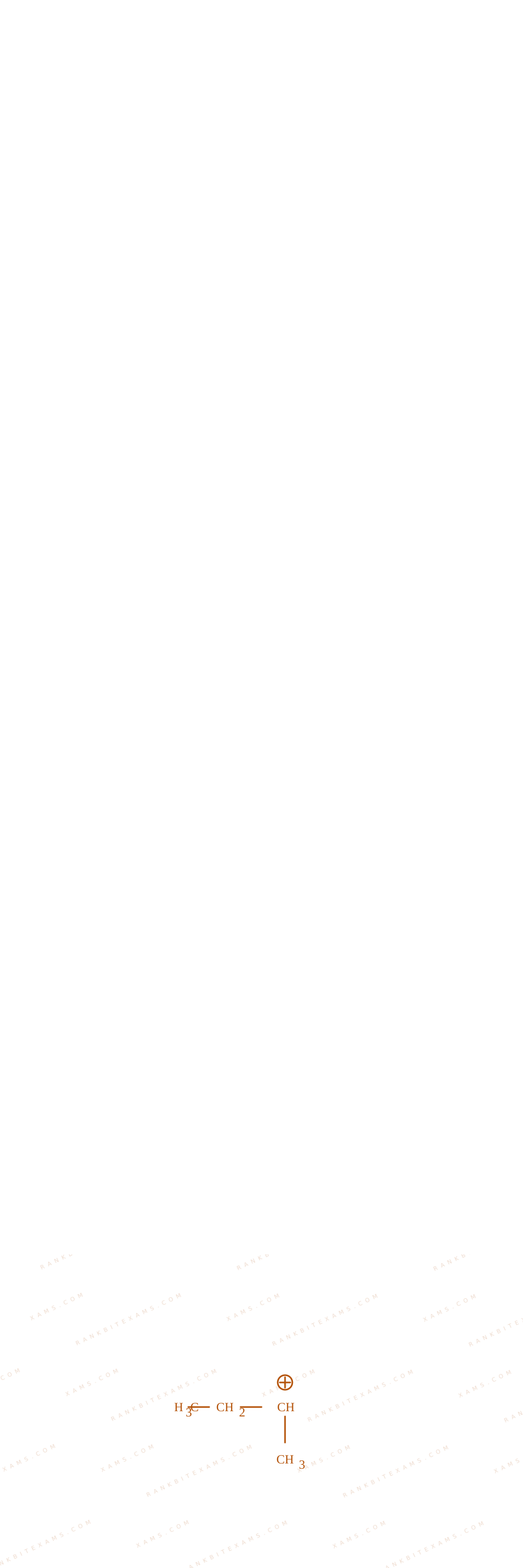
The correct order of stability of following carbocations is :
The images show different structural models labeled A, B, C, and D for evaluating stability variations.
A
The images show different structural models labeled A, B, C, and D for evaluating stability variations.
B
The images show different structural models labeled A, B, C, and D for evaluating stability variations.
C
The images show different structural models labeled A, B, C, and D for evaluating stability variations.
D
A.A > B > C > D$\mathrm{A} > \mathrm{B} > \mathrm{C} > \mathrm{D}$
B.B > C > A > D$\mathrm{B} > \mathrm{C} > \mathrm{A} > \mathrm{D}$
C.C > B > A > D$\mathrm{C} > \mathrm{B} > \mathrm{A} > \mathrm{D}$
D.C > A > B > D$\mathrm{C} > \mathrm{A} > \mathrm{B} > \mathrm{D}$
Solution
Core Logic
To evaluate carbocation stability, apply the priority rules: Aromaticity > Resonance > Hyperconjugation.
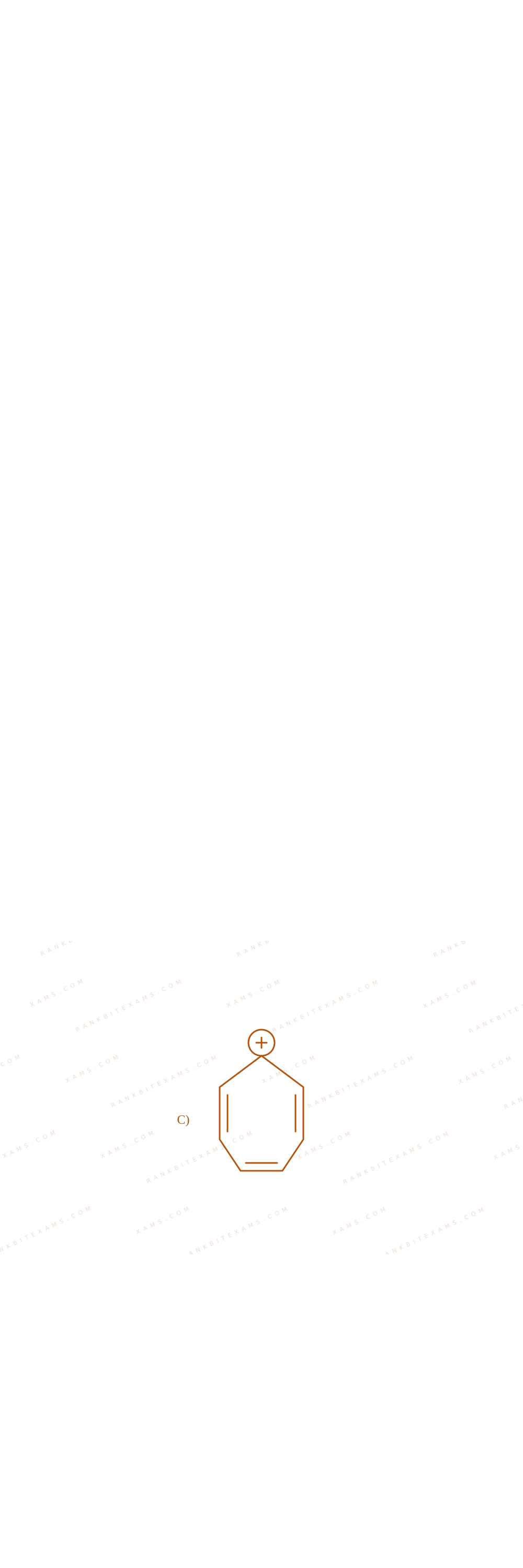
C: Represents a cyclopropenyl cation derivative which achieves full aromatic stabilization due to its planar cyclic conjugated system satisfying Huckel's rule (2π$2\pi$ electrons). This makes it the most stable.
A: Stabilized by extended resonance from multiple phenyl groups.
B: Contains fewer phenyl rings participating in active cross-conjugation relative to A.
D: Stabilized solely by simple aliphatic hyperconjugation, making it the least stable.
Visual alignment chart:
The images show different structural models labeled A, B, C, and D for evaluating stability variations.
Hence, the correct stability hierarchy is:
C > A > B > D$$\mathrm{C} > \mathrm{A} > \mathrm{B} > \mathrm{D}$$
Pattern Recognition
Sees: Mixed aromatic, benzylic, and aliphatic carbocations.
Shortcut: Isolate the cyclopropenyl system as an aromatic champion to confidently lead the sequence.
Chapter Mix
Class 11 Chemistry: Organic Chemistry - Some Basic Principles and Techniques
Q43jee_main_2025_28_jan_morningAcidity of Organic Compounds
The compounds that produce CO₂$\mathrm{CO}_{2}$ with aqueous NaHCO₃$\mathrm{NaHCO}_{3}$ solution are:
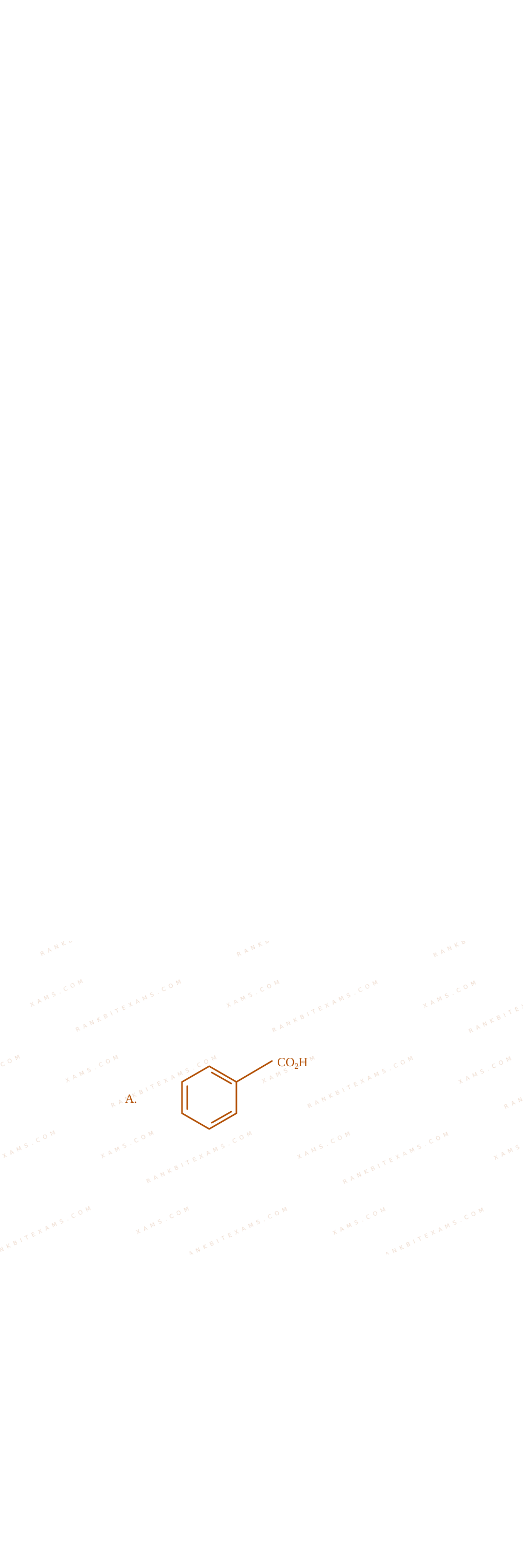
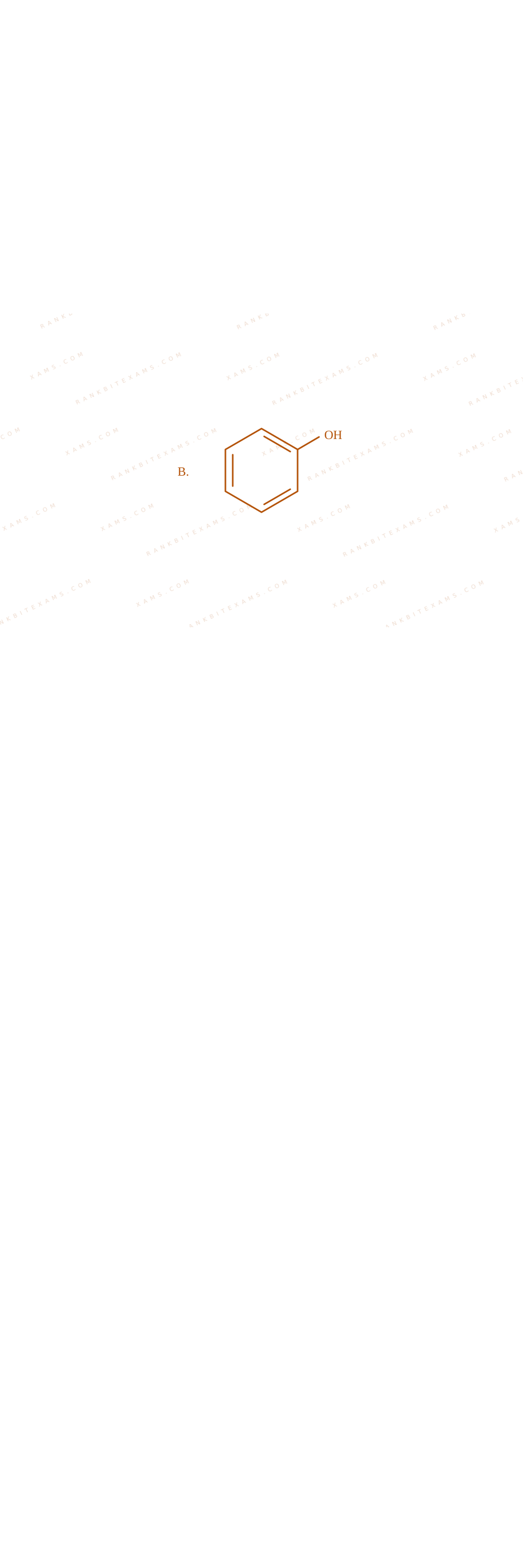
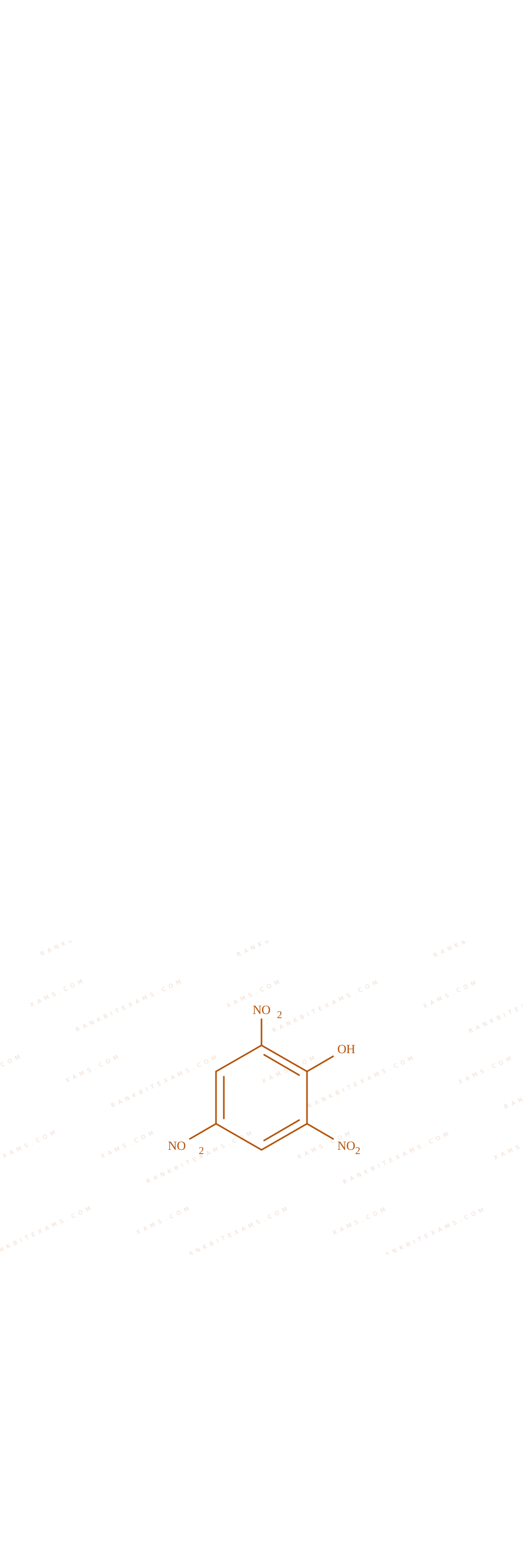
A. The prompt lists five structures labeled A through E evaluating structural acidities.
B. The prompt lists five structures labeled A through E evaluating structural acidities.
C. The prompt lists five structures labeled A through E evaluating structural acidities.
D. The prompt lists five structures labeled A through E evaluating structural acidities.
E. The prompt lists five structures labeled A through E evaluating structural acidities.
Choose the correct answer from the options given below:
A.A and C only$\text{A and C only}$
B.A, B and E only$\text{A, B and E only}$
C.A, C and D only$\text{A, C and D only}$
D.A and B only$\text{A and B only}$
Solution
Core Logic
Organic compounds react with sodium bicarbonate (NaHCO₃$\mathrm{NaHCO}_3$) to liberate CO₂$\mathrm{CO}_2$ gas if they are stronger acids than carbonic acid (H₂CO₃$\mathrm{H}_2\mathrm{CO}_3$).
Evaluating the structures:
A: Benzoic acid, which is significantly more acidic than carbonic acid.
C: Picric acid (2,4,6-trinitrophenol). Due to three strong electron-withdrawing nitro groups, its acidity exceeds typical carboxylic acids and H₂CO₃$\mathrm{H}_2\mathrm{CO}_3$.
D: Benzenesulfonic acid, a highly strong mineral-like organic acid.
B & E: Standard phenols or weakly substituted phenols, which are less acidic than carbonic acid and do not liberate CO₂$\mathrm{CO}_2$.
Therefore, structures A, C, and D give a positive test result.
Pattern Recognition
Sees: Sodium bicarbonate test for organic systems.
Shortcut: Only carboxylic acids, sulfonic acids, and highly nitrated phenols like picric acid possess sufficient proton acidity to displace CO₂$\mathrm{CO}_2$ from bicarbonate ions.
Chapter Mix
Class 11 Chemistry: Organic Chemistry - Some Basic Principles and Techniques

More Organic Chemistry - Some Basic Principles and Techniques Questions — jee_main_2025_28_jan_evening
Practice past-year questions one chapter at a time. Pick an exam → subject → chapter and get every PYQ for that topic — pulled together from all past papers — with the chapter's key formulas alongside.