JEE Main · Chemistry ↓ Falling

Haloalkanes and Haloarenes appeared 40 times across 3 years — 4.7% of Chemistry. This question is from Nucleophilic Substitution Reactions.

Year 2026 2025 2024 Total
Questions 11 16 13 40

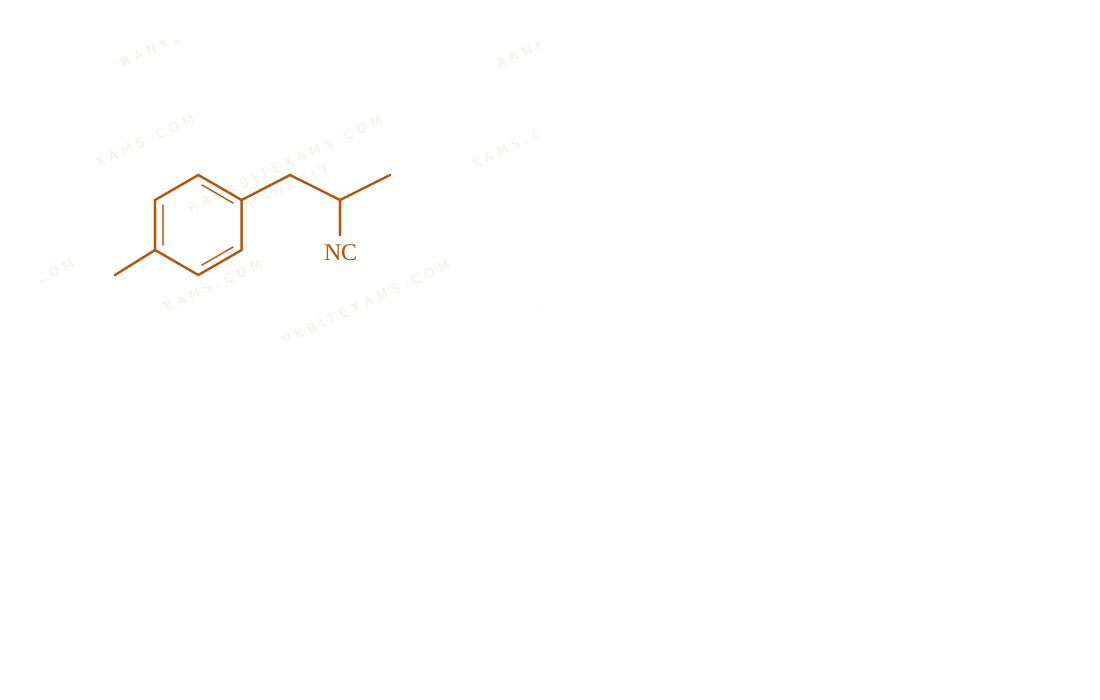
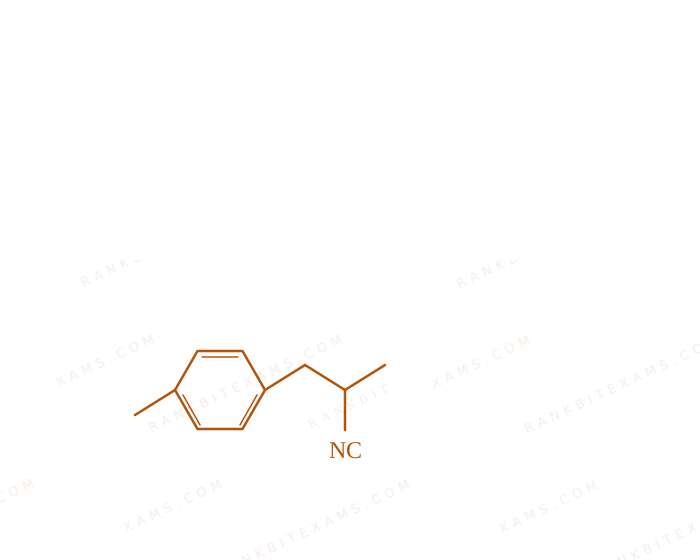
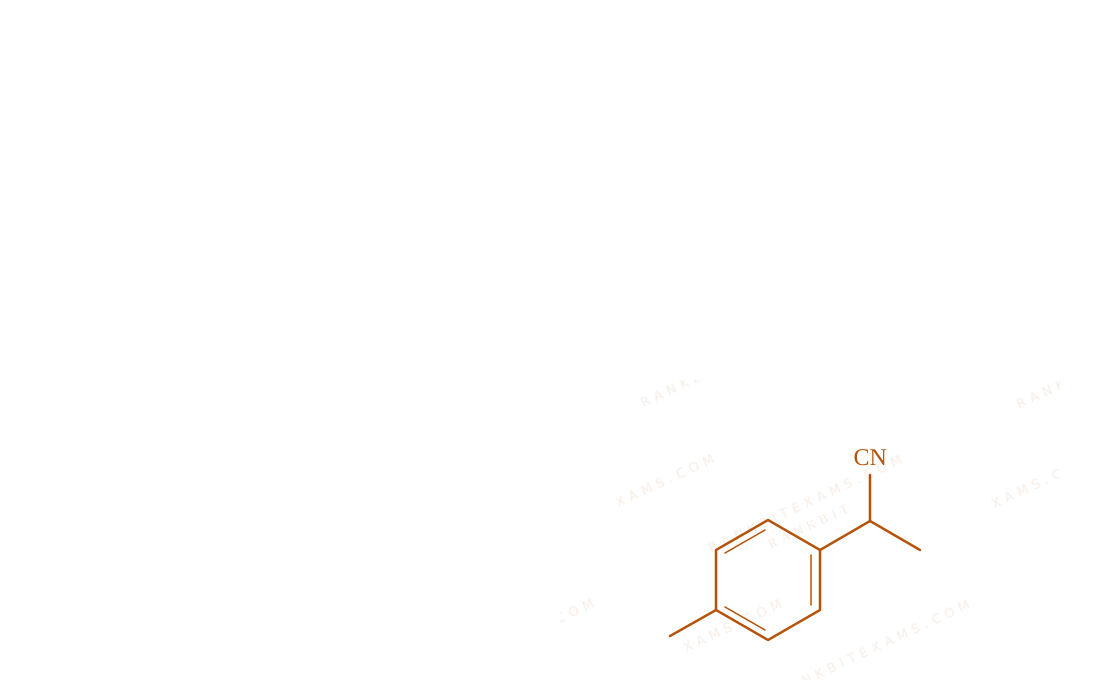
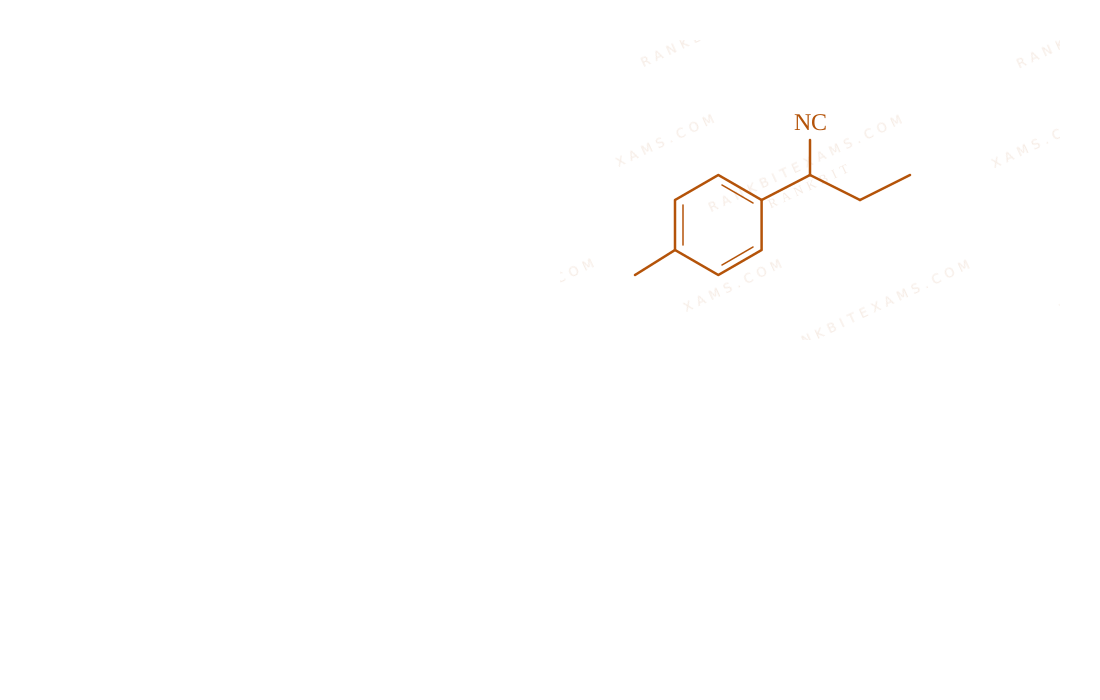
The product B formed in the following reaction sequence is :
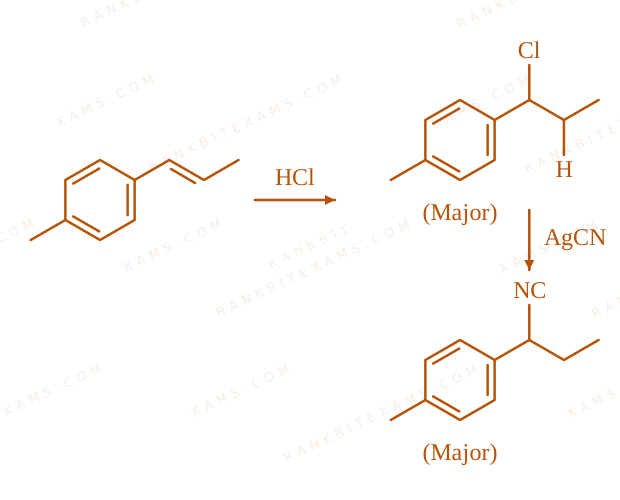
Reaction sequence diagram for Q34 - JEE Main 2025
The image outlines an addition reaction followed by substitution using silver cyanide.

Solution & Explanation

Related Formula

Markovnikov addition of HCl across an alkene:

R-CH=CH₂ + HCl arrow R-CHCl-CH₃

Nucleophilic substitution with AgCN favors coordinate carbon bonding over nitrogen, yielding covalent isocyanides (R-NC).

Core Logic

Step 1: The starting material contains a double bond. Treating it with HCl leads to addition. According to Markovnikov's rule, the chloride ion attaches to the secondary position, creating chloride intermediate [A].

Step 2: Compound [A] reacts with AgCN. Since AgCN is covalent, the lone pair on nitrogen acts as the attacking nucleophile, leading to substitution with an isocyanide group (-NC) rather than a cyanide group (-CN).

Step 1: Structural Synthesis

The intermediate [A] possesses a chlorine atom at the secondary carbon position. Substituting this chlorine with -NC provides the product corresponding to option (4).

Detailed mechanism step for reaction sequence of Q34
The image outlines an addition reaction followed by substitution using silver cyanide.

Pattern Recognition

Distinguish between ionic vs covalent cyanide sources:

  • KCN / NaCN forms alkyl nitriles (R-CN)
  • AgCN forms alkyl isocyanides (R-NC)
Chapter Mix

Class 12 Chemistry: Haloalkanes and Haloarenes

Reference Study Guides

More Haloalkanes and Haloarenes Previous-Year Questions — Page 4

Q jee_main_2025_08_april_evening Preparation and Reactions of Styrene derivatives
Choose the correct set of reagents for the following conversion: Ethyl benzene 4-bromostyrene {{Q_IMG1}}
Conversion scheme of ethylbenzene to 4-bromostyrene for Q29
The figure illustrates the multi-step conversion starting from ethylbenzene to yield a brominated styrene derivative.
Conversion scheme of ethylbenzene to 4-bromostyrene for Q29
The figure illustrates the multi-step conversion starting from ethylbenzene to yield a brominated styrene derivative.
  • A. Br₂/Fe; Cl₂, Δ; alc. KOH
  • B. Cl₂/Fe; Br₂/anhy. AlCl₃; aq. KOH
  • C. Br₂/anhy. AlCl₃; Cl₂, Δ; aq. KOH
  • D. Cl₂/anhy. AlCl₃; Br₂/Fe; alc. KOH

Solution

Core Logic

To synthesize 4-bromostyrene starting from ethyl benzene, we must carry out ring functionalization prior to developing the side-chain double bond:

  • Ring Bromination: Treatment of ethylbenzene with Br₂ in the presence of Fe (or FeBr₃) acts via electrophilic aromatic substitution. The ethyl group is an ortho/para director, yielding 1-bromo-4-ethylbenzene as the major product owing to steric mitigation.
  • Side-Chain Halogenation: Free radical substitution with Cl₂ under thermal conditions (Δ) or UV light specifically chlorinates the benzylic position because the benzylic radical is exceptionally stable via resonance.
  • Elimination: Heating with alcoholic KOH drives an E2 elimination of the benzylic chloride, cleanly synthesizing the terminal alkene linkage of the styrene system.
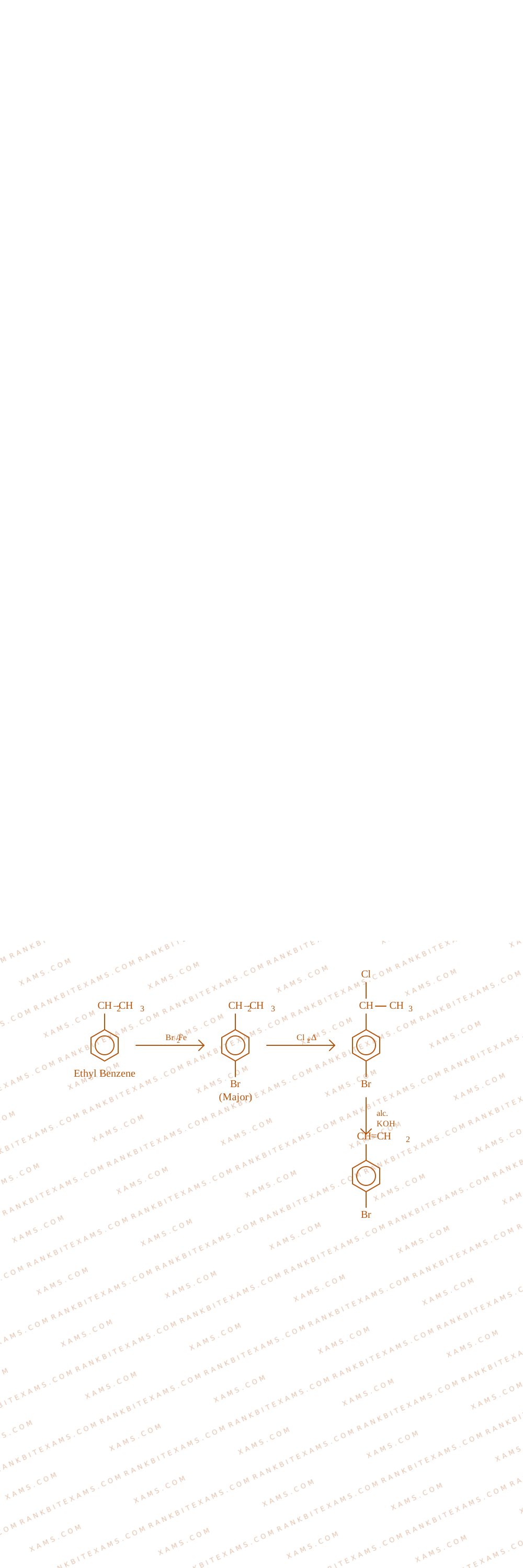
    Detailed mechanism of 4-bromostyrene synthesis from ethylbenzene
    The figure illustrates the multi-step conversion starting from ethylbenzene to yield a brominated styrene derivative.
Pattern Recognition

If you perform side-chain halogenation/alkene generation first, the ring substitution later would lack para-selectivity control and risk reacting across the alkene path. Hence, ring substitution MUST precede double bond creation.

Chapter Mix

Class 12 Chemistry: Haloalkanes and Haloarenes Class 11 Chemistry: Hydrocarbons

Q30 jee_main_2025_29_jan_evening Nucleophilic Substitution Mechanisms
Which among the following halides will generate the most stable carbocation in Nucleophilic substitution reaction?
  • A. Allylic halide option (1)
  • B. Secondary halide option (2)
  • C. Secondary benzylic halide option (3)
  • D. Triphenylmethyl halide option (4)

Solution

Core Logic

The mechanism of SN1 substitution proceeds via carbocation intermediate formation. Option (4) gives a triphenylmethyl carbocation (Ph₃C⁺), which is exceptionally stable due to extensive delocalization of positive charge across three phenyl rings (resonance stabilization via 9 canonical structures).

Nucleophilic Substitution Mechanisms diagram for Q30 - JEE Main 2025 Evening

Step 1: Stability Comparison

Stability sequence:

Ph₃C⁺ > benzylic > allylic > alkyl carbocations
Pattern Recognition

Look for maximum phenyl groups attached directly to the carbon bearing the leaving group to maximize resonance contribution.

Chapter Mix

Class 12 Chemistry: Haloalkanes and Haloarenes

Q29 jee_main_2025_28_jan_morning Alkaline Hydrolysis and NGP
Given below are two statements : Statement I: Et₂N-CH₂-CH₂-Cl will undergo alkaline hydrolysis at a faster rate than Et₂CH-CH₂-Cl. Statement II: In Et₂N-CH₂-CH₂-Cl, intramolecular substitution takes place first by involving lone pair of electrons on nitrogen. In the light of the above statements, choose the most appropriate answer from the options given below:
  • A. Both Statement I and Statement II are incorrect
  • B. Statement I is incorrect but statement II is correct
  • C. Both Statement I and Statement II are correct
  • D. Statement I is correct but Statement II is incorrect

Solution

Core Logic

Statement I is correct because the nitrogen atom contains a lone pair situated at the β-position relative to the chlorine atom, promoting Neighboring Group Participation (NGP).

Statement II is correct because the lone pair on nitrogen attacks internally to kick out the chloride ion, forming a cyclic aziridinium ion intermediate. This quick intramolecular cyclization leads to an exceptionally rapid hydrolysis rate compared to standard aliphatic substitution.

Pattern Recognition

Sees: Nitrogen with lone pair β to a leaving group. Shortcut: NGP (Neighboring Group Participation) accelerates substitution dramatically via intramolecular assistance.

Chapter Mix

Class 12 Chemistry: Haloalkanes and Haloarenes

Q39 jee_main_2025_28_jan_morning Ambident Nucleophiles Reactions
The products A and B in the following reactions, respectively are A A g - N O _ 2 C H _ 3 - C H _ 2 - C H _ 2 - B r A g C N B
  • A. CH₃ - CH₂ - CH₂ - ONO, CH₃ - CH₂ - CH₂ - NC
  • B. CH₃-CH₂-CH₂-ONO, CH₃-CH₂-CH₂-CN
  • C. CH₃ - CH₂ - CH₂ - NO₂, CH₃ - CH₂ - CH₂ - CN
  • D. CH₃ - CH₂ - CH₂ - NO₂, CH₃ - CH₂ - CH₂ - NC

Solution

Core Logic

Both silver reagents exhibit significantly covalent bond characters:

  • Reaction with AgNO₂: The bond between silver and oxygen is covalent, making the lone pair on the nitrogen atom the primary nucleophilic site. Attack via nitrogen yields a nitroalkane product:
A = CH₃-CH₂-CH₂-NO₂
  • Reaction with AgCN: The covalent Ag-C bond directs the nucleophilic attack to proceed through the lone pair on nitrogen, yielding an isocyanide compound:
B = CH₃-CH₂-CH₂-NC

Hence, option (4) represents the correct combination.

Pattern Recognition

Sees: Alkyl halide reacting with covalent silver salts of ambident anions. Shortcut: Silver reagents (AgCN or AgNO₂) drive bond formatting via the nitrogen center, producing isocyanides and nitroalkanes respectively.

Chapter Mix

Class 12 Chemistry: Haloalkanes and Haloarenes

Q jee_main_2025_04_april_evening Substitution versus Elimination
Given below are two statements : Statement (I): Alcohols are formed when alkyl chlorides are treated with aqueous potassium hydroxide by elimination reaction. Statement (II) : In alcoholic potassium hydroxide, alkyl chlorides form alkenes by abstracting the hydrogen from the β-carbon. In the light of the above statements, choose the most appropriate answer from the options given below:
  • A. Both Statement I and Statement II are incorrect
  • B. Statement I is incorrect but Statement II is correct
  • C. Statement I is correct but Statement II is incorrect
  • D. Both Statement I and Statement II are correct.

Solution

Related Formula
R-Cl + KOH(aq) arrow R-OH + KCl (SN Nucleophilic Substitution) R-CH₂-CH₂-Cl + KOH(alc) arrow R-CH=CH₂ + KCl + H₂O (E2 Elimination)
Core Logic
  • Statement I is incorrect: Treatment of alkyl chlorides with aqueous KOH yields alcohols via a nucleophilic substitution (SN) reaction, not an elimination reaction.
  • Statement II is correct: Alcoholic KOH acts as a strong base (R-O^- ions present), which preferentially abstracts a proton from the β-carbon atom, leading to dehydrohalogenation to form an alkene via an elimination pathway.
Pattern Recognition

Remember: Aqueous medium = substitution (nucleophilic attack dominates due to highly hydrated, less basic hydroxide ions). Alcoholic medium = elimination (alkoxide acts as a bulky strong base to capture β-hydrogens).

Chapter Mix

Class 12 Chemistry: Haloalkanes and Haloarenes

More Haloalkanes and Haloarenes Questions — jee_main_2025_28_jan_evening

Practice all Haloalkanes and Haloarenes previous-year questions →

Rankbit System
JEE Physics: Waves (+15.5%) | Electrostatics: Concentric Shells (-29.7%) | Modern Physics: Photoelectric Clones (+34.2%) | Mathematics: Definite Integrals (+18.1%) | Chemistry: Coordination Splitting (-11.4%) | JEE Physics: Waves (+15.5%) | Electrostatics: Concentric Shells (-29.7%) | Modern Physics: Photoelectric Clones (+34.2%) | Mathematics: Definite Integrals (+18.1%) | Chemistry: Coordination Splitting (-11.4%)
