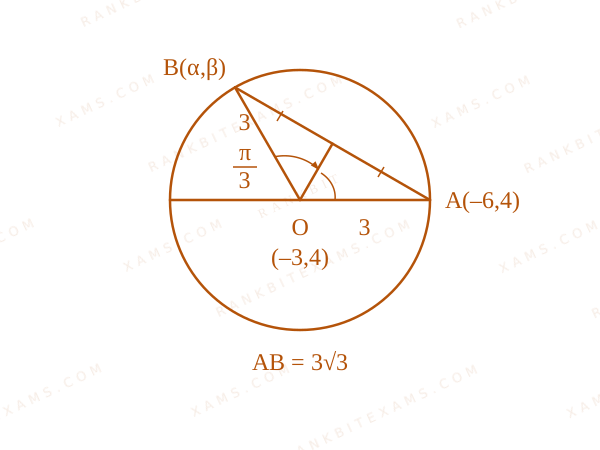
Let circle C$C$ be the image of x^2 + y^2 - 2x + 4y - 4 = 0$x^{2} + y^{2} - 2x + 4y - 4 = 0$ in the line 2x - 3y + 5 = 0$2x - 3y + 5 = 0$ and A$A$ be the point on C$C$ such that OA$OA$ is \parallel to the x-axis and A$A$ lies on the \right hand side of the centre O$O$ of C$C$. If B(alpha,beta)$B(\alpha,\beta)$, with beta < 4$\beta < 4$, lies on C$C$ such that the length of the arc AB$AB$ is (1/6)^textth$(1/6)^{\text{th}}$ of the perimeter of C$C$, then beta - sqrt3alpha$\beta - \sqrt{3}\alpha$ is equal to :
A.3$3$
B.3 + sqrt3$3 + \sqrt{3}$
C.4 - sqrt3$4 - \sqrt{3}$
D.4$4$
Solution & Explanation
### Related Formula
The coordinates for the reflection image of a point (x_1, y_1)$(x_1, y_1)$ across a standard line ax + by + c = 0$ax + by + c = 0$ are determined using:
fracx - x_1a = fracy - y_1b = frac-2(ax_1 + by_1 + c)a^2 + b^2$$\frac{x - x_1}{a} = \frac{y - y_1}{b} = \frac{-2(ax_1 + by_1 + c)}{a^2 + b^2}$$
### Core Logic
Find the center and radius of the original given circle:
x^2 + y^2 - 2x + 4y - 4 = 0 implies textCenter = (1, -2), \, r = sqrt1^2 + (-2)^2 - (-4) = 3$$x^2 + y^2 - 2x + 4y - 4 = 0 \implies \text{Center} = (1, -2), \, r = \sqrt{1^2 + (-2)^2 - (-4)} = 3$$Transformation and Reflection of Circles
Reflect the center point (1, -2)$(1, -2)$ across the line mirror 2x - 3y + 5 = 0$2x - 3y + 5 = 0$:
fracx - 12 = fracy + 2-3 = frac-2(2(1) - 3(-2) + 5)2^2 + (-3)^2 = frac-2(2 + 6 + 5)13 = -2$$\frac{x - 1}{2} = \frac{y + 2}{-3} = \frac{-2(2(1) - 3(-2) + 5)}{2^2 + (-3)^2} = \frac{-2(2 + 6 + 5)}{13} = -2$$x - 1 = -4 implies x = -3$$x - 1 = -4 \implies x = -3$$y + 2 = 6 implies y = 4$$y + 2 = 6 \implies y = 4$$
Thus, the center O$O$ of the reflected circle C$C$ is (-3, 4)$(-3, 4)$, and its radius is preserved at r = 3$r = 3$.
### Step 1: Locate Point A
We are given that OA$OA$ is \parallel to the x-axis, meaning its y-coordinate matches the center. Since A$A$ lies to the \right of the center O(-3, 4)$O(-3, 4)$:
A = (-3 + r, \, 4) = (-3 + 3, \, 4) = (0, 4)$$A = (-3 + r, \, 4) = (-3 + 3, \, 4) = (0, 4)$$
### Step 2: Determine Angular Position of Point B
The arc length AB$AB$ is given as frac16$\frac{1}{6}$ of the total perimeter:
textArc length = rtheta = frac16(2pi r) implies theta = fracpi3 = 60^circ$$\text{Arc length} = r\theta = \frac{1}{6}(2\pi r) \implies \theta = \frac{\pi}{3} = 60^\circ$$Transformation and Reflection of Circles
Using parametric coordinates relative to center O(-3, 4)$O(-3, 4)$ with radius r = 3$r = 3$:
alpha = -3 + 3costheta, quad beta = 4 + 3sintheta$$\alpha = -3 + 3\cos\theta, \quad \beta = 4 + 3\sin\theta$$
Since beta < 4$\beta < 4$, the \angle theta$\theta$ must point downwards into the negative quadrant relative to A$A$, meaning theta = -60^circ = -fracpi3$\theta = -60^\circ = -\frac{\pi}{3}$:
alpha = -3 + 3cosleft(-fracpi3right) = -3 + 3left(frac12
ight) = -frac32$$\alpha = -3 + 3\cos\left(-\frac{\pi}{3}\right) = -3 + 3\left(\frac{1}{2}
ight) = -\frac{3}{2}$$beta = 4 + 3sinleft(-fracpi3right) = 4 - frac3sqrt32$$\beta = 4 + 3\sin\left(-\frac{\pi}{3}\right) = 4 - \frac{3\sqrt{3}}{2}$$
### Step 3: Evaluate Final Algebraic Value
Substitute the determined coordinates into the target expression:
beta - sqrt3alpha = left(4 - frac3sqrt32right) - sqrt3left(-frac32
ight)$$\beta - \sqrt{3}\alpha = \left(4 - \frac{3\sqrt{3}}{2}\right) - \sqrt{3}\left(-\frac{3}{2}
ight)$$beta - sqrt3alpha = 4 - frac3sqrt32 + frac3sqrt32 = 4$$\beta - \sqrt{3}\alpha = 4 - \frac{3\sqrt{3}}{2} + \frac{3\sqrt{3}}{2} = 4$$
### Pattern Recognition
Whenever parametric configurations on a circle involve radical coordinate multipliers like beta - sqrt3alpha$\beta - \sqrt{3}\alpha$, using angular vectors centered at the origin of the circle avoids setting up and solving long distance equations.
### Evaluation Rubric / Model Answer
null
### Chapter Mix
Class 11 Mathematics: Circles
Keywords:#circle reflection line image#parametric circle coordinates#JEE Main 2025 Morning Q65#arc length angular sector
More Circles Previous-Year Questions — Page 3
Q4jee_main_2024_31_jan_eveningEquation of Tangent and Normal
Let a variable line passing through the centre of the circle x^2 + y^2 - 16x - 4y = 0$x^2 + y^2 - 16x - 4y = 0$, meet the positive co-ordinate axes at the point A$A$ and B$B$. Then the minimum value of OA + OB$OA + OB$, where O$O$ is the origin, is equal to
A.12$12$
B.18$18$
C.20$20$
D.24$24$
Solution
### Related Formula
textIntercept form of line: fracxa + fracyb = 1$$\text{Intercept form of line: } \frac{x}{a} + \frac{y}{b} = 1$$
### Core Logic
Circle x^2 + y^2 - 16x - 4y = 0$x^2 + y^2 - 16x - 4y = 0$ has its centre at (8, 2)$(8, 2)$.
Let the line passing through (8, 2)$(8, 2)$ have slope m$m$. Its equation is:
y - 2 = m(x - 8)$$y - 2 = m(x - 8)$$
x-intercept (A$A$): set y=0 implies -2 = m(x-8) implies x = 8 - frac2m$y=0 \implies -2 = m(x-8) \implies x = 8 - \frac{2}{m}$.
y-intercept (B$B$): set x=0 implies y = 2 - 8m$x=0 \implies y = 2 - 8m$.
Sum of intercepts OA + OB = (8 - frac2m) + (2 - 8m) = 10 - frac2m - 8m$OA + OB = (8 - \frac{2}{m}) + (2 - 8m) = 10 - \frac{2}{m} - 8m$.
To minimize, let f(m) = 10 - frac2m - 8m$f(m) = 10 - \frac{2}{m} - 8m$.
f'(m) = frac2m^2 - 8 = 0 implies m^2 = frac14$$f'(m) = \frac{2}{m^2} - 8 = 0 \implies m^2 = \frac{1}{4}$$
Since the line meets the positive coordinate axes, intercepts must be positive, which requires m < 0$m < 0$. Thus m = -1/2$m = -1/2$.
Substitute m = -1/2$m = -1/2$:
OA + OB = 10 - frac2-1/2 - 8(-1/2) = 10 + 4 + 4 = 18$$OA + OB = 10 - \frac{2}{-1/2} - 8(-1/2) = 10 + 4 + 4 = 18$$
### Pattern Recognition
AM-GM can also be applied: 8a + 2b = ab implies 1 = frac8a + frac2b$8a + 2b = ab \implies 1 = \frac{8}{a} + \frac{2}{b}$. To minimize a+b$a+b$, use Cauchy-Schwarz or standard differentiation. Differentiation directly yields intercept minima.
### Evaluation Rubric / Model Answer
null
### Chapter Mix
Class 11 Maths: Circles
Q4jee_main_2024_31_jan_morningIntersection and Common Chords
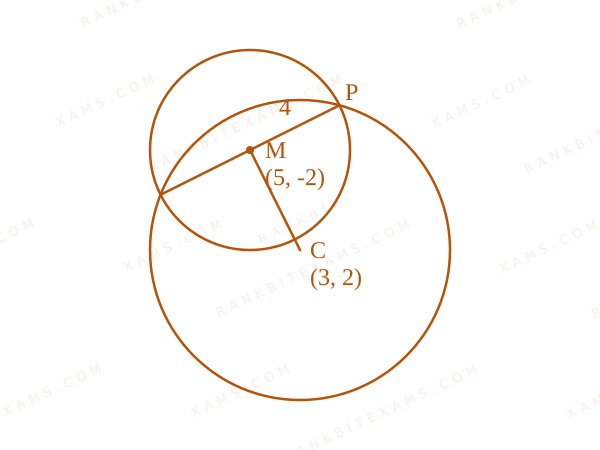
If one of the diameters of the circle x^2 + y^2 - 10x + 4y + 13 = 0$x^2 + y^2 - 10x + 4y + 13 = 0$ is a chord of another circle C, whose center is the point of intersection of the lines 2x + 3y = 12$2x + 3y = 12$ and 3x - 2y = 5$3x - 2y = 5$, then the radius of the circle C is
A.sqrt20$\sqrt{20}$
B.4$4$
C.6$6$
D.3sqrt2$3\sqrt{2}$
Solution
### Core Logic
Find the center of circle C by solving 2x + 3y = 12$2x + 3y = 12$ and 3x - 2y = 5$3x - 2y = 5$.
Multiplying and subtracting yields 13x = 39 implies x = 3, y = 2$13x = 39 \implies x = 3, y = 2$.
Center of C is (3, 2)$(3, 2)$.
### Step 1: Properties of Given Circle
Given circle: x^2 + y^2 - 10x + 4y + 13 = 0$x^2 + y^2 - 10x + 4y + 13 = 0$.
Center M(5, -2)$M(5, -2)$.
Radius r = sqrt25 + 4 - 13 = 4$r = \sqrt{25 + 4 - 13} = 4$.
Intersection and Common Chords diagram for Q4 - JEE Main 2024 Morning
### Step 2: Radius Calculation
The diameter of the first circle is a chord of circle C. Therefore, the distance between the two centers forms a right-angled triangle with the radius of C (CP$CP$) and the radius of the first circle (r = 4$r = 4$).
Distance CM = sqrt(5-3)^2 + (-2-2)^2 = sqrt4 + 16 = sqrt20$CM = \sqrt{(5-3)^2 + (-2-2)^2} = \sqrt{4 + 16} = \sqrt{20}$.
Radius of circle C is CP = sqrtCM^2 + r^2 = sqrt20 + 16 = sqrt36 = 6$CP = \sqrt{CM^2 + r^2} = \sqrt{20 + 16} = \sqrt{36} = 6$.
### Pattern Recognition
When a diameter of circle 1 is a chord of circle 2, the triangle formed by the centers and the point of intersection is a right-angled triangle at the center of circle 1.
### Evaluation Rubric / Model Answer
null
### Chapter Mix
Class 11 Maths: Circles
Class 11 Maths: Straight Lines
More Circles Questions — jee_main_2025_24_jan_morning
We Map Every Repeating Question in Competitive Exams.
Say goodbye to generic mock test fatigue. RankBit uses smart analysis to group past exam questions into their foundational Repeating Question Types. Find chapter weightage, track repeating questions, and score higher with targeted practice.
Select Your Target Exam
Choose an exam track below to find formulas per chapter and patterns.
Syncing Exam Intelligence
Mapping formulas and patterns across all tracks…
PATH A — FULL LENGTH PRACTICE
Full Mock Test Hub
Simulate real NTA exam conditions with fully tracked mocks. Time yourself against past papers.
Practice past-year questions one chapter at a time. Pick an exam → subject → chapter and get every PYQ for that topic — pulled together from all past papers — with the chapter's key formulas alongside.