Given below are two statements I and II. Statement I: Dumas method is used for estimation of "Nitrogen" in an organic compound. Statement II: Dumas method involves the formation of ammonium sulphate by heating the organic compound with conc mathrmH_2mathrmSO_4 In the light of the above statements, choose the correct answer from the options given below

Solution & Explanation

### Core Logic Statement I is fully accurate: Dumas method is standardly applied for estimating elemental nitrogen across structural compounds. Statement II is incorrect: The reaction leading to ammonium sulphate generation by intense thermal heating alongside concentrated mathrmH_2mathrmSO_4 describes the **Kjeldahl method**, not the Dumas strategy. The Dumas process instead relies on burning carbonaceous compounds explicitly with copper oxide to convert nitrogen cleanly into free gas (N_2). ### Pattern Recognition Dumas method collects element gas N_2 via volumetric analysis; Kjeldahl maps digestions via standard (mathrmNH_4)_2mathrmSO_4 pathways. ### Evaluation Rubric / Model Answer null ### Chapter Mix Class 11 Chemistry: Organic Chemistry - Some Basic Principles and Techniques
Reference Study Guides

More Organic Chemistry - Some Basic Principles and Techniques Previous-Year Questions — Page 10

Q31 jee_main_2025_28_jan_evening Purification of Organic Compounds
The purification method based on the following physical transformation is : textSolid xrightarrow[(textX)]textHeat textVapour xrightarrow[(textX)]textCool textSolid
  • A. Sublimation
  • B. Distillation
  • C. Crystallization
  • D. Extraction

Solution

### Related Formula Direct phase transition without passing through an intermediate liquid phase defines sublimation: textSolid rightleftharpoons textVapour ### Core Logic The schematic diagram represents a solid turning directly into vapor on heating, which then reverts back to a solid phase upon cooling. This distinct behavior isolates sublimable solids from non-sublimable impurities. ### Step 1: Identification This transformation perfectly defines the laboratory purification process known as **Sublimation**. ### Pattern Recognition Look for the skipping of the liquid state entirely: Solid rightarrow Vapour rightarrow Solid. Common examples include camphor, naphthalene, benzoic acid, and iodine. ### Evaluation Rubric / Model Answer null ### Chapter Mix Class 11 Chemistry: Organic Chemistry - Some Basic Principles and Techniques
Q44 jee_main_2025_28_jan_evening Isomerism
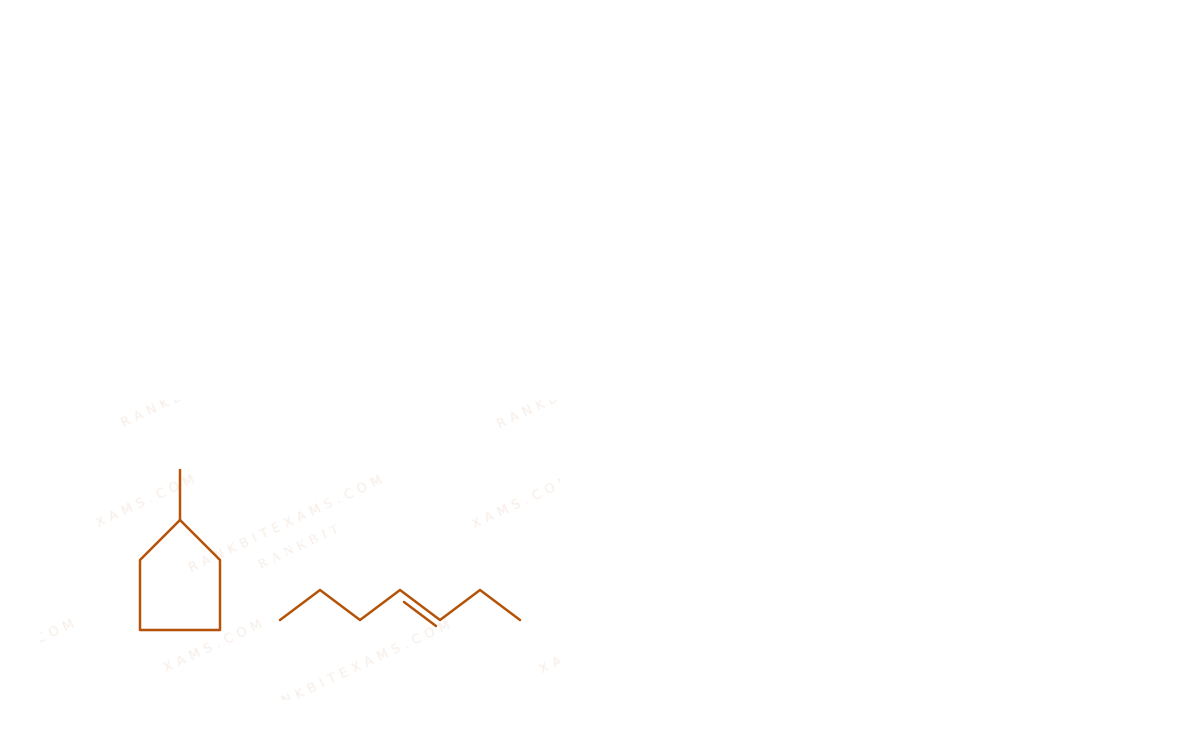
Given below are two statements: Statement (I): Oxacyclobutane and prop-2-en-1-ol are isomeric compounds. Statement (II): Propan-1-amine and N-methylethanamine are functional group isomers. In the light of the above statements, choose the correct answer from the options given below :
  • A. Both Statement I and Statement II are false
  • B. Both Statement I and Statement II are true
  • C. Statement I is true but Statement II is false
  • D. Statement I is false but Statement II is true

Solution

### Related Formula Isomers share an identical molecular formula but differ in structural arrangement or functional groups: textSame M_f neq textSame structural layout ### Core Logic Evaluating the structural parameters: - **Statement I**: Oxacyclobutane (a cyclic ether) and prop-2-en-1-ol (an unsaturated alcohol) both possess the molecular formula C_3H_6O. They are functional/ring-chain isomers, so Statement I is true. - **Statement II**: Propan-1-amine (1^circ amine) and N-methylethanamine (2^circ amine) both share the molecular formula C_3H_9N. Because primary, secondary, and tertiary amines contain different functional groups, they act as functional group isomers. Thus, Statement II is true. ### Step 1: Conclusion Match Since both structural statements are valid, both Statement I and Statement II are true.
Skeletal representations for the specified organic isomers
### Pattern Recognition Always remember that 1^circ, 2^circ, and 3^circ amines are classified as *different functional groups* in IUPAC nomenclature. Consequently, structural shifts between them with a constant carbon count represent functional group isomerism. ### Evaluation Rubric / Model Answer null ### Chapter Mix Class 11 Chemistry: Organic Chemistry - Some Basic Principles and Techniques
Q jee_main_2025_29_jan_morning Nucleophiles and Electrophiles
Total number of nucleophiles from the following is :- mathrm N H _ 3, mathrm P h S H, (mathrm H _ 3 mathrm C) _ 2 mathrm S, mathrm H _ 2 mathrm C = mathrm C H _ 2, stackrel ominus mathrm O mathrm H, mathrm H _ 3 mathrm O ^ oplus, (mathrm C H _ 3) _ 2 mathrm C O, > = mathrm N C H _ 3
  • A. 5
  • B. 4
  • C. 7
  • D. 6

Solution

### Related Formula Nucleophiles are electron-rich species containing lone pairs of electrons or pi-bonds that can donate an electron pair to an electrophilic center. ### Core Logic Let us examine each species: * mathrmNH_3: Contains a lone pair on nitrogen rightarrow Nucleophile * mathrmPhSH: Contains lone pairs on sulfur rightarrow Nucleophile * (mathrmH_3mathrmC)_2mathrmS: Contains lone pairs on sulfur rightarrow Nucleophile * mathrmH_2mathrmC=mathrmCH_2: Contains a nucleophilic pi-bond rightarrow Nucleophile * stackrelominusmathrmOmathrmH: Negatively charged with lone pairs rightarrow Nucleophile * mathrmH_3mathrmO^oplus: Electron deficient, positively charged oxygen cannot donate electrons rightarrow Electrophile * (mathrmCH_3)_2mathrmCO: Carbonyl carbon is electrophilic * >=mathrmNCH_3: Imine carbon is electrophilic Thus, the total number of nucleophiles is 5. ### Pattern Recognition Neutral molecules with lone pairs (N, S) or alkenes/alkynes with available pi-electrons operate as good nucleophiles, along with full anions. ### Evaluation Rubric / Model Answer null ### Chapter Mix Class 11 Chemistry: Organic Chemistry - Some Basic Principles and Techniques
Q jee_main_2025_29_jan_morning IUPAC Nomenclature of Organic Compounds
Match List-I with List-II. Choose the correct answer from the options given below:
IUPAC Nomenclature of Organic Compounds
  • A. (A)-(II), (B)-(III), (C)-(IV), (D)-(I)
  • B. (A)-(III), (B)-(II), (C)-(I), (D)-(IV)
  • C. (A)-(II), (B)-(III), (C)-(IV), (D)-(I)
  • D. (A)-(II), (B)-(III), (C)-(I), (D)-(IV)

Solution

### 1. RELATED FORMULA IUPAC Rules select the longest principal carbon chain and number it to give substituents the lowest possible locants. ### 2. EXECUTION **CORE LOGIC** Let's systematic decode each name : * (A) Longest chain contains 7 carbons (heptane) with an ethyl group at position 3 and a methyl group at position 5 rightarrow 3-Ethyl-5-methylheptane (II) . * (B) C expanded yields a 7 carbon main chain with two methyl groups at carbon-4 rightarrow 4,4-Dimethylheptane (III) . * (C) 5-carbon diene numbered from the left double bond side rightarrow 2-Methyl-1,3-pentadiene (IV) . * (D) 5-carbon alkene starting from the double bond end rightarrow 4-Methylpent-1-ene (I) . Therefore, matching sequence: (A)-(II), (B)-(III), (C)-(IV), (D)-(I). ### 3. PATTERN RECOGNITION Expanding compressed groupings such as mathrm(C_3H_7)_2 prevents errors regarding parent chain carbon counts. ### 4. EVALUATION RUBRIC / MODEL ANSWER null ### 5. CHAPTER MIX Class 11 Chemistry: Organic Chemistry - Some Basic Principles and Techniques

More Organic Chemistry - Some Basic Principles and Techniques Questions — jee_main_2025_24_jan_morning

Practice all Organic Chemistry - Some Basic Principles and Techniques previous-year questions →

Rankbit System
JEE Physics: Waves (+15.5%) | Electrostatics: Concentric Shells (-29.7%) | Modern Physics: Photoelectric Clones (+34.2%) | Mathematics: Definite Integrals (+18.1%) | Chemistry: Coordination Splitting (-11.4%) | JEE Physics: Waves (+15.5%) | Electrostatics: Concentric Shells (-29.7%) | Modern Physics: Photoelectric Clones (+34.2%) | Mathematics: Definite Integrals (+18.1%) | Chemistry: Coordination Splitting (-11.4%)
