JEE Main · Chemistry ↓ Falling

Haloalkanes and Haloarenes appeared 40 times across 3 years — 4.7% of Chemistry. This question is from Nucleophilic Substitution Reactions.

Year 2026 2025 2024 Total
Questions 11 16 13 40

Given below are two statements : Statement-I: The conversion proceeds well in the less polar medium. CH₃-CH₂-CH₂-CH₂-Cl HO^- CH₃-CH₂-CH₂-CH₂-OH + Cl^- Statement-II: The conversion proceeds well in the more polar medium. CH₃-CH₂-CH₂-CH₂-Cl R₃N [CH₃-CH₂-CH₂-CH₂-NR₃]⁺Cl^-

Solution & Explanation

Core Logic

Analyzing the solvent effects on reaction kinetics:

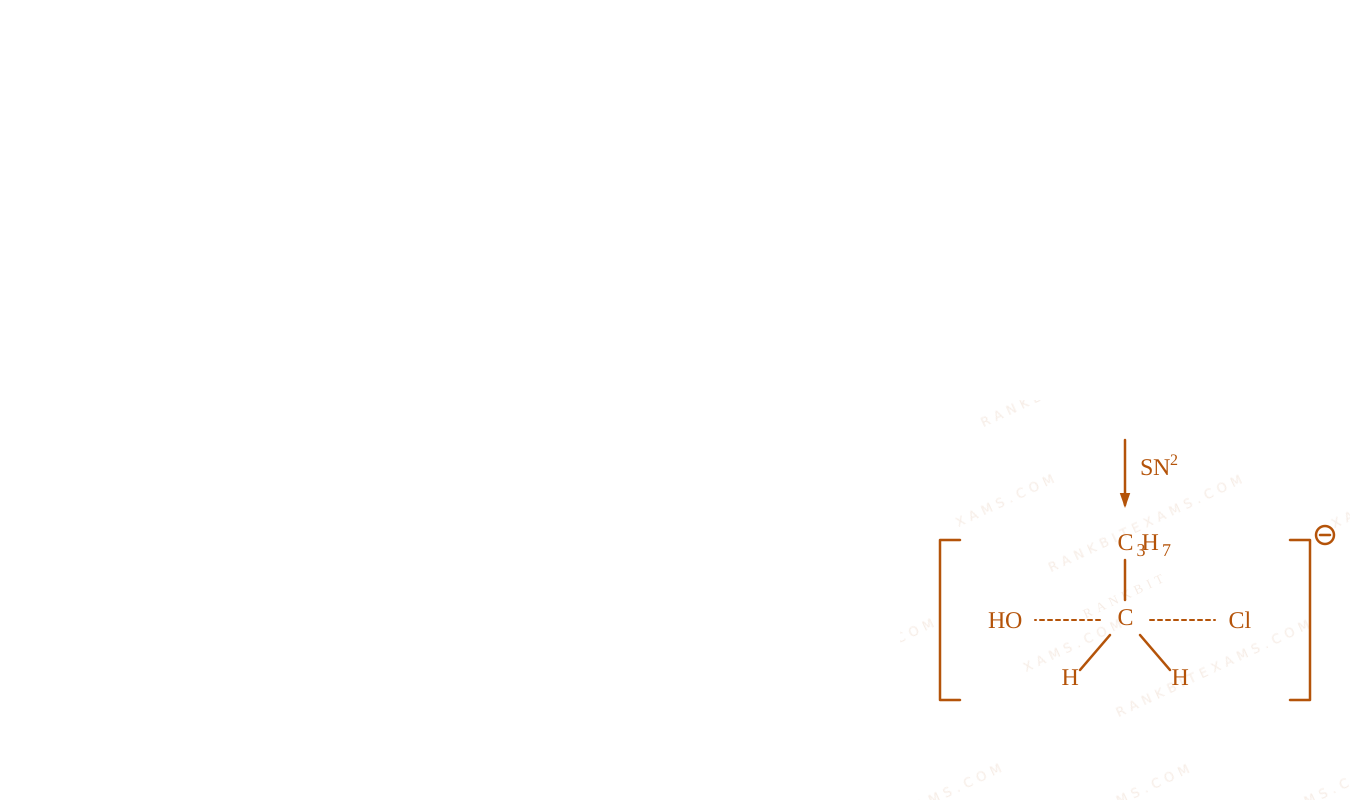
  • In Statement-I, the reaction involves an anionic nucleophile (OH⁻), creating a highly localized charge density on the reactant side. The resulting transition state disperses this negative charge over a larger volume, lowering its charge density. Highly polar solvents strongly solvate the reactant ion, increasing the activation energy barrier. Consequently, less polar solvents accelerate this process.
    SN2 pathway charge density solvent dynamics part 1
    SN2 pathway charge density solvent dynamics part 1
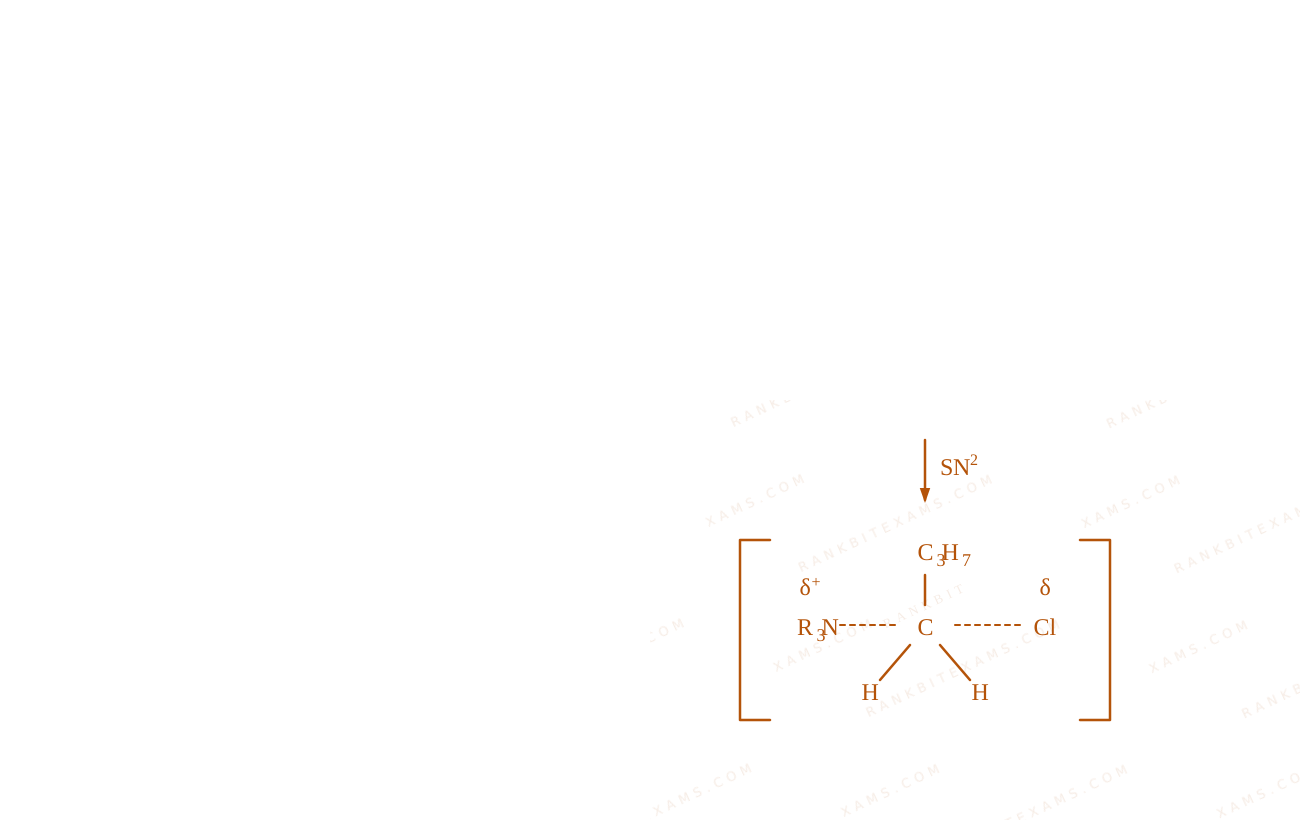
  • In Statement-II, the reaction begins with neutral precursors (R₃N and alkyl chloride). The resulting transition state develops partial charges (δ+ and δ-) as the new bond forms, increasing its charge density relative to the reactants. Polar solvents stabilize this charged transition state, lowering the activation energy barrier. Thus, highly polar media accelerate this substitution pathway.
    SN2 pathway charge density solvent dynamics part 1
    SN2 pathway charge density solvent dynamics part 1
Pattern Recognition

If the transition state concentrates charge relative to the reactants, polar solvents accelerate the reaction. If the transition state disperses charge, less polar solvents are favored.

Chapter Mix

Class 12 Chemistry: Haloalkanes and Haloarenes

Reference Study Guides

More Haloalkanes and Haloarenes Previous-Year Questions — Page 8

Q74 jee_main_2024_30_jan_morning Classification
Given below are two statement one is labeled as Assertion (A) and the other is labeled as Reason (R). Assertion (A): CH₂=CH-CH₂-Cl is an example of allyl halide Reason (R): Allyl halides are the compounds in which the halogen atom is attached to sp² hybridised carbon atom. In the light of the two above statements, choose the most appropriate answer from the options given below:
  • A. (A) is true but (R) is false
  • B. Both (A) and (R) are true but (R) is not the correct explanation of (A)
  • C. (A) is false but (R) is true
  • D. Both (A) and (R) are true and (R) is the correct explanation of (A)

Solution

Core Logic

Assertion (A): CH₂=CH-CH₂-Cl is an allyl halide. This statement is True. The halogen is attached to the carbon adjacent to the double bond (allylic position).

Reason (R): Allyl halides are compounds in which the halogen atom is attached to an sp² hybridized carbon atom. This statement is False. In allyl halides, the halogen is attached to an sp³ hybridized carbon atom which is next to an sp² hybridized carbon (C=C double bond).

Step 1: Conclusion

Therefore, (A) is true but (R) is false.

Pattern Recognition

Allylic = sp³ C adjacent to C=C. Vinylic = sp² C of the C=C itself.

Chapter Mix

Class 12 Chemistry: Haloalkanes and Haloarenes
Q jee_main_2024_31_jan_evening Nucleophilic Aromatic Substitution
Identify A and B in the following reaction sequence.
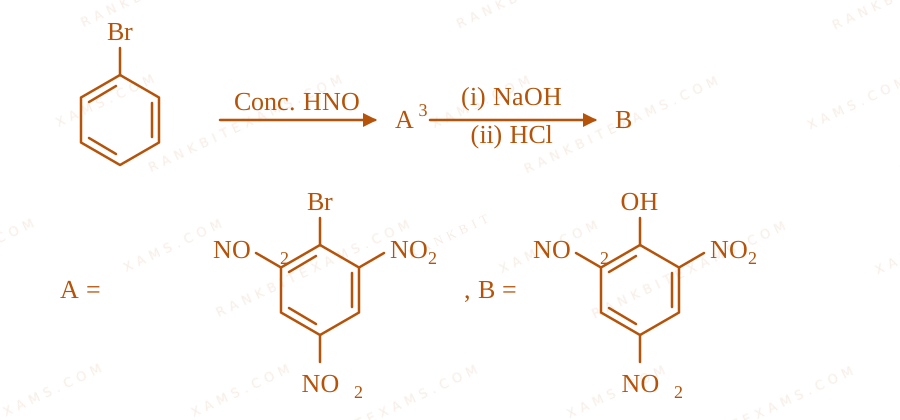
Nucleophilic Aromatic Substitution diagram for Q63 - JEE Main 2024 Evening
The image shows a reaction scheme starting from bromobenzene undergoing nitration followed by substitution.
  • A.
  • B.
  • C.
  • D.

Solution

Core Logic
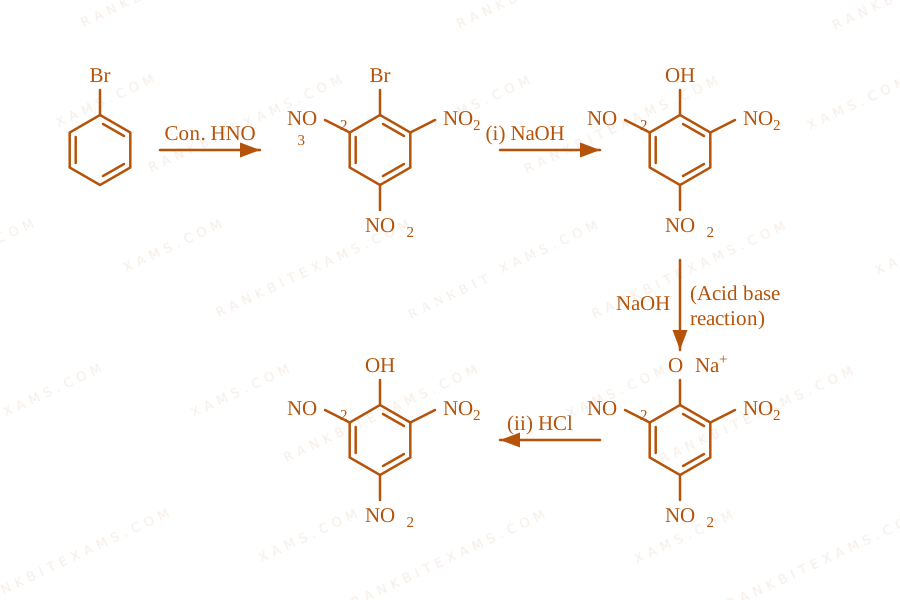
  • When bromobenzene reacts with concentrated HNO₃ (nitration), the bromine atom is ortho/para directing. However, under drastic conditions with excess concentrated nitrating mixture, 1-bromo-2,4,6-trinitrobenzene is formed (Compound A).
  • When 1-bromo-2,4,6-trinitrobenzene (Compound A) is treated with NaOH, the presence of three strong electron-withdrawing -NO₂ groups activates the aromatic ring toward Nucleophilic Aromatic Substitution (SNAr). The -Br is easily replaced by -OH to form 2,4,6-trinitrophenol (picric acid).
  • Subsequent acidification with HCl yields the neutral picric acid (Compound B).
  • Nucleophilic Aromatic Substitution diagram for Q63 - JEE Main 2024 Evening
    The image shows a reaction scheme starting from bromobenzene undergoing nitration followed by substitution.

Pattern Recognition

Multiple NO₂ groups drastically increase the susceptibility of halobenzenes to SNAr. Bromine is replaced completely by OH^- under alkaline conditions.

Chapter Mix

Class 12 Chemistry: Haloalkanes and Haloarenes Class 12 Chemistry: Alcohols, Phenols and Ethers
Q jee_main_2024_31_jan_evening IUPAC Nomenclature of Haloalkanes
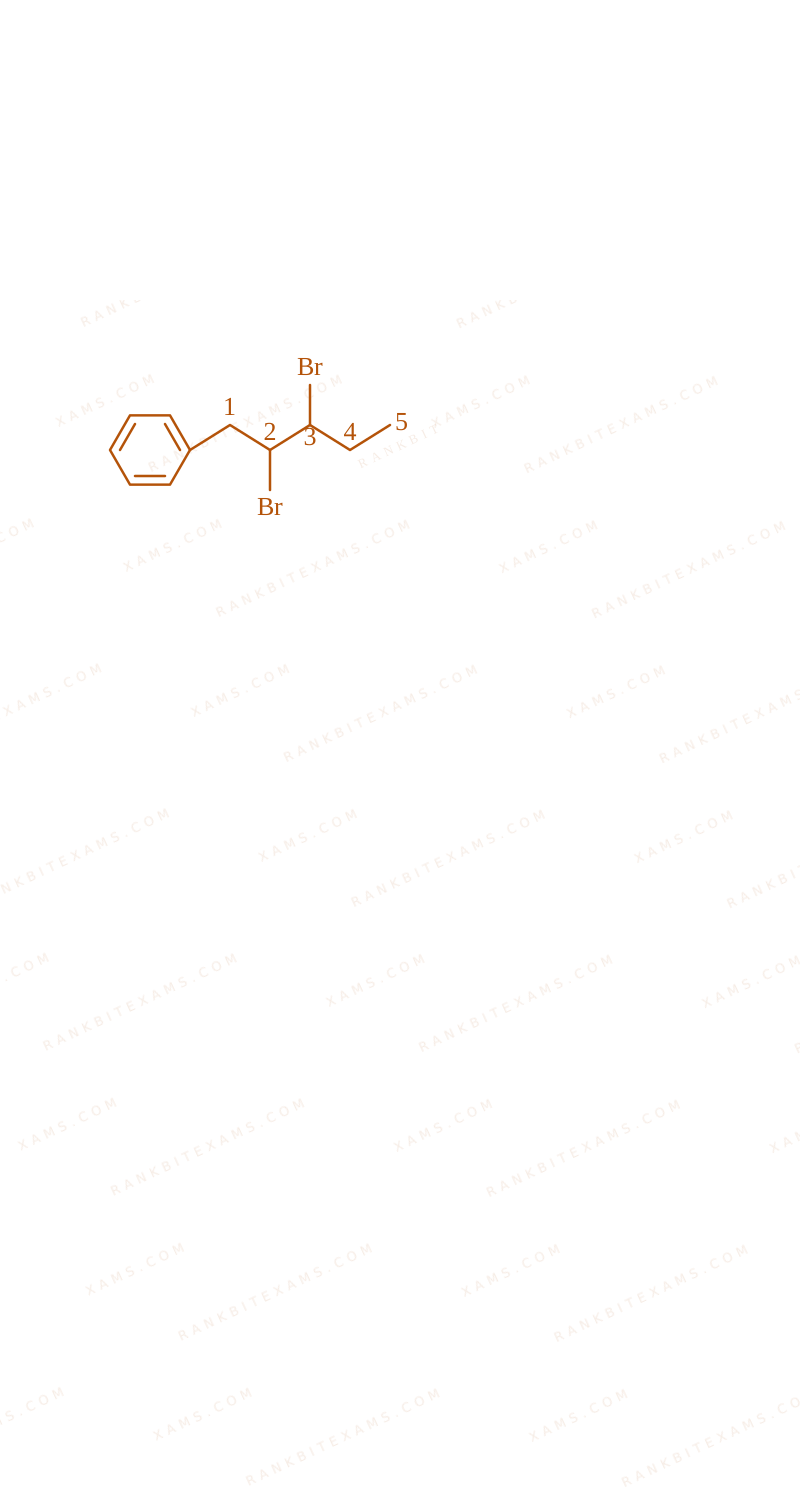
Identify structure of 2,3-dibromo-1-phenylpentane.
  • A.
  • B.
  • C.
  • D.

Solution

Core Logic

Decode the IUPAC name: 2,3-dibromo-1-phenylpentane.

  • Parent chain is pentane (5 carbon chain: C1-C2-C3-C4-C5).
  • Substituents:
  • Phenyl group at position 1.
  • Bromo groups at positions 2 and 3.
  • Option (3) correctly displays a 5-carbon straight chain. The first carbon attaches to the benzene ring (phenyl group), and the second and third carbons each hold a bromine atom.

    IUPAC Nomenclature of Haloalkanes diagram for Q67 - JEE Main 2024 Evening
    IUPAC Nomenclature of Haloalkanes diagram for Q67 - JEE Main 2024 Evening

Chapter Mix

Class 12 Chemistry: Haloalkanes and Haloarenes
Q jee_main_2024_31_jan_morning Elimination and Addition Reactions
The product (C) in the below mentioned reaction is: CH₃-CH₂-CH₂-Br [Δ]KOH(alc) A [Δ]HBr B [Δ]KOH(aq) C
  • A. Propan-1-ol
  • B. Propene
  • C. Propyne
  • D. Propan-2-ol

Solution

Step 1: Elimination to form Propene
CH₃-CH₂-CH₂-Br KOH (alc), Δ CH₃-CH=CH₂ (Compound A: Propene)
Step 2: Electrophilic Addition of HBr

Addition of HBr follows Markovnikov's rule:

CH₃-CH=CH₂ + HBr Δ CH₃-CH(Br)-CH₃ (Compound B: 2-Bromopropane)
Step 3: Nucleophilic Substitution

Reaction with aqueous KOH leads to SN2/SN1 substitution of Br^- with OH^-:

CH₃-CH(Br)-CH₃ KOH (aq), Δ CH₃-CH(OH)-CH₃ (Compound C: Propan-2-ol)
Pattern Recognition

Alc. KOH gives elimination (alkene). Aq. KOH gives substitution (alcohol). HBr on unsymmetrical alkene gives Markovnikov addition.

Chapter Mix

Class 12 Chemistry: Haloalkanes and Haloarenes

Q86 jee_main_2024_31_jan_morning Elimination and Substitution
CH₃CH₂Br + NaOH arrow Product A CH₃CH₂Br + NaOH / H₂O arrow Product B The total number of hydrogen atoms in product A and product B is
Numerical Answer. Answer: 10 to 10

Solution

Core Logic

Reaction 1: If the reagent is alcoholic NaOH (implied due to formation of a distinct product A to contrast B), elimination occurs:

CH₃CH₂Br + NaOH (alc) arrow CH₂=CH₂ (Ethene)

Hydrogen atoms in ethene (C₂H₄) = 4.

Reaction 2: If the reagent is aqueous NaOH (NaOH / H₂O), nucleophilic substitution (SN2) occurs:

CH₃CH₂Br + NaOH (aq) arrow CH₃CH₂OH (Ethanol)

Hydrogen atoms in ethanol (C₂H₆O) = 6.

Total hydrogen atoms = 4 + 6 = 10.

Chapter Mix

Class 12 Chemistry: Haloalkanes and Haloarenes

More Haloalkanes and Haloarenes Questions — jee_main_2025_24_jan_morning

Practice all Haloalkanes and Haloarenes previous-year questions →

Rankbit System
JEE Physics: Waves (+15.5%) | Electrostatics: Concentric Shells (-29.7%) | Modern Physics: Photoelectric Clones (+34.2%) | Mathematics: Definite Integrals (+18.1%) | Chemistry: Coordination Splitting (-11.4%) | JEE Physics: Waves (+15.5%) | Electrostatics: Concentric Shells (-29.7%) | Modern Physics: Photoelectric Clones (+34.2%) | Mathematics: Definite Integrals (+18.1%) | Chemistry: Coordination Splitting (-11.4%)