| List-I (Conversion) | List-II (Reagents, Conditions used) [cite: 248, 249] | ||||
|---|---|---|---|---|---|
| (A) Chlorobenzene arrow Phenol | (I) Warm, H₂O | ||||
| (B) p-Nitrochlorobenzene arrow p-Nitrophenol | (II) (a) NaOH, 368 K; (b) H3O^+ | (C) 2,4-Dinitrochlorobenzene arrow 2,4-Dinitrophenol | (III) (a) NaOH, 443 K; (b) H₃O^+ | (D) 2,4,6-Trinitrochlorobenzene arrow 2,4,6-Trinitrophenol | (IV) (a) NaOH, 623 K, 300 atm; (b) H₃O^+
Choose the correct answer from the options given below:
SolutionRelated FormulaRate of SNAr ∝ Number of electron-withdrawing groups (-I, -M) at ortho/para positionsCore LogicAryl halides are generally unreactive towards nucleophilic substitution due to resonance stabilization of the C-Cl bond. However, the presence of strong electron-withdrawing groups (-NO₂) at ortho and para positions dramatically increases reactivity by stabilizing the intermediate carbanion: - (A) Chlorobenzene: Needs extreme conditions: NaOH at 623 K, 300 atm (Dow's Process) arrow (IV) - (B) p-Nitrochlorobenzene: One para -NO₂ group softens required temperature to 443 K arrow (III) - (C) 2,4-Dinitrochlorobenzene: Two electron-withdrawing groups lower needed temperature further to 368 K arrow (II) - (D) 2,4,6-Trinitrochlorobenzene: Highly activated picryl chloride hydrolyzes smoothly with just warm water arrow (I) Step 1: Final Match AlignmentMatching sequences cleanly yields: (A)-(IV), (B)-(III), (C)-(II), (D)-(I). Pattern RecognitionThe more -NO₂ groups present on the ring, the less aggressive the reagent/temperature setup required. Count -NO₂ groups: 0 arrow 623K, 1 arrow 443K, 2 arrow 368K, 3 arrow warm water. Chapter MixClass 12 Chemistry: Haloalkanes and Haloarenes
Q42
jee_main_2025_07_april_evening
Physical Properties of Dihalobenzenes
Given below are two statements:
Statement (I):
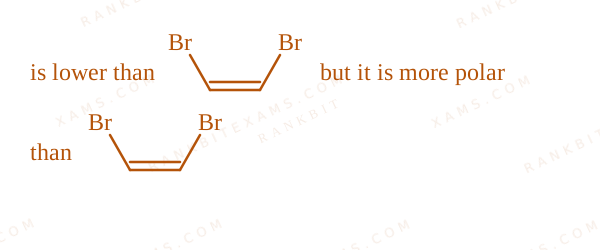 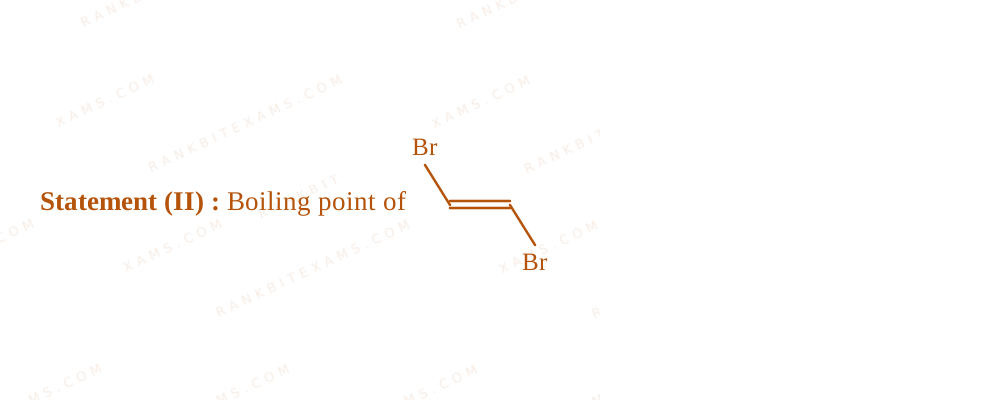 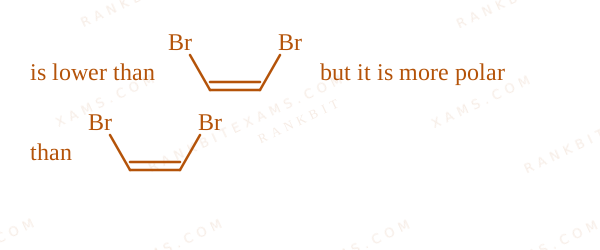 SolutionRelated Formulaμnet = √(μ₁² + μ₂² + 2μ₁μ₂ θ) Boiling point ∝ Dipole-dipole interactions + Van der Waals forcesCore LogicLet's analyze the visual structures alongside their scientific orientations:
Since μmeta > 0, the para-isomer is less polar than the meta-isomer. This directly falsifies Statement II. Step 1: Spatial AlignmentsThe geometric configurations map out as follows:
Hence, Statement I is correct, but Statement II is incorrect. Pattern RecognitionDipole tracking rule: Para-substituted benzenes with identical groups possess a structural center of inversion, guaranteeing a net dipole moment of exactly zero (μ = 0). They can never be more polar than any asymmetric ortho or meta structural isomer. Chapter MixClass 12 Chemistry: Haloalkanes and Haloarenes
Q43
jee_main_2025_24_jan_evening
Nucleophilic Substitution Reactions
The structure of the major product formed in the following reaction is :
 "silver cyanide alkyl halide, isonitrile product substitution, chemoselective nucleophilic pathway") SolutionCore LogicThe substrate contains two distinct carbon-halogen bonds: an aryl-bromide bond (Ar-Br) on the ring and an aliphatic alkyl-chloride bond (CH₂-Cl) on the side chain.
When reacting with silver cyanide (AgCN): AgCN is predominantly covalent. The lone pair on the nitrogen atom acts as the primary nucleophilic center rather than the carbon atom. Consequently, substitution at the aliphatic site yields an isonitrile (-NC) derivative as the major product, leaving the aryl bromide group completely untouched. Step 1: Structural ResolutionThe reaction progresses cleanly at the side-chain carbon:
Pattern RecognitionRemember the key selectivity rule for cyanide nucleophiles:
Chapter MixClass 12 Chemistry: Haloalkanes and Haloarenes
Q
jee_main_2025_28_jan_evening
Elimination Reactions (E2)
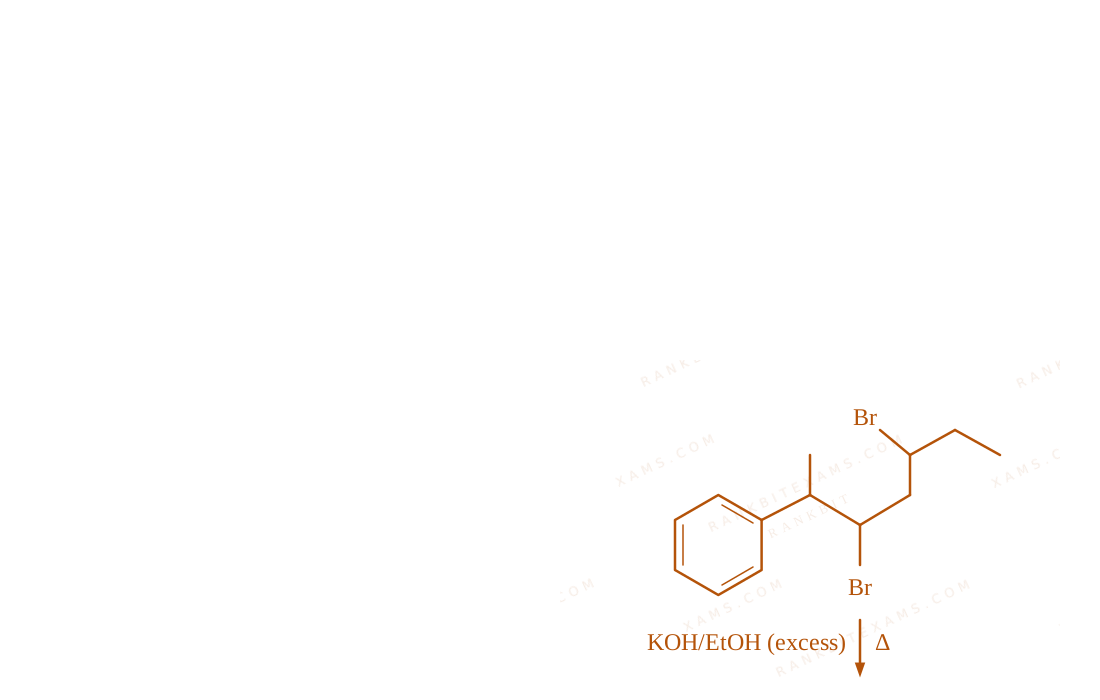
The major product of the following reaction is:
 SolutionRelated FormulaBase-induced dehydrohalogenation follows the Zaitsev rule to maximize thermodynamic stability via conjugated double bond networks: R-CHX-CH₂-CHX-R' excess KOH/EtOH, Δ Conjugated DieneCore LogicThe reactant is a dihalide containing a phenyl substitution. Treating with excess alcoholic KOH and heat induces double dehydrohalogenation via successive E2 elimination pathways. The eliminations occur to yield the most stable, highly conjugated product where the double bonds are conjugated with each other and, if possible, with the aromatic phenyl ring system. Step 1: Eliminating and Tracking ConjugationEliminating the first and second equivalents of HBr sets up a conjugated diene system along the heptadiene chain. Tracing carbon numbers correctly from the end closest to the phenyl ring reveals that the conjugated diene centers sit across carbons 2 and 4, producing 2-Phenylhepta-2,4-diene.
Pattern RecognitionWhen dealing with excess elimination agents on dihalides, look for options that form a continuous conjugated diene structure (alternating double-single-double bonds). This conjugation offers significant thermodynamic stability, especially when directly extended from a phenyl group. Chapter MixClass 12 Chemistry: Haloalkanes and Haloarenes More Haloalkanes and Haloarenes Questions — jee_main_2025_24_jan_morningPractice all Haloalkanes and Haloarenes previous-year questions →

SYSTEM
Syllabus Analysis & Trend Mapping
Rankbit System
JEE Physics: Waves (+15.5%)
|
Electrostatics: Concentric Shells (-29.7%)
|
Modern Physics: Photoelectric Clones (+34.2%)
|
Mathematics: Definite Integrals (+18.1%)
|
Chemistry: Coordination Splitting (-11.4%)
|
JEE Physics: Waves (+15.5%)
|
Electrostatics: Concentric Shells (-29.7%)
|
Modern Physics: Photoelectric Clones (+34.2%)
|
Mathematics: Definite Integrals (+18.1%)
|
Chemistry: Coordination Splitting (-11.4%)
Select Your Target ExamChoose an exam track below to find formulas per chapter and patterns. Syncing Exam Intelligence Mapping formulas and patterns across all tracks…
PATH A — FULL LENGTH PRACTICE
Full Mock Test HubSimulate real NTA exam conditions with fully tracked mocks. Time yourself against past papers.
Now Live
Open
PATH B — TARGETED PRACTICE
Topic-wise Practice HubPractice past-year questions one chapter at a time. Pick an exam → subject → chapter and get every PYQ for that topic — pulled together from all past papers — with the chapter's key formulas alongside.
Loading Questions...
Browse Topics
Exam Analysis ToolsChapter weightage trends and topic-wise practice — all mapped from past shift papers. Chapter Weightage & TrendsSee high-yield chapters, year-wise counts and the frequency-based chance each topic repeats next exam.
Weightage Board
Open
Topic-wise Practice HubEvery past-year question for a chapter pulled from all papers, with its key formulas alongside.
One chapter at a time
Open
Latest from the Blog
View all →
Loading articles... JEE Main Exam PapersSelect a specific exam paper to view its topic-wise syllabus weightage, formula trends, and practice interactive questions.
Chapter-level Exam Weightage & Trends
Chapter Weightage BoardWe analyzed past shift papers to map these topics. Select a chapter to start targeted practice. ACTIVE SUBJECT Physics No chapters or subjects match your search. Formula Recognition
🔥 Practice Session
Live
Showing All Questions
Exam QuestionsTest your concepts live. Choose options or enter numerical values, then verify your answer to reveal the double-box solution matrix. Practice all questionsSelect an ExamPlease select a specific exam shift from the dashboard to unlock data-driven insights and practice materials. |
JEE Main · Chemistry
↓ Falling
Haloalkanes and Haloarenes appeared 40 times across 3 years — 4.7% of Chemistry. This question is from Nucleophilic Substitution Reactions.
Solution & Explanation
Core Logic
Analyzing the solvent effects on reaction kinetics:
- In Statement-I, the reaction involves an anionic nucleophile (OH⁻), creating a highly localized charge density on the reactant side. The resulting transition state disperses this negative charge over a larger volume, lowering its charge density. Highly polar solvents strongly solvate the reactant ion, increasing the activation energy barrier. Consequently, less polar solvents accelerate this process.
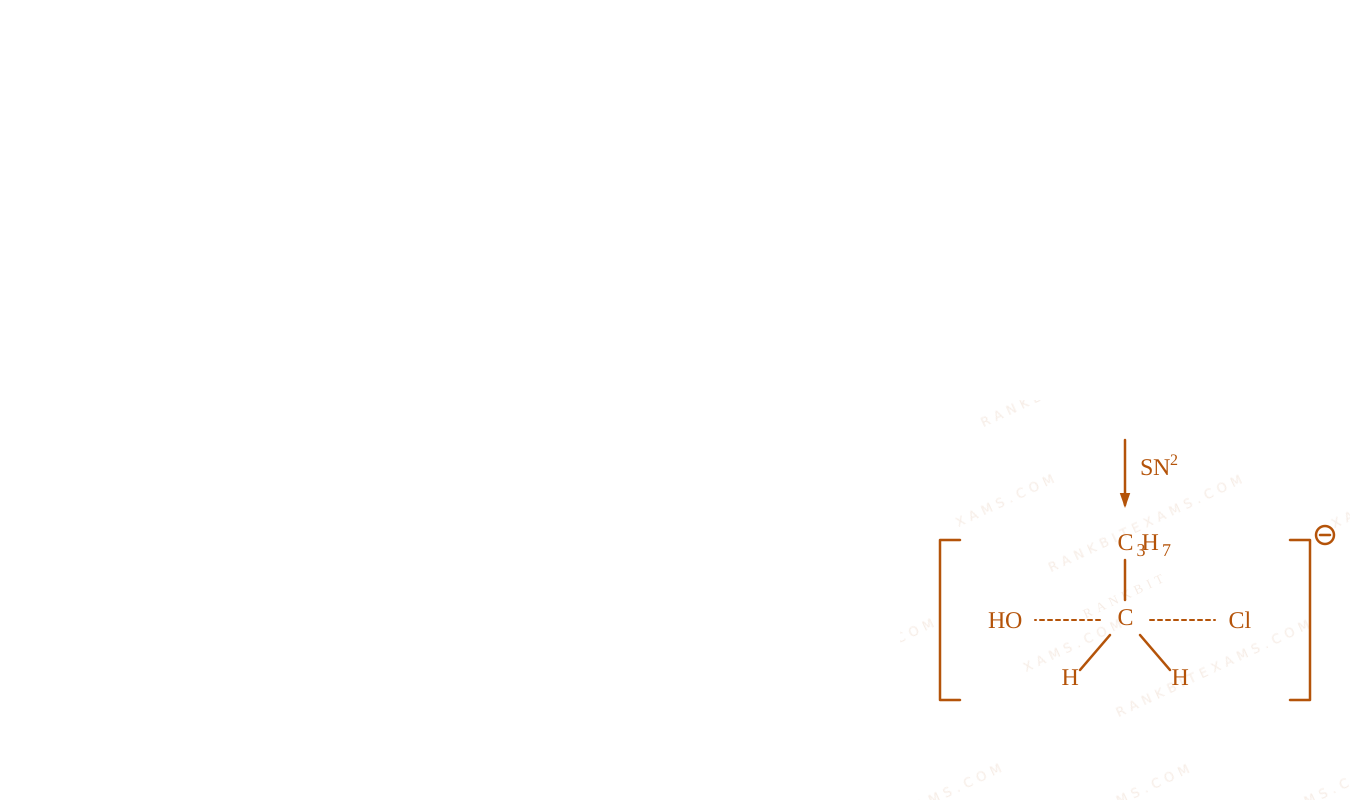
SN2 pathway charge density solvent dynamics part 1 - In Statement-II, the reaction begins with neutral precursors (R₃N and alkyl chloride). The resulting transition state develops partial charges (δ+ and δ-) as the new bond forms, increasing its charge density relative to the reactants. Polar solvents stabilize this charged transition state, lowering the activation energy barrier. Thus, highly polar media accelerate this substitution pathway.
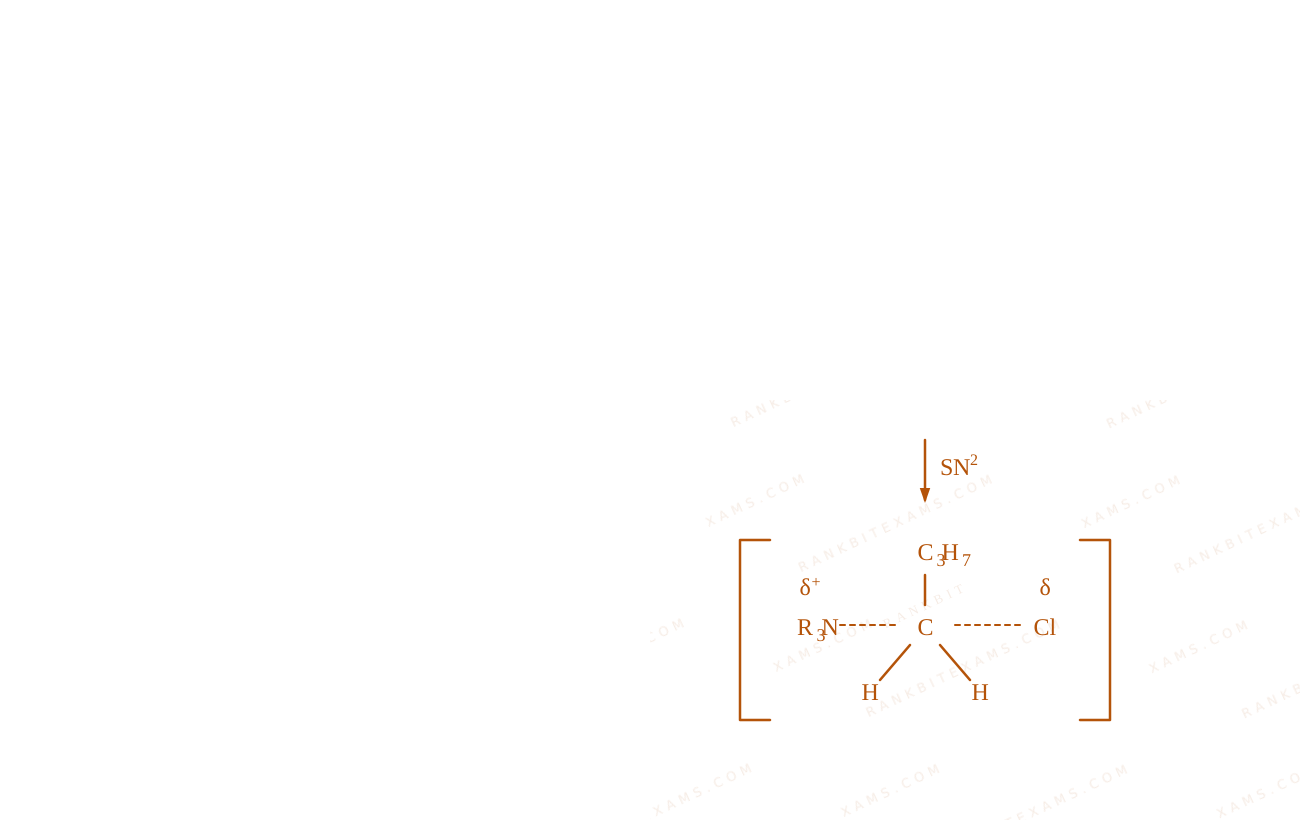
SN2 pathway charge density solvent dynamics part 1
Pattern Recognition
If the transition state concentrates charge relative to the reactants, polar solvents accelerate the reaction. If the transition state disperses charge, less polar solvents are favored.
Chapter Mix
Class 12 Chemistry: Haloalkanes and Haloarenes
Reference Study Guides
More Haloalkanes and Haloarenes Previous-Year Questions — Page 5
Q32
jee_main_2025_07_april_evening
Nucleophilic Aromatic Substitution
Match List-I with List-II.
 "ortho-isomer, para-isomer, dipole moment structural field")
 "ortho-isomer, para-isomer, dipole moment structural field")
 "ortho-isomer, para-isomer, dipole moment structural field")
 "silver cyanide alkyl halide, isonitrile product substitution, chemoselective nucleophilic pathway")