JEE Main · Chemistry → Steady

Electrochemistry appeared 39 times across 3 years — 4.6% of Chemistry. This question is from Galvanic Cells and Standard Cell Potential.

Year 2026 2025 2024 Total
Questions 13 18 8 39

For the given cell: Fe²⁺(aq) + Ag⁺(aq) arrow Fe³⁺(aq) + Ag(s) The standard cell potential of the above reaction is given by: Ag⁺ + e⁻ arrow Ag E⁰ = x V Fe²⁺ + 2e⁻ arrow Fe E⁰ = y V Fe³⁺ + 3e⁻ arrow Fe E⁰ = z V

Solution & Explanation

Related Formula
Δ G⁰ = -nFE⁰
Core Logic

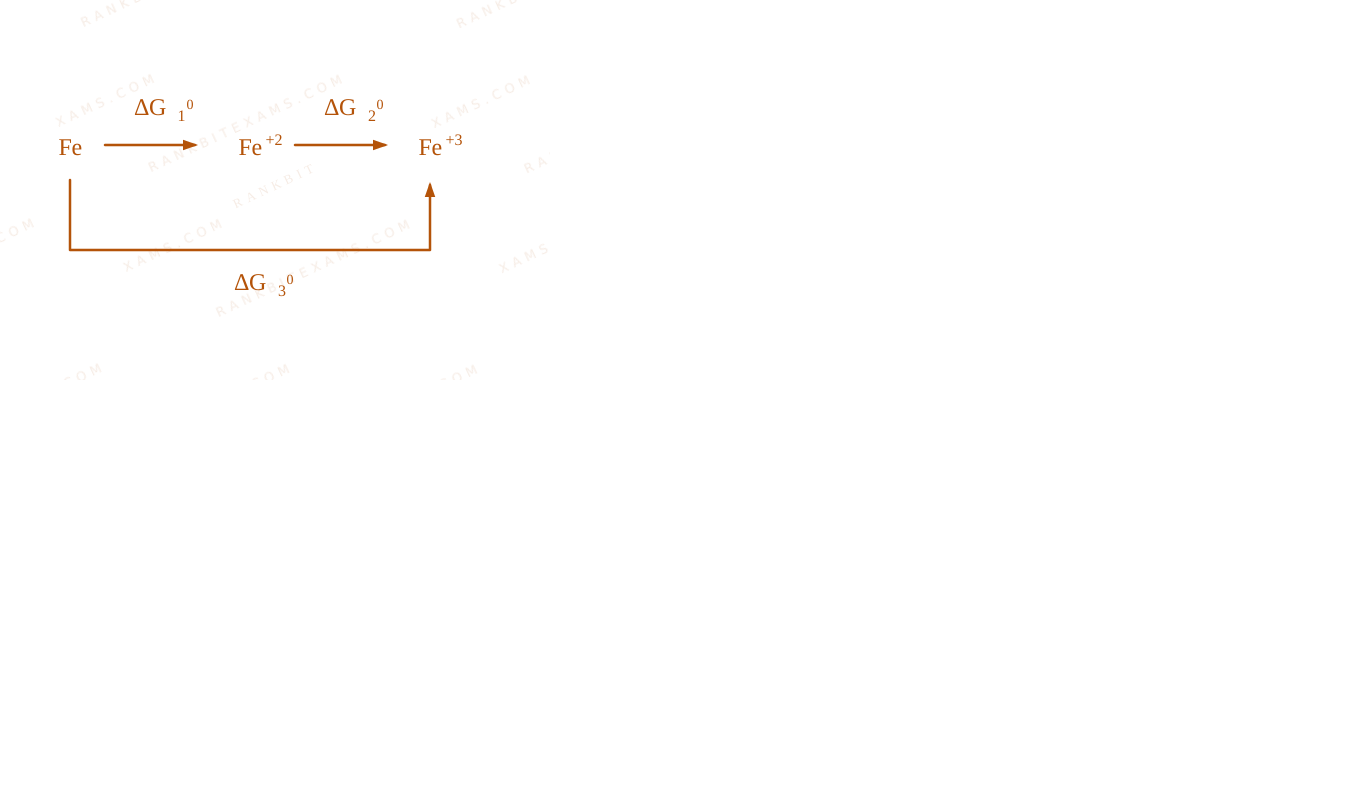
Using Gibbs free energy changes for individual steps to find the target reduction potential:

  • Ag⁺ + e⁻ arrow Ag Δ G₁⁰ = -1Fx
  • Fe²⁺ + 2e⁻ arrow Fe Δ G₂⁰ = -2Fy
  • Fe³⁺ + 3e⁻ arrow Fe Δ G₃⁰ = -3Fz
  • For the conversion of Fe²⁺ arrow Fe³⁺ + e⁻, we compute the free energy change as:

Δ G⁰ = Δ G₂⁰ - Δ G₃⁰ = -2Fy - (-3Fz) = 3Fz - 2Fy

Thus, E⁰Fe²⁺/Fe³⁺ = 2y - 3z

Combining with silver reduction:

E⁰cell = E⁰Ag⁺/Ag + E⁰Fe²⁺/Fe³⁺ = x + 2y - 3z
Step 1: Final Calculation

The overall potential equals x + 2y - 3z.

Galvanic Cells and Standard Cell Potential diagram for Q26 - JEE Main 2025 Morning

Pattern Recognition

Direct application of Δ G⁰ summation. Remember that standard cell potentials cannot be added directly unless the number of electrons involved is identical.

Chapter Mix

Class 12 Chemistry: Electrochemistry

Reference Study Guides

More Electrochemistry Previous-Year Questions — Page 7

Q jee_main_2025_29_jan_morning Nernst Equation
For a Mg Mg²⁺ (aq) ∥ Ag⁺(aq) Ag the correct Nernst Equation is :
  • A. Ecell = Ecello - (RT)/(2F)ln [Ag⁺][Mg2 +]
  • B. Ecell = Ecell° + RT2 ~F ln [Ag⁺]²[Mg²⁺]
  • C. Ecell = Ecello - (RT)/(2F)ln [Mg2 +][Ag⁺]
  • D. Ecell = Ecello - (RT)/(2F)ln [Ag⁺]²[Mg2 +]

Solution

Related Formula
Ecell = Ecell° - (RT)/(nF) ln Q
Core Logic

Let us explicitly formulate the complete chemical oxidation-reduction equations : Anode oxidation: Mg(s) arrow Mg²⁺(aq) + 2e^- Cathode reduction: 2Ag⁺(aq) + 2e^- arrow 2Ag(s)

Net total equation :

Mg(s) + 2Ag⁺(aq) leftharpoons Mg²⁺(aq) + 2Ag(s)

Total transferred moles of electrons n = 2 . Reaction quotient :

Q = [Mg²⁺][Ag⁺]²

Substituting into Nernst form :

Ecell = Ecell° - (RT)/(2F) ln( [Mg²⁺][Ag⁺]² )

Inverting the inside quotient changes the sign of the logarithm term from negative to positive:

Ecell = Ecell° + (RT)/(2F) ln( [Ag⁺]²[Mg²⁺] )
Pattern Recognition

A standard negative logarithmic quotient can always toggle into an addition configuration by inverting the products/reactants variables concentration ratio.

Q82 jee_main_2024_01_february_morning Nernst Equation
The potential for the given half cell at 298K is (-) × 10⁻² ~V. 2H^+(aq) + 2e^- arrow H₂(g) [H^+] = 1 M, PH₂ = 2 ~atm Given: 2.303RT/F = 0.06V, 2 = 0.3
Numerical Answer. Answer: 0.9 to 1

Solution

Related Formula
E = E^° - (2.303RT)/(nF) Q

For the Standard Hydrogen Electrode half-reaction: 2H^+ + 2e^- arrow H₂

EH^+/H₂ = E^°H^+/H₂ - (0.06)/(2) PH₂[H^+]²
Step 1: Substitute the given values

E^°H^+/H₂ = 0.00 ~V (by definition) [H^+] = 1 ~M PH₂ = 2 ~atm n = 2 electrons

E = 0.00 - (0.06)/(2) ( (2)/(1²) )
Step 2: Solve the calculation

E = -0.03 2 Given 2 = 0.3 E = -0.03 × 0.3 E = -0.009 ~V E = -0.9 × 10⁻² ~V

Step 3: Match the requested format

The question asks for (-) × 10⁻² ~V. This gives exactly 0.9. For NAT type with integer expected, 0.9 can be rounded to 1. However, exact calculation yields 0.9. According to official JEE rounding, 0.9 ≈ 1.

Pattern Recognition

Hydrogen electrode non-standard potential depends strictly on pressure of H₂ and concentration of H^+. If [H^+]=1, increasing H₂ pressure lowers the potential below zero (makes it negative).

Chapter Mix

Class 12 Chemistry: Electrochemistry

Q jee_main_2024_29_january_evening Faraday's Laws of Electrolysis
A constant current was passed through a solution of AuCl₄^- ion between gold electrodes. After a period of 10.0 minutes, the increase in mass of cathode was 1.314g. The total charge passed through the solution is ________ × 10⁻²F. (Given atomic mass of Au = 197)
Numerical Answer. Answer: 2 to 2

Solution

Related Formula
Number of equivalents deposited = (W)/(E) = (Q)/(F) Equivalent Weight (E) = Atomic Massn-factor
Core Logic

In the reduction of gold from the tetrachloroaurate(III) complex anion:

AuCl₄^- + 3e^- arrow Au(s) + 4Cl^- n-factor = 3

Calculate the equivalent weight (E) of Gold:

E = (197)/(3)

Set up the Faraday equivalence relation to solve for charge (Q in Faradays):

(1.314)/(((197)/(3))) = Q
Step 1: Arithmetic Resolution
Q = (1.314 × 3)/(197) = (3.942)/(197) = 0.02 F = 2 × 10⁻² F

Thus, the required integer value is 2.

Pattern Recognition

Always determine the correct change in oxidation state (+3 to 0) to establish the proper n-factor value for calculations using Faraday's laws.

Chapter Mix

Class 12 Chemistry: Electrochemistry

Q81 jee_main_2024_27_jan_morning Faraday's Laws of Electrolysis
The mass of silver (Molar mass of Ag: 108 g mol⁻¹) displaced by a quantity of electricity which displaces 5600 mL of O₂ at S.T.P. will be g.
Numerical Answer. Answer: 107 to 108

Solution

Related Formula

By Faraday's Second Law of Electrolysis:

Equivalents of Ag = Equivalents of O₂ Equivalents = MassEquivalent Mass = Moles × n-factor
Step 1: Calculate equivalents using standard metrics

Let x grams of Silver be displaced. Using the older STP molar volume baseline (22.4 L or 22400 mL):

Moles of O₂ = (5600)/(22400) = 0.25 moles

Since the n-factor of O₂ is 4 (2O²⁻ arrow O₂ + 4e^-):

Equivalents of O₂ = 0.25 × 4 = 1
Step 2: Equating equivalents for silver mass
Equivalents of Ag = (x)/(108) × 1 = 1 x = 108 g
Step 3: Alternative calculation using current STP metric

Using modern STP volume metrics (22.7 L):

(x × 1)/(108) = (5.6)/(22.7) × 4 x ≈ 106.57 g arrow 107 g
Pattern Recognition

Equivalents equations bypass complex current/time measurements. Always link volume fractions directly to n-factor equivalents.

Chapter Mix

Class 12 Chemistry: Electrochemistry Class 11 Chemistry: Some Basic Concepts of Chemistry

Q82 jee_main_2024_29_jan_morning Faradays Laws of Electrolysis
The mass of zinc produced by the electrolysis of zinc sulphate solution with a steady current of 0.015 A for 15 minutes is ______ × 10⁻⁴ g. (Atomic mass of zinc = 65.4 amu)
Numerical Answer. Answer: 45.75 to 46

Solution

Related Formula
W = Z · I · t = (M)/(n · F) · I · t

where, W = mass deposited Z = electrochemical equivalent I = current in amperes t = time in seconds M = molar mass n = n-factor (electrons exchanged) F = Faraday's constant (96500 C/mol)

Core Logic

The electrolysis of zinc sulphate (ZnSO₄) involves the reduction of zinc ions at the cathode:

Zn⁺² + 2e^- arrow Zn

Here, the n-factor (n) is 2.

Step 1: Calculation

Given values: I = 0.015 A t = 15 minutes = 15 × 60 seconds = 900 s M = 65.4 g/mol F ≈ 96500 C

Plugging the values into Faraday's First Law:

W = (65.4)/(2 × 96500) × 0.015 × 15 × 60 W = (65.4)/(193000) × 13.5 W = 3.3886 × 10⁻⁴ × 13.5 W = 45.746 × 10⁻⁴ g

Rounding to two decimal places (or nearest integer depending on convention), we get 45.75 × 10⁻⁴ g.

Chapter Mix

Class 12 Chemistry: Electrochemistry

More Electrochemistry Questions — jee_main_2025_24_jan_morning

Practice all Electrochemistry previous-year questions →

Rankbit System
JEE Physics: Waves (+15.5%) | Electrostatics: Concentric Shells (-29.7%) | Modern Physics: Photoelectric Clones (+34.2%) | Mathematics: Definite Integrals (+18.1%) | Chemistry: Coordination Splitting (-11.4%) | JEE Physics: Waves (+15.5%) | Electrostatics: Concentric Shells (-29.7%) | Modern Physics: Photoelectric Clones (+34.2%) | Mathematics: Definite Integrals (+18.1%) | Chemistry: Coordination Splitting (-11.4%)