JEE Main · Chemistry → Steady

Electrochemistry appeared 39 times across 3 years — 4.6% of Chemistry. This question is from Galvanic Cells and Standard Cell Potential.

Year 2026 2025 2024 Total
Questions 13 18 8 39

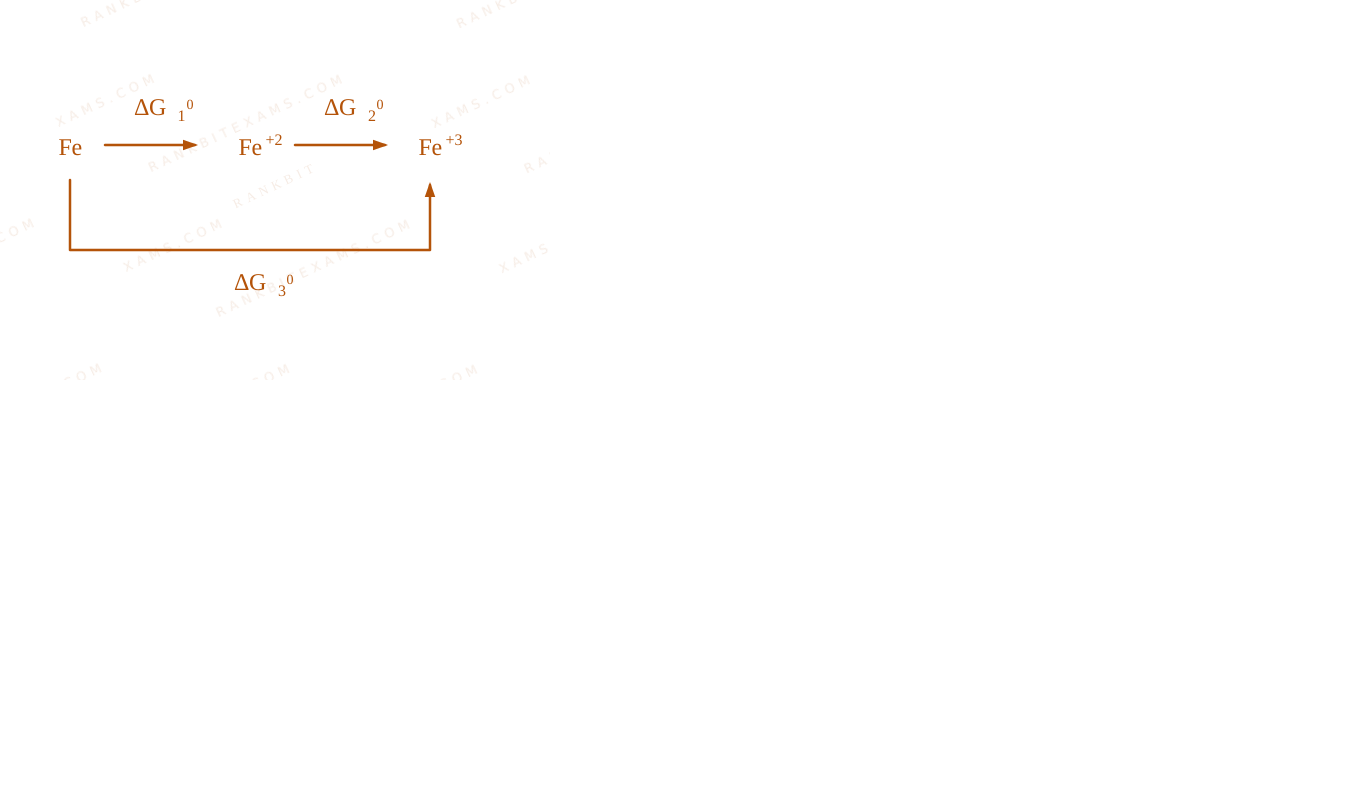
For the given cell: Fe²⁺(aq) + Ag⁺(aq) arrow Fe³⁺(aq) + Ag(s) The standard cell potential of the above reaction is given by: Ag⁺ + e⁻ arrow Ag E⁰ = x V Fe²⁺ + 2e⁻ arrow Fe E⁰ = y V Fe³⁺ + 3e⁻ arrow Fe E⁰ = z V

Solution & Explanation

Related Formula
Δ G⁰ = -nFE⁰
Core Logic

Using Gibbs free energy changes for individual steps to find the target reduction potential:

  • Ag⁺ + e⁻ arrow Ag Δ G₁⁰ = -1Fx
  • Fe²⁺ + 2e⁻ arrow Fe Δ G₂⁰ = -2Fy
  • Fe³⁺ + 3e⁻ arrow Fe Δ G₃⁰ = -3Fz
  • For the conversion of Fe²⁺ arrow Fe³⁺ + e⁻, we compute the free energy change as:

Δ G⁰ = Δ G₂⁰ - Δ G₃⁰ = -2Fy - (-3Fz) = 3Fz - 2Fy

Thus, E⁰Fe²⁺/Fe³⁺ = 2y - 3z

Combining with silver reduction:

E⁰cell = E⁰Ag⁺/Ag + E⁰Fe²⁺/Fe³⁺ = x + 2y - 3z
Step 1: Final Calculation

The overall potential equals x + 2y - 3z.

Galvanic Cells and Standard Cell Potential diagram for Q26 - JEE Main 2025 Morning

Pattern Recognition

Direct application of Δ G⁰ summation. Remember that standard cell potentials cannot be added directly unless the number of electrons involved is identical.

Chapter Mix

Class 12 Chemistry: Electrochemistry

Reference Study Guides

More Electrochemistry Previous-Year Questions — Page 6

Q45 jee_main_2025_07_april_evening Electrolysis and Discharge Potential
Given below are two statements: 1 M aqueous solution of each of Cu(NO₃)₂, AgNO₃, Hg₂(NO₃)₂; Mg(NO₃)₂ are electrolysed using inert electrodes, Given: EAg⁺/Agθ = 0.80V , EHg₂²⁺/Hgθ = 0.79V, ECu²⁺/Cuθ = 0.24V and EMg²⁺/Mgθ = -2.37V Statement (I): With increasing voltage, the sequence of deposition of metals on the cathode will be Ag, Hg and Cu Statement (II): Magnesium will not be deposited at cathode instead oxygen gas will be evolved at the cathode. In the light of the above statement, choose the most appropriate answer from the options given below [cite: 426, 427]
  • A. Both statement I and statement II are incorrect
  • B. Statement I is correct but statement II is incorrect
  • C. Both statement I and statement II are correct
  • D. Statement I is incorrect but statement II is correct

Solution

Related Formula
Ease of discharge at Cathode ∝ Standard Reduction Potential (E⁰)
Core Logic
  • At the cathode, the metal ion with the highest standard reduction potential (E⁰) gets reduced and deposited first. Arranging the given potentials:
E⁰Ag^+/Ag (0.80V) > E⁰Hg₂²⁺/Hg (0.79V) > E⁰Cu²⁺/Cu (0.24V)

Thus, deposition follows the order Ag arrow Hg arrow Cu as voltage is steadily increased, confirming Statement I.

  • For Mg²⁺, its reduction potential is highly negative (-2.37 V), much lower than that of water (-0.83 V). Consequently, water undergoes reduction at the cathode instead of magnesium:
2H₂O + 2e^- arrow H₂(g) + 2OH^-

This results in the evolution of Hydrogen gas at the cathode, not oxygen gas. Oxygen gas is evolved at the anode via water oxidation. Thus, Statement II is incorrect. [cite: 1042, 1044]

Step 1: Conclusion Match

Since Statement I is correct and Statement II is incorrect, we select option (2).

Pattern Recognition

Cathode vs Anode Gas Trap: During the aqueous electrolysis of highly reactive metals (Groups 1, 2, and Al), H₂ gas is always discharged at the cathode due to water's easier reduction profile. Oxygen gas (O₂) is an anodic product generated by water oxidation.

Chapter Mix

Class 12 Chemistry: Electrochemistry

Q48 jee_main_2025_28_jan_evening Faraday's Laws of Electrolysis
Electrolysis of 600~mL aqueous solution of NaCl for 5 changes the pH of the solution to 12. The current in Amperes used for the given electrolysis is ______ (Nearest integer).
Numerical Answer. Answer: 2 to 2

Solution

Related Formula

Faraday's law of electrolysis equation:

Moles of electrons (equivalents) = (I · t)/(F)

Water ion product relation:

pH + pOH = 14
Core Logic

During the electrolysis of brine (NaCl(aq)), hydroxide ions (OH^-) are generated at the cathode:

2H₂O + 2e^- arrow H₂ + 2OH^-

Given metrics:

  • Final pH = 12 pOH = 14 - 12 = 2
  • [OH^-] = 10⁻² M
  • Volume = 600 mL = 0.6 L
  • Time = 5 = 300 s
Step 1: Calculate Moles of Hydroxide Produced

Find the absolute moles of OH^- ions generated:

Moles = Molarity × Volume (L) = 10⁻² × 0.6 = 6 × 10⁻³ moles
Step 2: Relate to Electrical Current

Since 1 mole of electrons produces 1 mole of OH^-, the moles of charge equals 6 × 10⁻³. Applying Faraday's equation:

6 × 10⁻³ = (I × 300)/(96500) I = 6 × 10⁻³ × 96500300 = 1.93 A

Rounding to the nearest integer gives 2.

Pattern Recognition

Always convert a given pH value into [OH^-] concentration when dealing with cathodic water reduction. Tracking the relationship where 1 e^- ≡ 1 OH^- provides a direct shortcut to link pH changes to current flow.

Chapter Mix

Class 12 Chemistry: Electrochemistry

Q jee_main_2025_29_jan_morning Standard Reduction Potential and Oxidising Power
The standard reduction potential values of some of the p-block ions are given below. Predict the one with the strongest oxidising capacity.
  • A. ESn⁴⁺/Sn²⁺ = +1.15V
  • B. ETl³⁺/Tl = +1.26V
  • C. EAl³⁺/Al = -1.66V
  • D. EPb⁴⁺/Pb²⁺ = +1.67V

Solution

Related Formula
Oxidising Capacity ∝ Standard Reduction Potential (E)
Core Logic

A higher positive value of standard reduction potential (E) indicates a stronger tendency to undergo reduction, hence behaving as a stronger oxidising agent. Comparing the given values:

  • ESn⁴⁺/Sn²⁺ = +1.15V
  • ETl³⁺/Tl = +1.26V
  • EAl³⁺/Al = -1.66V
  • EPb⁴⁺/Pb²⁺ = +1.67V
  • Since +1.67V is the highest value, Pb⁴⁺ possesses the strongest oxidising capacity.

Pattern Recognition

Strongest oxidising agent = Most positive reduction potential. Weakest oxidising agent = Most negative reduction potential.

Chapter Mix

Class 12 Chemistry: Electrochemistry Class 12 Chemistry: p-Block Elements

Q jee_main_2025_29_jan_morning Variation of Molar Conductivity with Concentration
The molar conductivity of a weak electrolyte when plotted against the square root of its concentration, which of the following is expected to be observed?
  • A. A small decrease in molar conductivity is observed at infinite dilution.
  • B. A small increase in molar conductivity is observed at infinite dilution.
  • C. Molar conductivity increases sharply with increase in concentration.
  • D. Molar conductivity decreases sharply with increase in concentration.

Solution

Related Formula

For weak electrolytes, the degree of dissociation α increases sharply near infinite dilution according to Ostwald's Dilution Law:

α = √((Kₐ)/(C))
Core Logic

When a weak electrolyte is diluted (concentration C arrow 0), its molar conductivity increases steeply. Conversely, when plotted against √(C), as concentration increases, the degree of dissociation drops rapidly, causing a sharp decrease in molar conductivity. This matches the curve given below:

Variation of Molar Conductivity with Concentration diagram for Q28 - JEE Main 2025 Morning

Pattern Recognition

Weak electrolyte plots feature a steep asymptotic exponential-like rise towards the y-axis as C arrow 0, meaning a sharp decrease occurs with increasing concentration.

Chapter Mix

Class 12 Chemistry: Electrochemistry

More Electrochemistry Questions — jee_main_2025_24_jan_morning

Practice all Electrochemistry previous-year questions →

Rankbit System
JEE Physics: Waves (+15.5%) | Electrostatics: Concentric Shells (-29.7%) | Modern Physics: Photoelectric Clones (+34.2%) | Mathematics: Definite Integrals (+18.1%) | Chemistry: Coordination Splitting (-11.4%) | JEE Physics: Waves (+15.5%) | Electrostatics: Concentric Shells (-29.7%) | Modern Physics: Photoelectric Clones (+34.2%) | Mathematics: Definite Integrals (+18.1%) | Chemistry: Coordination Splitting (-11.4%)
