JEE Main · Chemistry → Steady

Electrochemistry appeared 40 times across 3 years — 4.7% of Chemistry. This question is from Molar Conductivity and Cell Resistance.

Year 2026 2025 2024 Total
Questions 13 19 8 40

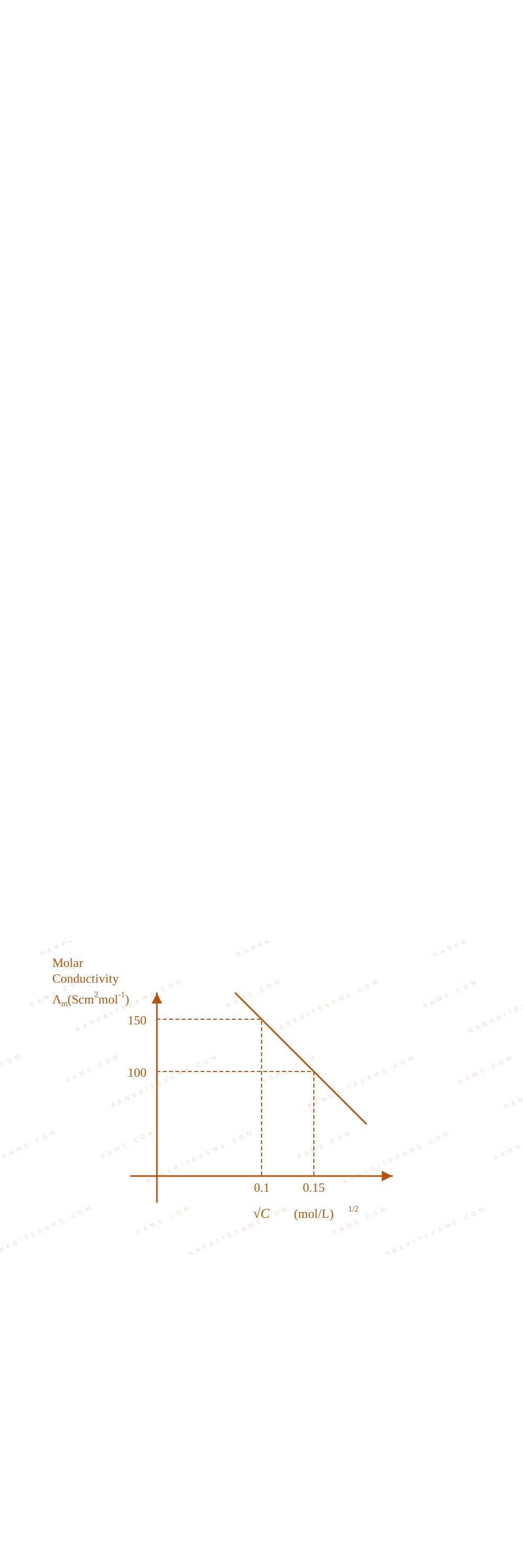
Given below is the plot of the molar conductivity vs concentration for KCl in aqueous solution.
Molar conductivity vs root concentration graph for Q46 - JEE Main 2025 Morning
The image features a standard linear plot tracing electrolytic molar conductance trends over root concentration variations.
If, for the higher concentration of KCl solution, the resistance of the conductivity cell is 100Ω then the resistance of the same cell with the dilute solution is xΩ The value of x is (Nearest integer)

Numerical Answer Type:
Enter a numerical value Answer: 150 to 150 +4 marks

Solution & Explanation

Related Formula

Conductivity relationship with cell parameters:

κ = G · G^* = (G^*)/(R) λm = (κ × 1000)/(C)

where G^* represents the static cell constant.

Step 1: Setting Up Ratios

Using concentration subscripts c (concentrated) and d (dilute):

(κc)/(κd) = (Rd)/(Rc)

Expressing conductivity through molar conductivity values:

κ = (λm · C)/(1000) ((λm · C)c)/((λm · C)d) = (Rd)/(Rc)

Substituting the graphical read coordinates (Cc = 0.15², Cd = 0.1² with scaled λm parameters):

(100 · (0.15)²)/(150 · (0.1)²) = (Rd)/(100) Rd = 150 Ω
Pattern Recognition

Sees: Resistance correlation across specific graph coordinates. Shortcut: Equate cell parameters through κ ∝ (1)/(R) and solve for the target resistance directly.

Chapter Mix

Class 12 Chemistry: Electrochemistry

Reference Study Guides

More Electrochemistry Previous-Year Questions

Q72 jee_main_2026_21_jan_morning Conductance of Electrolytic Solutions
The pH and conductance of a weak acid (HX) was found to be 5 and 4 × 10⁻⁵ S, respectively. The conductance was measured under standard condition using a cell where the electrode plates having a surface area of 1 cm² were at a distance of 15 cm apart. The value of the limiting molar conductivity is ..... S m² mol⁻¹. (nearest integer) (Given: degree of dissociation of the weak acid (α) ll 1)
Numerical Answer. Answer: 6 to 6

Solution

Related Formula
κ = G × (l)/(A) Λm = (κ × 1000)/(C) α = ΛmΛm∞

[H^+] = Cα

Core Logic

Given: pH = 5, so [H^+] = 10⁻⁵ M. Since [H^+] = C · α = C · ΛmΛm∞, we have 10⁻⁵ = C · ΛmΛm∞.

First, calculate conductivity (κ): Conductance G = 4 × 10⁻⁵ S. Cell constant G^* = (l)/(A) = 15 cm1 cm² = 15 cm⁻¹.

κ = G · G^* = (4 × 10⁻⁵) × 15 = 6 × 10⁻⁴ S cm⁻¹

Molar conductivity (Λm):

Λm = (κ × 1000)/(C) = 6 × 10⁻⁴ × 1000C = (0.6)/(C)

Substitute Λm into the proton concentration formula:

[H^+] = 10⁻⁵ = C · 0.6 / CΛm∞ 10⁻⁵ = 0.6Λm∞ Λm∞ = 0.610⁻⁵ = 60000 S cm² mol⁻¹

Convert units to S m² mol⁻¹: Since 1 m² = 10⁴ cm²,

Λm∞ = 60000 × 10⁻⁴ S m² mol⁻¹ = 6 S m² mol⁻¹
Chapter Mix

Class 12 Chemistry: Electrochemistry Class 11 Chemistry: Equilibrium

Q67 jee_main_2026_21_jan_evening Daniell Cell and Cell Potential Variation
For a closed circuit Daniell cell, which of the following plots is the accurate one at a given temperature?
  • A. (1) Plot 1
  • B. (2) Plot 2
  • C. (3) Plot 3
  • D. (4) Plot 4

Solution

Core Logic

For a closed circuit Daniell cell operating under given conditions, standard cell potential Ecell° remains constant with time during discharge until equilibrium or noticeable concentration shifts occur in a specific manner, or cell potential versus time plots reflect constancy of standard electromotive force terms before polarization effects take over.

Step 1: Final Conclusion

Plot 2 accurately depicts the expected trend where Ecell° remains constant with time.

Pattern Recognition

Sees: graphical representation of electrochemical cell potentials over time. Trap: Confusing standard cell potential E° with operating cell potential Ecell.

Chapter Mix

Class 12 Chemistry: Electrochemistry

Q75 jee_main_2026_21_jan_evening Solubility Product and Electrode Potential
MX is a sparingly soluble salt that follows the given solubility equilibrium at 298 K: MX(s) leftharpoons M^+(aq) + X^-(aq); Kₛₚ = 10⁻¹⁰ If the standard reduction potential for M^+(aq) arrow M(s) is (EM^+/M) = 0.79 V, then the value of the standard reduction potential for the metal/metal insoluble salt electrode EX^-/MX(s)/M is ____ mV. (nearest integer) [Given: (2.303RT)/(F) = 0.059 V]
Numerical Answer. Answer: 200 to 200

Solution

Related Formula

EX^-/MX/M° = EM^+/M° + (0.059)/(n) Kₛₚr

Core Logic

Substituting the given values:

EX^-/MX/M° = 0.79 + (0.059)/(1) (10⁻¹⁰) EX^-/MX/M° = 0.79 + 0.059(-10) = 0.79 - 0.59 = 0.20 V
Step 1: Converting to Millivolts
0.20 V = 200 mV
Pattern Recognition

Sees: relationship between standard reduction potential, solubility product, and metal-insoluble salt electrodes. Trap: Sign or logarithmic base calculation errors.

Chapter Mix

Class 12 Chemistry: Electrochemistry

Q72 jee_main_2026_22_january_morning Nernst Equation
Consider the following electrochemical cell at 298K Pt | HSnO₂⁻(aq) | Sn(OH)₆²⁻(aq) || Bi₂O₃(s) | Bi(s) If the reaction quotient at a given time is 10⁶, then the cell EMF (Ecell) is x × 10⁻¹ V (Nearest integer). Given the standard half-cell reduction potential as E_Bi₂O₃/Bi,OH⁻⁰ = -0.44 V and E_Sn(OH)₆²⁻/HSnO₂⁻,OH⁻⁰ = -0.90 V
Numerical Answer. Answer: 4 to 4

Solution

Related Formula
Ecell = Ecell° - (0.0591)/(n) Q

(Using 0.06 for approximation if needed, as per standard practice unless specified).

Core Logic

First, calculate E°cell:

E°cell = E°cathode - E°anode E°cell = (-0.44 V) - (-0.90 V) = +0.46 V

Identify the number of transferred electrons (n) for the overall reaction. Anode reaction: Sn²⁺ arrow Sn⁴⁺ + 2e⁻ (Tin goes from +2 in HSnO₂^- to +4 in Sn(OH)₆²⁻). Cathode reaction: Bi³⁺ + 3e⁻ arrow Bi (Bismuth goes from +3 in Bi₂O₃ to 0). To balance the electrons, we multiply anode by 3 and cathode by 2, yielding n = 6 total electrons transferred.

Step 1: Apply Nernst Equation

Applying the Nernst equation (approximating 0.0591 to 0.06 for simplicity):

Ecell = E°cell - (0.06)/(n) ₁₀ Q Ecell = 0.46 - (0.06)/(6) ₁₀(10⁶) Ecell = 0.46 - 0.01 × 6 Ecell = 0.46 - 0.06 = 0.40 V
Step 2: Format Output

The problem asks for the answer in the form x × 10⁻¹ V.

0.40 = 4 × 10⁻¹

So, x = 4.

Pattern Recognition

Be extremely careful finding 'n'. You must balance the half-reactions. A +2 to +4 change (n=2) and a +3 to 0 change (n=3) resolves to a common multiple of 6.

Chapter Mix

Class 12 Chemistry: Electrochemistry

Q67 jee_main_2026_22_january_evening Standard Reduction Potentials and Reducing Strength
Consider the following reduction processes: Al³⁺ + 3e^- arrow Al(s), E⁰ = -1.66 V Fe³⁺ + e^- arrow Fe²⁺, E⁰ = +0.77 V Co³⁺ + e^- arrow Co²⁺, E⁰ = +1.81 V Cr³⁺ + 3e^- arrow Cr(s), E⁰ = -0.74 V The tendency to act as reducing agent decreases in the order:
  • A. Al > Cr > Fe²⁺ > Co²⁺
  • B. Al > Fe²⁺ > Cr > Co²⁺
  • C. Al > Cr > Co²⁺ > Fe²⁺
  • D. Cr > Fe²⁺ > Al > Co²⁺

Solution

Related Formula
Reducing Power ∝ 1Standard Reduction Potential (E⁰red)
Core Logic

Step 1: List standard reduction potential values:

  • E⁰(Al³⁺/Al) = -1.66 V
  • E⁰(Cr³⁺/Cr) = -0.74 V
  • E⁰(Fe³⁺/Fe²⁺) = +0.77 V
  • E⁰(Co³⁺/Co²⁺) = +1.81 V
  • Step 2: Arrange species in increasing order of E⁰red (decreasing reducing power):

Al > Cr > Fe²⁺ > Co²⁺
Pattern Recognition

Sees: Reduction potential values for reducing strength ordering. Shortcut: More negative standard reduction potential stronger reducing agent.

Chapter Mix

Class 12 Chemistry: Electrochemistry

More Electrochemistry Questions — jee_main_2025_28_jan_morning

Practice all Electrochemistry previous-year questions →

Rankbit System
JEE Physics: Waves (+15.5%) | Electrostatics: Concentric Shells (-29.7%) | Modern Physics: Photoelectric Clones (+34.2%) | Mathematics: Definite Integrals (+18.1%) | Chemistry: Coordination Splitting (-11.4%) | JEE Physics: Waves (+15.5%) | Electrostatics: Concentric Shells (-29.7%) | Modern Physics: Photoelectric Clones (+34.2%) | Mathematics: Definite Integrals (+18.1%) | Chemistry: Coordination Splitting (-11.4%)